
Japan’s Trash Talk Is Loud. The Scoreboard Is Louder.
Matsushima says 50 percent is enough. Harimoto says Wang Chuqin is the only hurdle. The record, the team event, and a sold-out Nagoya arena tell a different story.
Pre-Match Words, Points on the Table
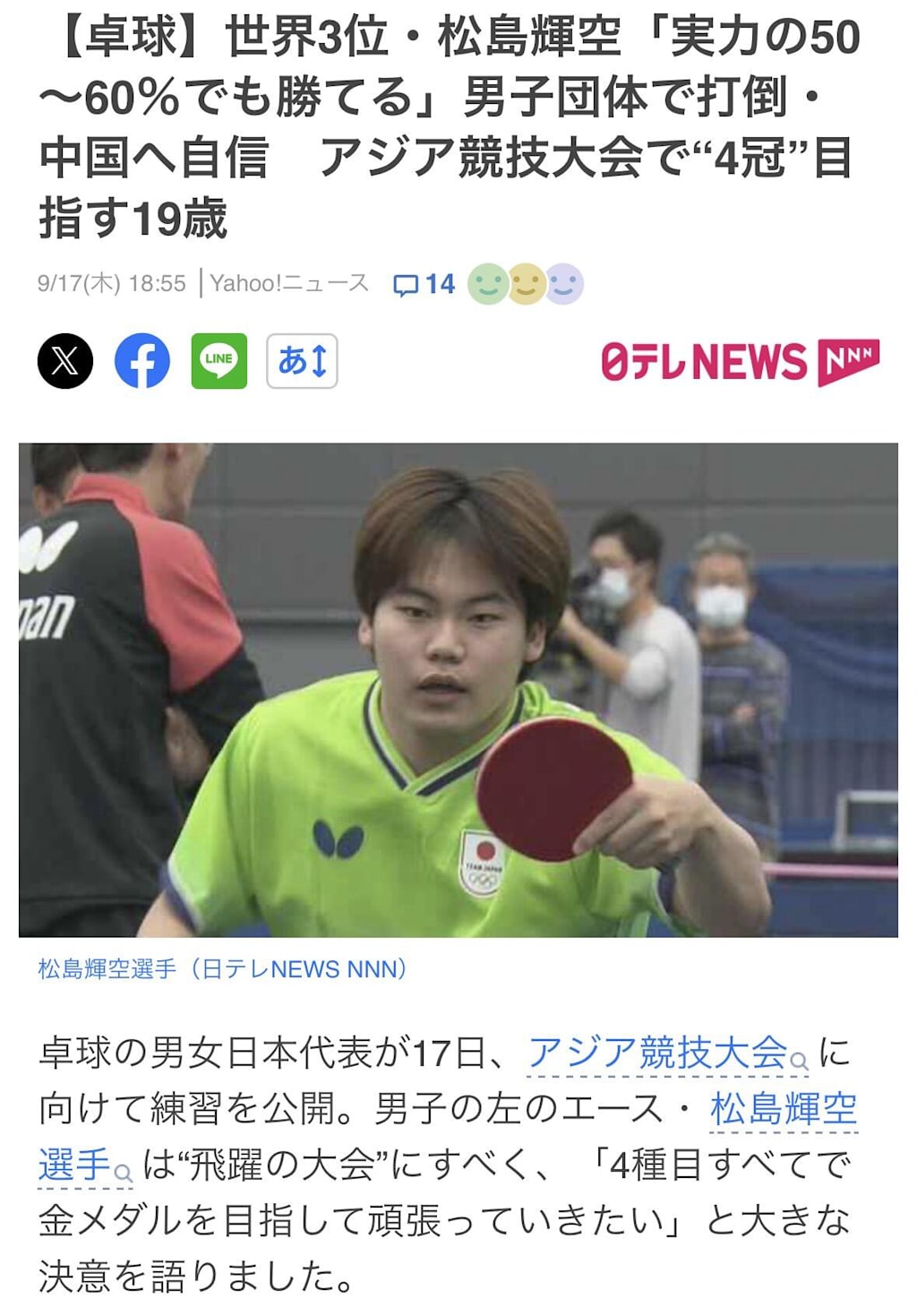
At the mixed zone of the Nagoya training hall, Sora Matsushima stood in front of the microphones. A reporter asked for his thoughts on the Chinese team. He paused, then said: "The Japanese team is very strong right now. I think even if we only play at 50 to 60 percent, we still have a chance to beat China."
Beside him, Tomokazu Harimoto picked up the thread: "As long as we beat Wang Chuqin, we can win the gold." Miwa Harimoto said: "We'll go all out to beat China and get our revenge." Within hours of the draw, these remarks were translated from Japanese into Chinese and pushed across every platform.
The Japanese men's team had cards to play.
Sora Matsushima is ranked No. 3 in the world, Tomokazu Harimoto No. 4, Shunsuke Togami No. 14, and both Yukiya Uda and Hiroto Shinozuka are in the top 25. The five average about 22 years old. A year ago, Matsushima was No. 24. In July, he won the WTT U.S. Grand Smash, the first Japanese player to take a title at that level. He had already defended his All-Japan Championships title and earned silver at the World Cup. Left-handed shakehand, short pips on the backhand, inverted rubber on the forehand. His backhand banana flick reaches 102 to 112 km/h, and he places the ball into the seams where opponents are most uncomfortable linking shots. He spent time in China's Super League. His forehand power and rally stability have grown.
Tomokazu Harimoto is changing too. In the final of the 2025 Yokohama Champions tournament, he dropped his signature backhand banana flick. He switched to a slower long push and forehand push-block, retreating to the mid-to-back court. The goal was direct: fix the problem of losing his footing whenever he ran into violent attacks. The technical direction is sound. Executing it consistently in a major event is another question.
Matsushima's remark hinged on "a chance." The "50 percent" figure was cover. Win, and it proves Japan is strong enough not to need full effort; lose, and he can say his form was not at its best. The sentence has an escape route built in. Harimoto's line has a structure too. He reduced the team event to a single premise, "beat Wang Chuqin." That is an admission: Wang Chuqin is the hurdle Japan cannot go around.
The record is lopsided. Wang Chuqin and Harimoto have met 17 times internationally. Wang leads 14-3, and 9-1 in the last 10. In the final of the Haikou Asian Cup in February 2026, Harimoto led 2-1 in games before Wang won three straight. At 7-7 in the fifth game, Harimoto could not hold the key points. Wang and Matsushima met three times in 2026. Matsushima won two, and in the one he lost he pushed Wang to a deciding game. Wang leads that series 4-3, but the pattern has shifted from domination to parity.
A team event is not singles matches added together.
Five months ago, in the men's team final of the London World Championships, Japan fielded the same lineup of Harimoto, Matsushima and Togami. China swept it 3-0. In the first match, Liang Jingkun trailed Harimoto 0-2 and won three straight games. In the second, Wang Chuqin beat Matsushima 3-1. In the third, Lin Shidong took the deciding point. The score was clean; the process was not easy. Japan can create trouble at a single point. To keep pressure on in a best-of-three format, it needs an entire system to hold. One person exploding is not enough. All three cannot slip.
The Chinese men's team this time is "one veteran leading four newcomers": Wang Chuqin at the helm, with Lin Shidong, Wen Ruibo, Xiang Peng and Huang Youzheng all playing their first Asian Games. Experience is thin. The flip side is that opponents have studied these newcomers less. Women's head coach Ma Lin, speaking about young player Fan Shuhan, said: "No major-event experience is also a good thing. Opponents don't know her, and she has a chance to be a surprise dark horse." The same logic applies to the men's team.
Home court is a variable. The table tennis competition at the Nagoya Asian Games is at the Toyota City Sky Hall, with about 6,000 seats. Official tickets are sold out. Harimoto said he hopes to draw on the support of home fans and play at more than 100 percent. Home court can push a player. It can also press down on him. In the 2010 Moscow World Championships women's team final, Singapore beat China away from home because it carried no psychological baggage. Home players carry the expectations of their own crowd, the media narrative, and the pressure of not being allowed to lose. Matsushima is playing four events in his first Asian Games. Harimoto carries the public narrative of "opening a Japanese era." When the score is tight, whether these are fuel or weight is only visible on the table.
Sun Yingsha once said of the Japanese team: "They have home advantage, so we have even less psychological pressure." The Chinese men's team is in the challenger's position this time. Apart from Wang Chuqin, the other four are Asian Games newcomers. Losing is no disgrace; winning is a bonus. That psychological position is looser than that of home players who "must win."
This is not the first time Japan has been loud before a tournament. Before the 2024 Paris Olympics, Harimoto said he would "win at least one medal." He went out in the first round of mixed doubles. In the men's singles quarterfinals, Fan Zhendong came back from behind to win four straight games. The shelf life of rhetoric does not outlast the first serve of the first match.
In the past six months, Matsushima has beaten Wang Chuqin twice: 3-2 at the Asian Championships in October 2025, and 4-2 at the WTT Chongqing Champions in March 2026. Every game in that six-game match came down to two points. Japan's men's team has more depth. Matsushima is still climbing. Harimoto is mid-overhaul. A few bold words do not erase any of that.
On September 20, at the Toyota City Sky Hall, the first match begins. Matsushima stands on the left side of the table, Wang Chuqin on the right. The ball is tossed. The score starts at 0-0. The words stay in the mixed zone; the points are played out on the table.
About the Creator
Jin
Writer of reamstories
https://reamstories.com/jin
Enjoyed the story? Support the Creator.
Subscribe for free to receive all their stories in your feed. You could also become a paid subscriber, letting them know you appreciate their work.
Comments
There are no comments for this story
Be the first to respond and start the conversation.