
I Played Table Tennis for Six Years. Then Ma Long Served.
What a club player learns when a world champion changes the spin, the placement, and the pace without changing his motion.
I played for five or six years. My forehand loop landed maybe three out of five. My backhand block stayed on the table. I knew how to push short, chop long, and serve backspin and no-spin from the same toss. At my club, people waited for me to finish before they stepped up. I was not a beginner. I was not a professional. I was the kind of player who understood enough to know how much I did not understand.
Then Ma Long stood across the table.
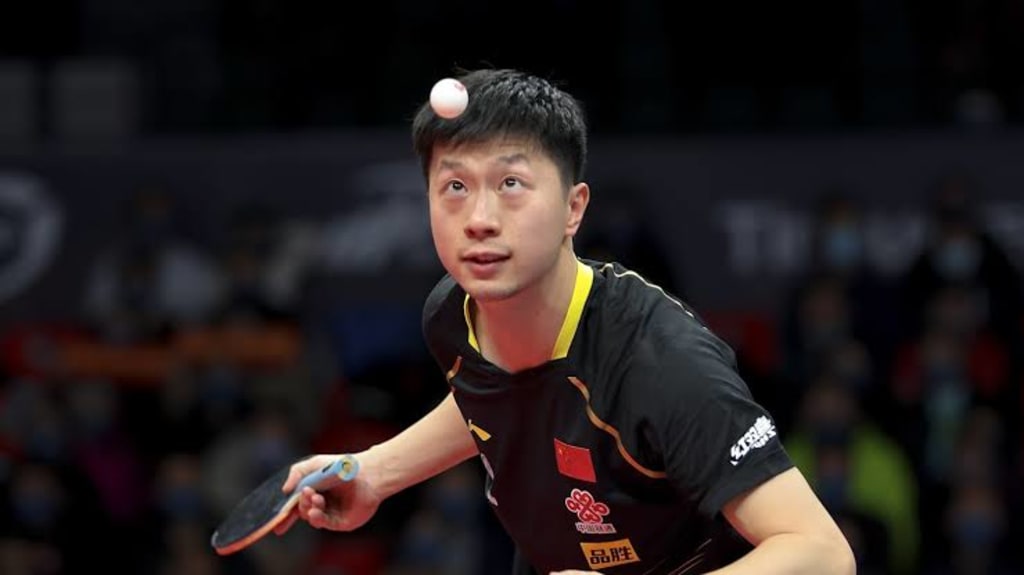
He spun the ball in his fingers. He looked at the ball. He did not look at my feet or my backhand corner. He tossed. The ball dropped. His paddle touched it. The ball landed on his side, crossed the net, landed on my side, and did not come forward.
I pushed. The ball went into the net.
I did not feel the spin. I felt the paddle face get pulled down, just a little. I adjusted. The next one I blocked. The ball floated high. Ma Long stepped in. His forehand snapped. The ball was gone.
A short backspin serve from Ma Long is not a ball you can borrow force from. It floats. It drifts. It sits on your side of the table and waits for you to make a mistake. Most amateur players live on borrowed force. They push with the incoming spin. They block with the incoming speed. When the ball does not come forward, they have nothing to borrow. They have to make their own power. Their own power is not stable. The ball goes into the net, or it goes long, or it pops up.
The second serve looked the same.
Ma Long's toss was the same. His body turn was the same. His paddle came down at the same angle. The first bounce on his side landed close to the first serve. I watched the paddle. I looked for the follow-through. By the time I saw the difference, the ball was already on my side. It kicked sideways. It headed for my backhand corner. It bounced twice. It stayed short. I reached. My feet were late. My paddle caught the ball on the edge. The ball spun away.
If you know what to do, you press the paddle down and guide the ball back. If you do not know, you swipe at air. If you guess sidespin and it is sidespin-top, the ball flies long. If you guess sidespin-top and it is sidespin-back, the ball drops into the net. Ma Long can make the same motion and change the spin at the last moment. He can make the same motion and change the landing point. He can make the same motion and make you guess.
The third serve was reverse spin.
He uses it against your backhand flick. You see the ball drift. You step in. You try to flick. The ball has no pace. You have to generate everything. Your wrist opens. Your elbow lifts. The ball hits your paddle and slides off the rubber. It goes wide. If you push instead, the ball floats. Ma Long waits. He punches it down the line. If you block, the ball kicks up. He loops it into your body.
You tell yourself you will read the spin next time. You tell yourself you will move earlier. You tell yourself you will keep the ball low. Then Ma Long serves again. The toss is the same. The motion is the same. The ball lands short. You step in. You push. The ball hits the net. You are not angry. You are not surprised. You are late.
The system is the problem. Ma Long can serve backspin, sidespin, reverse spin, no-spin, short, long, fast, slow. He can serve to your forehand short, then to your backhand long. He can serve with the same motion and change the spin. He can serve with the same spin and change the placement. He can serve with the same placement and change the pace. Every serve is a puzzle, and he changes the pieces while you solve it.
After five or six years, you have touch. You can push a backspin ball. You can block a loop. You can serve short. You can move a little. You have patterns. You know where the ball usually goes. You know what usually works.
Your footwork is late. You reach with your hand before you move your feet. Your own power is weak. You wait for the ball to come to you. Your backhand flick is a gamble. You have not hit ten thousand serves a day. You have not had a coach feed you balls for hours. You have not played matches where every point is a test.
Imagine ten serves from Ma Long.
First serve: short backspin. You push. Net.
Second serve: sidespin-back. You block. Ball pops up. Ma Long kills it.
Third serve: reverse spin. You flick. Ball wide.
Fourth serve: no-spin short. You push long. Ma Long loops.
Fifth serve: sidespin-top. You push. Ball flies out.
Sixth serve: fast long to your backhand. You block. Ball goes long.
Seventh serve: short backspin. You push short. Net.
Eighth serve: sidespin to your backhand corner. You reach. Ball misses.
Ninth serve: reverse spin-top. You guess backspin. Ball goes off your paddle.
Tenth serve: same motion as the first. You hesitate. The ball lands on your side. You do not move.
You might touch one or two. You might push one back. You might block one onto the table. None of them are good returns. None of them make Ma Long uncomfortable. None of them win the point.
You are not bad. Ma Long is Ma Long. Olympic champion. Grand Slam. One of the best players in the history of the sport. His serve is a skill built over decades. You have five or six years. You have a job. You have a club. You have a life. You do not have his hours. You do not have his coach. You do not have his opponents. You do not have his pressure.
You can still learn.
Watch the ball, not the eyes or shoulders or follow-through. Watch the moment the paddle touches the ball. That is where the spin is born. Learn to move your feet first. The hand is late if the feet are late. Learn to make your own power. Push through the ball. Flick through the ball. Do not wait for the ball to push you. Learn to push short and chop long. Change the placement. Make the other player move. Accept that you will miss. A bad return gives you information.
You will still miss Ma Long's serve. The short backspin goes into the net. You guess sidespin when it is reverse spin. Your feet stick, and you reach with your hand. The ball lands on your side, and you do not move.
That is fine.
The ball rolls to the wall. You walk over. You pick it up. You turn it in your fingers. You toss it back. Ma Long catches it. He stands at the table. You grip the paddle. You move your left foot half a step. He tosses. The ball falls. The paddle touches. The ball crosses the net. You reach. The ball hits the net. You straighten. You look at the table. You bend down to pick up the ball.
About the Creator
Jin
Writer of reamstories
https://reamstories.com/jin
Enjoyed the story? Support the Creator.
Subscribe for free to receive all their stories in your feed. You could also become a paid subscriber, letting them know you appreciate their work.
Comments
There are no comments for this story
Be the first to respond and start the conversation.