
I Played Rugby in China. Most of the Time, Nobody Was Watching.
Cinder fields, rented lights, self-bought helmets, and the teammates who said “see you tomorrow.”
What Is It Like to Play Rugby in China?
The field was cinder. At four in the afternoon, the sun still hung behind the classroom building. Two people came over carrying an oval ball. Its leather was worn pale, and black mud was packed into the seams. They called to me: “Come throw the ball around.”
I was training in track and field then, running the 800 meters, spikes clicking on the track. I took the ball. It was heavy, and the surface smelled of sweat. I threw it. It spun in the air. When I caught it, my palms went numb.
Later I learned that it was the first rugby team ever formed in Sichuan Province. A group of us cross-over athletes sat in the same room: long jumpers, javelin throwers, weightlifters. The coach wheeled in a TV and played a match recording. The screen was full of static. On screen, a group of people crashed together, then scattered, and the ball came out of the pile.
I sat on the floor, knees against the iron-frame bed. The water bottle in my hand was unopened, but water dripped through my fingers onto the floor. I didn’t wipe it.
That night I wrote in a notebook: I want to play this. My handwriting was ugly. Later the notebook was shoved under my pillow, and I lost it when I moved.
Training was four times a day. At 5:30 a.m., the track lights were yellow. My breath was white. Iron plates clanged in the weight room, and the barbell was cold in my hands. At lunch I couldn’t pick up chopsticks, so I switched to a spoon, and the spoon shook too. I called home and said I was fine. After hanging up, I went to the field and walked laps. By the third lap, my legs had stopped shaking. Many times I wanted to quit, but there was always one more refusal to give in than the many times I wanted to quit. When the alarm rang the next day, I still got up.
The first time I was tackled, the turf was wet. The mouthguard between my teeth tasted of mint. A shoulder hit my chest, and my ears rang. I lay on the grass and saw that the sky was gray. A teammate pulled me up, patted my back, and said, “It’s okay, again.” I spat, and there was grass in it.
My first touchdown. I ran to the end zone and pressed the ball to the ground. Teammates piled on top of me. I couldn’t breathe, and I laughed. That night in the shower, I found my knee bruised, purple. I pressed it with my hand. It hurt.
After matches began, I saw the other side of it. When an opponent went down, I reached out and pulled him up. He patted my glove. The coach said, heads must not hit heads. Whoever drops his head comes off. When I made a mistake, my teammate told me it was my mistake. On the next down, I passed him the ball. Someone on the sidelines shouted my name; the wind scattered the sound. I became the first person on the team to arrive at the field.
Many people think rugby is extremely violent, that you must be tall and strong to play, and that it’s especially easy to get injured. The shortest kicker on the team was 1.7 meters; the heaviest lineman was 120 kilograms. The coach said technique matters more than weight. Mouthguard, shoulder pads, insurance. Not one could be missing. The first time I was hit, I closed my eyes. The coach shouted: Open your eyes! Later I hit with my eyes open. In the instant of impact, fear is instinct, but training teaches you to handle contact correctly. A good rugby player must have good contact skills.
After I joined the national team, the training center had an ice bath, massage tables, and a video analysis room. For the first time I learned that after training you had to write a training diary. The daily work included strength, conditioning, speed, technical contact, and tactical review. I watched footage of Japan late into the night. The notebook was full of arrows; the instant noodles went cold. The coach said, look here. I poked the screen with my pen tip. A teammate had fallen asleep beside me, snoring.
Japan is one of our toughest opponents in Asia. Analyzing their characteristics and finding weaknesses, that process is interesting. I watched footage many times, sometimes late into the night. One year I was injured and sat in the stands watching my teammates run. The wind blew the tactic sheet to the ground. I picked it up and folded it. The coach handed me a bottle of water and said: What’s the hurry. A teammate texted: Waiting for you to come back. I tied a resistance band to the bedpost and pulled. My knee had effusion and was drained. My ankle swelled and was wrapped.
On Monday morning, I sat at my desk, legs sore. A colleague asked what I did over the weekend. I said I played a match. He asked what match. I said rugby. He asked, the kind with helmets? I said no. He said oh. I opened my computer and went back to spreadsheets.
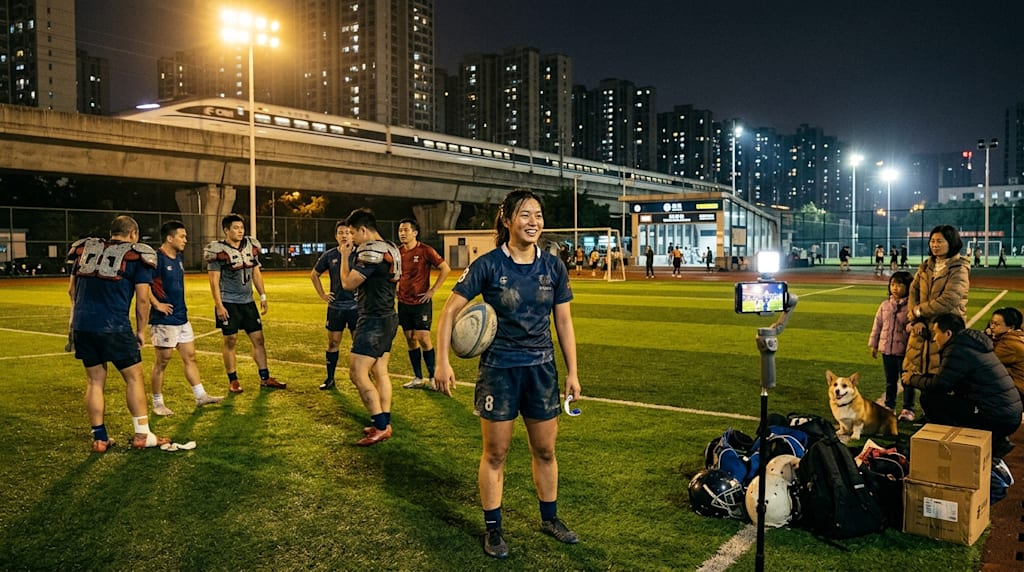
Rugby in China is not just one thing. City Bowl and AFLC are amateur American football full-pad leagues. At 7:30 p.m., a rented soccer field. Lights cost 300 yuan an hour. Players change shoes; helmets sit in trunks next to delivery boxes. The coach is an old player; the playbook is a literal translation from English; someone tapes up a cracked shoulder pad.
On game day, we gather at 6 a.m. Tape, pads, warm-up. The referee may also be part-time. Not many spectators: family, friends, a dog. The livestream is sometimes just a phone on a gimbal. For away games we take the high-speed train, carrying our own helmets and shoulder pads. Security asks: Is this a motorcycle helmet? I say: Football. He glances at it and lets me through.
On the field the shouting is huge. The first time you get hit silly, the world goes white for a second. The first time you make a solid block, you hear the dull thud of bone and flesh. The first time you catch a touchdown pass, you run to the end zone, teammates pile on, pressing you to the ground. The first time you intercept, you run back with the ball, wind passing your ears. After the game the two teams eat together and swap stickers and badges. Monday, back to work. A colleague asks what I did over the weekend. I say I played a match. He asks what match. I say football. He asks, the kind with helmets? I say yes. He says oh.
Flag football is a gentler entry point. University fields, women and men, colored flag belts. Pull the flag, run routes. More since it entered the Olympics. No tackling, but the competition is not weak. Route running, reading defense, teamwork. None of it is missing. Many start with flag and then move to full pads or rugby. Touch rugby in the park; some come in running shoes. No tackling, only touching. Positioning, passing, catching. Even kids can play.
A niche sport specialty means you spend a lot of time explaining a sport nobody knows. That gets tiring. Family doesn’t understand “still playing this at this age.” Insurance is self-paid. Field fees are pooled. Injuries are yours to carry. Full pads carry risks of concussion, ACL, shoulder injury; flag has fewer, but sprains are common. Coaches repeat: keep your head up, wear a mouthguard, buy insurance.
But inside the circle, people show up. A teammate lent me a mouthguard. The coach handed me water after I threw up. When an opponent went down, I pulled him up. After training, everyone stood in a circle, hands stacked together. Someone shouted: See you tomorrow.
Training ends, the field lights go off. Someone shouts see you tomorrow. I carry my bag, helmet hanging on it, and walk to the subway entrance. The subway wind is strong; the mouthguard in my pocket is still wet. The train comes. I get on, find a corner, sit down. The shoulder pads in my bag press against my calf, hard. Tomorrow I still have work.
About the Creator
Jin
Writer of reamstories
https://reamstories.com/jin
Enjoyed the story? Support the Creator.
Subscribe for free to receive all their stories in your feed. You could also become a paid subscriber, letting them know you appreciate their work.
Comments
There are no comments for this story
Be the first to respond and start the conversation.