
I Play Rugby in China. Most People Don’t Know the Sport Exists.
No stadium. No cameras. Just helmets, mud, and a small circle of people who keep showing up.
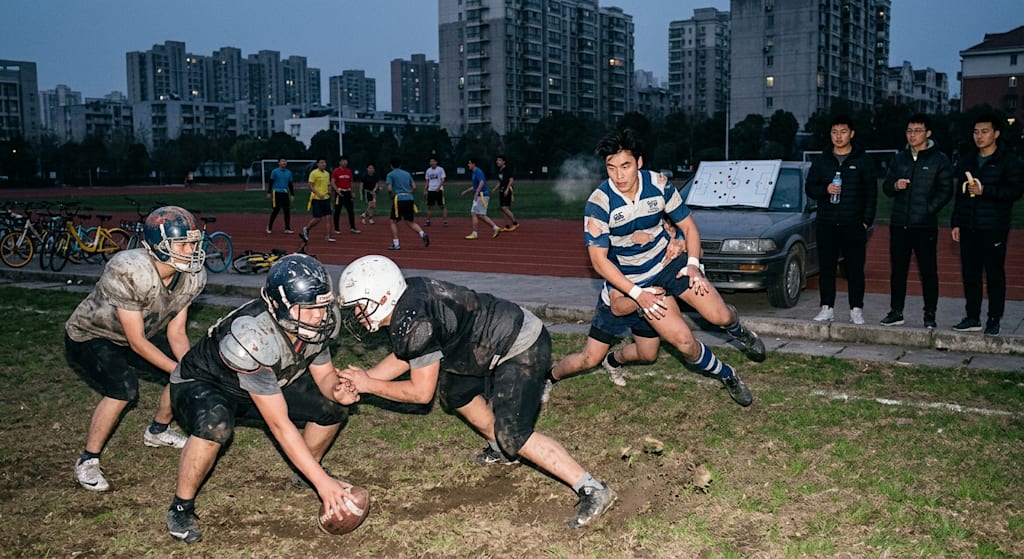
Saturday, three in the afternoon. A soccer field at the edge of the city. Wind knocks over the cones. A few people lift helmets and shoulder pads out of a trunk. Mouthguards in their mouths. Cleats in the mud. No broadcast truck. No stands. Shared bikes parked along the sideline. Water and bananas in plastic bags.
The quarterback bends, calls the cadence.
The next second, helmets crash together. The sound is like thunder dropped into a tin box.
This is a game of American football in China. It could be City Bowl. It could be AFLC. It could be a scrimmage between two amateur teams. Not many spectators. But the shouting is loud. Everyone on the field knows standing here was not easy.
I play rugby. When many people first hear the word “rugby,” they pause. Is that the helmet kind? Is that the Olympic kind? Is that the kind where you hold the ball and slam into people? Usually I spend a few minutes explaining. After a while it gets tiring. Every time I finish, I feel it was worth it.
I found rugby at fourteen. Back then I trained in track and field. I did not even know much about the big three ball sports. One day two people came to the field, holding an oval ball. They called to me as I warmed up on the track: “Throw it around a bit.”
Just like that, I got selected for the provincial team. It was the first time Sichuan Province was putting together a rugby team. A group of us crossovers who knew nothing sat in the same room. Everything was new.
The coach showed us a match video. From the first moment, I could not look away. So there was a sport in this world that could be played like that. In those few minutes, I decided I would become a good rugby player. I still did not understand how it was played.
Actual training hit me hard. Four sessions a day, out early, back late. My legs could barely walk. I could not pick up chopsticks to eat. Many times I wanted to quit. I was unwilling one more time than I was willing to give up.
After I started playing matches, the sport’s appeal spread out in front of me. Restraint hidden under hard collisions. Protection and respect shown inside what looks violent. The need and being needed when teammates stand on the field together. Match after match, I seemed to have become a good rugby player.
After I joined the national team, my view opened up. Daily training included strength, conditioning, speed, technical contact, and tactical review. In low moments I doubted myself. The coach talked me through it. Teammates stayed with me. I gritted my teeth and adjusted. I also met very tough opponents, like Japan. Analyzing an opponent and finding weaknesses is interesting to me. I watched film late into the night, excited.
This was my way into rugby. In China, rugby is not only this one road.
There is City Bowl. There is AFLC. There is flag football on college fields. They are not the same sport as the rugby I play, but they share a core: forward, contact, teamwork, respect.
Roughly, rugby in China has a few maps. One is rugby: tackles, rucks, scrums. One is American football in full gear: helmets, shoulder pads, four downs and ten yards. City Bowl and AFLC are the league memories of many amateur players. Another is flag football: pulling flags instead of tackling. Lower barrier, faster pace, common on college campuses, men and women mixed.
People often mix them up. Some think you must be tall and strong to play rugby. Not exactly. Rugby has contact, but it has complete, strict rules. It values skill, judgment, and coordination, not just body size. With proper training and self-protection, you can control injury risk to some extent. The sport needs strength and speed, but it tests focus, in-the-moment decisions, and above all teamwork. In the instant of a hit, fear is instinct. Training teaches you how to handle contact correctly. A good rugby player must have good contact technique.
If you ask a City Bowl or AFLC player what playing football in China is like, he will probably laugh first, then say: broke and hooked.
Broke is real. Full-gear American football has a threshold. Helmet, shoulder pads, mouthguard, cleats, gloves, jersey. Several thousand yuan. Teams often have no stable funding. Fields must be rented. Referees must be paid. Away games mean high-speed trains and budget hotels. Many teams split costs. Many pieces of gear are used for years. The leather on shoulder pads is worn. Helmet facemasks are scratched. Mouthguards are bitten out of shape. No one wants to throw them away. They carry the marks of every game.
Hooked is also real. Training is usually on weekday nights. After work, someone rushes out of an office building. Someone takes the subway from school. Someone rides a shared bike with gear on his back. Warm-up, footwork, routes, passing, contact, tactics. The coach may be an old player, a foreign coach, or a veteran hobbyist, coaching for free. Chinese and English terms mix: “Set, hut!” “Blue 42!” “Motion!” The playbook looks like a foreign language. When the route is right, the quarterback puts the ball where it should go, and the receiver catches it on the sideline, the joy is direct.
Game day is more like an expedition. City Bowl and AFLC teams often travel between cities. They carry equipment, line the field, set up cameras. The crowd may be only a few dozen friends and family, but the sideline shouts louder than the NFL. Kickoff, return, tackle, touchdown. Every successful defensive stop makes the bench explode. After the game, both sides shake hands, take photos, eat together, trade stickers. Many opponents become friends. Winning matters, but not that much. What matters is that this weekend, we played another game together.
Flag football is another entrance. On a college field, the evening wind blows. The campus radio plays a song. A club recruitment table holds an oval ball. Flag football needs no helmet or shoulder pads. A pair of cleats and you can play. On defense, you pull the flag from the opponent’s waist instead of tackling them to the ground. It keeps the fun of passing, running, routes, and reading the defense, while lowering the physical contact barrier. Women can play. Men can play. Mixed teams can play. Many college students learn for the first time that football is not only hitting. It is also tactics, positioning, coordination, and chemistry.
Flag football is fast. The quarterback calls the cadence. The receiver cuts. The running back finds a gap. The defender chases the flag. A beautiful pass, a key flag pull, can make the sideline scream. It gives more ordinary people a chance to touch football, to understand the rules in a gentler way, and to feel the core of unity and fight. Most will not become professional players. But they will remember that evening: the sun falling on the field, flags swaying in the wind, a teammate shouting, “One more!”
In China, you are not just a player. You are a league builder.
In the United States, American football has a pyramid of schools and communities. In China, many teams are held up by a few people. You recruit. You find sponsors. You find fields. You write promotions. You referee. You borrow gear. You handle the sign-up chain in the WeChat group. Teams may dissolve because of graduation, work, or injuries. They may merge or rebuild. The level gap is wide. Some teams can run beautiful plays. Some teams are doing well if they get the kickoff and formation right. These small chores make everyone still on the team important.
Small sports have a paradox. Not many people understand. When you are asked about it outside, you often have to spend time explaining the rules. Over time, it gets tiring. When labels like “violent,” “dangerous,” or “only for big guys” get stuck on it, it is frustrating. Inside the circle, the atmosphere is pure. People come together because they love it. The goal is the same. You know these people are not here for fame or money. They just want the sport to be seen by more people. They want to play one more game.
The physical experience is extreme.
The first full-gear collision feels like being hit by a car. Helmet on helmet. Shoulder pad on shoulder pad. Grass flies up. A ringing in the ears. Rules and technique teach you how to protect yourself. How to lower your head. How to aim. How to use the shoulder pad instead of the helmet. How to fall. How to get up. Injury risk is real: concussions, knee and ankle injuries, shoulder separations. Flag football sees pulls and sprains. Insurance, warm-ups, and proper movement matter. Many people fear contact at first. Later they learn to handle it and become more confident. That confidence is not “I can fight.” It is “I know how to face a collision, and I know someone beside me will catch me.”
The scary part of this sport is mainly the visual impact of defense. Especially for men, with strength and explosiveness, one hard tackle often makes the crowd gasp. This visual wildness makes people who love it love it even more firmly. People who play this sport know violence is not the goal. Protecting yourself and protecting your opponent is what keeps the sport alive.
I have tried several relatively small sports, like field hockey and cycling, but rugby is the smallest. Having a small-sport specialty is a special and helpless experience. You get used to people not understanding. You get used to explaining. You get used to hard-to-find fields, hard-to-schedule games, hard-to-find sponsors. You also get a pure joy: doing one thing as well as you can in a place where no one cheers.
Rugby taught me responsibility, trust, and respect. It made me confident, unafraid to show myself. It gave me a group of teammates I can trust with my back. Being needed is the heaviest equipment and the warmest equipment. You stand on the field not only running for yourself, but for the person beside you. You know he will block for you. You are willing to block for him. That is hard to find in daily life.
Today rugby in China is growing. Clubs are appearing in many provinces. Ordinary people have more chances to try touch rugby and flag football. Amateur leagues like City Bowl and AFLC give American football fans their own weekend battlefield. College flag football games are getting livelier. More young people pick up the oval ball for the first time. They may not be professional enough, polished enough, or visible enough. But they are growing. Like weeds. Like people who refuse to be silent.
Playing rugby in China feels like this. It is lifting helmets yourself on Saturday afternoon. It is rushing to training on a weekday night. It is a tactics board on a high-speed train. It is mud after a rain game. It is scratches on a helmet facemask. It is flags swaying in the wind. It is laughter at the hot pot table after a game. It is rehab after injury. It is doubt in a low moment. It is a teammate saying, “It’s fine, one more.” There are no packed stands, but a group of people take it seriously. It is small, burning, sometimes helpless, and still proud.
I still love this sport. Even if it remains small among the big ball sports. Even if it still takes a lot of time to be understood. When that oval ball rolls, I know why I run. And I know that on this land, in different cities, on different fields, many people are running with me.
About the Creator
Jin
Writer of reamstories
https://reamstories.com/jin
Enjoyed the story? Support the Creator.
Subscribe for free to receive all their stories in your feed. You could also become a paid subscriber, letting them know you appreciate their work.
Comments
There are no comments for this story
Be the first to respond and start the conversation.