
He was 39. His opponent had just won two Slams. Then Djokovic found the 10th game.
Novak Djokovic beat Alexander Zverev 4-6, 6-4, 6-4 in Beijing, pushed his China Open record to 32-0, and turned a quarterfinal into a lesson about close matches.
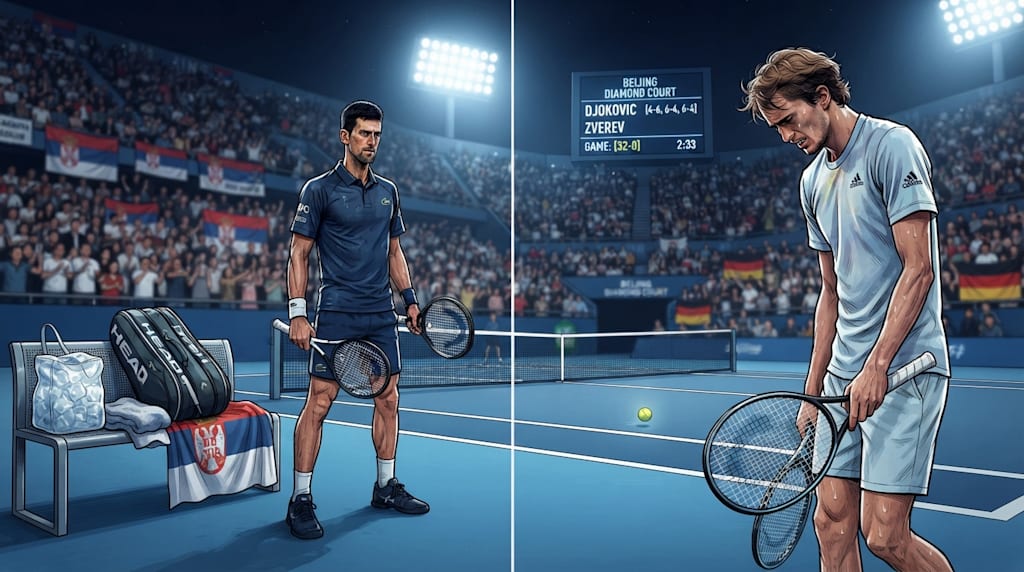
Beijing, October. Diamond Court. Just after seven. The stands were full. A quarterfinal should not feel like this.
At one end: Novak Djokovic, 39, 24 majors, first-round losses in Cincinnati and at the US Open this year.
At the other: Alexander Zverev, 29, French Open and US Open champion this year, world No. 2, top seed.
The last time Djokovic played the China Open was 2015. Zverev was 18, ranked outside the top 100. Now Zverev had two majors. Djokovic was still there.
They had played 14 times. Djokovic led 9-5. Recent meetings went Zverev’s way. Tokyo Olympics semifinal, 2021: Zverev. ATP Finals, 2021: Zverev. Djokovic’s only Grand Slam win over him was the 2021 Australian Open quarterfinal, after dropping the first set.
Before the tournament, Zverev said: “Novak has never lost at the China Open. That is impressive. But records are meant to end.”
Djokovic did not answer. He practiced forty minutes longer.
The first set was a pity, but it made sense.
Djokovic double-faulted twice in his first service game. The second came at 30-40. The ball hit the net. He looked at his strings, kept the racquet, and walked back. Zverev broke with a forehand down the line.
Djokovic held his next two service games. His fourth game brought trouble: 15-40. He won four straight points, including a backhand down the line and a drop shot. After holding, he nodded toward his box.
On Zverev’s serve, Djokovic found break points. He had two in Zverev’s serving-for-the-set game. Zverev erased both: one forehand winner, one service winner. In the first set, Zverev won 84 percent of his first-serve points and 71 percent of his second-serve points. 6-4.
Djokovic lost the first set by three total points. Serve was the difference.
The second set, both men held.
Zverev’s first-serve percentage reached 96 percent. Djokovic had almost no look on return. Through eight games, no breaks. 4-4.
Djokovic held for 5-4. Zverev stepped up to serve to stay in the set.
Djokovic moved his return position half a step forward. On television, the half-step was invisible. Zverev’s first second serve came in eight kilometers per hour slower. Djokovic stepped in, drove a backhand down the line, forced a short reply, followed to the net, and put the volley away.
15-30. Zverev missed his first serve. On the second, he chose a safer target. Djokovic ran around his backhand and took a forehand. Zverev’s reply sailed long.
30-40, break point.
Zverev walked to the ball kid for a towel, wiped his face, bounced the ball. He chose the outside corner. Djokovic read it, returned deep and flat. Zverev’s forehand went long.
Break. 6-4.
In that set, Djokovic won 83 percent of his net points. Zverev won 57 percent. Djokovic did not try to match the German’s speed from the baseline. He used placement and rhythm.
The first eight games of the third set were almost a copy of the second.
4-4. Djokovic held for 5-4. Zverev served to stay in the match.
First point: Djokovic returned straight at Zverev’s feet. The reply went into the net. 0-15.
Second point: Zverev made a first serve and won the point with his forehand. 15-15.
Third point: Djokovic dropped a short ball. Zverev ran from the baseline to the net, got to it, but Djokovic was already waiting. A backhand volley into the open court. 15-30.
Fourth point: Zverev’s second serve came in at 182 kilometers per hour. Djokovic’s backhand return went deep into the German’s backhand corner. Zverev sliced a defensive reply. Djokovic changed direction with his forehand. 30-40, match point.
Zverev saved the first match point with an ace down the T.
On the second match point, Djokovic again returned deep. Zverev went for his forehand. The ball landed out.
6-4. Match over.
It lasted 2 hours and 33 minutes. Zverev hit 19 aces, 0 double faults. Djokovic hit 3 aces, 3 double faults. Zverev won 82 percent of his first-serve points. Djokovic won 68 percent. Total points: 95-95.
Zverev won the serve stats. Djokovic won the match. In every other part of the game, Djokovic did more. At 5-4 in the second set and 5-4 in the third, Djokovic broke. Zverev did not.
After the match, Djokovic spoke in Chinese: “Hello, China. Hello, Beijing. Thank you for your support.”
He said the start was bad. “My serve was very bad in the first set. Two double faults. That is rare. In the second and third, I found my rhythm. At the end of the third, we both had chances. I am happy to win.”
A reporter asked him how, at 39, he still kept this level.
He thought for a moment. “I want to prove that I am still the best player in the world. I have always believed that. It takes a lot. But when you hear the crowd like this, you grow wings.”
The crowd had not left. Serbian flags. Signs that said “Nole.” Djokovic waved, packed his bag, and walked into the player tunnel.
The China Open has always been a special tournament for Djokovic.
He has played here six times. He has won six times. Before this year, he was 29-0. After tonight, 32 straight wins. The longest winning streak at a single event in the Open Era on the men’s tour. The record had belonged to Nadal, who won 31 straight at the French Open. Djokovic passed it in Beijing.
Across those six title runs, he has faced 28 players. Twenty-two of them have retired. Lleyton Hewitt’s son is now on the professional tour. If Djokovic plays a few more years, a father and son both facing Djokovic is possible.
Djokovic does not like talking about records. In the press conference, when a reporter mentioned 32 straight wins, he waved his hand. “I am only thinking about tomorrow’s match. Medvedev is difficult. I need to recover well.”
He said “tomorrow’s match” in a flat voice. As if 32 were just a number. As if 39 were just a number. As if he could keep going.
Zverev left the court without doing an interview. He walked with his head down, bag on his shoulder, fast.
In this match, he hit 19 aces and 0 double faults. By serve numbers, he had one of the best matches of his career. At 5-4 in the second and 5-4 in the third, he showed the same wobble: the second serve lost its bite, the baseline rallies turned passive, and he waited for the opponent to miss.
The problem was mental, the kind Djokovic creates in opponents.
Zverev once mocked Djokovic’s support for best-of-three sets at Grand Slams. This match showed the opposite. In a best-of-three format, with energy in the tank, Djokovic still has top-level tennis in him. He said after the match that his body felt better in the third set than in the first two. “That is very rare for me this year.”
When the match does not need to stretch into a long five-setter, a 39-year-old Djokovic can still use experience, tactics, and will to cover for the loss of footspeed and explosiveness.
On October 5 at 7 p.m., Djokovic will play No. 3 seed Medvedev for a place in the final.
Medvedev won his quarterfinal in straight sets. Afterward, he was asked about Djokovic. The Russian said: “He has never lost here. That is impressive. But tomorrow, the record is 0-0.”
When Djokovic heard that, he was getting treatment. He smiled. “Daniil is right. Tomorrow is a new match.”
He put the ice bag on his right shoulder and closed his eyes.
The lights in Diamond Court had gone dark. Staff began clearing trash from the stands. A Serbian flag was left on a seat, red, blue, and white moving slightly in the night wind.
Tomorrow night, the place will be full again. Most of them will cheer for Djokovic.
32 straight. The 25th major still far. Tonight, in Beijing, at Diamond Court, he proved the same thing again: he can still fight.
He plays Medvedev tomorrow. The 25th major is still far. He is still here.
About the Creator
Jin
Writer of reamstories
https://reamstories.com/jin
Enjoyed the story? Support the Creator.
Subscribe for free to receive all their stories in your feed. You could also become a paid subscriber, letting them know you appreciate their work.
Comments
There are no comments for this story
Be the first to respond and start the conversation.