
He Gave Up $49 Million Just to Sit at the Cool Kids’ Table
LeBron didn’t join the Sixers for money. He joined them so someone else could miss a shot.
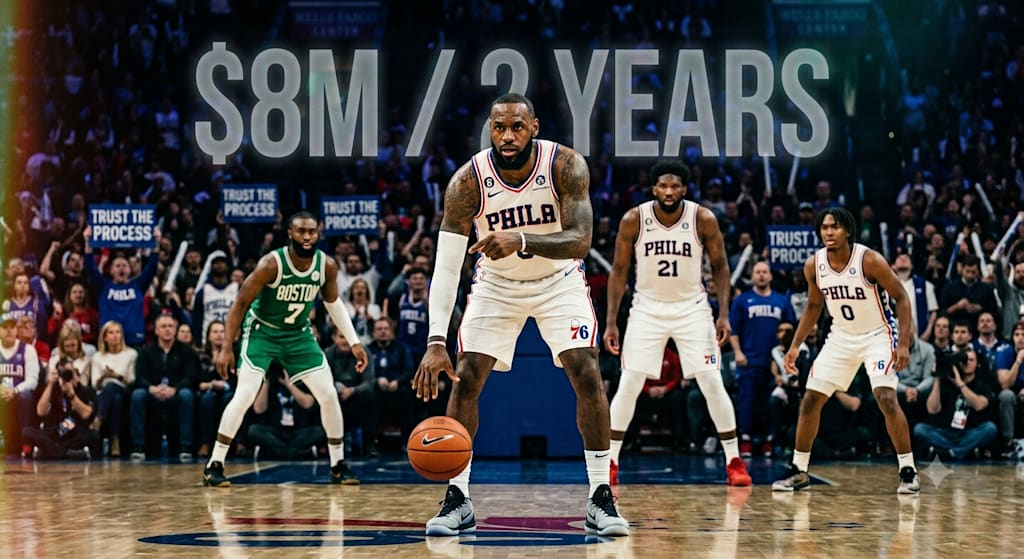
Late one night in July 2026, Shams Charania hit send.
An hour later, the tweet had been retweeted 200,000 times. Comments were exploding. Livestreams were screaming. Basketball editors who had stayed up for the news bolted upright from their chairs, grabbing their phones to make sure they hadn’t misread the number.
Two years, $8 million. LeBron James.
Not a max extension with the Lakers. Not a homecoming to Cleveland. Not the long‑awaited LeBron‑Steph duo. It was the Philadelphia 76ers. It was the veteran minimum. It was $4 million per year, $49 million less than he made the previous season.
People started doing the math: What does $4 million get you in the NBA? An end‑of‑bench rotation player. A two‑way contract from the G League. A veteran waving a towel at the end of the bench. And now that person was LeBron James.
This wasn’t a signing. This was a pledge of allegiance.
He slapped his money on the table. In return, he wanted one thing.
Philadelphia, early July. Free agency was at its most chaotic.
Inside the Sixers’ front office, the general manager stared at the salary sheet. Embiid’s super‑max. Maxey’s extension. Jaylen Brown’s giant contract, three locks that had already sealed the cap space. Chasing LeBron? In any salary‑cap expert’s eyes, that was a pipe dream.
Then LeBron’s agent called.
“What if the number is $4 million?”
Five seconds of silence on the other end.
On the negotiating table appeared a puzzle more confounding than any trade proposal: a player still averaging 25 points per game, voluntarily cutting his own market value to one‑tenth. Not out of generosity. Not out of pity. Not even out of any “sacrificing for the team” narrative.
This was arithmetic.
LeBron was doing the math: his business empire clears over $100 million a year—shoe contracts, media company, investment portfolio. None of that stops running because he takes home a few million less. But a championship ring? Miss this window, and it’s gone forever.
He wanted talent overflow. He wanted roster depth. He wanted, at age 42, when he stood on the Finals floor, for there to still be a player at the end of the bench who should have been making eight figures.
Philadelphia took the pledge, then turned around and used the freed‑up space to add Wade.
That was the “capital gamble”: LeBron traded $49 million of his own money for the possibility of a talent‑saturated roster. He wasn’t here for the paycheck. He was here for that “+1.”
He ruled out three doors. He pushed open the fourth.
In the 72 hours before LeBron made his decision, the basketball world was floating four different prophecies.
The first was a Miami return. Heat fans had already prepared a welcome video. Someone even accidentally posted it early. His close friends were there. The culture was ironclad. The winters were warm. But Pat Riley was still Pat Riley: 76 years old, still showing up at the practice facility at 6 a.m., still treating every player the same, still not giving you special treatment just because you’re LeBron James. And in Miami’s existing roster, he would have had to carry the playmaking load again, playing point guard in crunch time, the exact opposite of “lightening the burden.”
The second was a Cleveland homecoming. The Akron son returning to where it all began, the most poignant narrative in sports. But Cleveland was already Donovan Mitchell’s team. LeBron knew one fact clearly: the moment he walked into that locker room, everyone would look up at him. That wasn’t what he wanted. He didn’t want to be the “shadow emperor,” didn’t want a rising young core to live under the weight of “this is LeBron’s team.”
The third was Golden State. Draymond Green was even willing to opt out to make it happen. LeBron and Steph together would have been a nuclear explosion of attention. But Golden State’s age was written in plain numbers: the starting lineup averaged nearly 34, and in a seven‑game Western Conference grind, they couldn’t outrun guys in their twenties.
Then Jaylen Brown was traded to Philadelphia.
That trade changed every ranking. The Sixers went from “Embiid plus a bunch of shooters” to a four‑headed monster: Maxey (the slashing blade), Brown (two‑way wing), LeBron (the hub), and Embiid (the interior giant). In the East, that talent tier could overwhelm anyone.
That moment, LeBron’s phone went quiet. The other three options didn’t disappear, but their priority was reset by a single phone call.
Where he’d play on the floor, and how far he was willing to step back
Set aside the sentiment. Look at the basketball.
What position does LeBron play in Philadelphia? The official roster might say forward, but the real answer is secondary playmaker.
Philadelphia didn’t lack scorers. Maxey could drive and shoot. Brown could score one‑on‑one against anyone. Embiid could crush any defender in the post. What Philadelphia lacked was one person: someone to bring the ball up steady, to zip a pass out the moment Embiid got doubled, to find Maxey sprinting in transition, that one commander.
In LeBron’s manual, there’s a line that had long been overlooked: he can play off the ball.
When Embiid draws a double‑team in the post, LeBron’s ghost cuts appear at the softest spots in the defense. When Brown isolates, LeBron stands in the weak‑side corner, and his defender dares not leave him by a step. When Maxey pushes in transition, LeBron, at 42, can still fill a lane for a spot‑up look.
Theoretically, this was a perfect motion‑offense team: four stars, each with gravitational pull, leaving the defense in a perpetual “double one and the other burns you” dilemma. With LeBron on the floor, the offensive IQ was maxed out. With LeBron off it, the young duo of Maxey and Brown kept the pressure on.
But in front of that “theoretically” sat two brutal realities.
The first was Embiid’s knees. In his first nine seasons, Embiid averaged just 58 games per year. In 2024‑25, he played 39 regular‑season games. In 2025‑26, 41. That number hung over Philadelphia like a blade: if that blade fell in the first round of the playoffs, everything LeBron had bet would zero out.
The second was Embiid’s heart. He still loved the perimeter. He still dribbled, crossed over, faded away like a 7‑foot guard. In the ideal script, LeBron would walk into the locker room on Day 1, pull Embiid aside, and say: “Get to the rim. I’ll feed you.” But whether a 42‑year‑old legend could rein in a reigning MVP in his prime, making him abandon those flashy ball‑handling showcases and happily eat inside, was itself a locker‑room question mark.
He said it was for his daughter. But the contract exposed all the ambition.
“This decision was mainly about my daughter.”
When LeBron said that at the press conference, someone in the comments dug up the records: his daughter had already enrolled in a Philadelphia school. That was a father’s decision: warm, soft, beyond reproach.
But professional sports was never just about warmth.
The two‑year, $8 million deal, with a player option in Year 2, that structure drew a clean timeline.
In the summer of 2027, if Philadelphia won it all, LeBron would be 42, holding his sixth ring, and before anyone could even ask “how much longer?”, he would say “it’s over.” That would be the most graceful exit since Jordan: turning at the peak, leaving no regret behind.
If 2027 failed, he would most likely pick up the option. One more year. A farewell tour, while waiting for Philadelphia to use whatever chips remained for one last push. Maybe he’d get another piece. Maybe not. But at least he gave himself two trigger pulls.
Either way, this would be the last stop. He no longer needed to prove anything with numbers. 38,000 points. All‑time scoring leader. Four rings. Four MVPs. Those were already locked in the database, untouched by the wins and losses of the next two years. The only thing left, the only thing, was to draw one more mark in that column labeled “Victory,” before he walked away.
A gamble with no backup plan
LeBron James brought the last of his talent, the last of his youth, and the last bit of his unreasonable dominance to Philadelphia.
This city had waited too long under the slogan “Trust the Process.” It had seen regular‑season glory again and again, and playoff collapse again and again. Embiid had cried in the locker room. Fans had cursed in their own arena. Front offices had been reshuffled one after another. Now they were getting a 42‑year‑old, not to retire in peace, but to shove whatever fuel remained onto the table.
On the first day LeBron walked into the practice facility, he saw Embiid, Brown, and Maxey standing in a row. The theoretical ceiling of these four playing together was the highest in the entire East. But theory only lives before the season starts.
This was a high‑stakes gamble. The wager was money, reputation, legacy.
But for a man who had been great for twenty‑two years, he enjoyed standing at the edge of the cliff.
Good luck, LeBron. Good luck, Philadelphia.
This season is going to be fun.
About the Creator
Jin
Writer of reamstories
https://reamstories.com/jin
Enjoyed the story? Support the Creator.
Subscribe for free to receive all their stories in your feed. You could also become a paid subscriber, letting them know you appreciate their work.
Comments
There are no comments for this story
Be the first to respond and start the conversation.