
China Won 11 Golds on Day 1 in Nagoya. Japan Won 6. The Gap Wasn’t Just the Medal Count.
A 13-year-old broke a Games record, a 31-year-old outswam an Olympic champion, and China’s second wave made the host country look outmatched.
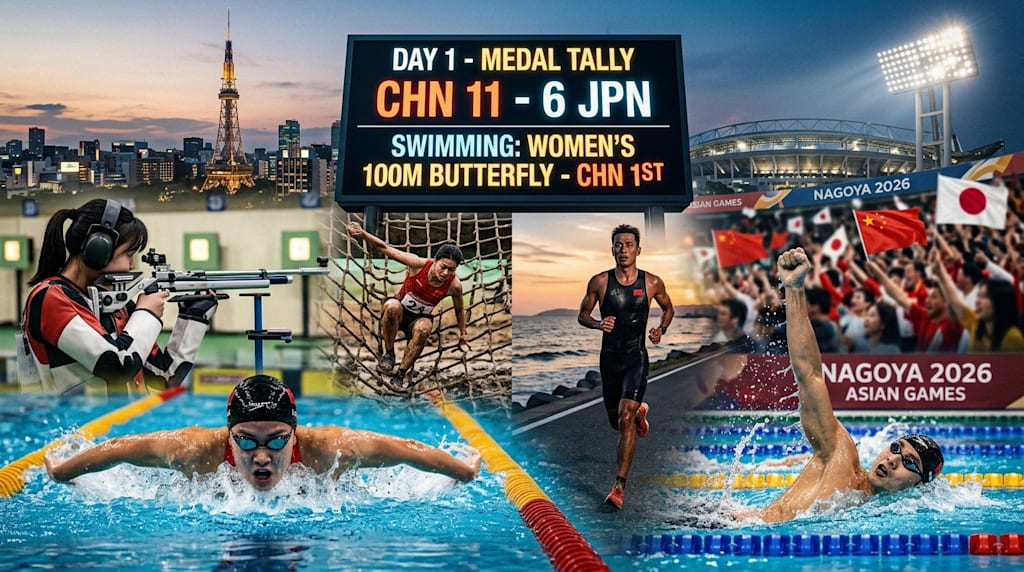
China took 11 golds on Day 1 in Nagoya. Japan took 6. The gap went deeper than the medal table.
Beijing time, September 20. The 2026 Aichi-Nagoya Asian Games wrapped up the first full day of competition. All 31 gold medals were decided. China took 11 gold, 6 silver and 3 bronze to top both the gold medal table and the overall medal table. Host Japan was second with 6 gold, 7 silver and 7 bronze. South Korea was third with 4 gold, 3 silver and 7 bronze.
11 to 6. Nearly double the host’s gold count. But the medal count only tells part of the story.
Wholesale gold in the pool
The aquatics center showed China’s depth most clearly.
Swimming awarded seven gold medals on Day 1. China took six, plus one silver and two bronzes. Seven finals, seven podium finishes. Five record-breaking swims across four events in a single day.
Leading off was 13-year-old Yu Zidi. In the women’s 200m butterfly final, she swam 2:05.08, taking 0.49 seconds off the Games record of 2:05.57 set by Zhang Yufei at the Hangzhou Asian Games. The 200m butterfly is not even her main event. Fifteen-year-old Chang Mohan took silver behind her, giving two swimmers born in the 2000s a sweep of gold and silver.
Then came Li Bingjie. In the women’s 1500m freestyle, she led from the start and never gave up the lead, winning in 15:53.52 to defend her title. It was her eighth career Asian Games gold and China’s third straight Asian Games title in the event.
Pan Zhanle’s race had palms sweating. In the men’s 100m freestyle final, his reaction time was 0.67, and at the 50m turn he was third, 0.11 behind South Korea’s Kim Yeong-beom. Over the final 15 meters he reeled him in. 47.61, winning by 0.04 seconds to defend his title.
Tang Qianting delivered a “two records in one day” performance in the women’s 50m breaststroke. She broke the Games record with 29.50 in the morning heats, then lowered it to 29.45 in the final, erasing the mark she had just written.
Xu Jiayu won the men’s 100m backstroke in 51.98, breaking his own Games record of 52.02 set at Hangzhou and completing a three-peat in the event. He went through the first 25 meters in 25.13, more than 0.7 seconds ahead of the field, and touched nearly two seconds clear of the runner-up. At 31, he has swum under 53 seconds five times this season and under 52 seconds twice in his career. His time was faster than the 52.00 posted by Paris Olympic champion Thomas Ceccon.
The finale was the women’s 4x100m freestyle relay. China’s quartet of Yu Yiting, Zhang Yufei, Cheng Yujie and Wu Qingfeng won in 3:33.10, breaking the Games record they themselves had held. The gold was Zhang Yufei’s 10th career Asian Games gold.
The only gold China missed was the men’s 200m individual medley. Wang Shun, 32, took bronze in 1:57.14, while Japan’s Tomoyuki Matsushita won gold in 1:55.30. “I can still find joy in competitive sport,” Wang said afterward. “I hope that through my performances in the pool, I can give people more spiritual strength.”
The first gold was not in the pool
China’s first gold came earlier than expected, and it was a hard-edged one.
In the women’s modern pentathlon team event, China’s Zhang Mingyu, Wu Xiyao, Meng Xin and Fu Jing successfully defended their title. These Asian Games introduced a new modern pentathlon format, replacing traditional equestrian with obstacle running. The competition consists of fencing, obstacle running, swimming and laser run, all to be completed in about 90 minutes. Team scores are based on the combined points of a team’s top three finishers. All four Chinese athletes reached the final, and China’s overall depth carried it past South Korea and host Japan for gold.
In the individual event, South Korea’s Seong Seung-min won with 1,492 points, Zhang Mingyu took silver with 1,460 and Wu Xiyao bronze with 1,447. China did not retain the individual title, but with two athletes on the individual podium, the team gold was secured.
In the men’s modern pentathlon, Li Liuchang won gold with 1,598 points, giving China its first Asian Games title in the event in 12 years.
A world record at the range
In the women’s 10m air rifle team event, China’s Wang Zifei, Du Yuchen and Han Jiayu won gold with 1,904.2 points, breaking the previous world record of 1,902.0.
The gold made 16-year-old Du Yuchen China’s youngest Asian Games shooting champion and the Chinese delegation’s first Asian Games champion born after 2010. India took silver with 1,898.0 and Japan bronze with 1,897.1.
A return in the sea breeze
In the women’s triathlon individual event, Lin Xinyu won gold in 57:37, with teammate Huang Anqi taking silver. It was China’s first Asian Games women’s triathlon title in 20 years. Lin ran the fastest run split of the day, 16:36, to cross the line first and secure a Los Angeles Olympic quota for China.
In the women’s wushu taijiquan and taijijian all-around, Tong Xin successfully defended her title with 19.553 points (9.770 + 9.783).
The host’s first gold
Japan had its moments. In the men’s triathlon individual event, Japanese star Takumi Hojo produced a comeback on the final run leg to take the Games’ first gold in 52:56. China’s Zhang Xirui took silver in 53:05. “This is our first gold medal, and it gives the Japanese team a real boost,” Hojo said afterward.
After Day 1, the gap between Japan and China was wide. China’s 11 golds were spread across five sports: modern pentathlon, triathlon, shooting, wushu and swimming. Swimming alone contributed six. China’s gold rush did not rely on a few stars delivering isolated breakthroughs. It came from a tiered, collective strength.
From 13-year-old Yu Zidi to 31-year-old Xu Jiayu, from first-time Games competitor Du Yuchen to five-time veteran Wang Shun, the generational handover happened in Nagoya.
In Nagoya, the pool churned, the shooting range fell quiet, and the sea breeze of Gamagori still lingered. China finished Day 1 with 11 gold medals across five sports. Its youngest champion was 13. Its oldest swimming champion was 31.
About the Creator
Jin
Writer of reamstories
https://reamstories.com/jin
Enjoyed the story? Support the Creator.
Subscribe for free to receive all their stories in your feed. You could also become a paid subscriber, letting them know you appreciate their work.
Comments
There are no comments for this story
Be the first to respond and start the conversation.