
Canelo Álvarez vs. History: The Final Verdict on Mexico's Greatest Boxer of All Time
A Deep Dive Comparing the Undisputed Champion Against the Legends Who Forged Mexican Boxing and Defined What It Means to Be a Ring Warrior

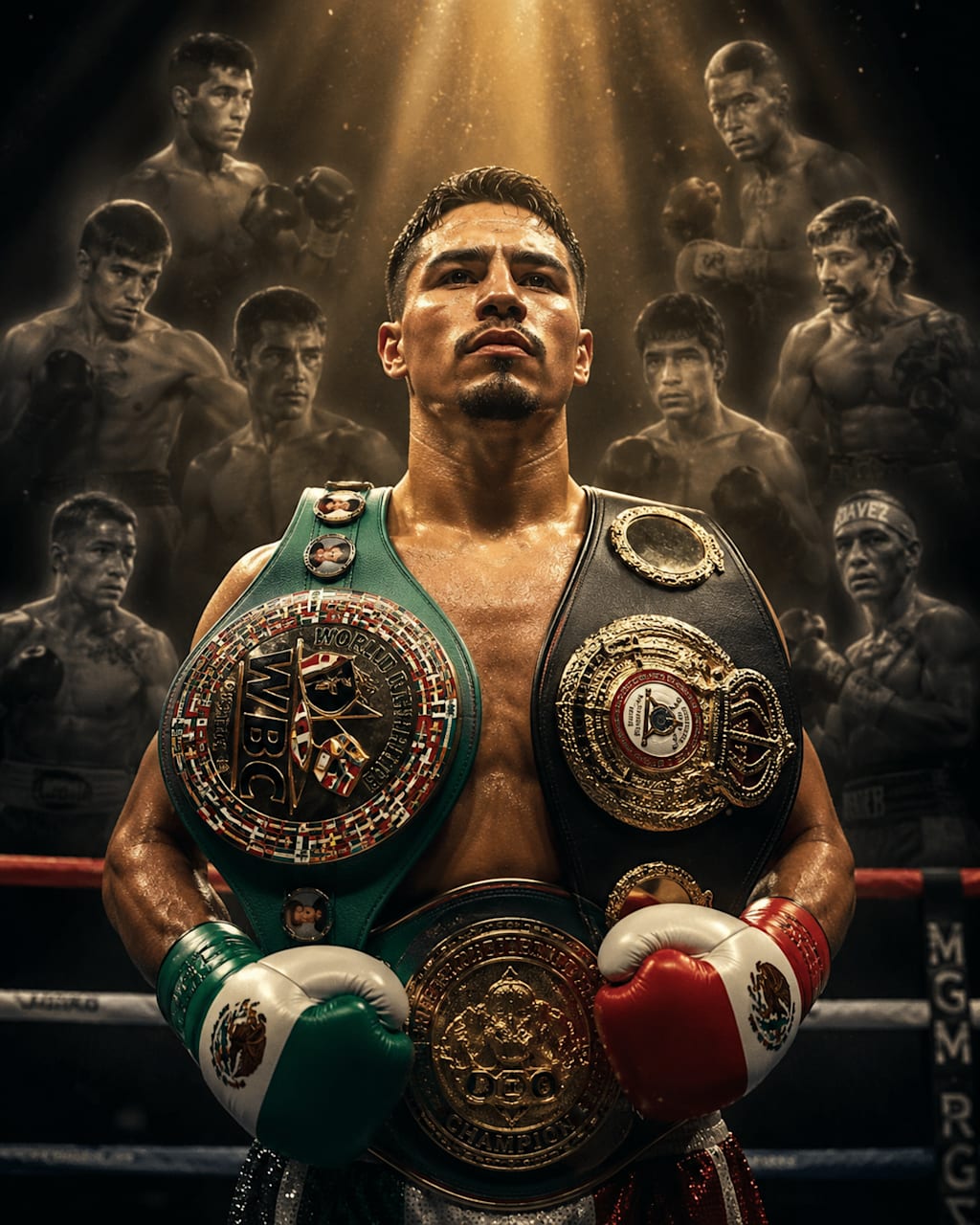
In the pantheon of world boxing, few countries have produced as many legendary warriors as Mexico. From the dusty neighborhoods of Culiacán to the humid gyms of Mexico City, generations of fighters have forged a tradition of bravery, heart, and technique that has left an indelible mark on the sport. But now, one question divides fans in every bar, gym, and family gathering: Is Saúl "Canelo" Álvarez the greatest Mexican boxer of all time?
This is not simply a sports discussion. It is a debate about identity, legacy, and what it means to represent an entire nation with your fists. Today, we will analyze this question with the depth and respect it deserves.
## The Rise of a Living Legend
Saúl Álvarez was born in Guadalajara, Jalisco, in 1990, the youngest of eight siblings, seven of whom were also boxers. He began training at 13 and made his professional debut at 15. Since then, his rise has been meteoric and unprecedented in many respects.
With a professional record exceeding 60 fights, Canelo has accumulated world titles in four different weight divisions: super welterweight, middleweight, super middleweight, and light heavyweight. He became the undisputed champion at 168 pounds, unifying all four major belts (WBA, WBC, IBF, and WBO) in an era when such a feat was considered nearly impossible.
His fighting style combines exceptional defense with devastating power in both hands. His head movement, heir to the Mexican tradition but refined with modern technique, has made him one of the most difficult fighters to hit cleanly in the history of the sport.
His counter-punching ability is particularly noteworthy. Canelo possesses an almost supernatural sense of timing, allowing him to slip punches by millimeters and respond with crushing combinations. This defensive mastery, combined with his offensive firepower, creates a complete fighter who can adapt to virtually any opponent.
## The Giants of the Past: Julio César Chávez
Any discussion about the greatest Mexican boxer must begin with Julio César Chávez, the "Great Mexican Champion." His record speaks for itself: 107 victories, 6 losses, 2 draws, with a career start that included 87 consecutive fights without knowing defeat.
Chávez dominated three weight divisions and defended his world titles on 31 occasions. His fight against Meldrick Taylor in 1990, where he achieved a technical knockout with just two seconds remaining while losing on the scorecards, remains one of the most dramatic moments in boxing history.
What distinguished Chávez was his relentless pressure, his demolishing body shots, and his warrior mentality. He represented working-class Mexico, the man who never backs down regardless of circumstances. His connection with the Mexican people transcended the sport itself.
When Chávez walked to the ring, entire stadiums would erupt with the chant "México, México." He was more than a boxer; he was a symbol of national pride during a time when Mexico needed heroes to believe in.
## Salvador Sánchez: The Interrupted Genius
When discussing pure talent, many experts point to Salvador Sánchez as the most technically gifted Mexican boxer. A featherweight world champion, Sánchez possessed a combination of speed, ring intelligence, and power that made him seem invincible.
His victories over Wilfredo Gómez and Azumah Nelson demonstrated that he could defeat any opponent at their best. Tragically, his life was cut short at 23 years old in a car accident, leaving an eternal question: What would he have achieved with a complete career?
Boxing historians frequently place him among the best pound-for-pound fighters of all time, an extraordinary recognition considering the brevity of his professional career. Those who watched him fight speak of a maturity and wisdom beyond his years, a fighter who seemed to have unlocked secrets of the sweet science that others spend lifetimes pursuing.
## Rubén Olivares, Carlos Zárate, and the Small Weight Classes
Mexico has produced an endless line of champions in the lower divisions. Rubén "Púas" Olivares, with his explosive power at bantamweight, is considered by many as the best pound-for-pound knockout artist in Mexican boxing history. Carlos Zárate, another legendary bantamweight, accumulated 66 victories, 63 of them by knockout—a terrifying effectiveness rate.
Ricardo López, "El Finito," retired undefeated after 51 fights, dominating the minimumweight division with technical perfection rarely seen in any era. Erik Morales and Marco Antonio Barrera staged a trilogy that defined an entire era of world boxing, capturing the imagination of fans worldwide.
Each of these warriors has valid arguments for being considered among the greatest. The richness of Mexican boxing tradition makes this discussion particularly complex and fascinating.
## The Case for Canelo
Canelo's defenders present compelling arguments that deserve serious consideration. First, he has competed and won in an era of greater scrutiny, where every fight is analyzed frame by frame and where opponents have access to unprecedented technology and preparation methods.
Second, he has defeated multiple world champions and future Hall of Famers: Gennadiy Golovkin, Miguel Cotto, Shane Mosley, Caleb Plant, and has faced the toughest challenges available. He has actively sought the biggest tests in his era rather than protecting an undefeated record.
Third, his financial and media impact has elevated Mexican boxing to new heights. His fights generate hundreds of millions of dollars and attract global audiences that surpass any precedent for a Mexican boxer. He has become a global sports icon.
Fourth, his longevity at the absolute elite of the sport, remaining a dominant force for more than a decade, demonstrates exceptional consistency. Many fighters have brief moments of brilliance; Canelo has sustained excellence year after year.
Finally, his willingness to move up in weight and challenge himself against bigger, stronger opponents shows a courage that resonates with the warrior spirit Mexico celebrates in its boxing heroes.
## The Case Against
Critics point to several factors that complicate Canelo's claim to supremacy. The loss to Floyd Mayweather Jr. in 2013, although Canelo was young and inexperienced, remains a blemish on his record. Some argue he was thoroughly outclassed that night.
The defeat against Dmitry Bivol showed that he has limitations when he moves up too much in weight. While seeking challenges is admirable, losses matter when comparing all-time greats.
Some argue that Chávez faced tougher opponents in a more competitive era for the lighter divisions. The depth of competition in the 1980s and early 1990s lightweight divisions was extraordinary.
Others maintain that Salvador Sánchez's natural talent was simply superior, that he possessed gifts that cannot be taught or developed through training alone.
There is also the cultural argument: Chávez connected with the Mexican people in a way that transcended boxing. He was the symbol of an entire nation, something that Canelo, despite his success, has not fully replicated. Chávez was the people's champion in a way that felt almost spiritual.
## Comparing the Incomparable
The truth is that comparing boxers from different eras is inherently problematic. The sport evolves, opponents change, and circumstances are unique for each generation.
Chávez fought in an era without social media, without instant video analysis, and with fewer training resources. His opponents couldn't study thousands of hours of footage to find weaknesses. Canelo fights in a world where every flaw is studied and exploited by teams of analysts.
Salvador Sánchez never had the opportunity to demonstrate his complete greatness. We can only imagine what he might have accomplished with another decade in the ring. Rubén Olivares and Carlos Zárate never moved up in weight to seek titles in multiple divisions as Canelo has done.
The equipment, nutrition, training methods, and medical support available today are vastly superior to what previous generations had access to. Does this make modern achievements less impressive, or does it simply reflect the evolution of the sport?
What we can state with certainty is that Canelo indisputably belongs in the conversation. He has earned his place in the Olympus of Mexican boxing with sweat, blood, and determination.
## The Verdict: A Celebration, Not a Competition
Perhaps the question itself is poorly framed. Instead of seeking a definitive "best," we should celebrate the extraordinary tradition that has produced so many exceptional champions.
Canelo Álvarez is, without doubt, the best Mexican boxer of his generation and one of the greatest of all time. Whether he is "the best" depends on the criteria each fan values most: record, cultural impact, pure talent, or financial legacy.
What is undeniable is that he has honored the tradition of Mexican warriors who came before him. Every time he steps into the ring with the tricolor flag, he carries with him the spirit of Chávez, Sánchez, Olivares, and all the others who paved the way.
He has brought Mexican boxing to a global audience larger than ever before. He has shown that a kid from Guadalajara can become one of the most recognized athletes on the planet. He has inspired a new generation of young fighters who dream of following in his footsteps.
For boxing fans, especially Mexicans, this debate will continue at every gathering, every broadcast, every gym conversation. And that is exactly as it should be. Greatness deserves to be discussed, analyzed, and celebrated.
The beauty of this debate is that there is no wrong answer. Chávez, Sánchez, Canelo—each represents something unique and valuable about Mexican boxing. Each has contributed to a legacy that makes Mexico one of the most important boxing nations in history.
One thing is certain: when the history of boxing is written in its final form, the name Saúl "Canelo" Álvarez will occupy a place of honor alongside the legends who defined what it means to be a Mexican champion.
What do you think? Is Canelo the greatest? Share your verdict and join the conversation that unites millions of fans around the world. The debate continues, and your voice matters in this ongoing celebration of Mexican boxing excellence.
About the Creator
ELIAS PULIDO
Storyteller by necessity. The best stories don't live in headlines — they live in the details nobody notices. I write about people, ideas, and the moments when the world shifts direction. Sometimes without anyone realizing it.
Enjoyed the story? Support the Creator.
Subscribe for free to receive all their stories in your feed.
Comments
There are no comments for this story
Be the first to respond and start the conversation.