
Can Iran Actually Close the Strait of Hormuz?
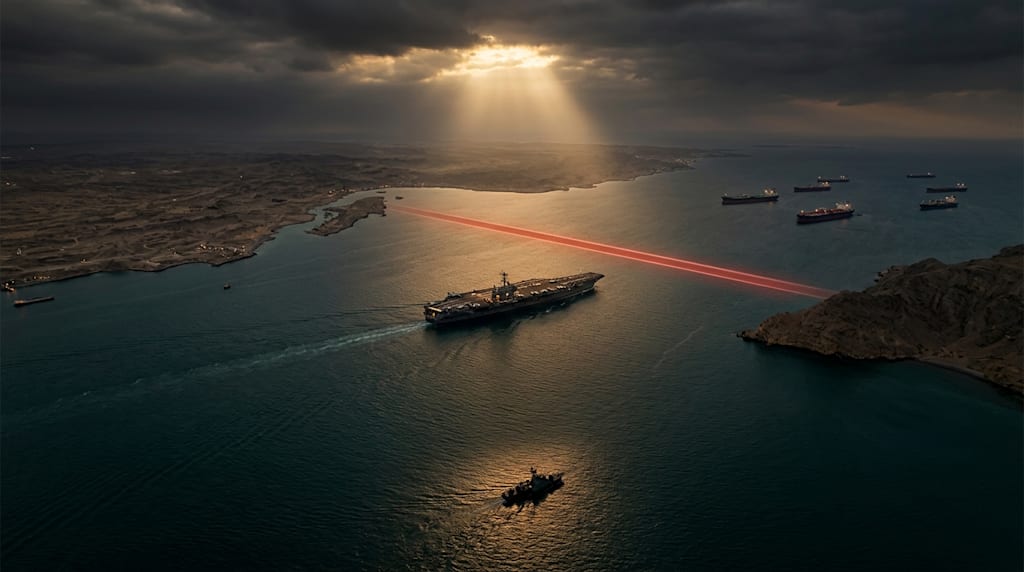
A bold "expulsion" threat. A carrier running on fumes. And Gulf allies questioning whether Washington is worth the cost. This is the real state of the Persian Gulf.
I. One Statement, Three Readings
On August 16, 2026, Iran's Tasnim News Agency published comments by General Hattami, commander‑in‑chief of the Islamic Republic's armed forces: "The United States has been expelled – this is a fact. In the future, it will not be permitted to enter the Persian Gulf, the Gulf of Oman, or the Strait of Hormuz."
The sentence can be read in three ways.
For the domestic audience: a rallying cry. The rial has fallen to historic lows, sporadic protests have broken out on the streets, and the military needs a wall of "common enemies."
For Washington: a raising of the stakes. Iran is using its enriched‑uranium stockpile to push up the negotiating threshold; by drawing a "red line" over the Strait, it is effectively saying: if you want shipping lanes to stay open, you first have to loosen the grip of sanctions.
For the Gulf neighbours: a warning. The oil tankers of Saudi Arabia, the UAE, and Qatar pass through this waterway every day, and Iran is reminding them who controls the northern shore of that channel.
All three readings point to the same conclusion: this is not an order that changes the status quo, but a risk signal thrown onto the chessboard. To assess its real weight, one must look away from the statement itself and towards three harder facts – the legal and physical realities of the Strait, the actual condition of the US aircraft carrier at this moment, and the shift in attitudes taking place among the Gulf states.
II. That 33‑Kilometre Waterway
The Strait of Hormuz is about 33 kilometres wide at its narrowest point.
Roughly 21% of the world's seaborne oil and 26% of its liquefied natural gas pass through it every day. A very large crude carrier takes about eight hours to traverse the Strait. During those eight hours, every minute of global crude futures trading is watching its position.
Under international law, the Strait is considered an "international strait" used for navigation, and foreign ships enjoy the right of transit passage. But Iran has never signed the UN Convention on the Law of the Sea; it asserts jurisdiction over the northern part of the waterway under its domestic laws. Over the past four decades, Iran has repeatedly simulated closures in military exercises, deploying shore‑based anti‑ship missiles, fast attack craft, and naval mines – yet it has never actually severed international shipping, because that would mean declaring war, in effect, on all the world's major economies.
So Hattami's "no entry" is not an immediately enforceable maritime prohibition. It is more like a ballast stone on the negotiating table: I can make this very expensive, and you can choose to make me not have to do that.
III. The Fatigue of the USS Lincoln
On the morning of August 15, at Muscat International Airport in Oman.
An MH‑60S helicopter (tail number 615) from HSC‑14 landed. On board was Admiral Cooper, commander of US Central Command. His destination was not a land base, but the aircraft carrier USS Lincoln, then on duty in the Gulf of Oman.
Flight‑track records show:
11:28 – landed at Muscat.
12:23 – took off, and at 17:31 landed again at Muscat.
18:40 – took off a third time and returned to the carrier.
The ADS‑B signal disappeared at around 13:00 at 23.704°N, 58.673°E, heading 088°, speed 120 knots. One hour later, Cooper appeared on the carrier's flight‑deck monitoring screen – the time on the monitor was 14:01.
Based on the helicopter's speed and the position where its signal was lost, the carrier's approximate location was 23.81°N, 60.15°E – in the northern Gulf of Oman, about 150 kilometres off the Iranian coast, squarely within the "exclusion zone" declared by Hattami.
But the atmosphere of this visit was far from a triumphant "show of force."
The Lincoln had already been deployed for more than 260 days, with 250 consecutive days without a port call. US Navy internal media had described crew morale as being in a "state of crisis." Cooper's trip was more like a front‑line morale visit – the commander flew into contested waters, sat down with pilots of VMFA‑314 "Black Knights" in their mission planning room, where a whiteboard showed the day's duty roster: 312, 316, 305, 313 – four F‑35Cs rotating in pairs, with red‑marked 301 and 306 noted as "standing alert airborne."
He stayed on the carrier for about 2 hours and 40 minutes, then returned by the same route.
The entire journey reveals a subtle contrast: the US military still maintains a forward presence, but that presence has been running continuously for nine months, and every additional day wears down the margins of both equipment and personnel. Iran's statement came at precisely this moment, stepping on America's "window of fatigue."
IV. A Backyard That Is Loosening
More alarming to Washington than carrier fatigue is the shift in attitudes among the Gulf states.
According to CCTV News, citing informed officials, several Gulf states – including Saudi Arabia, the UAE, and Qatar – have reached a consensus of dissatisfaction with the Trump administration. Some have begun discussing whether it is still necessary to allow the US to maintain large‑scale military installations on their soil.
The sources of discontent are concrete:
Trump has repeatedly threatened a major strike against Iran, only to withdraw those threats later, citing "progress in negotiations." This vacillation leaves the Gulf states uncertain: does the US actually have a coherent Iran strategy?
If war breaks out, the US can withdraw its carriers from the Middle East, but Saudi Arabia's and the UAE's oilfields, desalination plants, ports, and refineries cannot be moved. They would bear the brunt of Iran's retaliatory strikes.
And these countries have provided the US with bases, airspace, and logistical support in exchange for increasingly vague protection commitments.
One remark attributed to a Gulf diplomat has been widely quoted: "Trump starts a war, and we pay the price."
That sentence worries the Pentagon more than any Iranian missile. America's military presence in the Middle East is heavily dependent on host‑nation bases and permissions. If the Gulf states begin to "re‑evaluate" those permissions, Washington's strategic options will narrow sharply.
V. Three Possible Paths
Iran's declaration, the Lincoln's fatigue, and the alienation of Gulf allies – these three threads converge not towards an imminent all‑out war, but towards a long, uncertain, low‑intensity but persistently frictional "cold standoff."
Over the next six to twelve months, the most likely outcomes are not an actual Iranian blockade of the Strait, nor a full‑scale US‑Iran war, but some combination of the following three scenarios:
Scenario One: Intermittent diplomatic openings (probability ~45%)
Under Omani or Qatari mediation, the two sides conduct indirect talks. Iran trades "refraining from expanding Strait disruptions" for partial sanctions relief, while the US tacitly accepts Iran's moderate enrichment activities. Transit through the Strait remains largely normal, and oil prices stay in the $90–105 range. Tensions ease periodically, but are never truly resolved.
Scenario Two: Normalised friction (probability ~35%)
Iran regularly detains or harasses "violating" vessels, the US strengthens escorts, and the two sides engage in close‑range maritime confrontations while avoiding direct exchange of fire. Brent crude fluctuates between $105 and $120. This state could last for months or even a year, testing each side's endurance rather than its combat power.
Scenario Three: Accidental escalation (probability ~20%)
A miscalculation during an interception leads to an exchange of fire – an Iranian fast boat is sunk by US forces, or an Iranian missile hits an escort ship. The US then conducts limited airstrikes, and Iran responds with missile strikes on Saudi oil facilities or US bases. The conflict is contained within 48–72 hours, but oil prices may briefly spike above $150, and global stock markets experience severe turbulence.
The key variables are the internal political clocks on both sides – the pressure of the US electoral cycle, the limits of Iran's domestic economic tolerance, and whether the Gulf states continue to provide basing permissions. A change in any one of these factors will redefine the boundaries of the "red sea."
VI. Back to That Ship
On August 16, Cooper had already left the Lincoln. The carrier continues to patrol in the northern Gulf of Oman; the duty roster on the flight deck is updated every day, and 301 and 306 are not necessarily airborne every time.
Iran's declaration made headlines around the world, but the tankers in the Strait have not stopped, and Brent futures rose only slightly – about 2% – at the open. Markets have learned to trade in this cycle: loud words, small changes, but every increase in volume raises the cost of the next accidental escalation.
Hattami said "the United States has been expelled." The fact is that the US carrier is still 150 kilometres off the Iranian coast. It is just that the people on board have been on duty for nine months straight.
That is the real state of the Persian Gulf today: neither side has fully delivered on its threats, but both are approaching the limits of what they can bear. The 33‑kilometre waterway will continue as the world's most expensive chokepoint, carrying tankers, warplanes, and diplomatic correspondence, swaying between war and negotiation.
About the Creator
Jin
Writer of reamstories
https://reamstories.com/jin
Enjoyed the story? Support the Creator.
Subscribe for free to receive all their stories in your feed. You could also become a paid subscriber, letting them know you appreciate their work.
Comments
There are no comments for this story
Be the first to respond and start the conversation.