
Caitlin Clark: The Political Pawn the WNBA Wasn’t Ready For — And the Real Cost of Her Success
She's an athlete, not an activist

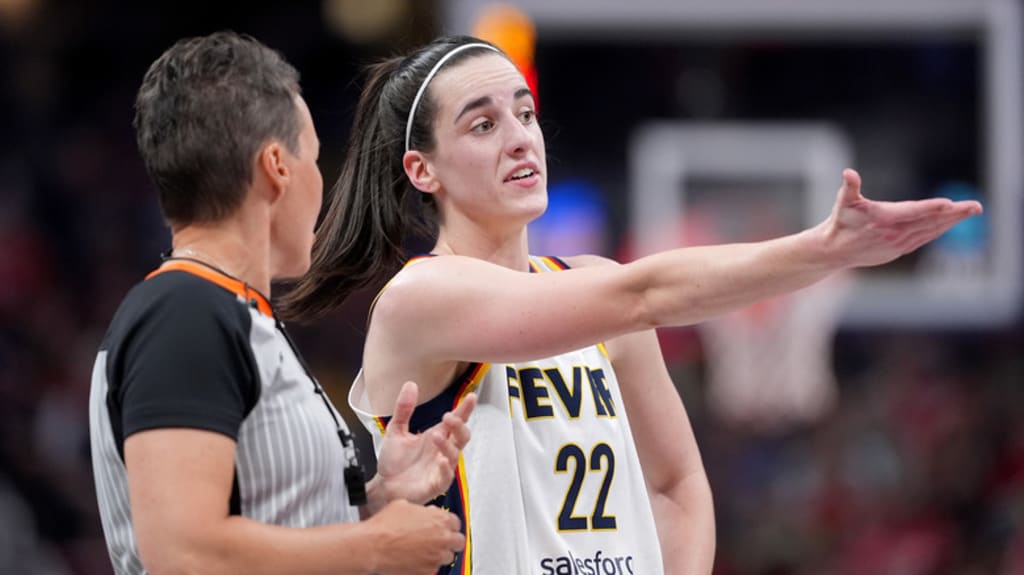
You know, I really feel sorry for Caitlin Clark.
I’ve never met her and probably never will. I have a rookie card I’d love her to sign someday, but this isn’t about trading cards or jerseys. It’s not an obsession.
It’s about watching a young woman get turned into a political pawn — Adam Silver himself called her a political “football” — not just for the WNBA, but for the whole country.
She never asked for any of it.
Caitlin didn’t come into the league to spark culture wars. She’s not an activist for either side. She’s a basketball player first and foremost — an incredibly gifted one. She’s not a symbol, other than someone who gives hope to young girls growing up in a world where excellence too often gets turned into a weapon, and where the very definition of what a woman is has been twisted so badly that clear role models are hard to find.
In a culture that politicizes everything, she just wants to play the game she loves. Yet her mere presence has stirred enough controversy that even the United States Congress feels compelled to get involved.
Why?
Why is there such intense dislike — even hatred, if we’re being honest — for this young woman who has stayed as neutral as a non-activist possibly can?
It’s not primarily about skin color or race, though that’s the narrative one side keeps pushing. Paige Bueckers is white too, yet she isn’t treated with anywhere near the same vitriol. This runs deeper.
It’s about representation.
Caitlin Clark has become a symbol of something many people desperately want to tear down: the last remaining image of pure, unapologetic Americana — the kind captured in that old 1975 Chevrolet commercial: baseball, hot dogs, apple pie, and Chevrolet. Except in this case, substitute basketball for baseball.
She plays the game with joy, works incredibly hard, and carries herself with class. And for some, that very normalcy is threatening.
Caitlin Clark is attempting to live out her version of the American Dream.
In a deeply divided culture, however, not everyone shares the same vision of that dream. For some, her success, her playing style, and her relatively apolitical approach represent values they seek to challenge rather than celebrate.
And that’s exactly why she sparks so much controversy. It’s not really her skill on the court, though plenty go out of their way to diminish everything she’s accomplished. Since she refuses to speak out on politics (where they could attack her directly), the only place left to hit her is on the floor.
Gone is the explosive Caitlin Clark who put the league on chartered flights and filled otherwise empty arenas, forcing teams to move games to larger venues to accommodate the new fans she brought. Now she’s being reduced to just another role player on a team that seems determined to treat her as nothing more than a woman who should know her place in a league that existed long before she arrived. Her stats don’t matter. She’s not gay, she’s not Black, and she doesn’t push the leftist agenda. Therefore, she won’t be allowed to play the game the way she does it best.
The bottom line is simple: Caitlin Clark won’t pander.
I’m sure she has political opinions. I’m sure she voted in the last election. We know where she stands on homosexuality — she’s straight.
If life would be so much easier for her — both on and off the court — why doesn’t she just give in to the pressure? Why not give a few speeches, hold a couple of press conferences promoting Black players and Black culture, and show public support for the LGBTQ community in the league?
Because she won’t. Period.
And for some, that’s the real crime — she won’t play along. Because of her reluctance to check certain ideological boxes, a standard 94-by-50-foot basketball court transforms into a 30-by-750-square-foot MMA octagon.
From her rookie season to today, Caitlin Clark has been on the receiving end of a disproportionate number of hard fouls, flagrant hits, and physical play. It’s not subtle. Watch the highlights or the game film — defenders close out aggressively, elbows fly, and bodies collide in ways that go beyond normal basketball contact. Some of it is the physical nature of the WNBA, but the volume and intensity directed at Clark stand out. She’s often left on the floor after plays that draw little more than a whistle (if any), while the league’s stars on other teams seem to get the benefit of the doubt — and the whistle — far more often.
In contrast, Dallas Wings guard Paige Bueckers, also a highly talented white player, has not faced anything close to the same level of physical targeting or off-court vitriol. The difference? Bueckers (who is gay and openly dating her teammate Azzi Fudd) has been far more willing to speak the language the league’s dominant voices want to hear — publicly aligning with Black culture, LGBTQ causes, and progressive narratives in ways Clark has not.
Clark has largely stayed neutral. She wants to play basketball. She hasn’t turned herself into a spokesperson for any particular identity group. And for that refusal to perform, she pays a visible price — on the court and in the court of public opinion.
Geno Auriemma, legendary coach of the University of Connecticut Huskies, called Clark a “generational talent,” but in a June 2024 interview during her rookie season with Dan Patrick, he said: “She’s just not built for the physicality of this league, and she’s not quick enough to get away from the physicality.” He also added, “There are players in that league that would love to kick her ass every minute of every day.”
Many current and former WNBA players, along with some analysts, seem to agree with Auriemma: Caitlin Clark isn’t built—physically—for the WNBA. She’s lean and wiry, six feet tall, with long arms and legs that give her excellent reach and vision on the court. Under normal circumstances, she’s more than capable of handling the league’s demands. But no one is built for the hip-checks, eye pokes, blindside hits, and fists to the throat she’s been dealing with.
During her rookie season, Clark drew 17% of all technical fouls in the league with no precedent for any other player, white or Black. Diana Taurasi faced the intense physicality and scrutiny common for rookies and young stars early in her career, yet she was among the first to criticize Clark rather than defend her. In a pointed moment, Taurasi said something along the lines of “reality is coming” when talking about Clark’s transition to the league.
Candace Parker also endured physical challenges and high expectations as a versatile star who broke molds in her own way. In contrast, players like Paige Bueckers and Olivia Miles have not faced the same level of physical targeting, a clear sign that the tectonic plates of our culture are shifting.
It’s about scale. Clark’s record-breaking popularity brought unprecedented attention — more fouls (called or missed), more intense media scrutiny, and louder off-court narratives. Social media and the explosion of sports podcasts have amplified the spotlight on players like Clark, and to a lesser extent Angel Reese and Paige Bueckers, in ways that veterans like Diana Taurasi and Candace Parker never experienced in their earlier careers.
Caitlin Clark’s impact on attendance and TV ratings has been massive and undeniable.
Before Clark (2023), the WNBA averaged around 7,000–8,000 fans per game. In her 2024 rookie season, league-wide attendance jumped nearly 50%. The Indiana Fever went from roughly 6,000 to over 17,000 per home game — a more than 300% increase. When Clark came to town, opposing teams often saw 80–100%+ spikes, with several games moved to larger NBA arenas to meet demand. On average, Clark games drew over 15,500 fans compared to about 7,600 for non-Clark games.
The TV numbers tell the same story. Pre-Clark regular-season games struggled to pull even low hundreds of thousands of viewers. With Clark, nationally televised games averaged 657,000 viewers — the highest in 24 years — while Fever games with her drew an average of 1.18 million, nearly triple non-Fever matchups. Multiple games topped 2 million viewers. Even in 2025, when she missed time, her return games still drove significant spikes, and the league has maintained much higher baselines than the pre-Clark era.
She didn’t just boost the numbers — she changed the spotlight in a way the league had never seen before. And the WNBA just wasn’t ready for Caitlin Clark, or the millions of blue-collar, everyday fans she brought with her. Millions of regular, conservative folks who suddenly started watching women’s basketball, because of Caitlin Clark.
I don’t think growth was ever the real priority for the league. They seemed more interested in staying in their own little isolated bubble — keeping things “inclusive” on their terms, with a definite left-leaning tilt.
The WNBA leans pretty heavily on the NBA for money and structure. The NBA owns somewhere between 42 and 60 percent of the league (depending on how you count overlapping team owners), and they’ve been pouring money into it since it started back in 1997. Even with the recent boom, the league has mostly run at a loss — tens of millions a year — and NBA owners have been the ones covering the gap.
Sure, they weren’t complaining about the money Clark brought in — that revenue wasn’t there before her. But instead of treating her with respect and welcoming her with open arms, they went full “One Tin Soldier” on her. You know the song… one tin soldier rides away.
Kelsey Plum and Sabrina Ionescu, both elite players in their own right, have faced criticism for refusing to take a public stance in support of the LGBTQ+ agenda. Like Clark, they didn’t come into the league for activism. They just wanted to play basketball. The message remains clear: silence and conformity are expected.
Many have said that Caitlin Clark is her own worst enemy. Her deep passion for the game — like an unwatched pot of boiling spaghetti — has caused her emotions to boil over, leading to visible frustration with other players and, especially, with the referees. Those on-court antics have already resulted in six technical fouls and an expected $1,000 fine. If she reaches eight, she’ll be suspended for a game.
In many cases, her frustration is warranted. Social media is filled with clips showing Clark being grabbed, checked, poked, and elbowed — often in plain view of the officials — with no call. She’s emotional. In short, she’s a woman.
On July 18, 2026, Clark drove for a layup while Breanna Stewart defended her. In full view of the referee — the same one who had already teched Clark earlier in the game — Stewart’s right hand came down, fingers pointed downward, and poked Clark near her eye. What should have been a flagrant-1 foul went uncalled. Clark was left visibly holding her left eye in pain.
It was highly reminiscent of her rookie season when the Fever faced the Connecticut Sun (then coached by Stephanie White, who now coaches Indiana). DiJonai Carrington poked Clark in the eye during that playoff series. The video clearly shows Carrington’s fingers pointed downward, landing near Clark’s eye. Intention was never proven, and Carrington insists it was accidental, but both Carrington and Stewart were looking straight at Clark when their fingers made contact — not at the ball.
Rumors, speculation, and conspiracy theories continue to swirl. Will Caitlin Clark walk away from the WNBA? Will she head to Europe, or simply leave the game she loves entirely?
It would be hard for her to do so. Clark has said she dreamed of playing in the WNBA since she was five or six years old. She grew up watching the league and idolizing players like Maya Moore. Despite the difficult terrain she must navigate, the game is in her blood. Walking away would mean abandoning a lifelong passion.
Perhaps you have heard of Pete “Pistol” Maravich. Some very interesting parallels can be drawn between Maravich and Clark. Maravich held the collegiate scoring title with 3,667 points for 53 years, until Caitlin Clark broke the record, scoring her 3,668th point on February 15, 2024, against Ohio State.
Like Maravich, Clark is one of the flashiest, highest-scoring guards in history. Like Maravich, Clark faces a ton of physical defense — lots of hacking, grabbing, rough play — because she is a scoring threat that plays with flair. Defenders tried to knock Maravich off his game, and like Clark, he dealt with injuries throughout his career. Like Clark, Maravich was criticized for his style of play, and like Clark, for not winning enough, despite putting up insane numbers.
Unlike Clark, Maravich didn’t have to deal with the added layer of cultural and political narratives that come with today’s spotlight. The NBA was still relatively young when he exploded onto the scene in 1970, but it was already established, making its own money and generating real revenue.
The WNBA, by contrast, has been around for 29 years and still hasn’t been able to fully wean itself off the NBA’s teat. Clark’s presence could help push the league beyond its current state and into something closer to what the NBA was becoming when Maravich entered it — bigger, more visible, and finally standing on its own.
How long will Caitlin Clark be willing to put up with the reality-show drama that is the WNBA?
She isn’t about drama — she just wants to play basketball. Like any true competitor, she wants to play it her way, and she has proven time and time again that her way is better. She is a natural leader who wants the ball in her hands with the game on the line.
She was born with a killer instinct that can’t be shut off. That’s not her fault, and out of her control.
The league will either accept her, or she will walk away — either by reluctant choice, or by injury, perhaps intentionally.
About the Creator
Mark Elliott
My name is Mark. I've been married going on 5 years now. We moved to Eastern Oregon. My wife is officially retired. I will be spending more time here now. Writing is hard with our schedule, but we make time for what we love!
Enjoyed the story? Support the Creator.
Subscribe for free to receive all their stories in your feed. You could also become a paid subscriber, letting them know you appreciate their work.
Comments
There are no comments for this story
Be the first to respond and start the conversation.