
After Midnight
How the U.S. Demanded Sovereignty, Canada Walked Away, and the Old Alliance Came Apart in a Hotel Room at 11:55 PM
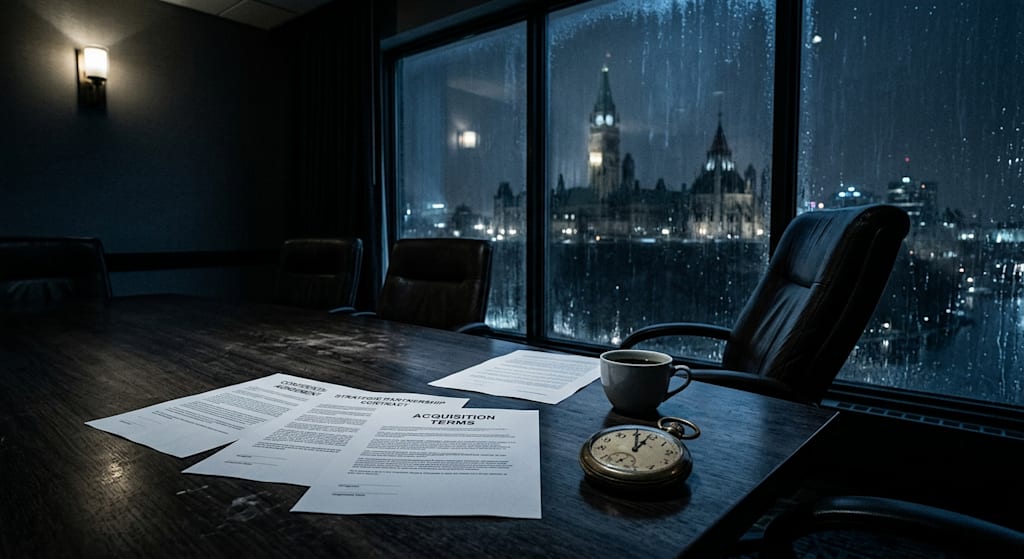
Ottawa, August 21, 23:45.
The Canadian negotiating team was still waiting in the hotel conference room. Three unsigned documents lay on the table. The coffee had gone cold.
What they received was an email from the U.S. side: no change to the position on the "U.S. content" clause. No revisions.
Ten minutes later, Prime Minister Carney called the lead negotiator.
"Come back."
At 23:55, the Prime Minister's Office issued a statement: Canada was suspending trade talks with the United States and recalling its negotiating team.
In Washington, U.S. Trade Representative Greer stepped in front of reporters four minutes earlier than his Canadian counterparts. He said: "Canada has refused to finalize a trade agreement. We offered significantly improved market access."
At the same hour, Reuters quoted an anonymous Canadian official: "What they call a new demand was a clause never mentioned when they first announced the tariffs on July 20."
Two timelines, two versions. The crack between them is where trust fell through.
July 20 to August 22: What happened in thirty‑two days
On July 20, Trump signed proclamations under Section 338 of the Smoot‑Hawley Tariff Act, imposing 50% tariffs on hundreds of Canadian goods—wine, hockey sticks, cement, among others. That Depression‑era statute authorizes the president to levy tariffs without investigation and without a sunset clause.
On August 18, Trump announced on social media a three‑day delay, claiming both sides had "reached a deal" and only the final paperwork remained.
On August 21, Greer said: "Canada refused to close."
At 00:01 on August 22, the 50% tariffs took effect.
In thirty‑two days, Washington's story changed three times: impose → delay → the other side refused. Not three versions of the same story—the same story retold at three different moments. After each retelling, the Canadian team had to ask themselves: who are they actually negotiating with? The man who signed the proclamation? The man who tweets? Or the man who speaks to the press?
A University of British Columbia professor wrote in a short essay: "The old Canada‑U.S. relationship is over. This is the end of a mode of engagement, not just a policy disagreement."
What was really at stake in the hotel room
Publicly, the sticking point was "U.S. content"—Washington demanded that a minimum share of components in Canadian‑made goods must originate from the United States to qualify for tariff relief.
But those familiar with the talks knew the fight went deeper. The U.S. proposals touched on ownership structures of Canadian critical minerals, pricing mechanisms for energy exports, and approval rights over foreign investment in core Canadian assets.
Canada's counter‑move: while negotiations were still ongoing, it advanced two domestic bills—creating a 25‑billion‑Canadian‑dollar sovereign wealth fund and tightening foreign‑investment screening in critical minerals.
Neither policy named any country when announced. But a report from the University of Toronto's Centre for Trade Law noted that the core logic of both measures was "preventing a single external country from gaining control over Canadian strategic resources through capital means." The footnote for "single external country" in that report pointed to Washington, not Beijing.
Canada was not willing to write its economic sovereignty into the fine print of a tariff waiver. Carney chose the tariffs. He kept the sovereignty.
Historical mirrors: when the negotiating table becomes a demand list
To understand why Canada walked away at the last minute, look at two precedents.
The first is Venezuela.
In 2024, the Maduro government tried to trade oil shipments for U.S. sanctions relief. The opening offer was 30 million barrels. Trump raised it to 50 million. Then to 100 million.
In June 2025, Trump said in a Dallas speech: "They really gave us a hundred million barrels." Laughter and applause from the audience. What he did not say: Venezuela is still under U.S. sanctions.
Later, Treasury Secretary Bessent proposed a new structure: Venezuela's oil export revenue would be deposited first with the U.S. Treasury; if Caracas needed funds, it would submit a spending plan for U.S. approval.
That was not a trade negotiation. That was trusteeship.
The second is Taiwan.
In the first half of 2025, Taiwanese negotiators went to Washington. The public agenda was "tariff relief." The first three days were indeed about tariffs. The next seven days turned into discussions of an "investment package."
The final commitment: cumulative investment in the United States of 500 billion U.S. dollars—250 billion in direct corporate investment, 250 billion in government‑backed loans. Along with the money went semiconductor production know‑how and technical personnel.
Moreover, this amount could not come from Taiwan's existing 300‑billion‑dollar foreign‑exchange reserves. It was an additional 500 billion dollars moved to the U.S.—800 billion total in real terms.
How much tariff relief did Taiwan get in return? No exact figure was made public. But a Taiwanese financial media outlet calculated: based on annual export value to the U.S., the total tariff reduction was roughly equivalent to 0.7% of the committed investment.
That was a trade: assets for tax rates.
What Venezuela and Taiwan share is that Washington's final ask always exceeds the opening offer. Even after the other side gives everything it can, the promised "sanctions relief" or "tariff reduction" may remain just words.
Canadians saw both examples. They knew that once they signed on the "U.S. content" clause, a new clause would be waiting at the next round.
Where the 50% tariffs land
The new tariffs cover roughly 20 billion dollars' worth of Canadian exports to the U.S.—about 5% of Canada's total exports to its southern neighbour. A Canadian Chamber of Commerce survey found that 40% of small exporters are already directly affected.
The president of the Canadian Steel Producers Association said: "A 50% tariff is effectively closing the border. This is no longer a trade friction—it is an economic blockade."
On employment, if the tariffs persist, Canada could lose roughly 90,000 jobs.
The U.S. also bears costs. An internal memo from the U.S. Chamber of Commerce warned that the move would raise household costs, disrupt North American supply chains, and jeopardise roughly 13 million U.S. jobs that depend on the CUSMA framework.
But the numbers are not symmetrical. Twenty billion dollars hits the U.S. economy far less than it hits Canada. Carney did not dodge that in his statement. He said: "Asymmetry is our objective reality—but it is not a reason to surrender our autonomy."
Canada's next move: not retaliation, but reorientation
The reciprocal tariffs Canada announced are, in absolute value, smaller than the U.S. measure. That was not a sign of weakness—it was a choice of battlefield.
Ottawa has set two public targets: attract 1 trillion Canadian dollars in domestic investment by 2030; and double non‑U.S. investment over the next decade.
That means accelerating the deeper implementation of the Canada‑EU Comprehensive Economic and Trade Agreement, expanding trade ties with Asia‑Pacific economies, and pouring tens of billions into domestic infrastructure to reduce reliance on U.S. supply chains.
Trade Minister Mary Ng's remark at a closed‑door meeting was later leaked to the media: "We need a real trade‑diversification strategy. We can't put all our eggs in one basket. That basket is cracked."
This is not a short‑term retaliation. It is a long‑term path shift. Once the path shifts, even if a future U.S.‑Canada deal is reached, supply chains and investment flows will not fully return to the old patterns.
Trust is not a water pipe you can turn on and off. Close it, then open it again—the water no longer flows in the same direction.
Ottawa, August 22, early morning
After Carney announced the suspension, a reporter asked: "Prime Minister, what about tomorrow?"
He paused for three seconds.
"Tomorrow is Monday."
That sentence answered nothing—but it answered more than any proper answer could: life goes on, work goes on, a country moves forward without a signed agreement.
The unsigned documents remained in the hotel room. The Canadian team left them behind when they departed.
About the Creator
Jin
Writer of reamstories
https://reamstories.com/jin
Enjoyed the story? Support the Creator.
Subscribe for free to receive all their stories in your feed. You could also become a paid subscriber, letting them know you appreciate their work.
Comments
There are no comments for this story
Be the first to respond and start the conversation.