
You're Using Options All Wrong
Buying options is gambling. Selling them is how you turn time into money. The strategy Buffett uses that nobody talks about.
I’ll never forget the first time I sold a put option. My hands were shaking over the keyboard. Literally shaking. I’d spent three weeks reading forum threads where every other post screamed about "blow‑ups" and "losing everything." One guy had written a step‑by‑step account of how he'd wiped out his entire account in a single week. I closed the browser, took a walk, and told myself I was an idiot for even considering this.
But here's the thing. Every month, like clockwork, my stock account receives a deposit. Sometimes it's three thousand yuan, sometimes seven or eight. It's not dividends. It's not me selling shares. Over the past three years, I've only been forced to actually buy stock once—on that terrifying panic day in October 2022 when everyone thought the world was ending. Every other month? The income just shows up.
During the sharp drop in 2024, while my friends were panic‑selling at the worst possible moments, my account received two separate deposits from the market in that same month. I didn't have to do anything special. I just repeated the same boring routine: sell put options on stocks I already wanted to own anyway.
It started five years ago, after I read two sentences in the Rich Dad series. I underlined them so hard I nearly tore the page. They didn't tell me to get rich quick. They told me something far more useful: that I could turn time itself into a paycheck.
Let me back up, because I know what you're thinking. Isn't options trading just gambling with extra steps?
I used to think that too. I searched "options" on every financial forum I could find, and the first words I always saw were "wipeout" and "blow‑up." And look, that picture isn't completely wrong. But I came to realise it only showed half the story—the buyer's side.
Buyers paid a premium for the right to bet on a direction. They were hoping the stock skyrocketed or crashed before expiration. High risk, high reward, but honestly? Low win rate. I tried buying options once. Just once. I lost 80% of my money in two weeks. Never again.
When I started selling, I discovered I was doing the opposite. I collected the premium upfront. I took on the obligation to buy at a fixed price. And here's the part that finally clicked for me: my profit didn't depend on guessing where the stock was going. It depended on something far more predictable. Time.
Rich Dad said something that stuck in my skull: "Collecting premiums from selling call options or put options is a primary way to generate income using time decay."
Not "trend forecasting." Not "reading charts." Time decay. That became my whole game.
I thought of it like this: buyers were lottery players spending two yuan on a one‑in‑a‑million shot. I was the lottery operator. I was selling the tickets. I was profiting from probability and the sheer math of the house edge. Once I saw that the law of large numbers was on my side, I realised the operator's business was way more stable than the gambler's.
Here's where it gets interesting—and this is the part that took me forever to really trust.
I learned that an option's price has two components. Intrinsic value was the easy one. If a stock traded at 100 yuan and I held a call with a strike of 90, that was 10 yuan of intrinsic value. I could exercise right then, buy at 90, sell at 100, pocket the difference.
Time value was sneakier. It was what the market paid for the chance that something good—or bad—might happen before expiration. The further out I went, the more uncertainty, the higher the time value. As expiration approached, that uncertainty evaporated. Time value didn't just decline; it crumbled. In the final 30 days, it dropped like an avalanche.
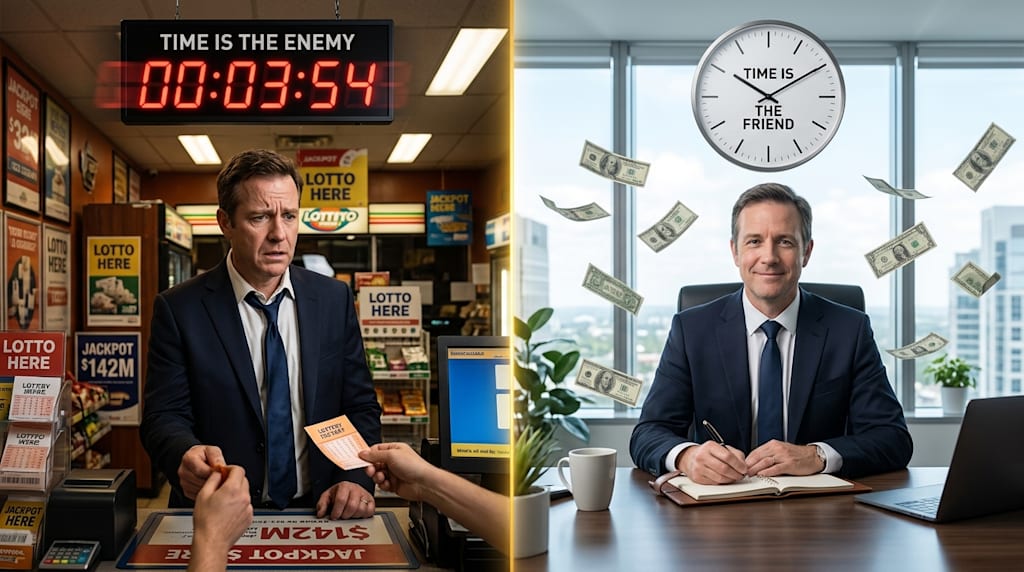
For buyers, that avalanche was a nightmare. Every day eroded their position. For me as a seller? Time became my best friend. I didn't have to do anything. My position gained value all by itself, day after day, as the clock ticked down.
Another line from Rich Dad hit me even harder: "What most captures my attention and excites me in the stock and options markets is that month after month, the opportunity to collect option premiums is always there."
"Month after month." That was the magic word for me. He wasn't excited about a one‑time windfall. He was excited about repeatability. Options expired every month. I sold again every month. I collected again every month. That recurring cash flow—that predictability—became exactly what financial freedom looked like to me. No dependence on market direction. No sleepless nights wondering if the Fed would hike rates.
Now, I know what the purists will say. Options are speculation. Value investing is about buying and holding. They're opposites.
But I've come to believe they're actually cousins. Maybe even siblings.
I had always believed value investing meant: buy when price is below intrinsic value, then wait for the market to catch up. Graham's famous line: "buy a dollar's worth for fifty cents." The problem I kept running into was that the market didn't always offer me that fifty‑cent dollar. A great company could stay overvalued for years. I sat on cash, watching inflation eat away at my purchasing power, while my target stock refused to drop to my price.
Sitting on cash was expensive. I learned that the hard way.
Selling put options filled that gap perfectly for me. I chose a company I genuinely believed in. I was willing to buy it at 100 yuan. The current price was 110, and I thought it was too expensive. So I sold a put option expiring in one month with a strike of 100, and I collected a premium.
Two things happened for me.
First: after a month, the stock was above 100. The option expired worthless. I kept the premium. The next month, I sold again. While I waited for my opportunity, the market paid me a waiting fee. I felt like I was being paid to stand in line.
Second: the stock fell below 100. I bought at the strike of 100. But because I already received the premium upfront, my actual cost was below 100. That was exactly the opportunity I'd been waiting for—buying a quality asset below my mental valuation.
Either way, I gained. I either pocketed free cash or got the stock at a discount. Rich Dad called it "having the market pay you to wait at the price you are willing to buy." That phrase alone was worth the price of the book.
Of course, when I started telling my investing buddies about this, they rolled their eyes. "That's not what Buffett does," one of them said.
Except, I discovered it actually was.
In 1993, Coca‑Cola shares were around $40. Buffett wanted to buy more, but his mental price was $35. Instead of just sitting around, he sold 5 million put options on Coca‑Cola at a strike of $35, expiring in December 1993.
What happened? Coca‑Cola never fell below $35. The options expired worthless. Buffett pocketed about $7.5 million in premiums. Just for waiting.
I looked this up myself in his shareholder letter. He later wrote that selling put options is essentially selling insurance. Insurers collect premiums and bear the risk of payouts. If the actuarial math is right, premiums become a steady profit source. He wasn't gambling. He was running an insurance company on the side.
And I also learned he'd sold massive put options on the S&P 500 with maturities of 15 to 20 years. His bet was simple: the U.S. economy wouldn't collapse in the long run, and the index would be above the strike price 15 years later. The probability was close to 100%, and the counterparties paid him enormous premiums upfront. That wasn't speculation; that was arbitrage on a near‑certainty.
I also read that Duan Yongping does the same thing with Apple and Alibaba. I read his interviews obsessively. His rule was identical to mine: sell only at the price you're willing to buy. Hold if assigned. Pocket the premium if not. Repeat.
When I saw these guys were doing it, I figured I was in good company.
Now, I'll admit, I had two mental blocks that almost stopped me from ever starting.
The first was the one everyone talked about: "selling options has unlimited risk."
Textbooks warned me that selling call options has theoretically unlimited risk—the stock can go to infinity. Selling puts has a finite maximum loss (the stock falls to zero), which is bad enough.
But I came to see that as pure theory. It completely ignored the most important anchor: the underlying asset.
I only sold puts on assets I was genuinely willing to own. If I got assigned, it wasn't a disaster for me. It was completing a transaction I already wanted, at a better price than I would have paid otherwise. The real risk wasn't in the option contract. The real risk was in how well I actually understood the company. If my judgment was "I will happily buy at this price," and the market gave me that price, I learned to be glad. Not scared.
The second block was the belief that I needed huge capital.
I'm not Buffett. I don't have billions. But I learned that one contract represents 100 shares. For a 100‑yuan stock, selling one put at a strike of 95 only required 9,500 yuan in my account as margin. That money was cash I was already planning to use for the purchase anyway. Now it earned returns just by sitting there.
The barrier wasn't money for me. It was whether I could assess a company's intrinsic value. And honestly? That turned out to be exactly the fundamental skill of value investing. If I couldn't do that, I realised I shouldn't be buying stocks either.
I'll be honest with you—I still get nervous sometimes. On expiry days, I still check my phone more often than I should. Old habits die hard.
But I've built a routine now. I pick companies I've followed for years. I sell puts at strikes I'd genuinely be happy with. I collect the premium. I wait. If the stock drops, I buy it at a discount. If it doesn't, I keep the cash and do it again next month.
Last month, I collected ¥680 from a single contract. It's not life‑changing money. But over a year, that's over eight thousand yuan—just for waiting. That's a new phone. That's a weekend trip. That's money I didn't have to trade my time for.
And that's the real lesson I took away, isn't it? Financial freedom didn't come from a single lucky break for me. It came from building a system where money worked for me. Selling options isn't the only piece of that system, but it's an elegant one. It turned waiting—that passive, frustrating condition—into an active income stream.
Time was always my enemy as an investor. Every day I sat on cash, I felt like I was losing. Now, time is my ally. Every day that passes brings me closer to the next premium.
That, I think, is exactly what Rich Dad wanted me to grasp.
About the Creator
Jin
Writer of reamstories
https://reamstories.com/jin
Enjoyed the story? Support the Creator.
Subscribe for free to receive all their stories in your feed. You could also become a paid subscriber, letting them know you appreciate their work.
Comments
There are no comments for this story
Be the first to respond and start the conversation.