
Why Spain Just Blocked Two of the World's Biggest Prediction Markets?
Spain's Ministry of Consumer Affairs ordered ISP-level blocks on Kalshi and Polymarket. Here's what happened, why it matters, and where this is all heading.

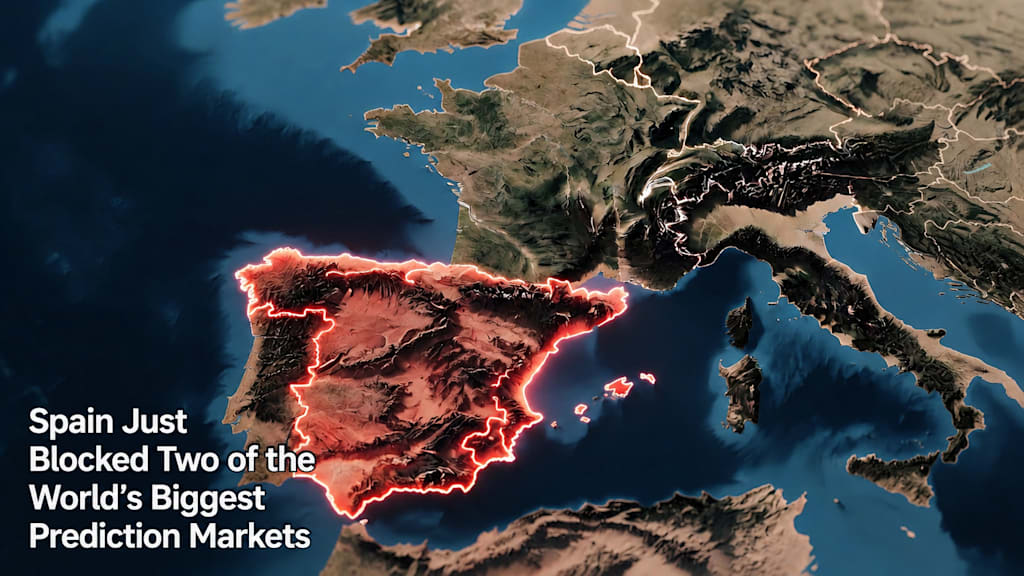
On May 26, Spanish traders opened their browsers and found Polymarket and Kalshi simply… gone. No warning, no transition period — just a government order and a loading screen.
It wasn't a glitch. Spain's Dirección General de Ordenación del Juego (DGOJ), the national gambling regulator operating under the Ministry of Consumer Affairs, had formally initiated disciplinary proceedings against both platforms and instructed internet service providers to block access within 7 to 10 days. Just like that, two of the most-used prediction market platforms in the world became inaccessible to an entire country.
For anyone watching the global regulatory landscape around prediction markets, this moment felt less like a surprise and more like an inevitability.
What Actually Happened in Spain
The mechanics of the Spanish crackdown are straightforward. The DGOJ published official notices in Spain's state gazette on May 26, mandating ISP-level blocks while opening a formal investigation expected to run three to four months. During that window, both Polymarket and Kalshi can respond to the allegations against them — but the blocks go up regardless.
The core allegation is simple: neither platform holds a gambling license under Spanish Law 13/2011, the national framework that governs all online wagering activity. Beyond the licensing gap, the regulator cited a lack of identity verification, insufficient mechanisms to prevent minors from accessing the platforms, and no self-exclusion tools for users who want to limit their own activity.
Sound familiar? These are almost word-for-word the same arguments U.S. state gaming regulators have used when challenging prediction markets domestically.
The Pattern That Should Worry the Industry
Here's what makes Spain significant: it isn't an isolated case. It's part of an accelerating global pattern.
A few weeks earlier, India moved against both platforms after issuing warnings that went largely ignored. Before that, Argentina ordered Google and Apple to remove Polymarket from their app stores entirely. Now Spain.
Each country has arrived at the same conclusion through slightly different reasoning, but the through-line is consistent — these platforms look like gambling operations to regulators, they are accessible to their citizens, and they are not paying into national licensing and tax frameworks that local gambling operators have long been required to operate within.
From the perspective of a Spanish regulator, this isn't complicated. Online gambling has been heavily regulated in Spain for over a decade. Established operators pay licensing fees, implement consumer protections, and contribute tax revenue. Polymarket and Kalshi walked into that same market without doing any of those things. The crackdown isn't just about protecting consumers — it's also about protecting a regulatory system that existing operators have invested heavily to comply with.
The Classification Problem at the Heart of Everything
The deeper issue — and the one that will define how this plays out globally — is a fundamental disagreement about what prediction markets actually are.
Platforms like Kalshi and Polymarket argue they are financial instruments. Users aren't gambling; they're trading contracts tied to real-world outcomes, not unlike options or futures. Under this framework, they should be regulated as financial products, not gaming products.
Regulators in Spain, India, Argentina, and several U.S. states see it differently. If you stake money on an uncertain future event and stand to win or lose based on the outcome, the substance of the activity is betting — regardless of how it's packaged or what you call the contracts.
Legal commentators have suggested that treating event contracts as financial derivatives could open a pathway for alternative regulatory models that might satisfy both sides. The CFTC in the United States has, at times, appeared open to this framing. But enforcement bodies at the state and international level have been far less flexible, insisting that consumer protections — age verification, self-exclusion, identity checks — are non-negotiable regardless of how the product is classified.
Until that classification question gets resolved in a durable way — either through litigation, legislation, or negotiation — this regulatory whack-a-mole will continue.
What This Means for Traders Right Now
For active users in Spain, the immediate impact is real. Positions held on both platforms don't simply pause when a country-level block goes up. Traders lose access to their dashboards, can't actively manage portfolios, and face uncertainty about how long restrictions will last.
Virtual private networks offer a technical workaround, but Spanish authorities have indicated that deliberately circumventing official blocks could carry its own legal exposure. It's a gray area, and not one most casual traders want to navigate.
The broader takeaway for the prediction market community is that geographic risk is now a live consideration. A platform that's accessible today may not be tomorrow, depending on where regulators decide to move next.
Where Does This End?
At some point, a workable framework will emerge. The demand for prediction markets is real, the platforms are sophisticated and well-capitalized, and there are clear models for regulated operation that exist in adjacent industries.
But that framework isn't here yet. For now, the industry is in a period of painful friction — country by country, regulator by regulator — as authorities worldwide decide how they want to treat this new category of financial product.
Spain is the latest chapter. It almost certainly won't be the last.
For the full regulatory breakdown, including details on the DGOJ proceedings, the specific violations cited, and how this compares to the India and Argentina bans, read the original report on Spain's Kalshi and Polymarket crackdown at PolyPunter.
About the Creator
Poly Punter
Poly Punter covers prediction market news, Polymarket trends, crypto forecasting, trader insights, and real-time event trading. We publish informative content about decentralised prediction markets and forecasting culture.
Enjoyed the story? Support the Creator.
Subscribe for free to receive all their stories in your feed.
Comments
There are no comments for this story
Be the first to respond and start the conversation.