
Why Leading Startups Are Building Their Own Crypto Wallets
Instead of Depending on Third Party Apps

In the world of digital money, crypto wallets play a key role. They help users store, send, and receive cryptocurrencies like Bitcoin and Ethereum.
Earlier, most startups used third party crypto wallet apps. These are readymade tools built by other companies. But now, many leading startups are choosing a different path.
They are building crypto wallets from scratch.
Why is this happening? What makes custom wallets better than readymade solutions?
In this blog, we will explain the main reasons in simple words and clear structure.
What Is a Crypto Wallet?
A crypto wallet is a digital tool that stores private keys. These keys allow users to access and manage their cryptocurrency.
There are two main types:
- Hot wallets: Connected to the internet (apps, web wallets)
- Cold wallets: Offline storage (hardware devices)
Wallets do not store coins directly. Instead, they store keys that give access to coins on the blockchain.
Why Startups Used Third Party Wallets Before
In the early days, startups preferred third party wallets because:
- They were fast to launch
- No need to build complex systems
- Lower development cost
- Easy integration with apps
Popular wallet providers handled security, updates, and blockchain connections. This helped startups focus on their main product.
But this convenience came with limitations.
Why Startups Are Building Their Own Crypto Wallets Instead of Third Party Apps
Today, the crypto space is more competitive. User expectations are higher. Security risks are also more serious.
Because of this, many startups now prefer to build their own wallets.
Let’s look at the main reasons behind this move.
1. Full Control Over User Experience
When startups use third party wallets, they depend on external design and features, but with a custom wallet, they can:
- Design the full user journey
- Control interface and features
- Add unique functions
- Match brand identity
This helps create a smooth and consistent experience for users.
2. Stronger Security Control
Security is one of the biggest concerns in crypto. With third party wallets, startups depend on another company’s security system. If that system fails, users may lose trust in the startup as well.
By building their own wallet, startups can:
- Set their own security rules
- Use custom encryption methods
- Control private key storage
- Reduce third party risks
This does not mean third party wallets are unsafe. But owning the system gives more control over risk management.
3. Better Brand Identity and Trust
In crypto, trust is very important. When users use a third party wallet, they often see another brand’s name and design. This can reduce brand visibility.
A custom wallet helps startups:
- Build stronger brand identity
- Keep users inside their ecosystem
- Increase customer loyalty
- Look more professional and reliable
Over time, this helps startups stand out in a crowded market.
4. Lower Long Term Costs
At first, third party wallets look cheaper. But they often come with ongoing fees. These may include:
- Transaction fees
- Integration costs
- Subscription charges
- Revenue sharing
As the user base grows, these costs can become very high. Building a wallet requires more effort upfront, but No dependency on external fees, Better cost control, and Scales better over time. So, many startups see it as a long term investment.
5. More Flexibility for Innovation
Crypto is growing quickly. New features appear often, such as:
- NFT support
- DeFi integrations
- Multi chain transactions
- In app staking and rewards
Third party wallets may not support new features quickly, but a custom wallet allows startups to:
- Add features faster
- Test new ideas
- Customize blockchain integrations
- Stay ahead of competitors
This flexibility is very important in fast moving markets.
6. Better Data Ownership
Data is valuable for improving products. When using third party wallets, startups often have limited access to user data. With their own wallet, they can:
- Track user behavior safely
- Improve product design
- Understand transaction patterns
- Build personalized features
This helps in making smarter business decisions.
7. Reduced Dependency on External Companies
Depending on third party tools always comes with risk. Problems may include:
- API downtime
- Policy changes
- Price increases
- Service shutdowns
If a wallet provider changes its system, the startup may need to rebuild parts of its app.
Owning the wallet removes this risk and gives full independence.
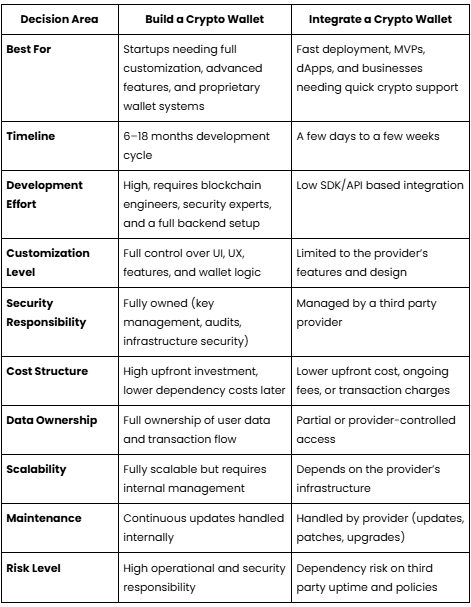
Build vs Integrate Crypto Wallet: Decision Framework for Startups
Conclusion
Leading startups are building their own crypto wallets because they want more control, better security, and stronger brand identity.
While third party wallets are still useful, they limit flexibility and long term growth.
A custom wallet gives startups the power to control user experience, improve security, reduce long term costs, innovate faster, and own their data.
In the competitive world of crypto, control and trust matter most. That is why building custom wallets is becoming the smarter choice for many growing startups.
About the Creator
Augustin
Sharing easy-to-follow content about trading platforms, trading tech, modern fintech and blockchain development.
Enjoyed the story? Support the Creator.
Subscribe for free to receive all their stories in your feed.
Comments
There are no comments for this story
Be the first to respond and start the conversation.