
Why Automated Trading Still Needs a Trading Journal
A practical look at why automated trading workflows still need execution history, logs, and reviewable records.
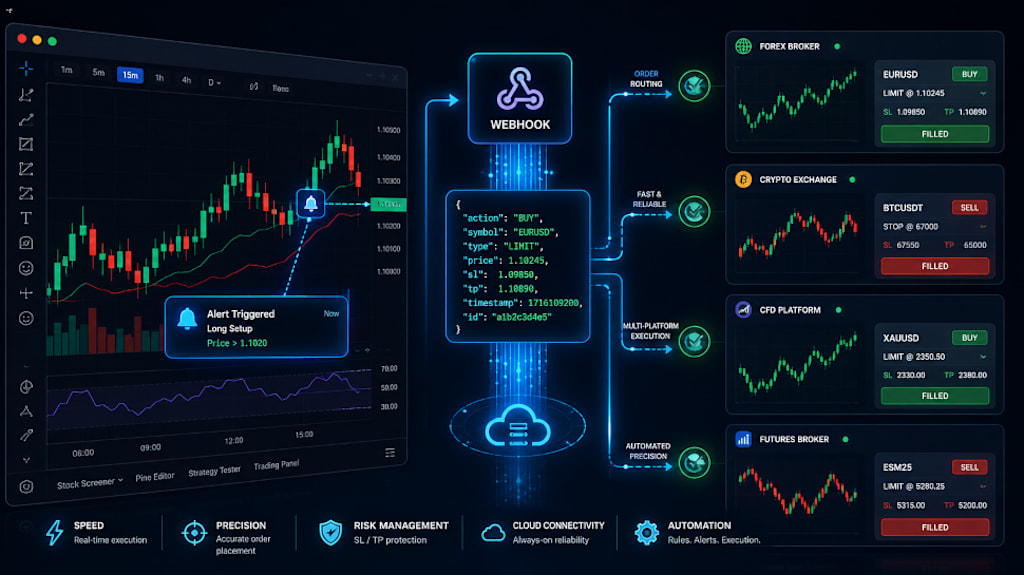
Why Automated Trading Still Needs a Trading Journal
Automated trading is often presented as a way to remove manual work from the trading process. A signal appears, an alert is sent, and an order can be placed without the trader copying every detail by hand.
That sounds simple, but it creates a new problem.
When execution becomes automated, the trader still needs a way to understand what happened. The signal may have been correct. The alert may have been delivered. The order may have been accepted. Or something may have failed in the middle of the workflow.
Without a trading journal or execution history, the trader only sees the final result. That is not enough.
A good trading workflow should make the process visible. It should show what signal arrived, what decision was made, what order was sent, and what happened after that.
Trading automation does not remove the need for review. It increases it.
Why execution history matters
Manual trading creates visible actions. A trader looks at the chart, reads the signal, opens an order ticket, enters the symbol, chooses the quantity, sets risk parameters, and confirms the trade.
In automated trading, many of those steps happen inside a system.
That can be useful, but it also means that errors may be less obvious.
A symbol may be rejected.
A quantity may be missing.
A stop loss value may be invalid.
An alert may arrive late.
A platform may return an error.
A trade may be routed differently than expected.
The trader needs a record of these events.
Execution history helps answer basic questions:
What triggered the trade?
Which symbol was used?
Which direction was sent?
Which quantity was selected?
Was the order accepted?
Was there an error?
Did the final trade match the original idea?
These questions matter for both discretionary traders and system-based traders.
Automation still needs accountability
A common mistake is thinking that automation makes the workflow self-explanatory. It does not.
A trading bot, webhook, alert system, or execution connector can act quickly, but speed does not explain quality.
A faster workflow can still make mistakes faster.
This is why the trader needs accountability inside the process. Execution records can show whether the system followed the intended logic. They can also show where a problem happened.
For example, a strategy may generate an alert correctly, but the final order may fail because the destination platform uses a different symbol format. Another setup may send the correct symbol but miss a required quantity field. A Telegram signal may be clear to a human, but too unstructured for software.
These are not strategy problems only. They are workflow problems.
A trading journal helps separate the trade idea from the execution process.
The role of logs in automated trading
Logs are the technical side of a trading journal.
A normal journal may record entry, exit, result, notes, screenshots, and trade review. Execution logs go deeper into the mechanics of the workflow.
Useful logs can show:
the received alert
the parsed message
the payload sent to the execution layer
the destination platform
the response from the platform
any error message
the time of each step
This helps the trader understand the real path from signal to execution.
Without logs, it is difficult to know whether a failed trade was caused by the strategy, the alert format, the symbol, the platform, or the connection.
With logs, each part of the workflow can be reviewed separately.
Why this matters for multi-source trading
Many traders do not rely on one source only.
They may use TradingView alerts for technical conditions, Telegram messages for external signals, manual webhook tests for checking setups, and different execution destinations for different markets.
As the workflow grows, the need for structure grows too.
One source may use EURUSD. Another platform may use EURUSD.r. A crypto exchange may use a different pair format. A futures platform may require another quantity model.
A journal can help the trader see whether these differences were handled correctly.
This becomes especially important when several strategies are active at the same time. Without execution history, it becomes difficult to know which strategy generated which action.
A journal does not only record results. It keeps the workflow understandable.
Reviewing automation as part of trading discipline
A trading journal is not only for emotional notes or screenshots. In automated trading, it becomes part of operational discipline.
The trader can review whether the automation followed the intended logic. The review can reveal repeated errors, unclear alerts, weak payload structures, symbol mapping problems, or platform-specific failures.
This kind of review is practical. It helps improve the workflow without changing the entire strategy.
Sometimes the strategy is not the problem. The issue may be the way the signal was sent, structured, routed, or logged.
A related article about trading journal dashboards and execution visibility is available here:
https://algoway.trade/blog/ironbot-trading-journal-dashboard.html
Final thought
Automated trading should not be a black box.
A signal starts the process, but execution history explains what really happened after the signal was sent.
Speed matters, but visibility matters more. A trader who can review the workflow can understand errors, improve the setup, and make better decisions about the automation process.
That is why automated trading still needs a trading journal.
About the Creator
Enjoyed the story? Support the Creator.
Subscribe for free to receive all their stories in your feed.
Comments
There are no comments for this story
Be the first to respond and start the conversation.