
What MemeCoin Prop Trading Taught Me About Discipline
Markets read emotion. Discipline is what holds it.


Meme coins are among the most volatile assets in any market. They can surge dramatically in hours and reverse just as fast. The hardest part isn’t spotting the move, it’s managing your own decisions under that pressure. Structured risk management is what separates traders who survive from those who don’t.
Memecoins Move Fast and Most Traders Lose it
Spotting a meme coin in motion isn’t the hard part, half of crypto Twitter sees the same green candle at the same time. The real challenge starts after entry, when the same volatility that pushed the price up becomes the force working against you.
Meme coins move on hype, community, and narrative, not earnings or fundamentals. That makes them unpredictable by design. In the fast paced world of memecoin prop trading, managing this unpredictability is everything, because the line between a community driven rally and a rug pull is thinner than most traders admit.
Meme Coins Don’t Punish Bad Analysis, They Punish Bad Risk
You can be completely right about a coin and still lose money, because being right about direction means nothing if your size is wrong and your exit is emotional. These markets are too volatile and too unpredictable to forgive loose risk management. A trader who DYORs, sizes sensibly, and trades wisely outlasts the one with the better “call” every time.
The Story You Tell Yourself After You Sold Too Late
Almost everyone who has traded a meme coin has the same memory. You were up. Then you were up a lot. Then you started doing the math on what you would buy, and somewhere in that daydream the candle turned red. You did not sell at the top because the top only exists in hindsight, and you did not sell on the way down because surely it would bounce.
That is not an analysis problem. The chart told you everything in real time. It is a decision problem, and meme coins are unpredictable enough that they punish indecision faster than almost any other market.
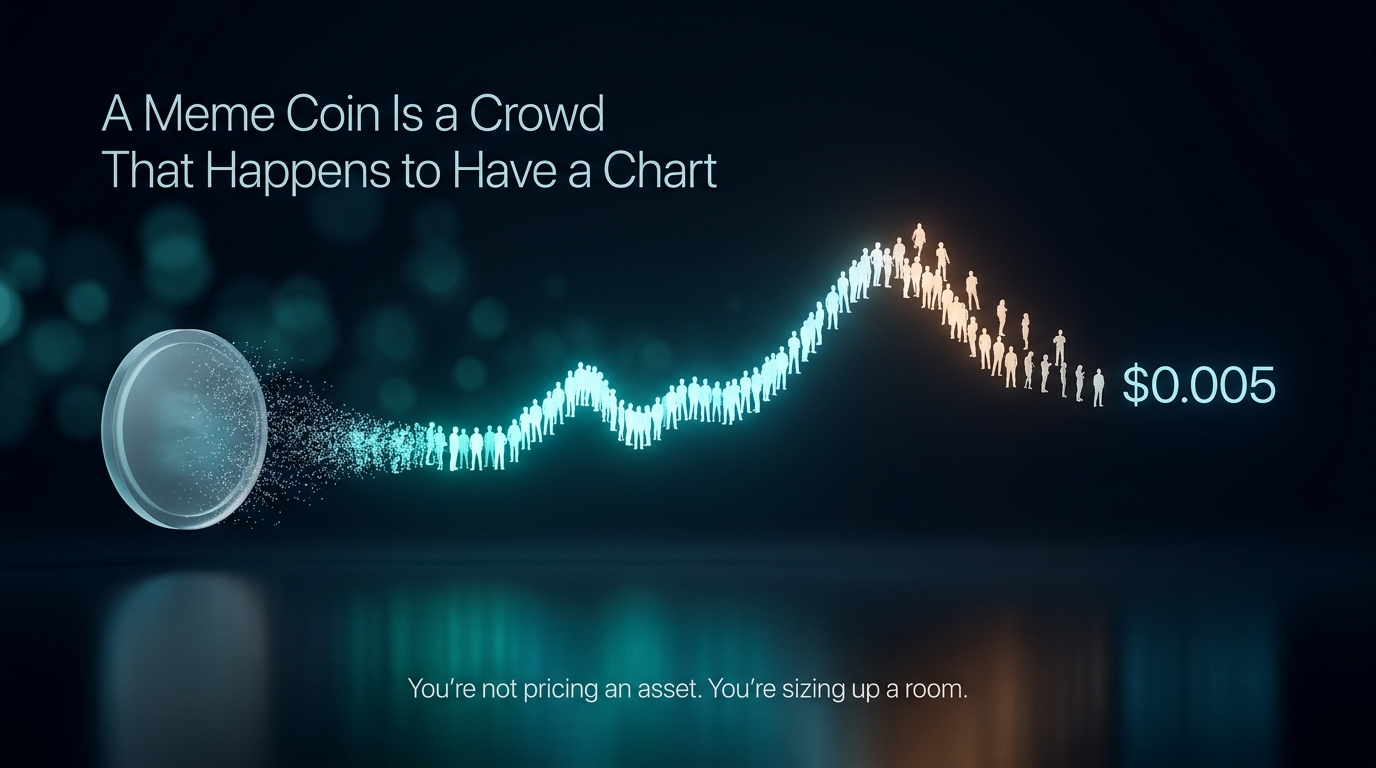
A Meme Coin Is a Crowd With a Ticker
A meme coin isn't really an asset in the way a stock or even a major cryptocurrency is. It's a crowd that happens to have a chart. Strip away the logo and the name, and what you're actually
trading is the size, mood, and conviction of the group standing behind it. There's no product roadmap doing the heavy lifting and no revenue to anchor a price. The token is just the place where collective attention becomes a number you can buy and sell.
That changes the question you're answering before every trade. With most assets you try to estimate worth. Here you're sizing up a room: how many people are watching, how committed they are, and how long they're likely to stay. The chart is downstream of that.
Once you see a meme coin as a crowd first and a token second, its behavior stops looking random and starts looking like exactly what it is, a group of people moving together in real time.
Narrative Moves Faster Than Fundamentals Here
If the crowd is the asset, then how fast that crowd forms is what sets the pace, and meme coins form crowds almost instantly. A single post, a clip, a coined phrase, and a token that nobody knew about an hour ago is suddenly the only thing a corner of the internet is talking about. There's no quarterly report, no adoption curve, no slow build. The story arrives fully formed and the price tries to catch up to it in minutes.
This is why traditional analysis tends to show up late here. By the time you've finished checking the on-chain data and the holder distribution, the narrative has already done its work and the move is either underway or over.
It isn't that the numbers are worthless, it's that they operate on a slower clock than the story does. The skill isn't reacting to a narrative once it's confirmed. It's reading which story is about to spread while it's still small enough to enter cleanly.
Liquidity Magnets, Culture, and the Engine Behind the Volatility
Attention does more than push the price up. It physically drags liquidity toward the token, and that's the part that makes the swings so violent. When a meme coin trends, capital floods into a pool that may have been thin and shallow just hours earlier. Suddenly there's depth, there's volume, and entering or exiting feels effortless.
The token has become a magnet, and the culture forming around it, the inside jokes, the shared identity, the sense of being early, is what keeps the magnet switched on.
The problem is that this liquidity is borrowed, not built. It belongs to the crowd's interest, not to the token, so it leaves the moment attention shifts elsewhere. A pool that absorbed large buys without flinching can turn paper-thin in a single session, and the same depth that made entries painless now turns exits into slippage and cascading liquidations.
Understanding this is the difference between treating volatility as a surprise and treating it as the predictable cost of trading on liquidity that can pack up and leave as fast as it arrived.
Why Your Own Money Is the Worst Money to Trade Memes With
The size of your account matters less than whose money is in it. Trade meme coins with your own savings and every candle feels personal. Trade them through funded capital and the same chart becomes a problem to solve, not a threat to survive. Here’s why that shift changes everything.
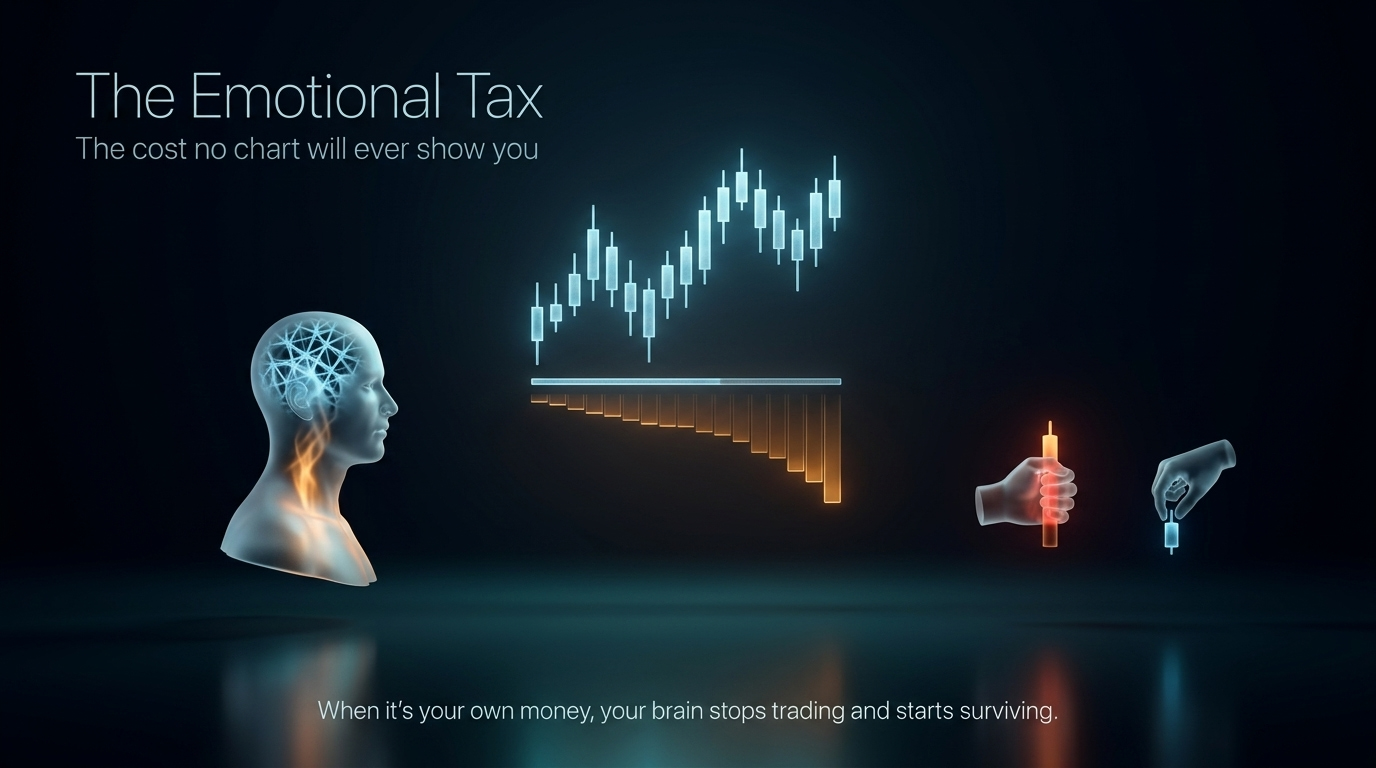
The Emotional Tax of Risking Your Savings
There’s a hidden cost that never shows up on any chart: the emotional tax you pay when the money on the line is your own. With meme coins, that tax is brutal. A token can rip 40% in an hour and bleed it all back before you’ve finished celebrating. When those swings are happening to your savings, your brain stops trading and starts surviving.
You hold the loser too long because closing it makes the loss feel real. You dump the winner too early because protecting a small gain feels safer than trusting the plan. Neither decision comes from strategy. They come from fear, and fear is expensive. Over enough trades, that emotional tax quietly eats more of your account than slippage or fees ever will.
How Risk Structure Quietly Changes Your Decisions
Swap your savings for firm backed capital and the noise in your head gets quieter. The same 40% candle still flashes across the screen, but it no longer threatens your rent. That single shift changes how you decide. You start reading the setup instead of bracing for impact.
That’s what defined risk structure does. Predefined limits, clear rules, and a hard ceiling on what any single trade can cost. In a market built on impulse, structure does the thinking your emotions can’t. The difference between a trader who survives volatility and one who doesn’t usually isn’t analysis, it’s whether they had boundaries in place before the move happened.

Reading the Meme Coin Map Before You Pick One
Before you risk a single dollar, it helps to know that not all meme coins are the same animal. They look alike on a chart, a candle is a candle, but the crowd behind each one behaves differently. Some carry years of internet history. Some were born on a fast chain last Tuesday. Some don’t even have a name yet, just a wallet and a whisper.
Reading this map won’t tell you what to buy. It tells you what kind of crowd you’re standing in, and that’s the part that decides how fast the ground can move under you.
Think of the map in two broad regions. On one side: the established names, coins that already survived at least one cycle and carry a recognizable identity. On the other: the frontier, coins still forming their crowd in real time. Both can run. They just fail in completely different ways. Knowing which region you’re in changes how you size, how long you hold, and how quickly you walk away.
From OG Numeric Memes to Solana Speedsters
The older end of the map is where the legacy memes live. These are the assets with number-heavy branding and a long internet backstory, the ones that have been passed around forums and group chats long enough to feel like furniture. Their crowds are slower to assemble and slower to leave, which can make the moves feel more deliberate.
That’s not safety, it’s just a different rhythm. A coin with history still trades on attention, it just has a larger, more patient audience holding the floor.
Then there’s the fast end, the Solana speedsters. These coins live on chains built for speed and near-zero friction, where a joke can mint, list, and trend before lunch. The crowd here moves at the speed of the feed. Entry is easy, exit is easy, and that ease is exactly the trap.
When everyone can get in and out in seconds, liquidity arrives in a flood and drains in a flush. You’re not trading a slow build of conviction, you’re trading the half-life of a meme. If you treat a speedster like an OG name and try to hold through it, you’re holding a crowd that has already left the room.
Emerging Gems and the Coins Nobody’s Named Yet
The frontier is the loudest and the loneliest part of the map. Emerging coins, the so-called niche gems, are the ones still recruiting their crowd. Some are concept-driven, built around a single gimmick or an experimental origin story. Some are pure novelty, riding whatever the timeline found funny that morning.
The upside story writes itself, you got in before the crowd. The problem is that before the crowd and no crowd look identical until the chart proves which one you were in. And past that edge are the coins nobody’s named yet, the ones with a contract address and almost nothing else.
There’s no community, no liquidity floor, no second buyer guaranteed. The entire thesis is that a crowd will show up. Sometimes it does, and the screenshots are unforgettable. Far more often the crowd never forms, and the position you opened becomes a position you can’t close. This is the part of the map where the gap between early and alone is the widest, and it’s exactly where a trader running personal capital tends to bet the most and think the least.
That’s the real value of the map. It doesn’t pick the winner for you. It tells you how much crowd is actually under your feet, so you can size the risk to the region instead of the dream.
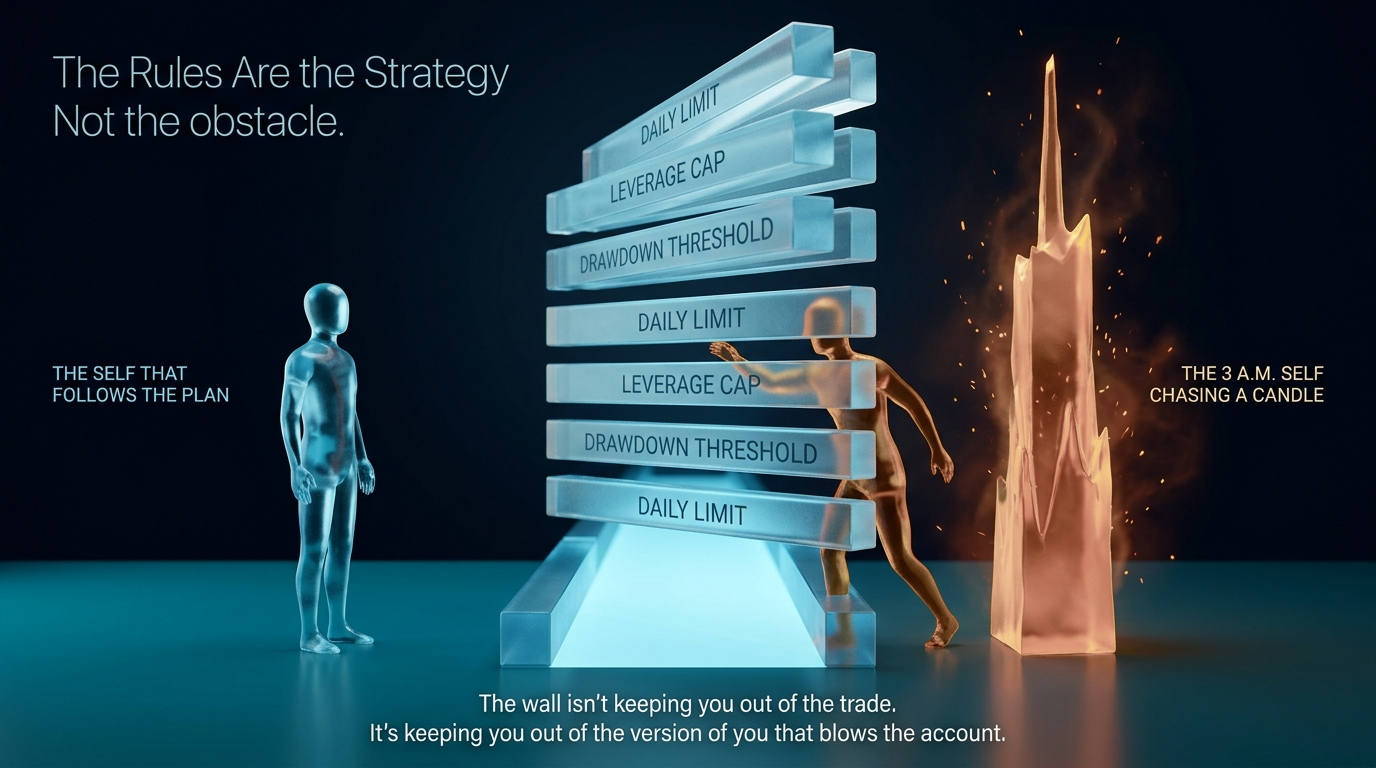
The Rules Are the Strategy, Not the Obstacle
Most traders read a funded account’s rulebook the way they read a terms of service page, fast, annoyed, looking for the exit. Daily limits, leverage caps, drawdown thresholds. It all feels like a fence built to keep you from the good part.
But in a market that moves at meme speed, the fence isn’t keeping you out of the trade. It’s keeping you out of the version of yourself that blows the account at 3 a.m. chasing a candle. The rules aren’t the obstacle between you and the strategy. On a meme coin, they are the strategy.
Here’s the part nobody likes to hear. The reason these rules exist isn’t that the firm doubts you. It’s that they’ve watched thousands of accounts die the exact same way, and almost none of them died from a bad entry. They died from a good entry held too long, sized too big, defended too stubbornly. The rulebook is just that pattern, written down and turned into a wall before you can walk through it.
Why Daily Drawdown Limits Save You From Yourself
A daily drawdown limit is a number that says you’re done for today before you get the chance to say just one more. On a normal asset, that ceiling feels conservative. On a meme coin, it’s a seatbelt, and you only notice it the moment everything stops.
Picture the worst version of the day. You’re up early, you give some back, you tell yourself you’ll make it up. The chart’s still moving, so you size up to recover faster. That’s the loop, the loss that funds the next loss, the trade you take to fix the trade you shouldn’t have taken.
With your own money there’s nothing standing between you and the bottom of that loop except willpower, and willpower is the first thing volatility burns through. The daily limit removes the question entirely. You don’t have to find the discipline to stop, because the floor finds it for you.
It turns “I’ll quit when I feel like it” into “I’m done at this number,” and on a meme coin that swap is the difference between a bad day and a closed account.
The traders who hate this limit the most are usually the ones who needed it the most. The ones who respect it learn something strange. When you know exactly how much you can lose before lunch, you stop trading scared. You take cleaner setups because you’re not trying to claw anything back. The cap that felt like a leash turns out to be the thing that lets you breathe.
Controlled Leverage in a Market That Moves in Seconds
Leverage is a magnifier, and a meme coin is already the loudest thing on the screen. Point a magnifier at something moving in slow motion and you get detail. Point it at something moving in seconds and you get whiplash.
That’s why a funded account’s leverage cap matters more here than almost anywhere else, because the asset is already supplying all the speed you can handle.
The fantasy is that more leverage means more upside. The reality is that more leverage means less time. Every multiple you add shrinks the distance between your entry and your liquidation, and on a meme coin that distance can vanish inside a single wick.
You can be completely right about direction and still get knocked out by the noise on the way there, stopped out at the bottom of a move that finishes exactly where you thought it would. Controlled leverage doesn’t make you smaller. It keeps you in the seat long enough for the trade to actually be the trade you saw.
So when the cap feels low, ask what it’s protecting. It isn’t capping your conviction. It’s capping the speed at which a single second can end you. On a chart that can move 40 percent before you’ve finished reading this sentence, a leverage limit isn’t a restriction on the strategy. It’s the only reason the strategy survives contact with the market.
Trading Volatile Meme Coins Without Getting Wrecked
By now the setup is in place. You understand what a meme coin actually is, why funded capital changes how you think, and why the rulebook is working for you instead of against you. What’s left is the part that doesn’t fit in a rule or a metric, the part that decides whether you survive the market or get spit out by it.
Trading volatile meme coins without getting wrecked isn’t about predicting the next pump. It’s about being the kind of trader who’s still standing when the pump arrives.
The traders who last don’t have a secret indicator. They have a relationship with chaos. They’ve made peace with the fact that the chart will lie to them, that the crowd will turn on a dime, and that being early and being wrong look identical until they don’t. Everything that follows is just two halves of that relationship, what you do before the trade, and who you are during it.
DYOR Isn’t a Slogan, It’s Your Edge
Do your own research gets thrown around so often it’s lost its weight. It’s printed on every chart, dropped under every post, repeated until it sounds like a disclaimer instead of advice.
But on a meme coin, research is the one thing the crowd actually skips, and that’s exactly why it’s an edge. When everyone is buying because everyone is buying, the person who looked closer is the only one trading on something real.
Research on a meme coin doesn’t look like research on a company. There’s no earnings report to read, no balance sheet to dig through. What you’re actually studying is the crowd. Who holds this, and how many of them hold most of it. Where the liquidity sits and how fast it can leave.
Whether the story behind the coin has legs or just a loud first day. You’re not trying to find a fair value, because there isn’t one. You’re trying to find the moment the narrative is real before it’s obvious, and the moment it’s hollow before it collapses.
That’s the difference between gambling and trading the same chart. The gambler sees a green candle and feels something. The trader sees the same candle and asks why, who’s behind it, and how long it can last. Same screen, different game. DYOR isn’t the thing you say to cover yourself after a bad call.
It’s the work that makes the good calls possible, and on a meme coin it’s the only edge the crowd hands you for free.
The Professional Mindset That Outlasts the Hype
Hype has a shelf life. Every meme coin that ever ran eventually stopped running, and the traders who got hurt weren’t the ones who missed the move. They were the ones who couldn’t tell the difference between a trade and a feeling.
The professional mindset isn’t about being emotionless. It’s about not letting the emotion hold the steering wheel.
Here’s what that actually looks like. You size the position before you’re in it, not after the price proves you right. You decide where you’re wrong before you have a reason to argue with yourself. You take profit on a plan instead of on a heartbeat, because the crowd that carried you up is the same crowd that will leave without telling you.
Most of all, you treat every trade as one of the next thousand, not the one that has to work. The amateur needs this trade. The professional just needs to still be here tomorrow.
This is where a defined risk structure quietly does its best work. The rules give you the floor, but the mindset is what fills the space above it. The drawdown limit stops the worst day, and the discipline makes sure most days never get close.
Put them together and the volatility stops being a threat. It becomes the thing you get paid to navigate, the reason the opportunity exists at all. The hype will always come and go. The trader who built a process underneath it is the one who’s still trading when the next coin nobody’s named yet starts to move.
This article is for educational purposes only and does not constitute financial advice. Cryptocurrency trading, including meme coins, involves significant risk. Never trade with money you cannot afford to lose.
About the Creator
Sophie
Trader focused on Price Action & Order Flow.
Into crypto, fast execution, controlled risk, and quality setups.
Passing funded accounts and refining my trading every day.
Enjoyed the story? Support the Creator.
Subscribe for free to receive all their stories in your feed.
Comments