
What I Learned Trading Crypto Perpetual Futures with a Crypto Prop Firm
What Funded Perpetual Futures Trading Actually Means

If someone had asked me a few years ago what was holding back my trading performance, I would have blamed my strategy.
Like many retail traders, I spent more time searching for better entries than improving my risk management. Every losing streak sent me looking for another indicator, another trading system, or another YouTube video promising higher win rates. I assumed consistency would come from finding the "perfect" strategy.
I was wrong.
The biggest improvement in my trading didn't come from changing my strategy. It came from changing the environment I traded in.
After moving from a personal account to a crypto prop firm, I realised that trading with funded capital forces you to think differently. Daily loss limits, maximum drawdown rules, profit targets, and evaluation requirements create a level of discipline that simply doesn't exist when you're trading only your own account.
That doesn't mean prop trading is easier.
In many ways, it is harder. The rules are strict, mistakes are punished quickly, and emotional decision-making becomes obvious almost immediately. But that structure also helped me identify weaknesses in my trading that I had ignored for years.
This article combines my own experience trading crypto perpetual futures with an explanation of how modern crypto prop firms operate. I'll explain what changed after switching to funded trading, how perpetual futures fit into the prop firm model, the mistakes I made during evaluations, and the criteria I now use when choosing a crypto prop firm.
Looking back on my experience, here is what I’ve learned about perpetual contracts, funding rates, and passing the evaluation challenge. Let's see exactly how drawdown rules, profit splits, and crypto native versus CFD firms actually work.
Disclaimer: This article is based on my personal trading journey and is for educational purposes only. It does not constitute financial advice. Trading cryptocurrency and perpetual futures involves significant risk.
What Funded Perpetual Futures Trading Actually Means
If you've spent any time in the crypto markets, you already know the psychological pressure that comes with risking your own savings. Watching a single volatile Bitcoin candle wipe out a week's worth of gains isn't just stressful, it leads to emotional decisions, over leveraging, and revenge trading
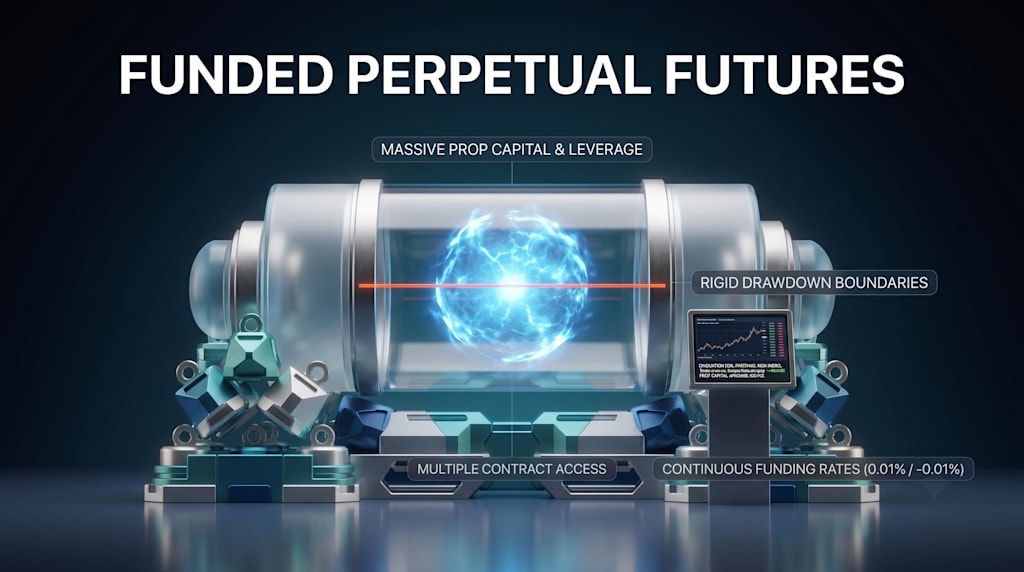
That was my reality for years as a retail trader: carrying 100% of the financial risk on my own. But switching from my own capital to a funded account was a total game changer. Crypto prop firms offer a structured alternative: you trade their capital while following strict risk management rules.
Here is how the dynamic works in practice:
Capital Access: You gain exposure to larger trading accounts without putting your personal net worth on the line.
Shared Downside: The firm absorbs market losses beyond your initial evaluation fee, provided you stay within their risk parameters.
Risk Discipline: Instead of guessing position sizes, you are forced to operate within rigid drawdown and daily loss limits.Why Traders Move From Personal Accounts to Prop Capital
Why Traders Move From Personal Accounts to Prop Capital
For a long time, I thought the ultimate goal of trading was simply finding the perfect strategy. But as anyone who’s made the switch to prop trading will tell you, long term success comes down to consistency, tight risk control, and a clear, structured framework.
When you're trading a small personal account, the temptation to over leverage just to see meaningful profits is massive. Retail traders are constantly fighting their own account size.
With prop capital, instead of stressing over every dollar, you get access to much larger allocations, allowing you to focus strictly on execution and risk management. The real appeal isn't just the larger capital, it's the built in discipline that keeps emotional trading and reckless leverage in check.
The Core Trade-Off
The promise of a prop firm is attractive: pass an evaluation, get funded, and keep a major percentage of the profits while the firm absorbs the heavy downside.
However, there is a strict catch. You don't get capital without strings attached. To protect their funds, firms enforce rigid risk parameters, such as maximum daily drawdowns and strict consistency rules. If you break the rules, even with a profitable strategy, you lose the account.
How Crypto Prop Firms Work
Understanding how these programs actually work under the hood is key to picking the right model for your trading style. At the end of the day, the biggest benefit isn't just the capital, it's the built-in discipline that forces you to become a better trader.
The Business Model Behind Funded Accounts
So how do these companies actually make money if they are handing out capital?
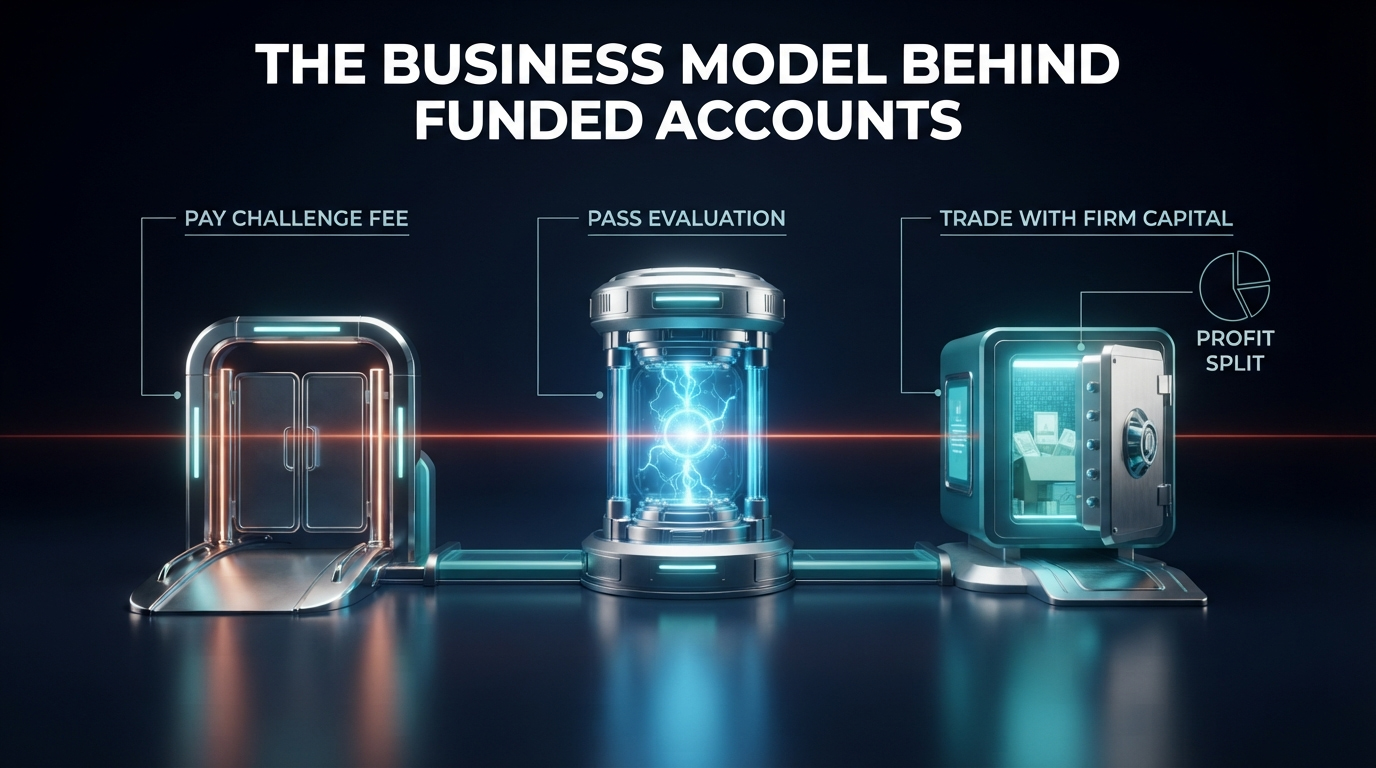
The business model is quite straightforward. Instead of you depositing your own money to trade with, you pay an upfront fee to enter a challenge. If you successfully complete their evaluation process, the firm grants you access to a funded crypto account.
From there, you trade using the firm's money and share a percentage of the profits you generate. Prop firms build their revenue primarily through those initial challenge fees, the actual trading performance of their funded traders, and highly controlled risk allocation models.
This setup allows skilled traders to scale their strategies while capping their downside strictly to the initial evaluation fee.
The Growth of Crypto Prop Trading
The recent explosion of crypto prop trading didn't happen by accident. As perpetual futures became globally accessible and deeply liquid, demand for funded programs skyrocketed. The massive growth of top tier centralized exchanges poured gasoline on the fire, accelerating the need for trading environments with fast execution, flexible leverage, and minimal personal capital requirements.
The industry has matured quickly. We're seeing a clear shift away from legacy CFD-based setups toward institutional grade infrastructure. Today, leading crypto native prop firms are doubling down on direct exchange liquidity and native charting software integrations to give traders a seamless, real market experience.

Personal Trading vs Prop Trading
When you trade as a retail trader, you are entirely on your own. Every single decision you make is tied directly to your personal bank account. This setup naturally introduces a lot of emotional friction because absorbing 100% of the risk individually can make you hesitate during critical entries or cut your winning trades way too early.
Prop trading flips this dynamic on its head. You step away from the solo retail grind and step into a system designed around professional backing and structural support.
What Changes When It’s Not Your Money
The psychological shift that happens when you move from personal capital to a funded account is massive. When it is your own hard earned money on the line, a string of losses can feel like a personal crisis. This stress often leads to revenge trading, over leveraging, and breaking your own strategy out of panic.
When you are trading with firm capital, the emotional weight changes. You no longer have to worry about your personal savings taking a hit during a market drawdown. This cushion allows you to look at the charts with much more clarity and execute your setups with cold objectivity.
However, it also requires a deep level of professional respect. Just because it is not your money does not mean you can treat it carelessly. In fact, the firm's tracking systems ensure that you are held to a much higher standard of accountability than you ever would be on a personal retail account.
The Trade-Off: Bigger Capital, Stricter Rules
This brings us to the ultimate trade off of the prop trading world. On one hand, you get access to significantly larger capital allocations and highly scalable payout systems that can turn a skilled trader into a high earning professional. You get to trade deep liquidity and use leverage efficiently without needing a massive personal net worth.
But you do not get that capital for free. The trade off for that massive buying power is a set of incredibly strict risk management rules. In your personal account, if you want to risk 20% on a single trade, nobody is going to stop you.
In a funded account, doing that will instantly breach your maximum drawdown limits or daily loss restrictions, resulting in immediate account termination. You must also manage consistency requirements and strict profit targets. It is a beautiful compromise. You get the capital you need to scale, but you must surrender total trading anarchy and operate like a disciplined professional.
Understanding Perpetual Futures
Before diving into the mechanics of how these firms back their traders, we need to examine the specific financial instrument that makes this entire ecosystem possible.
What Are Funded Perpetual Futures?
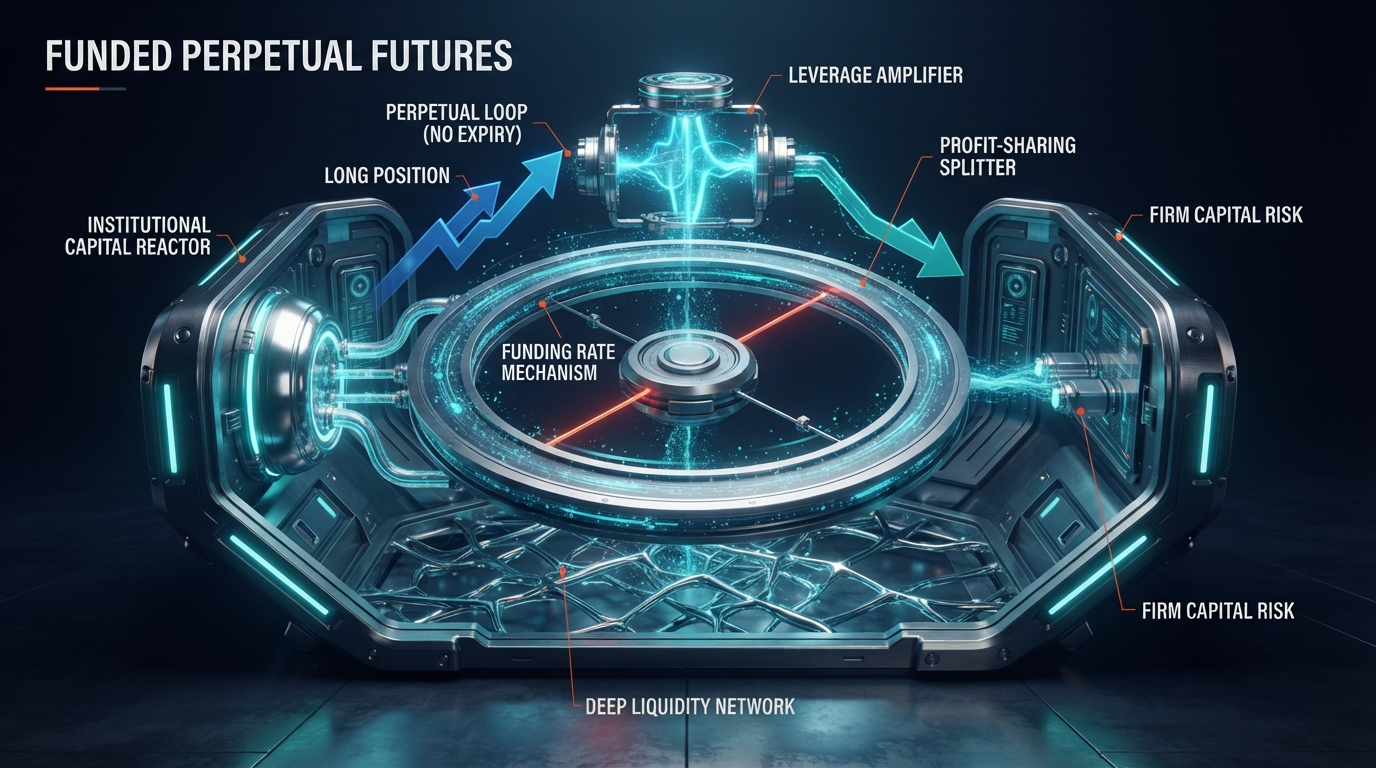
Funded perpetual futures are cryptocurrency derivative contracts traded using capital provided by a proprietary firm rather than personal funds. These contracts lack an expiration date and rely on a funding rate mechanism to stay aligned with spot market prices. Traders execute leveraged positions under strict firm guidelines and share generated profits while the firm absorbs the primary financial risk.
To really grasp why these firms operate the way they do, you need to understand the instrument they rely on most heavily. Perpetual futures have completely taken over as the dominant trading instrument in the modern crypto prop firm space.
Unlike traditional spot trading, these contracts give us the ability to use leverage, take both long and short positions, and navigate highly volatile markets with incredible efficiency. They are the lifeblood of funded trading programs because they provide deep liquidity and continuous market access.
Contracts Without an Expiry Date
At their most basic level, perpetual futures are cryptocurrency derivative contracts that track the price of an underlying asset. The defining feature here is right in the name. They are perpetual, meaning they do not have an expiration date. As long as you maintain the necessary margin requirements in your account, you can keep a position open indefinitely. This gives traders massive flexibility compared to being forced out of a trade because of an arbitrary calendar date.
How Perpetuals Differ From Traditional Futures
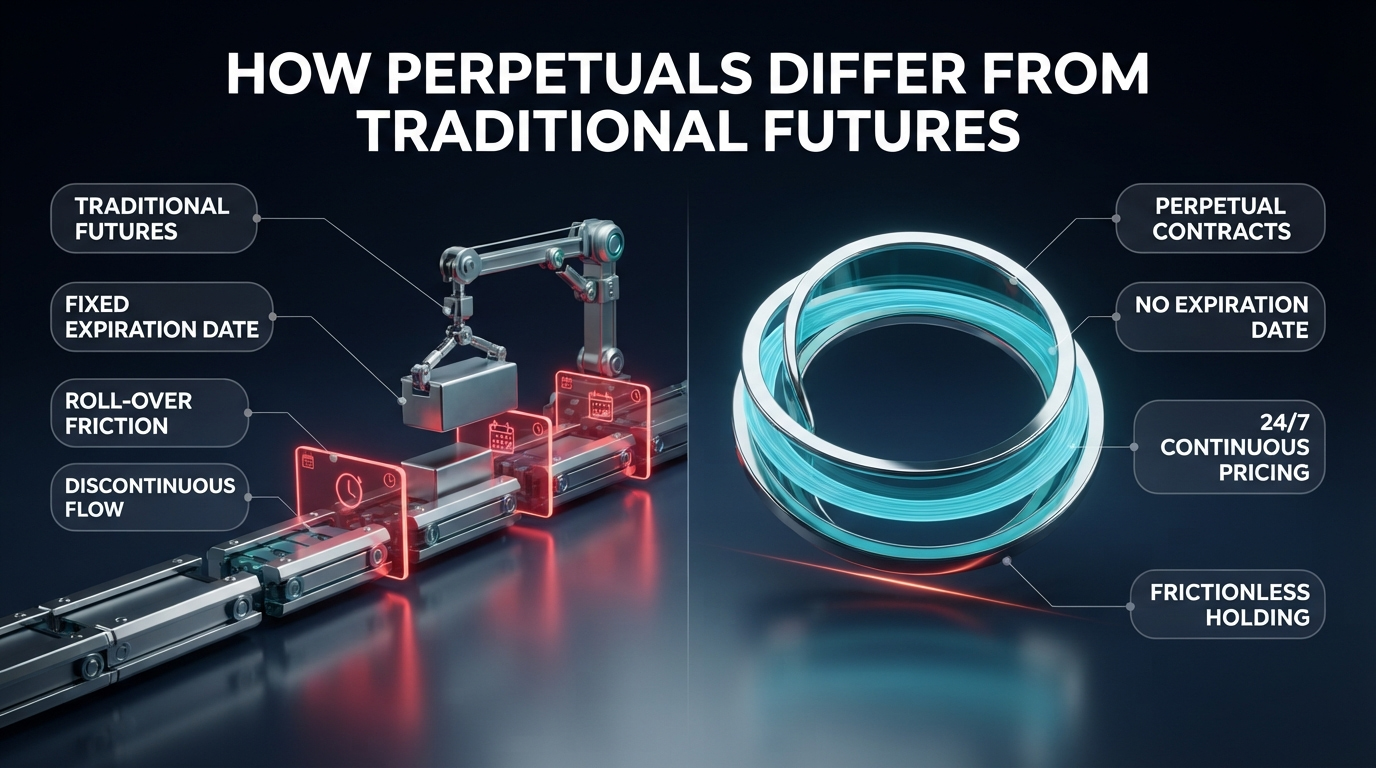
If you come from a traditional finance background, you are probably used to standard futures contracts that always settle on a fixed expiration date. That fixed time window forces traders to constantly close and roll over contracts if they want to hold a position longer.
Perpetual contracts eliminate that friction entirely. Because they remain open continuously, they support continuous pricing mechanisms that perfectly match the non stop 24/7 nature of the active crypto markets.
Funding Rate: The Balancing Mechanism
Since there is no expiration date to force a settlement, exchanges need a way to keep the price of the perpetual contract aligned closely with the actual spot market price. This is where the funding rate comes in. Funding rates are periodic payments exchanged directly between long and short traders.
When the perpetual price is trading higher than the spot price, traders holding long positions typically pay those holding short positions. Conversely, when the price dips below spot, the short traders pay the longs. This elegant mechanism creates stable market pricing without ever needing a contract to expire.
Leverage, Margin, and Position Sizing
The biggest draw to these contracts is the ability to use leverage. This allows you to control a much larger position using only a small amount of capital. Many crypto exchanges will offer leverage anywhere from 5x all the way up to 100x or more.
However, leverage is a double edged sword. It amplifies your potential profits, but it accelerates your losses just as quickly. In a prop trading environment where you are bound by strict funded account risk limits, reckless leverage will destroy an account in minutes. That makes absolute precision in your margin management and position sizing completely critical for your survival as a funded trader.
Why Perpetual Futures Dominate Prop Trading
When you look at the landscape of modern funded accounts, you will notice that spot trading is rarely an option. Instead, crypto prop firms build their entire evaluation systems and live accounts directly around the perpetual futures market. They do this because perpetuals align perfectly with how a prop firm needs to manage its capital and risk.
Successful prop trading requires precise execution, reliable market data feeds, and robust trading infrastructure. Perpetual futures check every single one of those boxes, offering the scale that firms need to back hundreds of traders simultaneously.
Long, Short, and 24/7 Liquidity
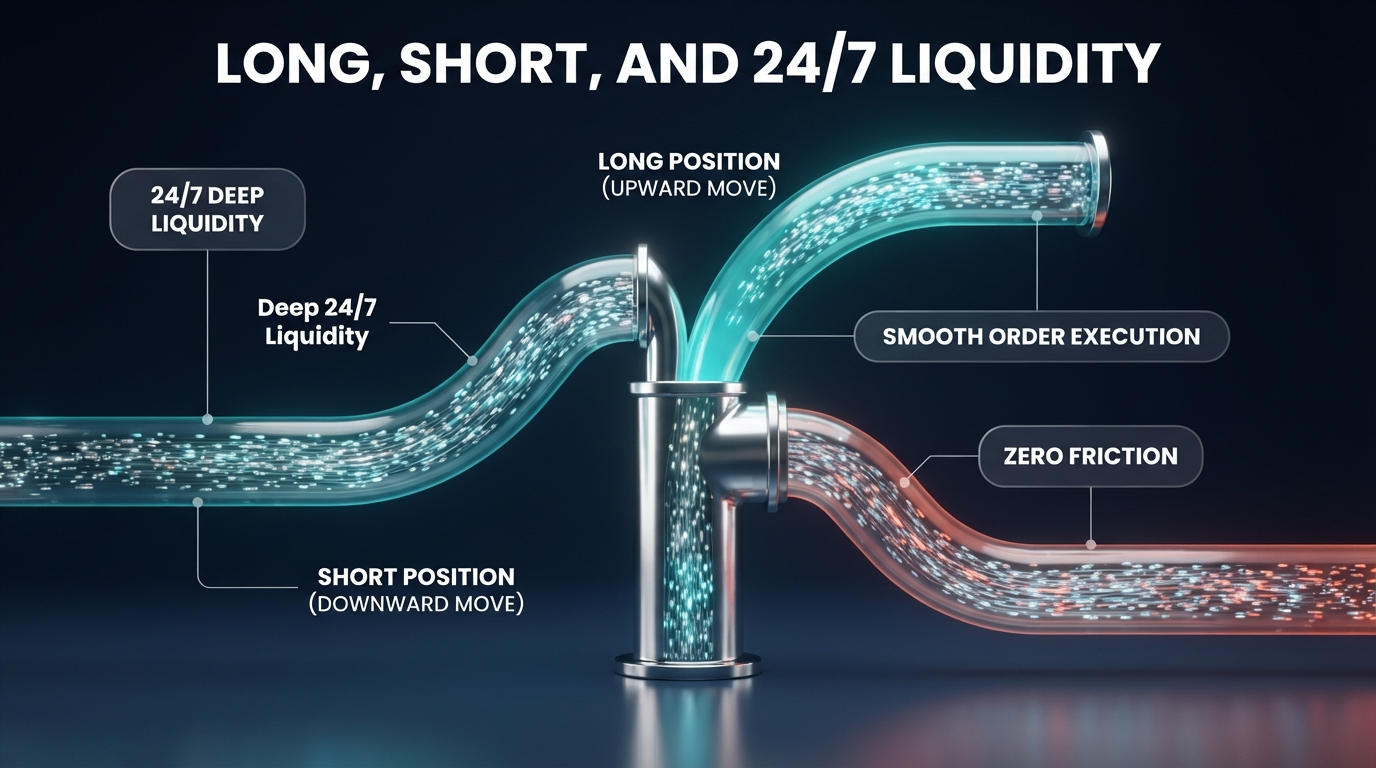
The first big reason perpetuals dominate is the raw flexibility they give to a trader's strategy. In traditional spot markets, it is easy to buy an asset, but shorting it can be incredibly cumbersome and capital inefficient.
Perpetual contracts remove that barrier entirely, allowing you to go long or short with equal ease. If the market is in a brutal downtrend, a funded trader can still hit their profit targets by catching the short side of the move.
Furthermore, major crypto assets like Bitcoin and Ethereum offer massive, deep pools of liquidity that stay active around the clock. This 24/7 liquidity means that whether you are a scalper looking for rapid intraday moves or a swing trader executing over longer periods, your orders fill smoothly with minimal friction.
This constant access is exactly why perpetuals are the preferred vehicle for fast moving strategies.
Where the Real Risk Lives
While the flexibility is incredible, it is essential to understand where the real risk lives in these markets. Because perpetual futures allow for immense leverage, they act as a massive risk amplification machine. Sudden market spikes or flushes can push an account to its liquidation level in the blink of an eye.
On top of standard price volatility, you also have to contend with funding rate fluctuations. Depending on which way the market is heavily leaning, holding a leveraged position open for too long can chip away at your account balance through periodic funding fees.
In a retail account, these fees are annoying. In a funded prop account governed by sharp daily loss limits and maximum drawdown parameters, those unexpected costs and sudden leverage spikes can breach your rules and cost you your account. This is why disciplined position sizing and risk control are not just good habits, they are the only things keeping your account alive.
From Challenge to Funded Account: The Evaluation Process
The journey to getting funded is essentially an extended job interview, but instead of answering standard behavioral questions, you are proving your execution skills directly in the market. The process typically begins with a structured evaluation phase, where your ability to balance profit targets against strict drawdown ratios dictates whether you move forward.
The prop firm hands you a simulated challenge account loaded with a specific set of predefined rules. Your only objective is to meet their conditions without triggering any risk violations. Once you successfully navigate that minefield, the firm officially hands you a funded account where you continue trading under those same defined parameters.
A Real Life Example of a Funded Payout
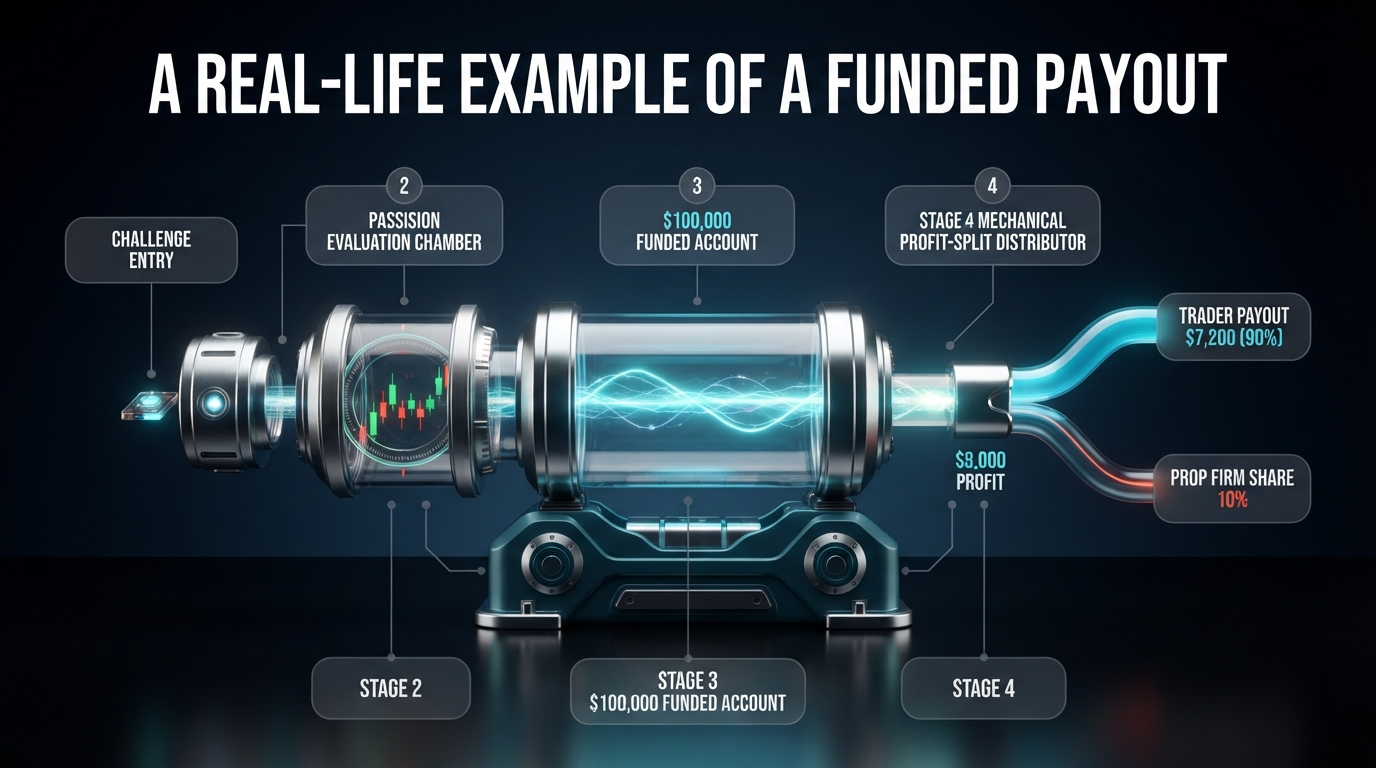
Let us look at how this actually plays out in a realistic scenario. Imagine a trader enters a challenge aiming for a $100,000 funded account, which requires hitting a 10% profit objective. Instead of sticking only to major assets, this trader applies a rigorous risk management framework to highly volatile markets like memecoins, using perpetual futures with very strict position sizing rules. By keeping risk incredibly tight, the trader successfully passes the evaluation phase and begins trading live market conditions.
Now, on the live funded account, the trader manages to generate $8,000 in profit during a standard payout cycle. Because their specific firm offers a 90% profit split, the trader gets to take home a clean $7,200, while the prop firm retains the remaining portion. It is a massive return on the initial challenge fee, achieved without risking any personal capital.
Account Rules, Drawdown, and Consistency
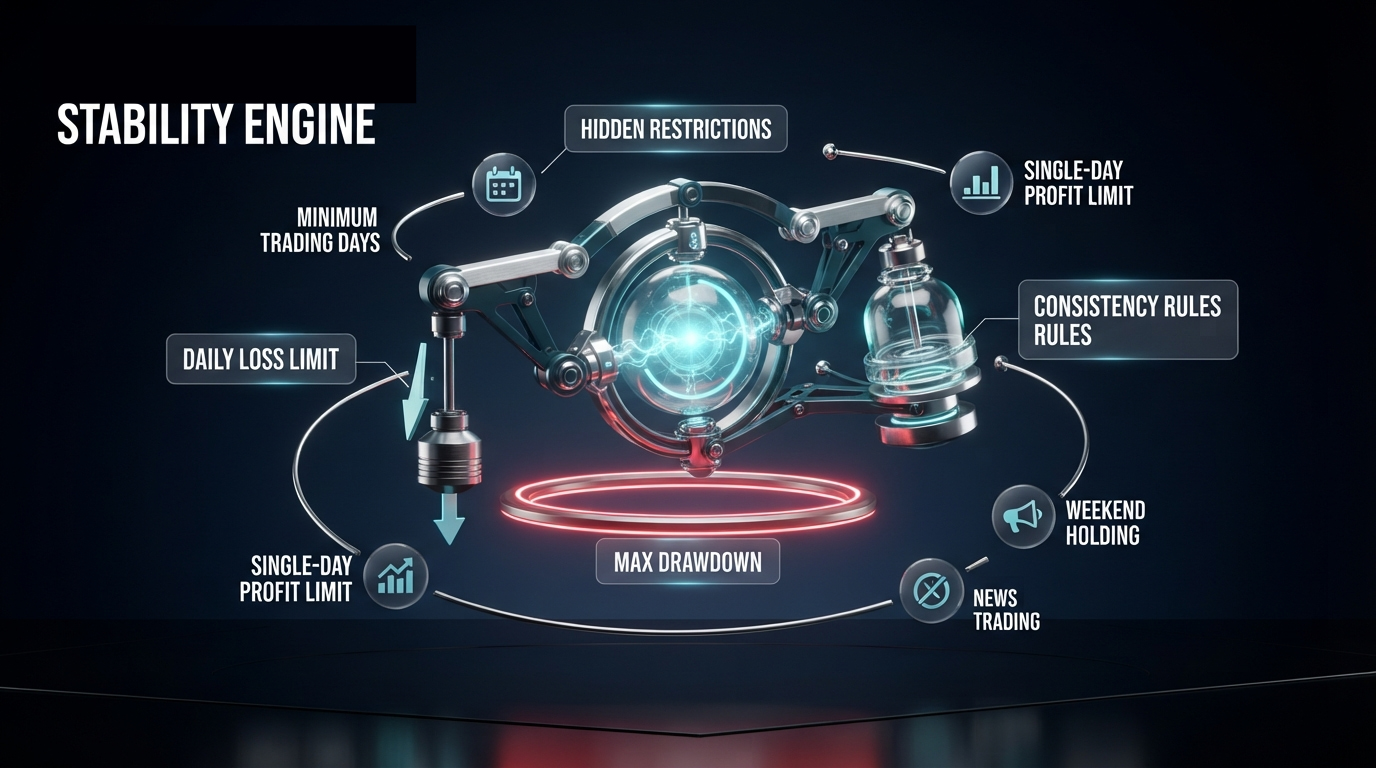
Getting the funded account is hard, but keeping it is definitely harder. Prop firms rely on rigid trading rules that define exactly how you can operate. The most notorious of these are the daily loss limits and maximum drawdown rules.
A daily loss limit strictly restricts the amount of capital you can lose within a single day, while the maximum drawdown sets a hard boundary on total allowable losses before the account is fully breached.
But it goes much deeper than just drawdowns. Many firms enforce consistency rules to ensure you are actually trading a repeatable strategy, rather than just getting lucky on one massive, high volatility trade.
You also have to navigate hidden restrictions, which might limit how much profit can come from a single day, enforce minimum trading days, or dictate weekend holding and news trading policies. Navigating these guidelines requires serious discipline, but mastering this risk management is exactly what determines your survival in a funded environment.
Prop Firms and Their Trading Models
When you start comparing different funding platforms, it is easy to get caught up in the marketing hype of massive profit splits and cheap challenge fees. But if you are serious about treating this as a long term profession, you have to look past the surface.
Crypto prop firms operate under fundamentally different underlying trading structures. The engine running the platform dictates your pricing, the quality of your execution, and the overall conditions you will face during a volatile market swing. Today, the industry is largely divided into two main categories: traditional CFD based environments and modern, exchange connected execution models.
My Shift from CFD-Based Firms to Crypto-Native Platforms
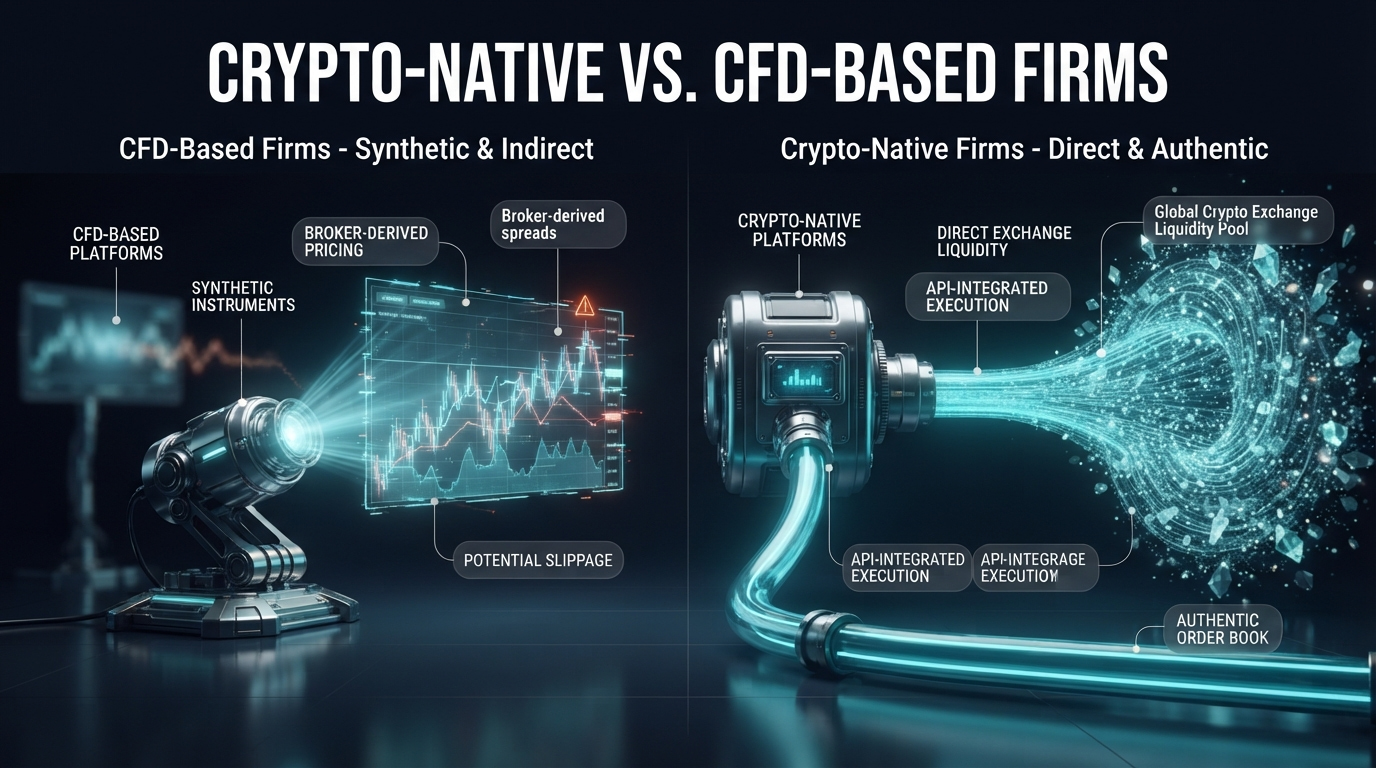
When I first started taking prop challenges, I naturally gravitated toward the established multi asset firms. Because these platforms originally built their infrastructure around traditional forex and CFD markets, they offered crypto exposure through derivative CFDs with broker-derived pricing.
For a while, those synthetic instruments worked fine for broader, higher timeframe setups. But during a period of extreme Bitcoin volatility, I hit inconsistent slippage that nearly wiped out my funded account. That was a huge wake up call.
I realized that because my strategy relied on fast market mechanics, synthetic pricing was a liability. I needed direct interaction with a real crypto order book. This pushed me toward a new wave of crypto native prop firms built entirely around exchange driven liquidity.
Moving to a direct exchange execution model changed everything. Instead of dealing with broker side feeds, routing trades directly into major crypto liquidity pools meant transparent spreads, tighter fills, and realistic order book conditions during sudden market flushes. Switching frameworks wasn't just a preference, it was a necessary step to keep my drawdown strictly protected.
Choosing the Right Firm for Your Style
So, how do you decide which model fits your trading? It ultimately comes down to your strategy and what you value most in execution.
If you’re a multi-asset trader who wants to chart major forex pairs in the morning and crypto in the afternoon, all from a single dashboard, a traditional CFD based firm might give you the flexibility you need.
However, if your edge relies strictly on crypto market mechanics, the choice is clear. Traders who prioritize execution quality, transparent pricing, and direct integration with popular charting tools are moving almost exclusively toward crypto-native models. If you’re scaling fast strategies or need to know your fills match true market depth, you want to be as close to the actual exchange order book as possible.
Most Essential Criteria for Choosing a Trading Firm
When choosing a funded trading platform, you have to look past the flashy marketing and evaluate how a firm actually performs in live market conditions. For me, the single most critical factor is the underlying liquidity model.
Understanding whether a platform uses synthetic CFD pricing or direct exchange liquidity is vital, as it directly shapes your execution quality, specifically your fill speeds and how much slippage you absorb during sudden volatility.
Beyond execution, a firm’s evaluation structure and risk limits dictate your day to day survival. You need complete clarity on whether you're taking a one step or two step challenge, alongside exact details on how daily loss limits, maximum drawdowns, and consistency rules are calculated.
Platform access is equally important; having responsive, professional grade charting tools natively integrated into your workflow can completely transform your trading experience.
Finally, look closely at the long-term mechanics. A solid firm provides transparent funding conditions, reasonable leverage, and clear payout terms, including competitive profit-split ratios and reliable withdrawal schedules. Just as important is scaling potential: you want a platform with progressive capital growth plans that systematically raise your allocation as you demonstrate consistent risk management.
Final Thoughts for Aspiring Funded Traders
As we navigate the landscape of crypto prop trading in 2026, it is clear that the industry is no longer defined by a single winning model. Traders today face a massive variety of execution environments, risk frameworks, and funding structures, each tailored to completely different trading styles. If you are looking to step into this world, your success will not come down to finding a firm with the flashiest marketing or the absolute cheapest entry fee.
Instead, long-term performance relies entirely on looking under the hood and evaluating the core factors that impact your daily edge. You need to prioritize execution consistency during volatile market conditions, because small differences in execution quality can completely change your results in fast-moving crypto environments.
Equally important is finding a platform with clear, fair risk management rules that match your personal approach. For instance, if you are a swing trader who likes holding positions for longer periods, you need to ensure the environment supports specific options like swap free structures to help you avoid overnight financing costs. Ultimately, your goal should be to find a prop firm that offers stable payouts and sustainable scalability, allowing you to build a true, long-term professional career using their capital.
About the Creator
Sophie
Trader focused on Price Action & Order Flow.
Into crypto, fast execution, controlled risk, and quality setups.
Passing funded accounts and refining my trading every day.
Enjoyed the story? Support the Creator.
Subscribe for free to receive all their stories in your feed.
Comments