
We Didn’t Expect This
Pop Mart's founder just admitted 2026 is brutal. But hidden inside the earnings miss is a $12 billion cash pile and a star that grew 580%.
On August 20, 2026, Pop Mart released numbers that made investors frown.
Revenue: RMB 17.17 billion, up 23.8% year-on-year. Net profit: RMB 5.04 billion, up 10.1%.
Both missed expectations. Revenue fell short by RMB 2.8 billion. Net profit missed by RMB 1.6 billion. The next morning, the stock opened 8% lower, and the market cap briefly dipped below HK$200 billion. The market voted with its feet before the earnings call even ended.
But if you close the report after reading only "below expectations," you miss a more complicated story.
I. The Hidden Number on the Income Statement
Start with net profit.
RMB 5.04 billion, up just 10.1% year-on-year. For a company that had posted triple-digit growth for the past two years, that looks almost like a stall.
But look closer at a line item most readers skip: foreign exchange gains and losses.
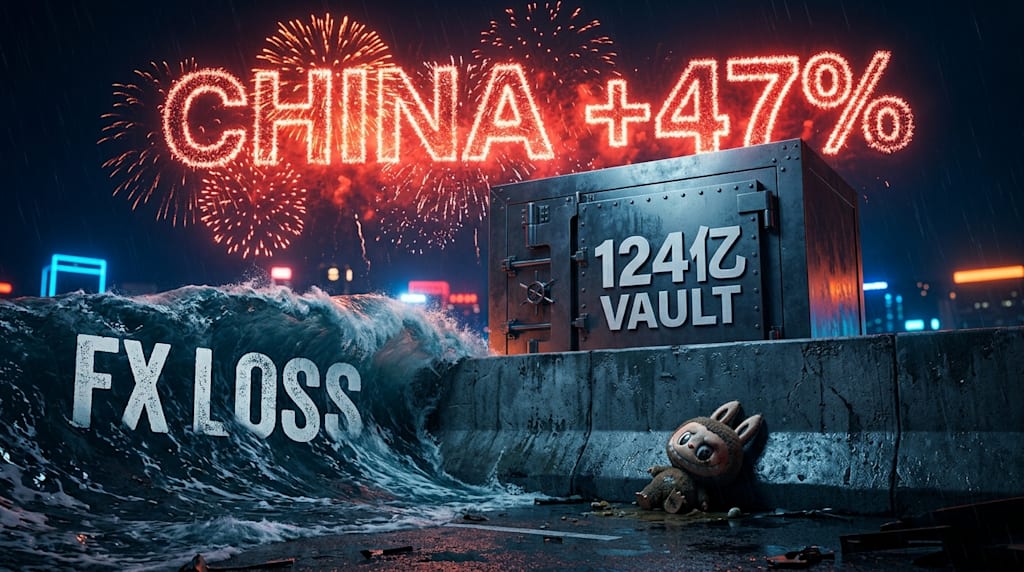
In the first half, Pop Mart recorded a net foreign exchange loss of RMB 720 million. In the same period last year, that number was a positive RMB 120 million. The swing is RMB 840 million.
Without the currency impact, Pop Mart's core operating profit increment would have been roughly RMB 1.3 billion, corresponding to a growth rate above 25%. Not the unsettling 10.1% reported.
RMB 720 million is not an operational failure. It is the cost of being a global company during sharp dollar volatility. It hits the books, but it says nothing about how well the company sells products.
First takeaway: nearly half of the "ugly" net profit figure comes from currency movements.
That does not mean other problems do not exist.
II. Overseas Online: The Tide That Went Out
Overseas revenue was the biggest structural concern.
Asia-Pacific revenue: RMB 2.58 billion, down 9.7% year-on-year. The Americas: RMB 1.89 billion, down 16.5%.
The headline numbers are weak. The breakdown is worse:
Asia-Pacific online revenue plunged 39.8%, with Shopee alone collapsing 62.1%.
Americas online revenue fell 45.6%, with both the proprietary app and the official website shrinking by more than 40%.
This is not an offline problem. The Americas expanded retail stores from 41 to 86, and offline revenue actually grew 19.5%. Europe grew from 18 to 45 stores, driving a 49.8% offline increase.
Online retreats fast; offline advances slowly.
Pop Mart's explanation in the earnings report is unusually blunt: "the dissipation of external traffic dividends" and "the normalization of core IP heat."
In plain language: the LABUBU global explosion on social media in 2025, that traffic surge, is over.
This time last year, LABUBU stickers spread wildly on TikTok. Young consumers in Southeast Asia crashed Shopee's servers for limited editions. A phenomenal, unrepeatable, inevitably fading wave.
When the wave recedes, online data returns to a realistic baseline.
This is not a collapse. It is normalization. The timing just happens to overlap with last year's absurdly high base, making it look like a free fall.
III. LABUBU Cools, a New Star Rises
Now look at the IP table.
THE MONSTERS series (including LABUBU) generated RMB 4.45 billion in the first half, down 7.5% year-on-year. It remains the No. 1 IP. But HSBC Research calculated: LABUBU's decline alone dragged the group's overall revenue growth down by about 11 percentage points.
Without LABUBU's cooldown, Pop Mart's first-half revenue growth could have approached 35%.
Here is the interesting part. When LABUBU slowed down, others sped up.
Xingxingren (Star Man)—an IP that generated only RMB 389 million in the first half of last year—rocketed to RMB 2.65 billion. A 580.6% year-on-year surge, propelling it from the periphery to the second-largest IP.
CRYBABY broke RMB 1.6 billion. DIMOO broke RMB 1.6 billion. SKULLPANDA broke RMB 1.55 billion. All positive.
In the first half, Pop Mart had six IPs with revenue exceeding RMB 1 billion and eleven IPs surpassing RMB 100 million.
The IP matrix is shifting from single-core driven to multi-core parallel. LABUBU's fever breaking is painful. But after the fever subsides, the other organs keep working normally, and some are stronger than before.
MOLLY is the exception. The veteran IP that has accompanied Pop Mart the longest generated RMB 900 million, down 33.7% year-on-year.
Management added on the earnings call: "MOLLY will see some relatively major breakthrough design products launched by the end of this year or early next year."
Translation: the old guard is not abandoned, and the new is already on its way.
IV. China: The Underestimated Anchor
Under the shadow of overseas online contraction, one fact is easy to overlook. The China market held the entire ship steady.
China revenue reached RMB 12.2 billion, up 47.3% year-on-year. Its share of total revenue rebounded from 59.7% back to 71%.
Online was the biggest growth engine:
The Pop Mart blind-box app generated RMB 2.06 billion, up 83.3%
Douyin (TikTok China) sold RMB 980 million, up 74%
Tmall flagship store sold RMB 900 million, up 37.1%
Three channels, three different approaches, all running faster than the company average.
Membership grew by nearly 10 million in six months, reaching 82.44 million. Members contributed 92.9% of China revenue, with a repurchase rate of 51.6%.
Out of every two people who have bought Pop Mart once, one buys a second time. In a non-essential category like collectible toys, that repurchase rate signals that the brand has woven itself into people's daily rhythms. Not a "pass-by-and-grab-one" impulse.
V. Category Shift: Plush Surpasses Figures
One more structural change worth highlighting separately.
Plush products generated RMB 9.82 billion in the first half, up 60% year-on-year, accounting for 57.2% of total revenue.
Collectible figures accounted for 30.2%.
For the first time, plush overtook figures. By nearly double.
Pop Mart is no longer just a "figure company." Plush toys have a lower average unit price, higher repurchase frequency, and stronger social-sharing attributes. They are closer to an "everyday emotional consumer good" than a "dust-collecting display piece on a shelf."
This category migration defines the company's future more than the rise or fall of any single IP.
VI. New Businesses, Cash, and Buybacks
A few other items in the earnings report deserve a pause.
Pop Mart's city theme park reopened its enclosed area this year, creating four new zones around THE MONSTERS and DIMOO, and introducing six large amusement rides for the first time. After June 18, the park extended operating hours and launched a summer night-tour event. Chief Operating Officer Si De said on the call that after the new zones opened, foot traffic more than doubled sequentially, with night tours contributing over a quarter of the increase.
Phase II of the park has already entered concept design.
This is a different revenue stream beyond retail: experience economy. It will not deliver substantial profit in the short term, but it gives IPs a physical space to build deeper connections with users.
On the financial side, the company held RMB 12.44 billion in cash, had no bank debt, and reduced its debt-to-asset ratio from 29.4% to 24.9%.
It paid RMB 3.15 billion in dividends and spent RMB 1.55 billion on share buybacks in the first half. Management also announced, for the first time on an earnings call, a new repurchase plan: over the next six months, buybacks will range between RMB 2 billion and RMB 5 billion.
RMB 12.4 billion in cash, zero debt, large-scale buybacks. Together, these three conditions send a signal: the company has conviction in its long-term value and is willing to back that conviction with real money.
VII. Wang Ning's Words
On the earnings call, founder Wang Ning said a few things rarely heard in public company meetings.
"This first half has been quite special for us. It was indeed much more pressured than we expected, and we faced many difficulties and challenges that we had not anticipated."
"We will most likely not achieve the 20% growth target we set at the beginning of the year."
"We do not want to make decisions that are detrimental to the company's long-term development just to meet market expectations."
Three sentences, layered progressively.
The first is honesty in acknowledging reality. The second is clarity in downgrading guidance. The third is a declaration of priorities: short-term growth is not the top priority; long-term health is.
When such words come from a founder, they scare investors in the short term. Over a longer horizon, they are more memorable than the standard boilerplate of "we are full of confidence about the future."
VIII. Slowing Down Is Not Derailing
Back to the opening question.
Pop Mart's first-half report is indeed not pretty. Growth slowed. Overseas online shrank. LABUBU cooled. Profits took a big bite from FX.
But reverse the FX loss. Interpret the online traffic ebb as cyclical normalization. Place LABUBU's cooldown within the broader IP matrix. The picture that emerges is not nearly as dire as the stock drop suggests.
China is still growing at 47%. New IPs are taking the baton. Plush has already moved onto a much larger track. RMB 12.4 billion in cash sits on the balance sheet. Management signals confidence through large-scale buybacks.
The growth rate broke. The business model did not. A pulse slowed. The foundation did not.
Pop Mart is moving from phenomenal explosion to normalized operations. This transition is painful, with quarterly numbers that will make the market wince.
Zoom out and look at today from three or five years down the road. This may turn out to be just one chapter in the company's long story. A chapter in which they learned to keep moving forward on their own, even after the tide receded.
About the Creator
Jin
Writer of reamstories
https://reamstories.com/jin
Enjoyed the story? Support the Creator.
Subscribe for free to receive all their stories in your feed. You could also become a paid subscriber, letting them know you appreciate their work.
Comments
There are no comments for this story
Be the first to respond and start the conversation.