
The Treasury Secretary Who Talked About War
Why Bessent went on CNBC to save the Strait—and the yen
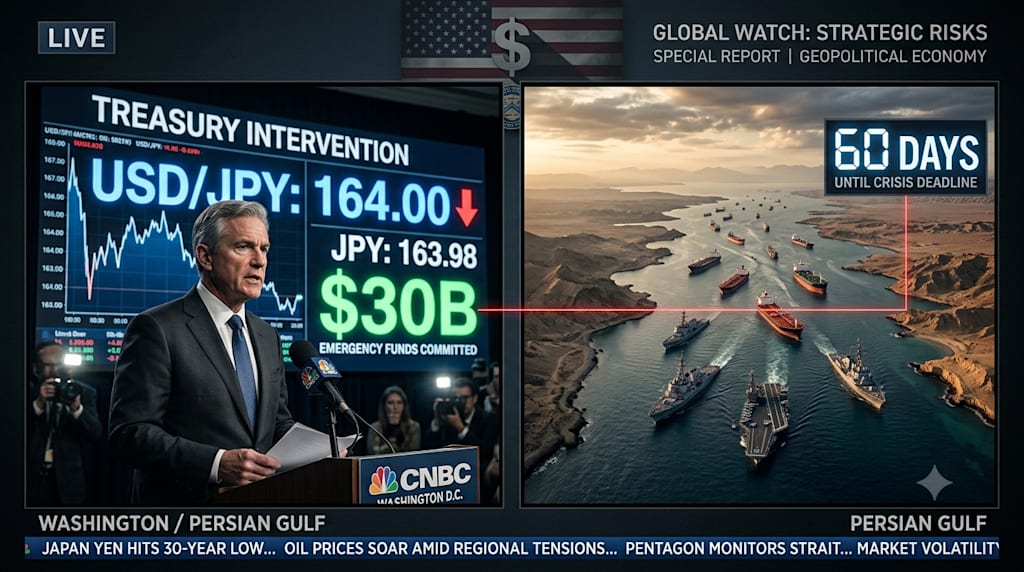
On August 4, 2026, U.S. Treasury Secretary Scott Bessent appeared on CNBC. He said the U.S. and Iran would reach an agreement on the reopening of the Strait of Hormuz "today or tomorrow." That same day, Secretary of State Marco Rubio confirmed U.S. involvement in Oman‑mediated talks with Iran, saying "progress" had been made. President Trump told Fox that negotiations were going "very well."
Where’s the oddity? The oddity is that the Treasury Secretary said it.
Foreign diplomacy belongs to the State Department. Military deployments belong to the Pentagon. If something happens in the Strait of Hormuz, the first responders are CENTCOM’s warships, not Treasury’s number‑crunchers. A man whose job is exchange rates, sovereign debt, and tax policy suddenly steps forward to say the Strait is about to open. There is only one reason: he was already losing control on another battlefield.
Rewind 72 hours. On August 1–2, the U.S. and Japan conducted their first joint yen‑buying intervention since the 2011 Tōhoku earthquake. The dollar had pushed past 164 yen, a level not seen since the 1998 Asian financial crisis. Japan’s Ministry of Finance spent roughly $30 billion in reserves over two days, pushing the yen back from 164 to near 158.
Bessent himself had been on TV right around then, saying the U.S. would "do whatever it takes" to support Japan’s currency stability, and that the yen’s weakness was "partly driven by the pass‑through of higher energy costs."
Put the two TV appearances side by side. The first: Bessent talks about the link between the yen and oil prices. The second: Bessent talks about the Strait and a deal. In between: three days and a $30 billion intervention bill.
This was not a foreign‑policy pivot. It was an extension of currency intervention. The same hand first pressed down on the yen, then tried to press down on oil. Pressing the yen cost too much, so much that the Treasury did not want to do it a second time. That is why they went after oil instead.
Japan imports over 80% of its oil through the Strait of Hormuz. When the Strait gets blocked, freight rates jump, insurance premiums soar, and landed prices spike. The import bill swells, the trade balance deteriorates, and the carry trade shoves the yen further into the abyss. The chain is transparent, transparent enough that Bessent sees it, and the market sees it too. The August 2 intervention temporarily held the 164 line. But if oil had surged another leg the next day, those $30 billion would have been wasted.
So the August 4 announcement was, in essence, buying an insurance policy for that $30 billion.
Trump pulled back at the same time. The military strike option against Iran, which you analyzed earlier as the "TACO" plan, was put on hold in early August. Not because they didn’t want to strike. Because they couldn’t afford to at that moment.
Why they couldn’t afford it can be read off a single ledger: U.S. federal debt at $34 trillion. The largest foreign holder of that debt is Japan, with roughly $1.1 trillion. If the yen kept collapsing, the Bank of Japan would have only two choices: either keep burning reserves to intervene (which itself means selling Treasuries) or accept depreciation and be forced to raise rates (which would also trigger Treasury selling). Either way, U.S. Treasury yields would spike. Every basis point spike adds billions to the Treasury’s annual interest bill.
Bessent was not calculating a military balance sheet. He was calculating the interest bill. And at that moment, the interest bill was more urgent than Iran’s centrifuges. Trump pulled back on military options not because Iran’s negotiating posture impressed anyone, but because the Treasury market could not survive another wave of selling. This was not peace. It was a ceasefire, a truce called because both sides had a bleeding wound and needed to bandage themselves first.
But the pullback has a shelf life. Based on information leaking from the Omani side, if a deal gets signed, it will most likely be a 60‑day interim arrangement: commercial vessels enter through the Iranian‑side lane and exit through the Omani side. Iran gains a greater regulatory role over the Strait, while the U.S. holds off on expanding its port blockade.
That is a concession, the kind the U.S. has never made before. But the concession buys not a peace treaty, only a 60‑day navigation guide. Even while striking an optimistic tone, Trump still said: "Unless Iran surrenders completely, the blockade will not be lifted." And Iran’s Revolutionary Guard has not been idle; anti‑ship missile batteries along the Persian Gulf coast are still there, with new positions placed even closer to the main shipping lane.
Both sides took one step back, but each kept one hand behind their back. If something does get signed on August 6, it will in substance be a "pause confirmation" that both sides desperately need: Iran needs to catch its breath, the U.S. needs to suppress oil to rescue the yen. They agreed on the word "pause." They agreed on nothing about the word "then."
After 60 days comes October. The Northern Hemisphere enters peak winter energy demand. The pressure on the yen will not vanish on its own; uncertainty over the Fed’s rate‑cut path remains. By then, nobody can guarantee this interim guide will be renewed. If the market reads these 60 days as a trend reversal, that’s mistaking a fever reducer for a vaccine.
Oil did fall on August 4. WTI punched through $75 from above $80, and Brent lost the $80 handle. But on that same day, the daily hire rate for a VLCC supertanker jumped $12,000. The shipowners weren’t buying it. What they believed was something else: if the Strait were safe, freight rates wouldn’t rise. Rates went up, which means owners think risk premium has only changed shape, not disappeared.
Another driver of the oil drop was the anticipated release of floating storage. If the tankers parked offshore during the blockade are cleared, there will indeed be an extra surge of supply hitting the market in the short term, a one‑off price shock. But that oil is stock, not flow. Once the stock is gone, it’s gone, and OPEC+’s spare capacity did not suddenly expand on August 4. Saudi and UAE idle capacity remains stuck near historical lows of about 2 million barrels per day. That number won’t change because Bessent appeared on TV.
A more hidden cost sits in war‑risk insurance premiums. Even if a deal is signed, the premiums on Japanese tankers transiting the Strait will not fall back to pre‑blockade levels. The implicit costs that carriers bear, including alternative routing plans, crew risk allowances, and schedule‑uncertainty discounts, will continue to attach to every barrel shipped to Japan. These costs are not quoted in WTI or Brent futures. But they become real energy expenses for Japanese companies. The erosion of the yen’s long‑term purchasing power has not been solved by any interim agreement.
If the yen breaks 160 again within those 60 days, Trump faces the same choice as in early August: either send Bessent back to the microphones, or send the Pentagon to act. The shorter the interval between two such calls, the lower the market’s trust. The lower the trust, the larger the speculative positioning. Once the market forms the expectation that "the U.S. won’t strike because it’s afraid of high oil prices," oil prices will actually fall further with each such reassurance, and the lower they fall, the harder it becomes to strike, because striking means an instant oil spike, and a spike means an instant yen crash. That is a paradox, and the exit from a paradox is usually not the negotiating table but an unexpected event.
Bessent’s cross‑border remarks this time exposed one thing clearly: in a high‑rate, high‑debt environment, the U.S. has drawn a clear priority line between military options and financial stability. Finance first, military later. That priority itself is not the problem; the problem is that it has been seen in public. Seen once, and next time someone will bet on it happening again.
Whatever the outcome of the August 6 talks reads, its impact on the long‑term trend may be far smaller than markets expect. Signed or not, it’s 60 days: Iran’s missiles are still there, America’s destroyers are still there, and the people at Japan’s Ministry of Economy, Trade and Industry have already started calculating the extra cost of routing LNG carriers around the Cape of Good Hope this winter. That number: no one is paying it for them.
About the Creator
Jin
Writer of reamstories
https://reamstories.com/jin
Enjoyed the story? Support the Creator.
Subscribe for free to receive all their stories in your feed. You could also become a paid subscriber, letting them know you appreciate their work.
Comments
There are no comments for this story
Be the first to respond and start the conversation.