
The Silence Is the Scariest Part: Inside South Korea's Invisible Financial Collapse
1.2 million wiped out. Not a single cry in the street. What's really happening behind the calm.
I. A Silent Catastrophe
In 2026, South Korea’s stock market triggered its circuit breaker for the ninth time.
The number itself is staggering, but what lies behind it is even more suffocating: over 1.2 million leveraged retail accounts hit their margin call limits, the equivalent of one in every 30 Korean adults standing at the edge of a cliff. Among them, between 320,000 and 360,000 accounts were forcibly fully liquidated by brokerages. Their principal went to zero. Some even ended up owing money to their brokers. And of those who were wiped out, 62% were young people between the ages of 20 and 30.
By any normal logic, this should have been a social earthquake. 1.2 million households wiped out in an instant, 360,000 accounts reduced to nothing, and the majority of the victims young. Any one of those metrics would be enough to set off a storm in the streets. Yet, eerily, Korean society has displayed an almost perverse calm. Occasionally, a video clip of a “gambler on the rooftop” flashes across the news, but on closer inspection, it’s the same footage played from a different angle over and over again. No mass protests. No run on the banks. No societal shutdown. The Seoul subway is as packed as ever, the lights of convenience stores still burn through the night, as if those 1.2 million liquidations were nothing more than digits flickering on a screen, never really landing on human soil.
Why? To answer that, we first need to step into a hidden financial corner of the South Korean military: the “Loyalty Loan.”
II. Usury in the Barracks: Loyalty Loans and Sergeant Loans
Men who have served in the South Korean military can apply for a type of private loan known as a “Loyalty Loan” or “Sergeant Loan.” The design of these loans is precision-engineered for harvesting.
Extremely low barriers. No collateral required. No strict credit checks. No review of existing debts. All an applicant needs is proof of military identity and a pay stub. The entire process is online, with no face-to-face approval. A soldier can apply right from his phone in the barracks, and the money is disbursed within minutes.
Exorbitant interest rates. Annual rates range from 17.9% to 20%, hovering near the legal maximum in South Korea. For comparison, standard bank loan rates in the country typically sit between 3% and 5%.
Staggering scale. By the end of 2025, the outstanding credit loan balance for South Korean military personnel had reached 444 billion won, more than half of which was borrowed by active-duty soldiers.
Serving your country only to return home saddled with a 20% annual interest debt is not dark comedy. It’s a standard life script for young Korean men.
More crucially, the existence of these loans has made military-serving men more susceptible, and more deeply entangled, in this stock market gamble than the average person. A 20% annual interest rate is a heavy shackle in normal times, but in the face of a golden era of “triple leverage and double your money” in the stock market, that cost was seen as a negligible entry ticket. Already in debt, why not add leverage and take a shot? This mentality, amplified through mobile phone screens in the barracks, spread like wildfire.
Thus, a terrifying logical closed loop took shape: the state conscripts young men for military service, lending institutions inside the military issue them high-interest loans in the name of “loyalty,” these young men are discharged carrying that debt, then convert that debt into stock market leverage, and ultimately, on the ninth circuit breaker, they are completely wiped out.
III. Why Does the Shock Seem “Imperceptible”?
To understand this anomalous calm, one must pierce the surface and see four structural features of South Korean society.
1. The Silence Filter of a Shame Culture
East Asian society carries a distinct “pay your bets and lose quietly” ethic. In South Korea, a margin call is not a hardship to be publicly lamented; it is a personal failure, a stigma. A report by 36Kr captured this atmosphere with precision: “Battle-hardened warriors, not afraid at all.”
This is not fearlessness. It is the inability to show fear. Publicly admitting that you’ve lost all your savings in the stock market is tantamount to announcing to society your own stupidity and weakness. In a society obsessed with saving face, this is akin to social death. And so, the pain of 1.2 million people was atomized into 1.2 million isolated silences: no collective cries, only countless private collapses in the dead of night.
2. The Atomization of Crisis: It Didn’t Drag Down the Banking System
During the 1997 Asian financial crisis, South Korea saw its banking system collapse, a chain of corporate bankruptcies, and the nation brought to the brink of default. But the stock market crash of 2026 is, in essence, “a stock-market crisis, not a banking-system crisis.”
Retail investors lost their own savings, along with high-interest loans borrowed from private channels like the “Loyalty Loan.” These debts did not enter bank balance sheets on a massive scale, did not trigger a chain-reaction collapse in the jeonse (key-money deposit) system, and did not cause large-scale corporate failures. The pain was strictly confined to the individual level, never spilling over into a systemic societal halt.
In other words, these 1.2 million people “sank silently,” rather than “dragging everyone else down with them.”
3. The Fig Leaf of Economic Fundamentals
Even as the Korean stock market plummeted, the country’s economic fundamentals were telling a contrary story.
In June 2026, South Korea’s exports surged 70.9% year-on-year, the strongest growth in nearly half a century. Quarterly GDP expansion was also the strongest in six years. The stock market crash was interpreted as a “technical stampede” and a “leverage mismatch,” not a collapse of economic fundamentals.
For ordinary Koreans who don’t trade stocks, life seemed to carry on as usual: Samsung and SK Hynix chips were still being exported, shipyards still had full order books, and street-corner coffee shops were still doing business. The bloodbath in the stock market was framed as something belonging to “that world,” having nothing to do with “this world.”
4. Media Survivorship Bias and Information Control
The “gambler on the rooftop” videos you see are precisely the result of extreme outliers being heavily circulated. The systemic suffering has been obscured, intentionally or not:
Psychiatric clinics saw a marked increase in patients seeking help for stock-market anxiety;
One retail investor, wiped out after following investment advice, stabbed the financial influencer who had provided it;
The South Korean government submitted an “Economic Crisis Family Suicide Prevention Plan” to the Blue House — only the second time in financial history, after Japan in 2006, that a government has introduced such a policy;
More than one-third of indebted young Koreans under 30 have experienced suicidal ideation, in a country where the suicide rate is already among the highest in the world.
These signals have been drowned out by official narratives of “stock market volatility is normal” and “South Korea’s economic fundamentals are strong.” The suffering exists. It just isn’t allowed to be seen.
IV. Not Patriotism, but Structural Despair
Some have interpreted the silence of Korean society as “patriotism”: even after being wiped out, young people still choose to trust their country, not causing trouble, not adding to the chaos.
But this reading is far too romanticized. The truth is more brutal: what looks like patriotism is actually structural despair, a form of self-numbing.
Young Koreans face impossibly expensive housing. Seoul’s house-price-to-income ratio has long been among the highest in the world. Buying a home on a salary alone is a near-impossible task. They face deeply entrenched class rigidity. Under the chaebol-dominated economy, upward mobility channels are narrow, and the costs of starting a business are prohibitively high. The paths available for ordinary people to change their destiny are extremely limited. They face the leverage trap of the jeonse system. South Korea’s unique jeonse (key-money deposit) rental system requires tenants to pay a lump-sum deposit equivalent to 50% to 80% of the property’s value, which landlords then use to invest in more real estate or the stock market. The entire society is woven into a vast web of leverage, where no one can truly remain insulated from the risk. And they face the temptation of the semiconductor myth. The wealth-creation stories of Samsung and SK Hynix have been told and retold, making the stock market appear to young people as the only visible ladder for class mobility. When the returns from legitimate work are dwarfed by those from stock-market speculation, going “all in” becomes an act of rational despair.
Those who served in the military had easier access to high-interest loans, pulling them into this gamble earlier and more deeply than their peers. The state called them to defend its borders, while private capital seized the opportunity to issue them high-interest loans, and in the end, the stock market wiped out both their debts and their dreams in one clean sweep. This is a precisely calibrated system of harvesting.
V. A Carpet Over the Cracks
The reason the impact of Korea’s stock market circuit breakers on daily life “seems imperceptible” is that the pain has been skillfully individualized and rendered invisible.
1.2 million people standing on the edge of liquidation, 360,000 households with their principal zeroed out, a government enacting suicide prevention measures, soldiers gambling on stocks with loans carrying 20% annual interest: these signals alone are enough to indicate that cracks are appearing in the foundations of Korean society. It’s just that these cracks have been covered with carpets: the strong economic data is a carpet, the media’s selective reporting is a carpet, and the cultural ethic of “paying your bets and losing quietly” is also a carpet.
But the cracks beneath the carpet won’t heal on their own. Those young men discharged from the military, carrying their “Loyalty Loans,” those tenants shuttling between their jeonse deposits and stock-market leverage, those young people scrolling through their liquidated accounts late at night, wondering how they will explain it to their families. Their pain has been engineered into an invisible form.
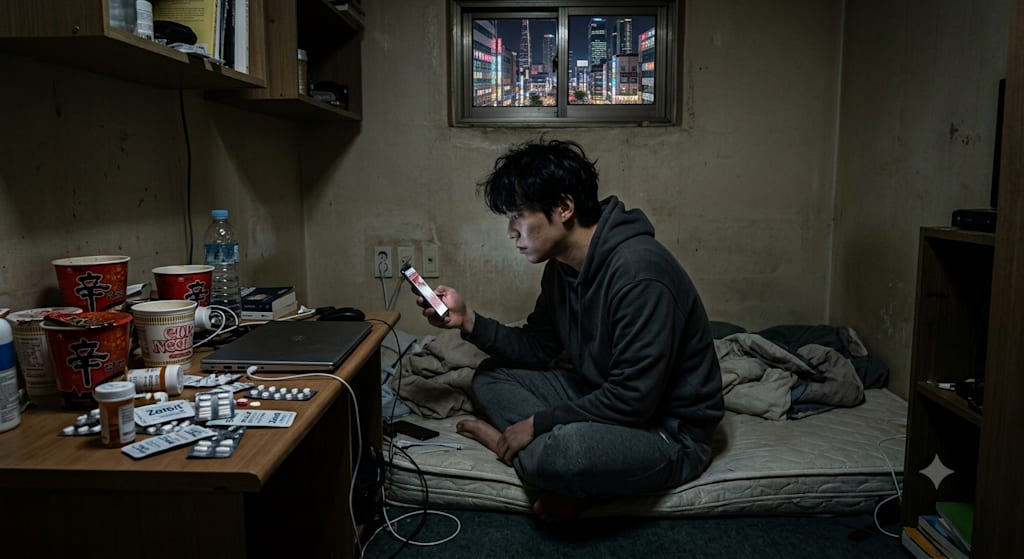
South Korea does not need to worry about dramatic plots like “soldiers defecting to the North.” A more realistic scene is this: a discharged soldier, saddled with a 20% annual interest loan, moves into a gosiwon in Seoul — a tiny, windowless cubicle that represents the lowest rung of Korean housing. He relies on psychiatric medication to sleep, switching back and forth between job-search websites and stock tickers on his phone, calculating whether he has any chance of ever paying off his debts in this lifetime.
He did not take to the streets. He did not wail out loud. He did not even tell his family he was wiped out. He simply sank in silence, becoming just one of those 1.2 million.
And that is the most terrifying thing about this crisis: it is a quiet, silent unraveling.
About the Creator
Jin
Writer of reamstories
https://reamstories.com/jin
Enjoyed the story? Support the Creator.
Subscribe for free to receive all their stories in your feed. You could also become a paid subscriber, letting them know you appreciate their work.
Comments
There are no comments for this story
Be the first to respond and start the conversation.