
The rocket throttled down when it should have throttled up
One telemetry call, forty lost satellites, and two deadlines that will not wait for the investigation.
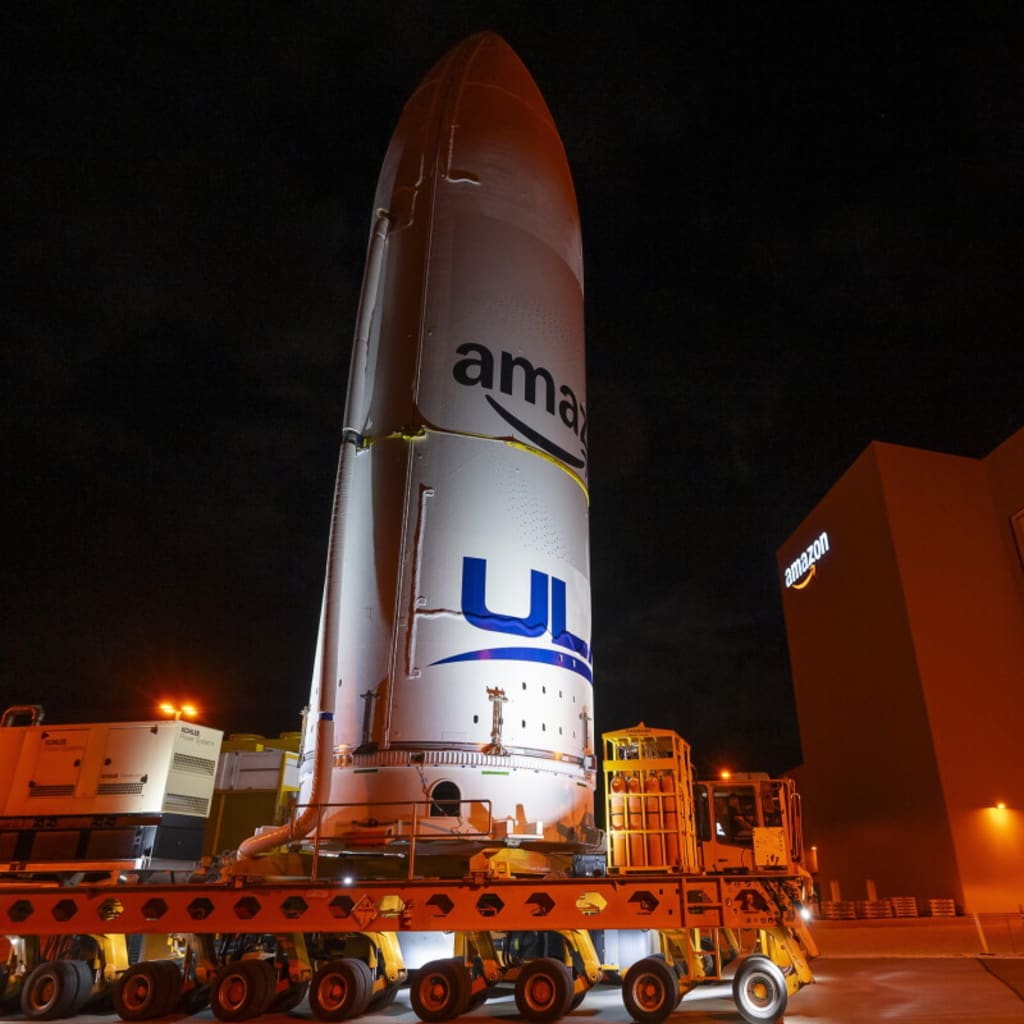
At around 1 a.m. Beijing time on November 16, Vulcan lifted off from Space Launch Complex 41 at Cape Canaveral. Ten minutes later an anomaly appeared, and 40 Amazon Leo satellites failed to reach orbit. ULA's nearly two-decade run of successful launches ended there.
The outcome reads as a return-to-flight failure. The clue that matters sits earlier. After solid booster separation, a ULA telemetry analyst said on the webcast: "BE-4 throttle down." On a nominal Vulcan flight, that is the moment the BE-4 engines throttle up, taking over the thrust the solid boosters had been providing. A reported throttle down is off the profile.
The first fork: the engines eased off when they should have pushed
The telemetry after that call pieces into a chain. The two BE-4s were supposed to shut down inside five minutes of flight. They burned at least 30 seconds longer. Stage separation came late. When Centaur lit, the altitude, velocity and attitude it inherited were already poor, and roll and attitude correction followed. Those early upper-stage maneuvers look like an attempt to cover an energy shortfall the first stage left behind.
The causality needs separating. Burning long is likely the result, not the cause. If BE-4 was commanded to ease off after booster separation, core-stage acceleration fell, and the rocket had to hold thrust longer to approach separation conditions at all. Even then the energy at separation may not have been enough for the upper stage to recover. What the investigation has to answer is why the engine eased off when it should not have.
Three candidates. The control software issued a bad command. The throttle or oxygen valve responded abnormally. The flight program's thrust estimate for the six GEM-63XL solid boosters was off, and the core stage was unloaded too early. This was Vulcan's first flight in the VC6L configuration, with six solids burning at once. A small error in the thrust model moves the throttle commands with it.
BE-4's hardware history keeps the software explanation from standing alone. These engines had just been fitted with a fix kit for an oxygen valve defect. In May 2026, New Glenn exploded on the ground, and the investigation pointed to the main oxygen valve of a BE-4. A thrust anomaly on the first flight after the fix means the inquiry cannot bypass the valve and throttle control chain.
ULA: the record was an asset, and the grounding is a clock
ULA had not had a complete failure since it was founded in 2006. That record was part of how national security launches get bought. Customers pay ULA a premium for the certainty of not having to worry about launch reliability. Vulcan is the only successor once Atlas and Delta retire, and that certainty is what it has to carry.
Vulcan had already been grounded about nine months over a solid booster nozzle problem. In February 2026, during USSF-87, a GEM-63XL booster showed an anomaly, and the Space Force paused Vulcan national security launches. ULA changed the nozzle design and process. The first flight back failed, and the investigation, repair and recertification clock reset.
The Space Force had started moving before this failure. In March 2026 it reassigned GPS III-8 from ULA to Falcon 9, with a stated reason: keep a critical system delivering while the Vulcan inquiry ran. In exchange, Vulcan was rescheduled to USSF-70, no earlier than summer 2028. Its role in national security launch went from expected half of the manifest to an option nobody can rely on until the investigation closes.
About half of the military's national security space launches in the coming years were planned on Vulcan. While it is grounded, those missions concentrate on SpaceX. In the near term that is scheduling risk. Over several years it is share and bargaining position, and both move toward SpaceX. ULA has to repair more than an engine. It has to repair the customer's confidence in the transition.
Amazon: the satellites are not the sore part
Losing 40 satellites in hardware terms is survivable. Amazon Leo's production line is at 27 satellites a week. It had about 400 in orbit before this launch, and the batch of 40 was the constellation's largest single launch. The sore part is the calendar.
Amazon was required to have 1,616 working satellites up by July 30, 2026, to hit the FCC's interim milestone. It did not. In June 2026 the FCC granted a conditional waiver. The interim threshold was let through, and the price was that satellites launched after July 30 temporarily lose Ka- and Ku-band priority, with Amazon carrying the regulatory burden of proving new satellites do not interfere with competitors, Starlink included. Priority returns when 1,616 working satellites are in orbit, automatically by March 2028 at the latest, possibly as early as October 2027 if Amazon can show the satellites are built and the launch contracts are signed. The final deadline for all 3,232 first-generation satellites stays at July 30, 2029. No waiver.
Vulcan was Amazon Leo's mainstay. Amazon booked 38 Vulcan launches with ULA, and Vulcan was to carry close to 1,500 satellites, roughly half the constellation. An indefinite grounding takes out the biggest piece of the build. The alternatives are shrinking in the same window. New Glenn's return slipped from end of year to January 2027 after the May 2026 pad explosion. Ariane 6's cadence cannot fill the gap.
So Amazon bought more Falcon 9. Beyond the first three contracts, it added 10 launches from SpaceX in early 2026, for 13 in total. A constellation built to challenge Starlink is finding it cannot leave the rocket behind Starlink. That is capacity arithmetic, and the calendar is what forced it.
What to watch next
Before the investigation closes, the thing to watch is whether ULA can produce a bounded anomaly resolution that the FAA and the Space Force both accept, and how fast. If the fault sits in throttle control software or the flight program, Vulcan can plausibly fly again in months, and Amazon's calendar is damaged but repairable. If the inquiry points to BE-4 itself, at the throttle valve, the oxygen valve, or under long high-load burns, the damage reaches New Glenn too, since it flies on the same engine. Then Amazon's non-SpaceX launch capacity is locked shut well before July 30, 2029.
After the launch, the SLC-41 control channel went quiet. Only the telemetry playback timestamps kept moving. When the next window opens depends on the investigation. The July 30, 2029 date on the FCC calendar will not pause for it.
About the Creator
Jin
Writer of reamstories
https://reamstories.com/jin
Enjoyed the story? Support the Creator.
Subscribe for free to receive all their stories in your feed. You could also become a paid subscriber, letting them know you appreciate their work.
Comments
There are no comments for this story
Be the first to respond and start the conversation.