
The Red Metal War: How Copper Became the New Oil and Started Breaking the World
A blizzard in Chile, a tariff panic in Washington, and an AI boom that eats copper by the tonne. Inside the record run that is splitting miners, smelters, and factories into winners and survivors.
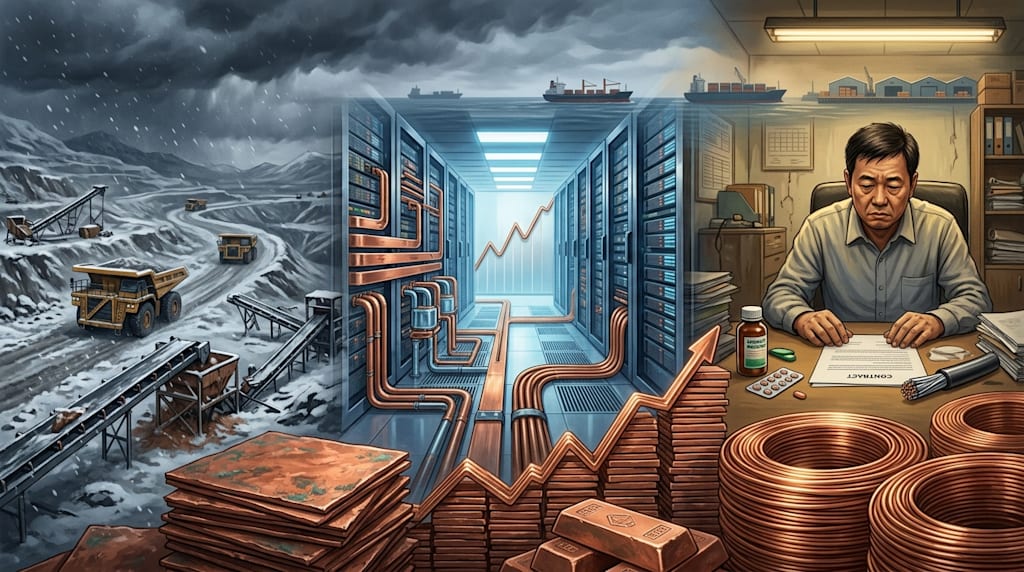
The copper war: from mines to computing power, a great migration of profit along the industrial chain
I
In Yingtan, Jiangxi, in the procurement office of a cable factory, a manager named Chen opened a contract and then closed it again.
The contract had been signed three months earlier at a fixed price, with copper locked in at 98,000 yuan per tonne. Now SHFE copper stood above 110,000. He still had 5,000 tonnes of such fixed-price orders to fulfill. Every tonne he delivered would lose him more than 10,000 yuan.
"The price-adjustment clause allows us to adjust by 3% at most," he said. On the desk sat a bottle of stomach medicine. Most of the blister pack had already been punched empty.
At the same moment, at the Los Pelambres mine in Antofagasta, Chile, the blizzard had just stopped. Antofagasta cut its 2026 production guidance from 650,000 to 700,000 tonnes down to 625,000 to 655,000 tonnes. The reason given was brief: extreme weather, supply disruption. Lundin Mining cut its guidance for the Caserones mine at the same time.
Data released by the Central Bank of Chile on Monday showed that Chile's August copper export value was $4.62 billion, down 14% month on month and 3.2% year on year. It was the lowest monthly figure since July 2025.
Two events separated by the Pacific Ocean. But they were the same event.
II
Copper on the London Metal Exchange touched $14,779 per tonne on the evening of September 8. The main SHFE copper contract hit a high of 111,720 yuan per tonne. The A-share copper sector rose 3.86% overall, with all 17 stocks in the sector closing higher.
If you looked only at the traditional supply-demand table, this price made no sense. Data from the International Copper Study Group showed that the global refined copper market ran a nominal surplus of about 131,000 tonnes in the first half of 2026. Real estate was contracting. Appliance consumption was weak. Traditional manufacturing was not growing explosively.
A book surplus and a price surge at the same time meant that copper's pricing logic was no longer on that supply-demand table.
The most direct driver was the large inventory migration caused by tariff expectations. In August 2025, the United States imposed a 50% import tariff on semi-finished copper products, while refined copper was temporarily exempted. The market widely expected that the United States would impose a 15% import tariff on refined copper from January 2027, with the rate possibly rising to 30% in 2028.
Traders moved faster than policy. In July 2026, U.S. refined copper imports in a single month exceeded 200,000 tonnes, the highest in at least 12 years. In the first half of the year, the United States imported nearly 885,000 tonnes of refined copper, more than double the same period in 2024. COMEX copper inventories accumulated to about 696,000 tonnes, nearly 70% of global exchange visible inventories.
LME registered warrants once fell to 89,900 tonnes in August. Near-dated deliverable spot copper had been drained.
Christian Cifuentes, a senior analyst at the Chilean copper research institution Cesco, said one thing: "The main factor driving this rally is not excess final demand, but the reconfiguration of copper caused by tariffs. This is a localized shortage, not a global demand surplus."
When he said "localized," he meant outside the United States.
III
The supply-side numbers were colder than the weather.
Global copper mine output fell 1.1% in the first half. Concentrate output, the main feedstock for smelters, fell 2.6%. Data compiled by CITIC Securities showed that output from major global copper miners fell 4.6% year on year in the first half, marking four consecutive quarterly declines since the third quarter of 2025. Guidance cuts by leading companies for 2026 and 2027 each exceeded 300,000 tonnes.
Chile's weather was only the latest disruption. The longer-term problem starts in the mines. Investment in copper supply over the past two decades has been insufficient. Ore grades have continued to decline. Environmental and geopolitical costs have raised the bar for extraction. UBS noted that the average capital intensity of copper projects that could be developed over the next decade has risen to about $27,000 per tonne of annual capacity, up about 65% from the 2021 to 2025 average. By 2035, the world will need cumulative new project capital expenditure of about $175 billion to close the supply gap.
This is not a problem that can be solved in a quarter. Nor in a year.
IV
Smelters sit between the two.
When copper prices rise or fall, smelters buy and sell at both ends simultaneously. The spread does not widen because of it. Their profit comes from treatment and refining charges, the fee for turning copper concentrate into refined copper. At the end of 2025, the annual benchmark TC/RC agreed between Chinese smelters and Chilean miner Antofagasta for 2026 was $0 per tonne. Previously, the number was $21.25.
Since the second quarter of this year, spot TC/RCs for copper concentrate have lingered around negative $40. Recently they fell to negative $201.56 per tonne.
For every tonne of copper concentrate processed, smelters earn nothing. They pay to process it.
A manager at a smelter in southwest China said: "The old inertia and experience have almost completely failed." The smelters still standing are mainly surviving on by-products such as sulfuric acid and sulfur. In mid-August 2026, domestic 98% sulfuric acid was priced at 1,940.6 yuan per tonne, up about 170% from 718.4 yuan per tonne in the same period of 2025.
But sulfuric acid is more volatile than copper. Profit from by-products is thin.
V
Downstream manufacturers are under a different kind of pressure.
Copper accounts for 20% to 30% of the manufacturing cost of an air conditioner. For every 10,000 yuan increase in copper prices, the cost of a 1.5-horsepower air conditioner rises by 200 to 300 yuan. The end market is in a price war. That money is hard to add to the selling price. Some appliance makers have begun accelerating the replacement of copper tubes with aluminum tubes.
The cable industry is under tighter pressure. The manager of the Jiangxi cable factory said his company consumes about 110,000 tonnes of copper, aluminum, and other raw materials a year, with costs accounting for 70% to 90% of the total. Two-thirds of its orders are fixed-price contracts. Of the one-third that are open contracts, price adjustments are capped at 3%.
JPMorgan estimates that about 2% of global copper demand will be replaced by aluminum in 2026. The number looks small, but the direction of substitution has been set.
Automakers face the most complicated situation. A battery electric vehicle uses three to four times as much copper as a traditional internal combustion vehicle. Copper consumption per vehicle is 80 to 100 kg. Higher copper prices add about 1,200 yuan to the cost of each vehicle. The vehicle price war continues. Chips are also getting more expensive. Some automakers have accelerated validation of aluminum-for-copper substitution in copper-intensive parts, but core components requiring high conductivity remain difficult to replace.
VI
The new variable on the demand side comes from computing power.
In the past, copper was called "Dr. Copper" because it was a barometer of traditional manufacturing, real estate, and power construction. Buildings and power grids need copper wire and copper tubing. Cars, air conditioners, and refrigerators cannot be made without copper. Now, AI data centers are becoming another source of demand.
Zheshang Securities estimates that a single computing cabinet consumes 800 to 1,000 kg of pure copper in its liquid-cooling cold plate, about 120 kg in liquid-cooled rack busbars, and about 220 kg in 800V DC busbars. A 1 GW data center consumes about 65,800 tonnes of copper. Copper consumption per AI server is three to six times that of a traditional server.
JPMorgan predicts that global data center copper consumption will reach 475,000 to 740,000 tonnes in 2026, with annual new demand of about 110,000 tonnes. Morgan Stanley expects that number to double to 1.3 million tonnes by 2028.
BHP offered a longer-term judgment: global copper demand will rise from about 34 million tonnes per year in 2026 to more than 50 million tonnes per year by mid-century. Pacific Securities estimates that the global copper supply-demand gap will be 40,000 tonnes, 350,000 tonnes, and 430,000 tonnes in 2026 to 2028, respectively.
Copper is shifting from an industrial raw material to a foundational computing-power resource. That identity shift has attracted macro allocation capital. When capital is bullish on AI infrastructure or the inflation-hedge narrative, billions of dollars in long futures positions can lift prices within days.
VII
The trading structure of copper has a distinctive feature.
Global refined copper physical production and consumption total about 26 to 27 million tonnes per year. But the annual cumulative notional trading volume of global copper futures and derivatives reaches more than a billion tonnes. The LME copper contract is 25 tonnes per lot. In 2025, about 1.1 billion tonnes of copper were traded on the LME. COMEX traded about 340 million tonnes. SHFE and INE traded about 200 to 400 million tonnes.
Registered visible inventories across the three major exchanges are often only tens of thousands to hundreds of thousands of tonnes, less than a few days of global consumption.
This means that a small physical delivery demand can trigger violent price moves in the futures market. Recently, the cash-to-three-month backwardation on the LME once widened to $545 per tonne, the highest since the large short squeeze in October 2021.
Copper's financial attributes are strengthening. Intensifying global geopolitical rivalry and high U.S. debt levels have led some institutional investors to question pure paper assets denominated in dollars. Copper, aluminum, gold, and other real assets have been given a degree of monetary substitution and inflation-hedge attributes. After the Russia-Ukraine war, Russia's overseas dollar assets were frozen, and it was gold reserves that supported its credit. That memory remains.
VIII
Views on the outlook are deeply divided.
CITIC Securities expects that under an escalating tariff scenario, the fourth quarter will be a window of high-intensity inventory hoarding, and LME copper could break $16,000 per tonne within the year. Citi expects copper to rise to $15,000 per tonne by the end of 2026. If manufacturing recovery, the energy transition, AI data center construction, or strategic stockpiling demand exceeds expectations, copper could even rise to $17,000 per tonne. UBS expects copper to reach $15,500 per tonne in the coming quarters.
The risks are equally clear. Zhan Dapeng, nonferrous metals research director at Everbright Futures, warned that if the U.S. tariff plan is delayed or shelved, inventories already moved to the United States could flow back, spot tightness outside the United States could ease quickly, and copper prices could see a sharp correction.
Analysis by Xinhua Finance noted that as prices rise to historic highs, the direction of U.S. tariff policy, the risk of inventory flowing back, and changes in the overseas macro environment could increase copper price volatility in the fourth quarter.
IX
In the workshop of the Jiangxi cable factory, workers were testing a batch of aluminum conductor samples.
Aluminum's conductivity is only 61% that of copper. For the same current-carrying capacity, the cross-sectional area of an aluminum conductor must be more than 50% larger. In space-constrained applications, aluminum cannot replace copper. But in some medium- and low-voltage scenarios, it can.
Manager Chen said customer acceptance of aluminum conductors is rising. "In the past, when you mentioned aluminum-for-copper substitution, customers would turn and walk away. Now they sit down and listen to you run the numbers."
On his desk, besides the stomach medicine, was a test report on aluminum conductor samples. The conclusion: some performance metrics met, usable in some applications.
He did not use the word "transformation." What he said was: "First, stay alive."
And on the other side of the Pacific, LME copper inventories are still low. COMEX inventories are still high. Chilean mines are still cutting output. AI data center construction is still continuing.
The copper war is not over. It has only moved to different parts of the chain.
About the Creator
Jin
Writer of reamstories
https://reamstories.com/jin
Enjoyed the story? Support the Creator.
Subscribe for free to receive all their stories in your feed. You could also become a paid subscriber, letting them know you appreciate their work.
Comments
There are no comments for this story
Be the first to respond and start the conversation.