
The Pig Who Ate the Market: Stanley Druckenmiller’s Secret Perceptual Machine
Most traders get slaughtered. He became the predator. Here’s the 40‑year blueprint that beat every algorithm.
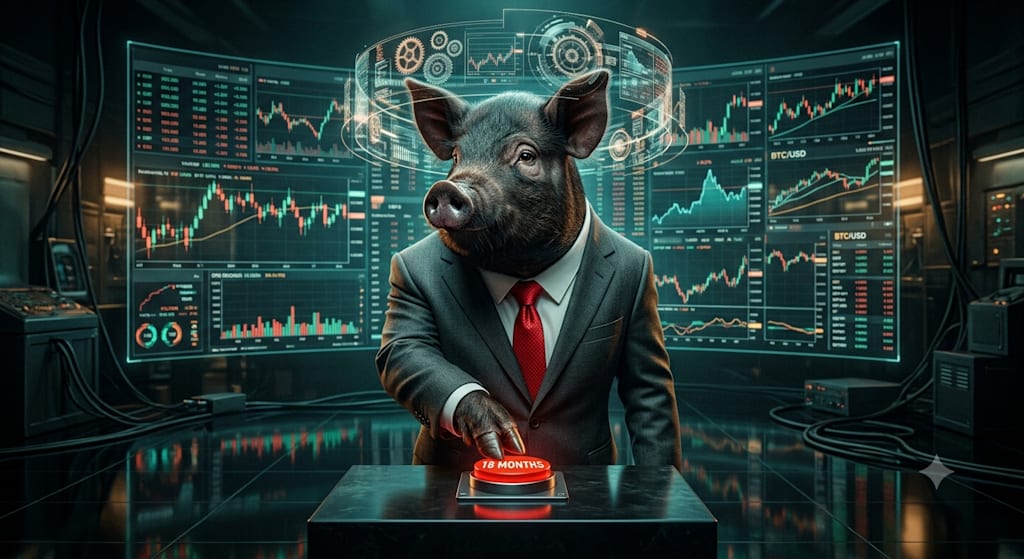
In 1979, in a cramped office at Pittsburgh National Bank, a 25‑year‑old stock analyst named Stanley Druckenmiller was trying to persuade his colleagues. The oil‑price shock from the Iranian Revolution had sent markets into panic; the consensus was to retreat and wait. But Druckenmiller saw something entirely different.
His recommendation sounded like a gambler’s delirium: sell all bond holdings, put 70% of the money into oil stocks and 30% into defence stocks. His colleagues thought the young man had lost his mind.
The market eventually delivered its verdict. His stock picks rose 100%, while the S&P 500 barely budged. The following year, at 26, Druckenmiller was promoted to head of the equity trading desk.
That beginning reveals the core paradox of his entire career: when a pig starts to think, it is no longer prey. It becomes a predator. Decades later, as quantitative storms swept through markets and black swans became routine, that same “pig” who once rampaged through Pittsburgh had turned into one of a handful of macro traders who could navigate structural ruins without losing their footing. Alongside Paul Tudor Jones and George Soros, the era gave him another label—the last macro trader.
This essay does not retell his biography. Instead, it dissects how that pig thinks, how over four decades of market evolution he has continuously iterated a perceptual machine that still extracts excess returns even while “consensus is right 80% of the time.”
I. Time discounting: Declaring war on the present
The foundation of Druckenmiller’s trading philosophy came from his first mentor, an injunction he has since treated as gospel:
“Never, ever invest in the present. You have to visualise the situation 18 months from now, and that is where the price will be, not where it is today.”
The weight of that sentence lies in its absolute negation. It condemns the daily efforts of most market participants, from retail traders to institutional analysts, as an expensive intellectual waste. GDP, CPI, quarterly earnings beats are merely “already‑happened realities” whose information has long been digested by asset prices.
He refined the time frame to 18 months to three years. This is not a rigid holding period but his default perceptual horizon. He admits to putting on a three‑year trade and getting out five days later, reversing his position. The point is not about holding discipline; it is that the starting point of thought is always the future, never the past. When companies are losing money, he does not see a miserable present; he sees margins recovering in three years after capacity shrinks. When companies are earning excess profits, he does not see tempting dividends; he sees margins deteriorating in three years as competition and mean reversion set in.
This is contrarian thinking in the time dimension, but not for contrarianism’s sake. It is a structural resistance to the human cognitive default of linear extrapolation.
II. The three‑tier lens: Liquidity, macro, and valuation
If time discounting is the worldview, the three‑tier framework is the methodology, organised in strict hierarchy.
The first tier is liquidity—central bank policy direction, credit expansion and contraction cycles, global fund flows. This is the water level in the system. Druckenmiller’s famous dictum: “Earnings don’t move the overall market; it’s the Federal Reserve Board.” Earnings are fish; liquidity is water. Fish matter, but without water a fish is just a dead fish.
The second tier is macro structure—interest rates, exchange rates, industry cycles, yield curve behaviour. It tracks the path of money flow. After liquidity is released from central banks, through which channels and at what speed does it enter or exit the real economy and financial assets?
The third tier is valuation. This is where he differs most from convention. He never uses valuation for timing; he treats it as a measuring stick. Only when both liquidity and macro structure align in the same direction does he pull out this ruler and ask: “If my story fully plays out, how far can this move go?”
The discipline of this framework lies in its sequence. You cannot buy a stock simply because it is “cheap.” You must first confirm that water is flowing into its pond.
III. Variant perception and catalysts: Mining non‑consensus from the ruins of consensus
Druckenmiller scoffs at the concept of “contrarian investing,” calling it “overrated.” He quotes Soros’s observation that the crowd is right 80% of the time. To stubbornly stand against consensus is intellectual narcissism, not an investment strategy.
So what does he pursue? A variant perception. First, precisely understand what the consensus is, why it exists, and where it has pushed prices. Then ask the much harder question: “If the consensus eventually proves wrong, where and when will it be wrong?”
Consensus can remain correct for a long time, and prices can stay elevated or depressed because of it. Hence the need for a catalyst. A variant perception without a catalyst belongs only on the watchlist. Only when a policy shift, an unexpected data point, or a technological breakthrough emerges, and only when the crack in the mispricing begins to widen, does he act.
“Valuation only tells me how far the market can go once a catalyst enters the picture to change the market direction.” The catalyst is the trigger, valuation is the scope, and liquidity is the ammunition. All three are indispensable.
IV. Second‑order derivation: Navigating the labyrinth of unintended consequences
This is the dividing line between Druckenmiller and the average macro analyst. The latter is satisfied with explaining first‑order effects: QE lowers rates and lifts asset prices. Druckenmiller, like a chess grandmaster, always thinks three moves ahead. He pinpointed the systemic hazard of zero‑interest‑rate policy with surgical precision:
“The marginal benefits you get through consumption greatly diminish, but there’s one thing that doesn’t diminish, which is unintended consequences.”
When rates are pinned at zero for too long, the first‑order effect (rising asset prices) begins to dull; the second‑order effect (bond‑market pricing dysfunction) starts to ferment; and eventually the third‑order effect (fiscal discipline erodes, deficits spiral) crystallises. Long before mainstream media began discussing MMT, he already saw that after central‑bank credibility is impaired, the re‑valuation of the fiat currency system and the long‑term structural benefit of hard assets like gold become inevitable.
Facing AI, he similarly refuses first‑order thinking. “Anybody who believes that with conviction suffers from arrogance.” Even if the pessimists are right about massive job losses, he argues, the government’s response would be to print money and provide universal basic income, which could produce a second‑order outcome: inflation, not deflation. After all, inflation is ultimately a monetary phenomenon.
V. Internal structure: The best economist
No matter how sophisticated the macro reasoning, it needs a reality check. Druckenmiller’s testing ground is not economic models; it is those 272 charts.
“The inside of the stock market is the best economist I know.”
Every trading day around 4:30 p.m., he reviews 272 charts covering every stock‑market sector, every commodity, and every currency cross he cares about. He is not looking at individual patterns; he is looking at relationships: which sectors are gaining relative strength, which are weakening, and where anomalous correlations between sectors and commodities appear.
Economists rely on lagging data; the internal structure of the market is the pulse of real‑time capital flows. When credit‑sensitive sectors (homebuilders, trucking, retail) have already started to decline, and defensive sectors (utilities, consumer staples) are outperforming, even if GDP data remain glossy, the market has already signalled a recession six to twelve months ahead through its capital reallocation. He will patiently wait for his macro narrative to be confirmed by internal structure before scaling up his position.
VI. Signal attenuation and system reconstruction
Yet this finely tuned instrument, after thirty‑five years of operation, faced an unprecedented shock in the algorithmic age.
Druckenmiller candidly describes the pain: “These algos have taken all the rhythm out of the market... price action versus news—the major disciplinary tool I used for 35 years—is gone.”
In an environment dominated by high‑frequency and quantitative models, price patterns are distorted, and once‑effective signals decay rapidly. “Technical analysis today is about 20% as effective as it was when I started.”
Worse, the signal function of the 10‑year Treasury yield, once “the most important price in the world,” has been nullified by massive central‑bank asset purchases. “When the central banks are buying $120 billion a month of bonds, that’s not the bond market talking—that’s the echo of the printing press.” He further argues for abolishing the Fed’s forward guidance, because when markets begin trading on “what the Fed will say” rather than “what the economy actually is,” price discovery itself breaks down.
Faced with the systematic erosion of his signal set, his response is evolution, not retreat. He does not believe pure machines can make money. Machines have discipline and can do math, but they lack intuition. His ideal “best investor in the world” is a human‑machine hybrid: a human with market intuition and macro vision, using AI as an auxiliary tool for objective scanning and pattern recognition. The human handles narrative, judgment, and the final trigger pull; the machine handles monitoring, quantification, and objective structural data.
VII. Position sizing above all: Be a conscious pig
If all the above methodologies point to “how to think,” then the most important lesson Druckenmiller inherited from Soros concerns “how to bet.”
He unabashedly calls himself “that pig.” Under Wall Street’s adage, “Bulls make money, bears make money, pigs get slaughtered,” he openly declares: “I’m here to tell you I was a pig. And I strongly believe the only way to make long‑term returns in our business that are superior is by being a pig.”
This is not greed; it is a highly disciplined probabilistic mindset. He breaks down the equation: “Sizing is probably 70 or 80% of the equation. It’s not whether you’re right or wrong, it’s how much you make when you’re right and how much you lose when you’re wrong.”
He makes the distinction sharper with a baseball analogy: he had a higher batting average; Soros had a much bigger slugging percentage. A .400 hitter who only hits singles scores far fewer runs than a .270 hitter with extraordinary power. In investing, the winner is not the one with the best predictions, but the one with the best position sizing.
His most important operating rule: become more aggressive when you are winning. When a trade goes against him, he cuts losses decisively. When the trend validates his thesis and paper profits accumulate, he uses “house money” to increase risk exposure. “If you’re up 20‑30%, you’re playing with house money. That’s when you try to get to 60 or 70%.”
VIII. State management: The alchemy of hot and cold
This is the most human, and most easily overlooked, chapter of Druckenmiller’s trading philosophy.
“You must know whether you’re cold or hot.” State assessment precedes position sizing, and position sizing precedes market judgment.
When he is “cold” (in a losing streak, judgment clouded), he forces himself to “bunt,” shrinking positions until he regains rhythm. “If I was down, I had not earned the right to play big.” He observes that 90% of people lose in Las Vegas, not because the odds are heavily against them (usually only a slight disadvantage), but because they do the exact opposite of what they should: they become cautious when winning, and reckless when losing. To recover losses or to brag about winning, they swing for the fences while cold, and the market eventually destroys them.
Before the 1992 sterling crisis, he stepped away from trading for four months. This was not disdain for opportunity, but an honest assessment of his own state. He needed to reset his judgment to zero. Only after regaining the “hot” feeling did he earn the right to go all‑in. Admitting that a tool is broken and voluntarily lowering ambition is far more powerful than any forced “I can win it back.”
IX. Ego‑less reversal: Views are tools, not identity
“If you make a mistake, respond immediately.”
On Black Monday in 1987, he had built a 130% net long position on Friday, based on technical support. Over the weekend, Paul Tudor Jones showed him historical data suggesting the market structure was extremely fragile. At Monday’s open, within an extremely short time, he liquidated all longs and went fully short.
The key was speed and finality, not a shred of hesitation or regret. His view was proven wrong in that instant; he accepted the unpleasant truth and acted immediately.
He refuses to use stop‑loss orders, calling them “the dumbest concept I’ve ever heard.” Yet his exit discipline is even more ruthless than any mechanical stop: when the original reason for entering a position is invalidated, close it immediately, regardless of profit or loss. Views are always tools, never badges of identity. When a tool fails, his response is not to fix it, but to discard it and find the next one.
Epilogue: The perceptual machine
In a 2026 interview, he looked back on hundreds of mistakes with a flat tone: “They’re just a moment in time. When you have these drawdowns—it’s easier said than done, just get over it and move on.”
He reiterated that he is not a natural workaholic; he is simply captivated by the game. Passion drove discipline, and discipline protected him, allowing him to run a complex perceptual machine called “Stanley Druckenmiller” for forty years.
The machine’s core components—time discounting of the future, the three‑tier framework, second‑order derivation, internal‑structure validation, position sizing, state monitoring, and ego‑less reversal—have all been disassembled, dissected, and encoded. But the ultimate secret may lie in that most primal metaphor.
Pigs are usually slaughtered because they are short‑sighted, greedy, and ignorant of timing. But a pig that learns to think, to bet big when hot and shrink when cold, to sniff the wind 18 months ahead—that pig is no longer prey. It has become the predator itself.
When he stood on the podium at the Lost Tree Club in 2015, facing young fund managers eager to capture the next “sterling trade,” and uttered that sentence, he might have been closing a loop:
“Never invest in the present.”
That phrase is both the beginning and the end. Ultimately, it is a simple compass: never invest in the present.
About the Creator
Jin
Writer of reamstories
https://reamstories.com/jin
Enjoyed the story? Support the Creator.
Subscribe for free to receive all their stories in your feed. You could also become a paid subscriber, letting them know you appreciate their work.
Comments
There are no comments for this story
Be the first to respond and start the conversation.