
The Fridge That Explained the 2026 Nobel Prize in Economics
Four shop owners, one broken circle, and why confidence moves money when rate cuts cannot.
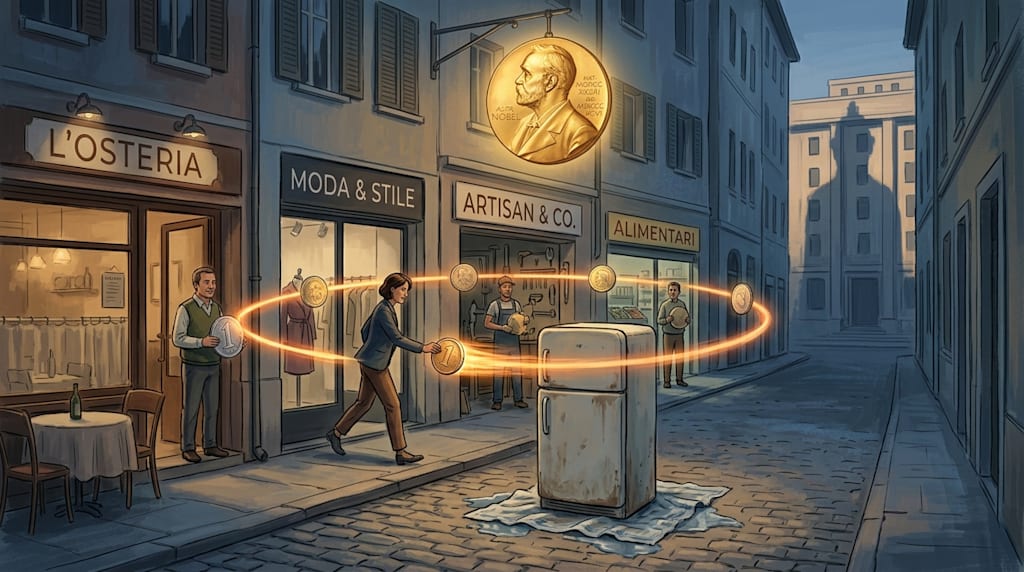
The street had four shops. Old Wang ran a restaurant. Old Zhang sold clothes. Old Li did renovation. Old Huang ran a supermarket. They were owners, neighbors, customers.
In good years, money moved like water. Old Wang’s restaurant filled at noon. He bought two new shirts from Old Zhang. He hired Old Li to redo his kitchen. He bought the best cigarettes and liquor from Old Huang. Old Zhang’s clothes sold. She took her family to Old Wang’s. She asked Old Li to redo her storefront. She bought imported fruit from Old Huang. Old Li had work. He bought a sofa from the furniture floor above Old Huang’s supermarket. He treated his workers at Old Wang’s. Old Huang’s supermarket had traffic. He bought his wife several outfits at Old Zhang’s. He asked Old Li to renovate his old apartment. A circle. Wang earned Zhang’s meal money. Zhang earned Huang’s clothing money. Huang earned Li’s cigarette and liquor money. Li earned Wang’s renovation money. Everyone’s pocket was fuller. Everyone spent. They smiled and thought it would last.
Then the wind changed.
Old Wang noticed fewer tables at noon. He told himself it was weather. Then a regular ordered one dish instead of three. Old Wang stopped recommending new dishes. He had planned to replace the old fridge. He went to Old Huang’s supermarket, looked at a model, checked the price, and walked away. The fridge had a broken seal. A towel on the floor caught the drip. He put the towel back.
Old Zhang noticed fewer buyers. Regulars tried on clothes, looked in the mirror, and said, “I’ll think about it.” She ordered less stock. She put last year’s styles on sale. She had wanted Old Li to repaint one wall. She looked at the wall, at the peeling corner, and did nothing. Old Li came in. She said, “This one is cheap after the discount.” He smiled. He did not buy.
Old Li’s renovation business fell. New apartments stopped opening. Old apartments stopped being redone. Two workers left. He pushed back the new small truck he wanted. He used to buy two cartons of good cigarettes a week from Old Huang. He cut to one. Then he switched to a cheap brand. Old Huang asked how it was going. Old Li waved a hand. “No work. Saving what I can.”
Old Huang’s supermarket held on at first. People still bought rice and oil. Then rice and oil sales fell. Old Wang used to buy dozens of pounds of meat at a time. Now he bought a few pounds. Old Zhang’s staff used to order lunch from him. Now they brought food from home. Old Huang cut orders to the minimum. Gaps appeared on shelves. His wife pointed at a new coat in a catalog. Old Huang glared. “At a time like this?” He quit smoking. He said he was saving.
The circle slowed.
Old Wang did not buy the fridge. Old Huang sold one less appliance. Old Huang sold one less appliance, so he did not buy clothes from Old Zhang. Old Zhang did not sell clothes, so she did not hire Old Li. Old Li had no renovation work, so he did not eat at Old Wang’s. Old Wang’s restaurant had fewer customers, so he did not buy the fridge.
One day the four met on the street. Old Wang sighed. “How’s business?” Old Zhang shook her head. “No one buys clothes.” Old Li gave a bitter smile. “I would buy. I have no money.” Old Huang said, “I would treat everyone. The supermarket cash flow is not enough.” They looked at one another. They said nothing. That night, Old Huang’s shelves still had gaps. Old Wang’s fridge hummed louder. The towel on the floor was wet again.
Old Wang spoke first. “Maybe… tomorrow I go to Old Huang’s and buy a fridge? The old one is done.” Old Huang’s eyes lit up. “You buy a fridge? Then I’ll tell my wife to look at coats at Old Zhang’s.” Old Zhang smiled. “You buy a coat? Then I’ll ask Old Li to fix the storefront.” Old Li slapped his leg. “You fix the storefront? Then tonight I’ll treat people at Old Wang’s restaurant.”
They laughed. Then they almost cried. The circle could turn again only if the money left their hands. Whether the money left their hands depended on what they expected tomorrow to be. That night, Old Wang wrote “fridge” on the back of a menu. Old Huang’s wife circled a coat in the catalog. Old Zhang called Old Li. Old Li called two workers back for a small job. The fridge was still old. The coat was still in the catalog. But the first order was placed.
The same channel runs through the macroeconomy.
In October 2026, the Royal Swedish Academy of Sciences awarded the Nobel Prize in Economic Sciences to Robert E. Hall and Michael Woodford. The citation: for their contributions to the microeconomic foundations of macroeconomic stabilization. John Hassler, chair of the committee, said the work of the two laureates provides a stable theoretical foundation now used by central banks and finance ministries around the world.
The prize pointed at a question that has sat in every central bank since the 1970s: why does a rate cut sometimes move the economy, and sometimes not?
The textbook answer is simple. Cut the policy rate. Borrowing becomes cheaper. Households spend. Firms invest. The economy picks up.
Woodford’s answer is less simple. Households and firms are forward-looking. The decision to spend or invest today does not depend only on the short-term rate today. It depends on what people expect about long-term rates and the broader economy tomorrow. If a family thinks next year will be worse, a cheap loan is still a loan. If a firm thinks demand will shrink, a low interest rate is still a reason to wait. The money stays on the table.
That is the street. Old Wang’s fridge was not expensive. The loan, if he took one, would have been cheap. He still walked away. He was thinking about the future he expected.
Woodford’s work, especially in Interest and Prices, showed how central bank rules, communication, and credibility affect the economy because they change what households and firms expect. When the policy rate is already near zero, a central bank can still lower long-term rates by convincing the market that future short-term rates will stay low. The rate is one tool. The signal is another.
Central banks call it forward guidance. Long-term rates depend on expected future short-term rates. If the central bank can make the market believe that rates will stay low for years, long-term rates fall even if the current short-term rate does not. Borrowing costs for households and firms fall. Spending and investment can return.
The reverse also works. A central bank governor stands at a press conference and says rates will stay higher for longer. Families delay buying a house. Firms slow hiring. The words do the work.
Confidence is the channel through which rate cuts travel. A rate cut is the base. Confidence is the multiplier. If the multiplier is one, a 100-basis-point cut has its ordinary effect. If the multiplier is two, the effect is larger. If the multiplier is zero, the cut does nothing. If the multiplier is negative, the cut can make things worse. People think the central bank sees something worse and pull back further.
The street also shows a fallacy that macroeconomics has a name for. For Old Wang alone, holding cash was rational. For Old Zhang alone, holding cash was rational. For Old Li and Old Huang, the same. But when all four held cash, every business got worse. Each person’s rational move became a collective trap. Economists call it a fallacy of composition. Sociologists call a version of it a self-fulfilling prophecy. In 1948, Robert K. Merton used the Great Depression as an example. People expected decline. They cut spending. The cut spending made the decline happen. The expectation confirmed itself.
Woodford’s framework is a way to understand how policy can break that loop. A central bank cannot buy a fridge for Old Wang. It cannot order a coat for Old Huang’s wife. But it can shape the expectations that make Old Wang and Old Huang willing to move. The policy signal, if credible, can coordinate scattered households and firms on a different future.
Credibility matters more than force. Japan’s central bank used forward guidance early. It adopted a zero-interest-rate policy in 1999 and quantitative easing with forward guidance in 2001. Forward guidance had a noticeable effect in the early years of unconventional policy. Later, the effect weakened as the market grew desensitized to the signals. The channel did not disappear. It clogged.
The Federal Reserve’s experience points the same way. When private-sector expectations are heterogeneous, forward guidance becomes less effective. If the public does not understand or believe the central bank’s commitment, the expectations channel narrows. The policy is announced. The transmission does not happen.
China’s 2026 Government Work Report put the issue in plain language: “improve expectation management mechanisms, boost social confidence.” The phrase moves expectation management into the center of macroeconomic governance. Expectation management requires coordination of policy targets, tool design, execution timing, and information communication. For a household, a credible signal of mid-term income growth comes from observable institutional changes: whether social security is more solid, whether employment is more stable, whether wage formation is improving.
That is the street again. Old Wang moved when he saw Old Huang’s eyes light up at the word “fridge.” Old Huang moved when his wife circled a coat, Old Zhang smiled, and Old Li slapped his leg. The signal became credible when it became a concrete order.
On the street, the four did not know when the economy would get better. They knew that if none of them bought from the others, the street was finished. Old Wang said, “So… tomorrow?” Three people nodded. “Tomorrow.”
The fridge was still old that night. The coat was still in the catalog. The storefront still had a peeling corner. But the order had been placed. The money had not yet moved. The expectation had.
Old Wang turned off the light in the restaurant. The fridge hummed. The towel on the floor was wet. On the back of a menu, the word “fridge” was written in blue ink.
About the Creator
Jin
Writer of reamstories
https://reamstories.com/jin
Enjoyed the story? Support the Creator.
Subscribe for free to receive all their stories in your feed. You could also become a paid subscriber, letting them know you appreciate their work.
Comments
There are no comments for this story
Be the first to respond and start the conversation.