
The Five Days That Ended Jensen Huang’s Nvidia
A private scandal, a national-security probe, and a board that proved it could cut loose the man who was the company.
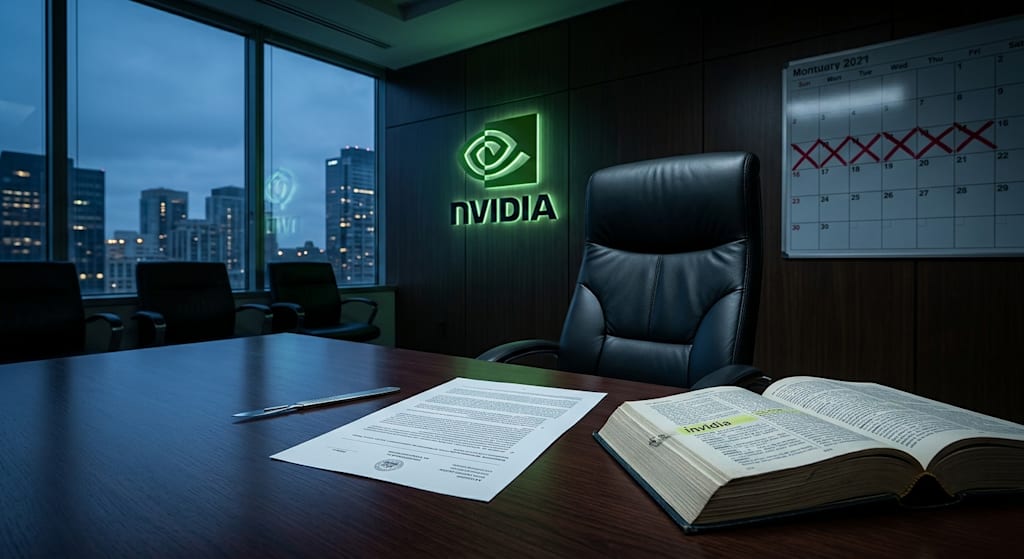
From invidia to invidious: Nvidia’s Five-Day Excision
On November 12, 2026, Nvidia posted an announcement on its website. It ran to fewer than a thousand words. There was no farewell letter, no statement from the founder—only one cold sentence: Jensen Huang was resigning as president, chief executive officer, and board member, effective immediately. From the apology letter of November 8, in which he admitted to an extramarital affair, to the moment his resignation took effect, five days had passed. A founder who had run the company for thirty-three years lost the line that belonged to him in an official document.
Nvidia’s governance structure is unusually “clean” among Silicon Valley giants: eleven board seats, with Huang the only internal director and the other ten all independent; he held about 3.58% of the shares and no super-voting stock; the company’s charter allowed the board to remove senior executives by majority vote. That structure was practically inert while Huang was at the height of his power, but the moment crisis struck it became an efficient cutting machine. On the same evening the resignation took effect, Nvidia announced the creation of the first board-chair position in its history, to be filled by Harvey C. Jones. The last blank space in the governance structure was filled at the very moment he left. This was a separation surgery carried out with precision on institutional rails. It was not a hasty coup.
The crisis itself was not complicated. On November 8, Huang admitted the affair in a memo to employees and apologized to his family and the company. Had it ended there, it might have been just another Silicon Valley private-conduct scandal. The board at one point publicly said there was “no reason to believe that national security or Nvidia confidential information was compromised,” and that Huang would continue to perform his duties “without interruption” during the investigation. What made the situation irreversible was the person linked to the affair: a woman suspected by U.S. officials of ties to Chinese intelligence, and the data-center company where she had worked, Megaspeed, which had business dealings with Nvidia. The affair was thus dragged from the private sphere into the minefield of national security and export controls, and the focus of the investigation shifted from “whether a personal relationship violated company policy” to “whether the contact caused commercial-secret or geopolitical risk.”
It was at this point that The Economist published its comment, titled “Jensen Huang Must Go.” The article’s subheading used a single word: Nvidious. The cleverness of the word rests on the etymology of Nvidia’s own name. When the company was founded in 1993, Huang took the root from the Latin invidia (envy), combined it with “NV” (short for Next Version), and coined “Nvidia,” hoping its graphics cards would make competitors jealous. But the English adjective invidious also comes from invidia, and it means “offensive, repellent, unpleasant.” Two words from the same root—one pointing to the desire to be envied, the other to the reality of being resented—and The Economist used a coined word to complete a revaluation of Nvidia’s position: it had gone from an industry benchmark that inspired envy to a governance liability that inspired revulsion.
The comment went beyond wordplay. The article’s closing line, “And his should not be the only head to roll,” borrows the metaphor of “heads will roll” but uses ellipsis to avoid repetition, setting out its central demand for accountability: Huang should not be the only one to leave. The weight of that sentence can only be fully read in what followed. The day after the resignation, House Speaker Johnson said publicly that, with Huang resigning over the “spy scandal,” Congress was “gradually forming a consensus” on tightening exports of advanced AI chips to China. Democratic leaders on the House Ways and Means Committee and the Senate Finance Committee wrote to the Commerce Department demanding that all records related to approvals of Nvidia’s China chip sales be preserved, and directly questioned whether the Trump administration was using “national-security tariffs” as cover for a de facto export tax. Huang’s departure did not calm the storm; it added fuel to the legislative momentum for tighter controls. As one think-tank analyst put it: Congress can still subpoena him, and Nvidia must still conduct an independent investigation “to clarify whether the problem involves more than Huang.” The “other heads that should roll,” as The Economist put it, point precisely to the network of political and business ties wrapped around Nvidia.
The market’s reaction split in two directions. When the news landed, Nvidia fell more than 13% in premarket trading, and its market value dropped below $4 trillion for the first time since July 2025; the decline narrowed to 4.34% at the close, at $166.19, but the stock was still more than 30% below its early-October high. That same evening, however, AMD rose more than 5% and Broadcom rose 5.5%. One financial outlet summed up the night as “one whale falls, all things rise”—investors sold Nvidia while betting that its orders and share would flow to competitors. Several investment banks quickly cut their target prices: Bernstein from $400 to $200, Baird from $500 to $200, and Morgan Stanley removed Nvidia from its list of top picks. Goldman Sachs’s characterization represented the mainstream Wall Street calibration: this was a “major but manageable negative event,” but execution risk over the next twelve to eighteen months had risen significantly. In analyst language, “manageable” meant short-term financial numbers would not collapse immediately; “execution risk” acknowledged a more fundamental fact—Huang’s operational involvement in Nvidia was so deep that no successor could quickly replicate that highly personalized decision-making rhythm.
The man cut away by the board was precisely the man the company’s insiders most wanted to keep. After the resignation news broke, a post by a senior engineer on Nvidia’s intranet drew more than 1,600 comments, about 97% of them hoping Huang would stay; a public petition called “Stand with Jensen” passed 15,000 signatures; people placed flowers at the company’s headquarters, and one person was photographed crying at the entrance. At the same time, Nvidia had never disclosed any written succession plan, and in its announcements over the previous year the word “succession” appeared zero times. CFO Colette Kress was pushed into the temporary CEO role. She joined Nvidia in 2013 and had nearly twenty-five years of finance background at Microsoft and Cisco; she is a familiar face to investors, but analysts generally see her as better suited to “steadying confidence” than “defining direction.” The internal long-term candidate most favored was Ian Buck, vice president for hyperscale and high-performance computing—he helped develop the CUDA architecture, and CUDA is the underlying code of Nvidia’s moat. One analyst’s summary of the Huang-Nvidia relationship was widely quoted: “It’s like Jobs to Apple, Musk to SpaceX—you could even say Nvidia is Jensen Huang.” The board proved in five days that it had the power to remove the man; no one proved that the company after his removal would still be the same company.
The last complete public statement Huang left was a line from his November 8 apology letter: “I love our country and our company. I am committed to protecting NVIDIA and supporting America’s national security.” Read after his resignation, the sentence carries a prescient irony: he tried to separate personal misconduct from loyalty to the country, but events moved in precisely the opposite direction—personal relationships were national-security-ized, and national security was then used by Congress as leverage to tighten industrial controls. Nvidia’s dilemma is that it can neither fully separate itself from the founder’s personal conduct (because “Nvidia is Jensen Huang”) nor, immediately after the separation, produce a narrative that does not depend on the founder. Interim CEO Kress will face analysts on a conference call as CEO for the first time on November 17; the market expects revenue of around $108 billion and gross margin of about 74%, the guidance Huang had previously given. The numbers may pass for now, but the more fundamental question will not disappear: after a company defined by its founder for thirty-three years sees that founder leave in the most undignified way, what does it rely on to answer the question “Who are you?”
The Economist’s word “Nvidious” did more than judge whether a CEO should stay or go. It reversed a value judgment: envy was once the ambition Nvidia actively planted in its own name; revulsion has now become the public impression it passively bears. And the weight of “he should not be the only one held accountable” lies in its refusal to reduce a structural crisis to a personal scandal. Huang is gone, but none of the political-business ties, export-control controversies, and governance gaps wrapped around Nvidia have automatically unraveled with his departure. Within five days, the board proved it had the ability to remove a founder. The next question is whether it can prove that the company does not need a man “too big to fail” in order to continue to exist.
About the Creator
Jin
Writer of reamstories
https://reamstories.com/jin
Enjoyed the story? Support the Creator.
Subscribe for free to receive all their stories in your feed. You could also become a paid subscriber, letting them know you appreciate their work.
Comments
There are no comments for this story
Be the first to respond and start the conversation.