
The Challenge Nobody Talks About in Prop Firms
Risk Synchronization Explained

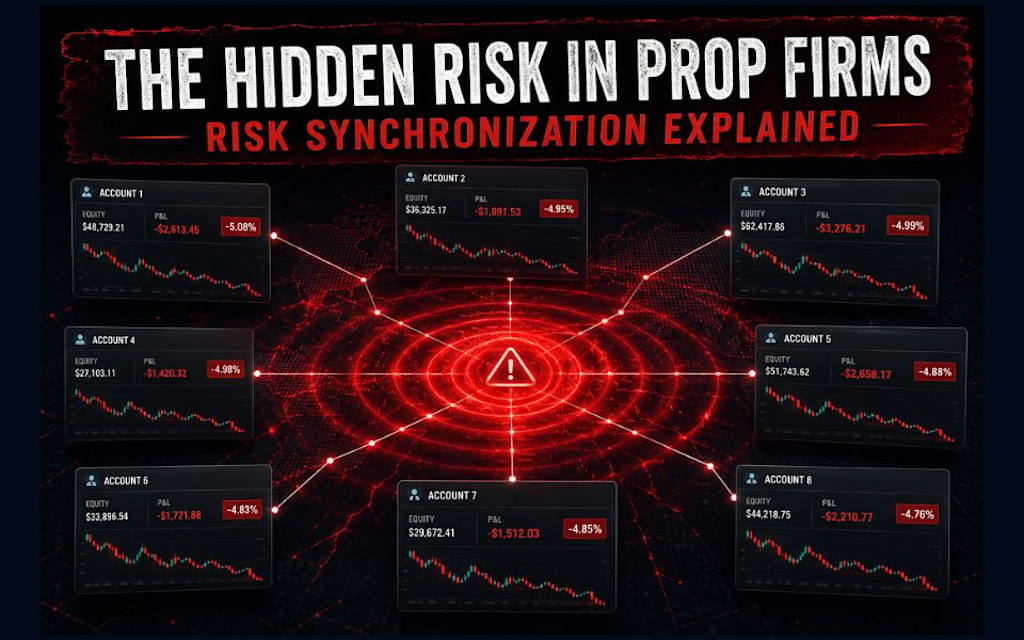
Most Prop Firm founders focus only on
→ Growing users
→ Funding models
→ Payout systems
But there is another challenge: Risk Synchronization.
This refers to how risk is distributed and managed across traders, strategies, and market conditions within the same platform. Even if individual traders perform well, the system can become unstable if overall risk is not properly aligned.
If risk is not managed properly, platform profitability becomes difficult to sustain.
Keep reading the blog to know in detail!
Risk Synchronization: Hidden Challenge in Prop Firm
The Illusion of Diversification
A common belief among traders is that multiple accounts automatically mean diversification.
For example, splitting $400,000 into four $100,000 accounts may feel like risk is distributed. Many assume that a loss in one account does not affect the others.
However, when all accounts are linked through a trade copier, they no longer operate independently. Instead, they behave like one large exposure spread across multiple endpoints.
This removes true diversification.
A single market move affects all accounts at the same time, turning what appears to be separation into a unified risk structure.
In reality, synchronization converts multiple accounts into one connected system where a single failure can impact everything simultaneously.
Execution Delays and Slippage Differences
Prop firms depend on brokers, liquidity providers, and bridge systems to execute trades. When a master account places an order, the copier system sends the same instruction to all connected accounts.
Even small execution delays measured in milliseconds can create meaningful differences.
During normal market conditions, this impact is minor. But during high-volatility events such as news releases or sudden economic shocks, the effect becomes significant:
- The first account may execute at the expected price
- The second may experience slight slippage
- Later accounts may receive worse fills due to price movement
Although the strategy is identical, outcomes differ across accounts.
This creates execution asymmetry, where performance divergence is driven not by trading decisions but by timing differences.
Drawdown Correlation Across Accounts
Most prop firms enforce strict daily or maximum drawdown rules. This is where risk synchronization becomes critical.
When multiple accounts follow the same trade setup, they are exposed to the same market movement. If the price moves sharply against the position, all accounts attempt to exit at the same time.
However, due to execution differences:
- Some accounts close within acceptable loss limits
- Others experience delays or slippage
- Some breaches drawdown thresholds and fail instantly
This means a trader can execute a correct strategy, yet still lose accounts due to system-level execution variance.
The key issue is that risk is no longer isolated per account. It becomes correlated across the entire structure.
System-Level Monitoring and Pattern Risk
Prop firms also monitor trading behavior at a broader level, not just individual account performance.
When multiple accounts show identical:
- Entry timing
- Lot sizes
- Instruments
- Exit behavior
It can trigger internal risk flags.
Even if no formal rule is broken, highly synchronized trading patterns may be classified as automated or clustered activity. Some firms may investigate or restrict accounts based on these patterns.
This introduces an additional layer of risk beyond market performance: behavioral detection risk.
How to Achieve Proper Risk Synchronization in Prop Firm?
To manage multiple prop firm accounts safely, traders use structured risk control methods instead of copying trades blindly across all accounts.
This approach is also part of modern Prop Firm Solutions, where systems are designed to reduce exposure imbalance and improve long-term stability.
1. Basket Distribution
Instead of placing the same trade size on every account, traders divide accounts into groups or “baskets.” Each basket carries only a portion of the total risk. This prevents all accounts from being exposed to the same level of loss at once.
2. Dynamic Risk Rotation
If one group of accounts goes through a losing phase, traders shift focus to another group with better performance. This helps protect capital by avoiding continuous pressure on all accounts at the same time.
3. Position Sizing Method
A structured formula is used to decide how much to risk per trade:
This helps traders control exposure logically instead of guessing lot sizes. It ensures that even a losing streak does not exceed account safety limits.

Example
If a trader has a maximum drawdown limit of $1,000 and expects a possible 5 consecutive losing trades, then:
Risk per trade = 1000 ÷ 5 = $200
This means the trader should risk $200 per trade to ensure that even after a losing streak, the account does not exceed the allowed drawdown limit.
Conclusion
Risk synchronization is one of the most overlooked challenges in prop firm operations. While scaling multiple accounts can look like a smart growth strategy, it also creates hidden connections that turn separate trades into a single system-wide exposure.
When execution differences, correlated positions, and strict drawdown rules come together, even a well-planned strategy can face unexpected failures. This is why success in prop trading is not only about finding good trades, but also about managing how those trades are executed and distributed across accounts.
For both traders and founders, understanding risk synchronization is essential. It helps build a more stable structure, reduces hidden vulnerabilities, and supports long-term growth in a highly competitive environment.
About the Creator
Augustin
Sharing easy-to-follow content about trading platforms, trading tech, modern fintech and blockchain development.
Enjoyed the story? Support the Creator.
Subscribe for free to receive all their stories in your feed.
Comments
There are no comments for this story
Be the first to respond and start the conversation.