
The $7.5 Trillion Ocean: Why Forex Dwarfs the Stock Market
Think the New York Stock Exchange is big? Think again. We are diving into the staggering scale of the foreign exchange market and why it is the real engine of global finance.

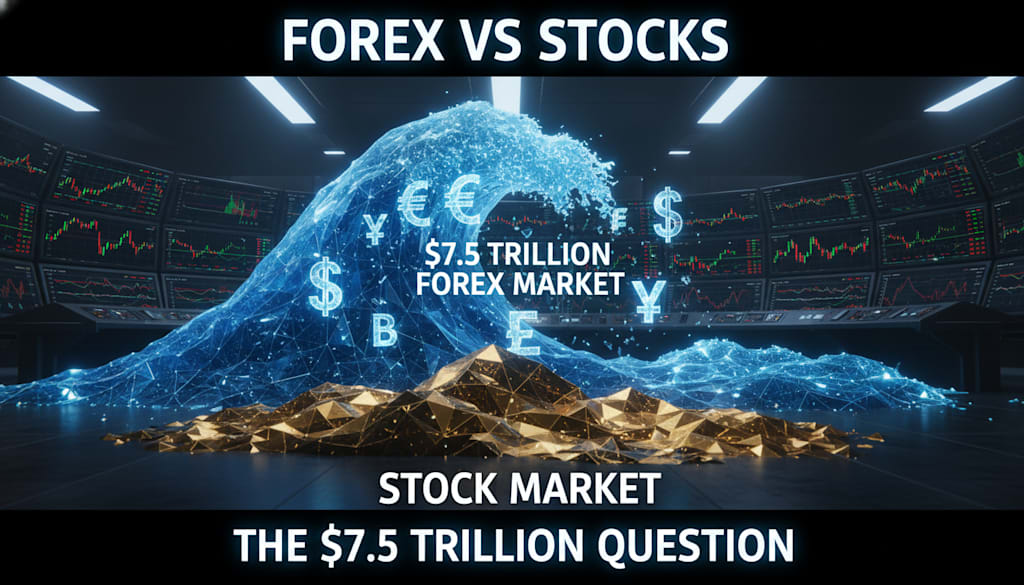
Think the New York Stock Exchange is big? Think again. We are diving into the staggering scale of the foreign exchange market and why it is the real engine of global finance.
It’s 3:00 AM in New York. The lights of the Stock Exchange are off, the trading floor is a ghost town, and the ticker tape has long stopped its frantic dance. But somewhere in a dimly lit home office in London, or a high-rise in Tokyo, a trader is watching a screen pulse with life. The Great British Pound is sliding against the Japanese Yen, and billions of dollars are changing hands in seconds. While Wall Street sleeps, the world’s largest financial market never even blinks.
We’ve been conditioned to think of the stock market as the pinnacle of wealth. Movies like The Wolf of Wall Street paint a picture of frantic shouting and paper-strewn floors as the ultimate theater of money. But there’s a bigger stage—a much bigger stage. If the stock market is a local swimming pool, Forex is the Pacific Ocean.
The David and Goliath Comparison
Let’s look at the cold, hard numbers. On a busy day, the New York Stock Exchange (NYSE) might see a trading volume of around $200 billion. That sounds like a lot until you look at the Foreign Exchange (Forex) market. According to the latest data from the Bank for International Settlements, the Forex market handles over $7.5 trillion per day.
Let that sink in. The entire daily volume of the world’s largest stock exchange is just a tiny ripple in the Forex sea. It would take the NYSE over a month of trading to match what happens in the currency markets in just 24 hours.
Why the massive disparity? Because the stock market is limited. You’re trading shares of individual companies—Apple, Tesla, Amazon. But Forex? You’re trading the very grease that keeps the wheels of global commerce turning. Every time a car manufacturer in Germany buys parts from Mexico, or a tech giant in California pays its developers in India, a Forex transaction occurs. It is the fundamental layer of the global economy.
Decentralization: The Wild West of Finance
One of the most striking differences between these two giants is how they are built. The stock market is centralized. If you want to buy shares of a US-listed company, it generally goes through a central exchange like the NYSE or NASDAQ. There are opening bells, closing bells, and strict oversight.
Forex is the opposite. It is an Over-the-Counter (OTC) market. There is no central building, no single boss, and no closing bell. It is a global network of banks, hedge funds, and retail traders linked electronically.
"In the stock market, you’re betting on a horse. In Forex, you’re betting on the entire track, the weather, and the speed of the grass growing."
This decentralized nature is exactly why the market is open 24 hours a day, five days a week. When one session ends (like New York), another is just heating up (like Sydney or Tokyo). For the trader who has a day job, this is the ultimate playground. You don't have to wait for the 9:30 AM bell to make a move.
Liquidity and the "Instant" Fil
If you’ve ever tried to sell a penny stock or a niche small-cap company, you know the frustration of waiting for a buyer. Sometimes the price you see isn't the price you get. This is a liquidity issue.
In the Forex market, liquidity is practically infinite. For major pairs like the EUR/USD, there is almost always someone willing to take the other side of your trade. This means "slippage" (the difference between your expected price and the actual price) is much lower than in the stock market. You can enter and exit positions of massive size without moving the market price—something even the biggest whales can't always do in the S&P 500.
The Double-Edged Sword: Leverage
Here is where things get spicy. In the stock market, you might get 2:1 leverage from your broker. That means if you have $1,000, you can trade $2,000 worth of stock.
In Forex, leverage can reach 50:1, 100:1, or even higher in some jurisdictions. This is why small retail traders are drawn to it. You can control a $100,000 position with just $1,000 of your own money.
But let’s be real: this is why many people lose their shirts. While the stock market generally moves in single-digit percentages over a week, currency pairs might move less than 1% in a day. To make significant money on that tiny movement, traders use massive leverage. It turns a tiny breeze into a hurricane. If the trade goes against you, that $1,000 can vanish in the time it takes to pour a cup of coffee.
Is One Better Than the Other?
It isn't about which is "better"; it's about what fits your personality.
Choose the Stock Market if: You prefer fundamental analysis, you want to own a piece of a brand you love, and you like the security of a regulated, centralized exchange. It’s a marathon, not a sprint.Choose Forex if: You’re a night owl, you love macroeconomics (geopolitics, interest rates, global trade), and you have the discipline to handle high volatility and leverage. It’s a high-stakes chess match played at light speed.
How to Transition from Stocks to Forex
If you're used to the relatively slow pace of equity trading, Forex will feel like jumping onto a moving train. Here is a quick guide to getting your feet wet:
Start with the Majors: Stick to pairs like EUR/USD or GBP/USD. They have the most liquidity and the lowest spreads.Learn Macroeconomics: Forget quarterly earnings reports. In Forex, the "earnings reports" are Federal Reserve meetings and employment data (Non-Farm Payrolls).Respect the Leverage: Just because your broker offers 100:1 doesn't mean you should use it. Treat your capital like your lifeblood.Use a Demo Account: This isn't optional. The speed of currency movements requires a different muscle memory than stock trading.
The stock market will always have the glamour. It has the IPOs, the celebrity CEOs, and the CNBC segments. But behind the scenes, the Forex market is the one that actually moves the world. It’s bigger, faster, and more complex. It isn't just a market; it’s the heartbeat of global capitalism. If you're ready to leave the pond and swim in the ocean, just make sure you know how to navigate the currents.
About the Creator
Alex John
Today I will share with you how to trade option trading. Although this indicator is made for Stock Market, Forex Market if you work in other pairs then you can use it. Like:- Nifty, Banknifty, XAUUSD, EURUSD, USDCAD, EURCHF, GBPUSD,etc.
Enjoyed the story? Support the Creator.
Subscribe for free to receive all their stories in your feed.
Comments
There are no comments for this story
Be the first to respond and start the conversation.