
The 0.03% That Has Hong Kong Asking: Is the Hong Kong Dollar Still the Only Currency That Matters?
Hong Kong says paying a tiny share of government expenses in RMB is just practical. Markets heard something bigger.
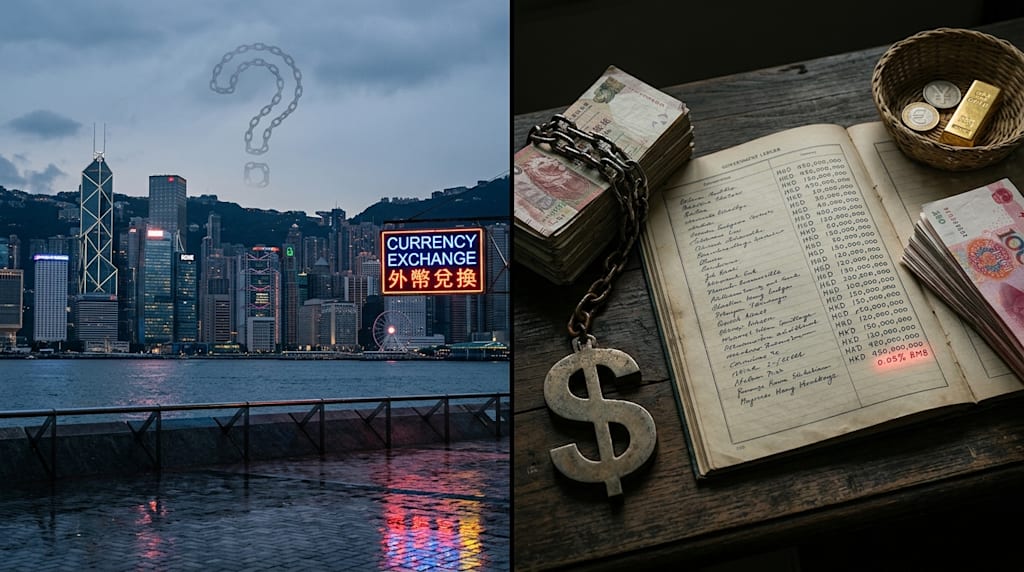
HKD and RMB: The Symbolic Cost of a 0.03% Expenditure
September 2026, Hong Kong SAR Government Headquarters. Page 47 of a five-year plan document. One sentence: the government will take the lead in studying and promoting the use of RMB to pay government expenses in more suitable scenarios.
No press conference. No televised address. The market began to react two days later.
Government sources told local media that the government currently pays about RMB 20 million a month. The money goes to civil servants' training on the mainland, Old Age Allowance under the Guangdong Scheme, and Old Age Living Allowance. That is about RMB 240 million a year. The government's total expenditure budget for 2026-27 is HK$843.4 billion. The RMB spending accounts for 0.03%.
Add the revised HK$35 million budget for mainland training at the Civil Service College. Add HK$5.282 billion for Dongjiang water. The total is HK$5.317 billion. That is 0.6% of annual expenditure.
Chief Executive John Lee said on a radio program that for some contracts with the mainland, the government is considering settlement in RMB rather than Hong Kong dollars. He gave two examples: civil servants' training on the mainland, and the purchase of Dongjiang water from Guangdong.
Government sources also said RMB will not be used to pay civil servants' salaries.
Secretary for Financial Services and the Treasury Christopher Hui called the arrangement "a natural development." His logic: the government receives RMB in different scenarios. It issues RMB bonds. It has legislated to allow stock stamp duty to be calculated and paid in RMB. It needs RMB payment scenarios to match that income and avoid currency-matching problems.
In July 2026, the Legislative Council passed an amendment allowing stamp duty on RMB counter trading of dual-counter securities to be calculated and paid in RMB. Implementation is expected in mid-2027.
Chong Tai-leung, associate professor in the Department of Economics at the Chinese University of Hong Kong, said the Hong Kong government is building a system of RMB income and expenditure. He predicted that the government might eventually collect taxes in RMB. "If some foreign companies do mainland business in Hong Kong, they receive RMB, and they are willing to pay taxes in RMB, the government will accept it. The whole mechanism is then established."
Kevin Tsui, chief economist at Orientis, said the Hong Kong government's role used to be making policy and building financial infrastructure. Now it is entering the field itself. He explained: "If a step was taken earlier to issue RMB bonds, now after issuing them it will use them, buy things. It sees that the market cannot easily start this kind of large-scale application, so it does it first."
Pantheon Macroeconomics published a report after the policy was announced. Economists Duncan Wrigley and Kelvin Lam wrote that the Hong Kong government's decision to pay some expenses in RMB was a first. It would trigger concerns about the importance of the Hong Kong dollar and its credibility.
The report also said the authorities' intention is to expand the use of RMB. The Hong Kong government has already issued RMB bonds. Finding more ways to use those funds will help increase issuance and circulation.
Veteran financial journalist Ngan Po-kong raised a specific concern. As a major procurer, the government paying for goods in RMB benefits Chinese state-owned enterprises that quote in RMB. They avoid exchange-rate fluctuation costs. Hong Kong, US, and European companies that can currently be paid in Hong Kong dollars would have to spend more on foreign-exchange management and hedging. Competitive conditions would be weakened.
HKMA Chief Executive Eddie Yue said in May this year that as of the end of 2025, US dollar assets accounted for less than 80% of the Exchange Fund. He added that the authority prefers to diversify assets. In recent years it has shortened the maturity of its US dollar assets to increase liquidity amid global uncertainty.
HKMA data show that US dollar assets in the Exchange Fund's "Backing Portfolio" and "Investment Portfolio" have fallen from more than 90% to about 79%. Non-US-dollar assets include RMB, euros, yen, and sterling.
This year's Policy Address proposed that the HKMA is studying a moderate increase in gold holdings by the Exchange Fund and participation in Hong Kong's spot and futures markets. Eddie Yue said the Exchange Fund's diversified investment portfolio already has a small gold position, and it is studying increasing the allocation. Existing gold stock will gradually be transferred to a designated warehouse of the Hong Kong Gold Settlement Corporation.
In August 2026, the Hong Kong Securities and Futures Professional Association submitted policy recommendations to the public consultation on the Policy Address. The group called on the authorities to follow the global trend of "de-dollarization" and include "reform of the Hong Kong dollar linked exchange rate system" in long-term policy research.
The recommendations included establishing an expert committee to study a moderate widening of the Hong Kong dollar's 7.75 to 7.85 fluctuation band. They also included gradually establishing a "basket of currencies" anchor mechanism including RMB, the euro, and gold.
The group's reasoning: the linked exchange rate system operates on the premise that "the US dollar is the world's sole core reserve currency." As the US dollar slowly declines, pegging the Hong Kong dollar entirely to the US dollar effectively cedes Hong Kong's monetary policy decision-making power to the US Federal Reserve. When retail is weak and small and medium-sized enterprises are under pressure, Hong Kong is still forced to follow the Fed in raising interest rates. That directly increases residents' mortgage burdens.
HKMA Chief Executive Eddie Yue responded: the linked exchange rate provides stability for Hong Kong, and the authority has no intention of changing the system. He added that, technically, because different currencies have huge exchange-rate differences, pegging the Hong Kong dollar to a basket of currencies is very difficult to operate.
Article 111 of the Basic Law stipulates: the Hong Kong dollar is the legal currency of the Hong Kong Special Administrative Region and shall continue to circulate.
In an online Q&A, the HKMA stated that even if RMB becomes fully freely convertible, the authority does not expect any change in the Hong Kong dollar's legal tender status.
Section 26 of the current Employment Ordinance requires employers to pay wages directly in legal tender. Hong Kong's legal tender is the Hong Kong dollar. Kevin Tsui pointed out that this legal constraint means the government cannot arbitrarily switch to paying civil servants' salaries in RMB. But in other commercial transactions, as long as both parties agree, the Hong Kong government does not necessarily have to pay in Hong Kong dollars.
Macao offers a comparison. The pataca is Macao's legal currency. But the circulation of the Hong Kong dollar in Macao far exceeds that of the pataca. Monetary Authority of Macao data show that most large transactions, such as durable goods and mortgage loans, and some private companies' salary payments, are denominated in Hong Kong dollars. Since 1977, the pataca has been pegged to the Hong Kong dollar at about 1:1. Note-issuing agents must deliver Hong Kong dollars to the Monetary Authority at a fixed rate of HK$1 to MOP1.03 as statutory reserves.
Chong Tai-leung analyzed that Macao's economy relies on gambling and tourism. Many tourists come from Hong Kong. Some prefer to transact in Hong Kong dollars rather than exchange for patacas. In the end, although the pataca is the legal currency, Hong Kong dollars are more commonly used in some transactions. He said that whether a currency circulates and is used locally is a different matter from whether it is legal tender.
Chong Tai-leung proposed three indicators for judging whether the Hong Kong dollar is being dominated by RMB. First, civil servants being paid. Second, private companies paying salaries. Third, home purchases. He said: "If developers are willing to accept RMB, once these biggest items are done, RMB will basically dominate more than the Hong Kong dollar."
At present, the Hong Kong government has made clear it will not pay civil servants' salaries in RMB. Private-sector salaries are still mainly paid in Hong Kong dollars. Real estate transactions are denominated in Hong Kong dollars.
Chong Tai-leung expects that in the future the Hong Kong government may switch to paying in RMB for building materials and other purchases from mainland China. Major government expenditures, including civil servants' salaries, will still need to be paid in Hong Kong dollars. He expects that in the future RMB payments will account for less than 10% of overall government expenditure.
Kevin Tsui believes that as long as the Hong Kong government holds sufficient US dollar assets and ensures the linked exchange rate does not break, market confidence will not be shaken.
During the British colonial era in Hong Kong, the Hong Kong dollar was pegged to sterling from 1935 to 1972. It then went through a brief period pegged to the US dollar and a period of free floating. In October 1983, the Hong Kong government announced the linked exchange rate system, pegging the Hong Kong dollar to the US dollar and keeping the exchange rate within a band of HK$7.75 to HK$7.85 per US dollar. The system has been in use for about 43 years.
A currency exchange shop in Central. The electronic board at the entrance showed the RMB buying and selling rates. The clerk said that recently not many more people had been exchanging RMB. But more people had been asking. Someone asked whether the government would pay salaries in RMB from now on. The clerk said no. The person said oh, and exchanged HK$5,000.
About the Creator
Jin
Writer of reamstories
https://reamstories.com/jin
Enjoyed the story? Support the Creator.
Subscribe for free to receive all their stories in your feed. You could also become a paid subscriber, letting them know you appreciate their work.
Comments
There are no comments for this story
Be the first to respond and start the conversation.