fintech
A foray into fintech; a breakdown of the latest and greatest innovations in financial technology.
Want to Trade Large Amounts Without Risks and Delays? Consider Using OTC
In the fast-paced world of cryptocurrency and traditional finance, large-volume traders face a unique set of challenges. Price slippage, liquidity issues, and regulatory scrutiny can all complicate high-value trades. If you're looking to execute large transactions securely, discreetly, and efficiently, Over-The-Counter (OTC) trading might be the ideal solution.
By smithtaylorabout a year ago in Trader
Why it is important to have knowledge of candles in the Forex market?. AI-Generated.
Understanding candlesticks in the Forex market is crucial for any trader aiming to succeed in this dynamic and high-stakes environment. Candlestick charts are one of the most widely used tools in technical analysis, providing traders with essential visual insights into market psychology, price movements, and potential reversals.
By Pooja Vermaabout a year ago in Trader
Tesla insider makes concerning move on Tesla stock
Recent insider stock sales at Tesla have raised alarms among investors and market analysts. Key executives and board members of Tesla Inc. have been selling substantial amounts of company shares, coinciding with ongoing market volatility and internal challenges. This wave of sales has led to speculation about the future of the electric vehicle giant and the confidence of its leadership.
By GLOBAL NEWSabout a year ago in Trader
The Hidden Risks of Multi Currency Accounts
So, what’s the big deal with multi currency accounts? If you’re someone who juggles international transactions, travels a lot, or runs a global business, these accounts sound like a dream. They let you hold and manage multiple currencies in one place, often offering better exchange rates and fewer fees than traditional banks.
By Talha Mazharabout a year ago in Trader
Why A Crypto Dip is An Opportunity
Understanding Crypto Dip: In the crypto world, the word “Dip” signifies a notable decrease in the price of the digital assets, which may be one or more assets. It is like a temporary price drop on the stock market or ongoing sales in your favourite market. These crypto dips have occurred from small, short-term fluctuations to prolonged downturns.
By koinbxcryptoabout a year ago in Trader
The Ultimate Crypto Glossary: Key Terms You Need to Know
A Address A string of letters and numbers is utilized to send or receive crypto on a blockchain network. Airdrop Free distribution of crypto tokens to several wallet addresses is a common marketing strategy.
By koinbxcryptoabout a year ago in Trader
Amazon and Meta Stocks Surge After Trump Reduces Tariffs on 'De Minimis' Shipments from China
After Trump reduces tariffs on "De Minimis" Chinese imports, Amazon and Meta stock prices rise. In a significant shift in trade policy, former President Donald Trump announced a reduction in tariffs on small-value shipments from China and Hong Kong, sending ripples through global markets and boosting the share prices of several U.S. tech giants. Amazon and Meta Platforms were among the top beneficiaries, with their stock prices climbing on expectations of lower costs and renewed advertising momentum.
By GLOBAL NEWSabout a year ago in Trader
Top 5 Most Popular Cryptocurrencies Right Now. AI-Generated.
As of May 2025, the cryptocurrency market continues to evolve, with several digital assets standing out due to their technological advancements, institutional adoption, and market performance. Here’s an overview of the top five most popular cryptocurrencies right now:
By Girisha K Mabout a year ago in Trader
What is ICO Software, and What Purposes Does It Serve?
In the ever-evolving world of blockchain and cryptocurrency, Initial Coin Offerings (ICOs) have emerged as a powerful fundraising method for startups and tech ventures. A reliable ICO software system is key to executing a smooth and effective token launch. But what exactly is ICO software, and what purposes does it serve in the crypto ecosystem?
By smithtaylorabout a year ago in Trader
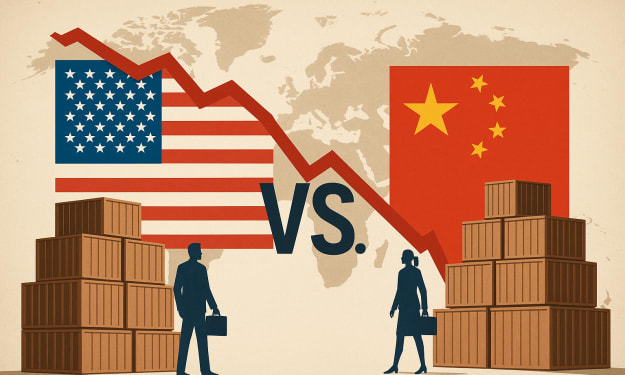
The U.S.-China Business War.
The United States and China, two of the world's largest economies, are engaged in a high-stakes economic rivalry that is reshaping the global business landscape. What began as a tariff war during the Trump administration has evolved into a broader competition over technology, supply chains, and geopolitical influence. This ongoing conflict is often referred to as the "business war," and its consequences reach far beyond just tariffs and trade balances. The Roots of the Business War Tensions between the U.S. and China didn’t start overnight. For years, American policymakers and business leaders expressed concerns over China's trade practices, including intellectual property theft, forced technology transfers, and heavy government subsidies to domestic companies. In 2018, the Trump administration imposed sweeping tariffs on Chinese goods, aiming to pressure Beijing into changing these practices. China retaliated with tariffs of its own, targeting U.S. agricultural products, automobiles, and technology sectors. What followed was a series of tit-for-tat actions that sent shockwaves through global markets. While both sides signed a Phase One trade deal in January 2020, the underlying issues remained unresolved. Technology: The New Battleground In recent years, the U.S.-China rivalry has intensified in the tech sector. Washington has blacklisted major Chinese tech firms like Huawei and ZTE, citing national security concerns. Meanwhile, the U.S. has restricted China's access to advanced semiconductor technology, which is critical to everything from smartphones to AI and defense systems. America accuses China of using tech companies for espionage, while China accuses the U.S. of suppressing its rise as a technological power. The battle now includes emerging technologies like quantum computing, biotechnology, and 5G networks. This tech war is not just about gadgets—it's about who controls the future of innovation. Both nations are racing to dominate these fields, investing billions in research and development. The result? Global tech firms are being forced to pick sides, with many reevaluating their supply chains to reduce dependence on either country. The Impact on Global Business Multinational corporations are caught in the crossfire. American companies like Apple, Tesla, and Qualcomm rely heavily on Chinese manufacturing and markets. At the same time, Chinese firms like TikTok and Shein are expanding aggressively into Western markets, often facing political and regulatory pushback. The business war has forced companies to rethink global strategies. Many are diversifying manufacturing to countries like Vietnam, India, and Mexico in a process known as "decoupling." While complete economic separation between the U.S. and China is unlikely, partial decoupling is already underway—and it’s reshaping the global economy. Political Pressure and Public Opinion This business war is also fueled by politics. In the U.S., there is bipartisan consensus that America needs to take a tougher stance on China. Recent legislation like the CHIPS and Science Act, which boosts domestic semiconductor production, reflects this shift. Similarly, China has doubled down on its “dual circulation” strategy, which emphasizes self-reliance and domestic consumption. Public opinion plays a role too. Surveys show rising distrust between the populations of both countries, with economic competition seen as a major national threat. This creates a feedback loop where governments feel justified in escalating tensions, further straining economic ties. What Lies Ahead? The U.S.-China business war is far from over. As both nations continue to prioritize economic security and technological dominance, businesses worldwide will have to adapt to a more fragmented, politically charged global marketplace. The challenge for leaders on both sides will be to manage this competition without allowing it to spiral into open conflict. Cooperation on global issues like climate change, public health, and nuclear security still requires engagement. But for now, the business war shows no signs of slowing—and the world is watching closely.
By Dr Gabriel about a year ago in Trader