fintech
A foray into fintech; a breakdown of the latest and greatest innovations in financial technology.
MACD + EMA Crossover Strategy for Explosive Momentum Trades
Momentum is the heartbeat of the market. If you’ve ever felt frustrated entering too early or too late on a trade, the problem might not be your timing—it could be your tools. That’s where the MACD + EMA Crossover Strategy comes in. This strategy helps you capture high-probability momentum moves by combining two proven indicators: the Moving Average Convergence Divergence (MACD) and the Exponential Moving Average (EMA). Let’s break it down and show how you can use it to find explosive trade setups with better precision and confidence. 🔍 What Is the MACD? The MACD (Moving Average Convergence Divergence) is a momentum oscillator that reveals changes in the strength, direction, and duration of a trend. It consists of: MACD Line = 12 EMA – 26 EMA Signal Line = 9 EMA of the MACD line Histogram = Difference between MACD Line and Signal Line 🔍 What Is the EMA? The Exponential Moving Average (EMA) is a moving average that gives more weight to recent price data. It reacts faster than a simple moving average and is ideal for identifying short-term momentum. In this strategy, we’ll use the 50 EMA to identify trend direction. ✅ Strategy Overview: MACD + 50 EMA Crossover This strategy is powerful because it only signals a trade when both the trend and momentum are aligned. 📈 Buy (Long) Setup 1. Price is above the 50 EMA This shows the market is in an uptrend 2. MACD line crosses above the Signal line This indicates bullish momentum is increasing 3. Enter the trade On candle close after MACD crossover confirmation 4. Stop loss Below the recent swing low 5. Take profit At next resistance level or using 1:2 risk-reward ratio 📉 Sell (Short) Setup 1. Price is below the 50 EMA Market is in a downtrend 2. MACD line crosses below the Signal line Bearish momentum is building 3. Enter short After confirmation candle closes 4. Stop loss Above swing high 5. Take profit At next support zone or based on 1:2 RR 📌 Why This Strategy Works The power of this strategy comes from confirmation. You're not entering just because the MACD crossed or just because price is above/below an EMA. You're combining both trend direction and momentum—this filters out low-quality signals. MACD catches the spark 50 EMA shows the direction Together, they create a high-probability setup. 💡 Bonus Tip: Use the Strategy with Price Action To boost the accuracy even more, look for price action confirmation like: Bullish or bearish engulfing candles Breakout of a consolidation zone Retest of a support or resistance level This gives you additional context for your entries. 🚫 Common Mistakes to Avoid Trading MACD signals against the trend MACD crossovers in the opposite direction of the 50 EMA trend can be false signals. Avoid them. Not waiting for candle close confirmation MACD can fluctuate during the candle. Always wait for a candle to close before confirming the crossover. Overtrading every crossover This setup works best when the market is already showing clear direction—avoid ranging conditions. 🧠 Example in Action (GBP/USD on 1H Timeframe)
By Junaid Ali (Official)about a year ago in Trader
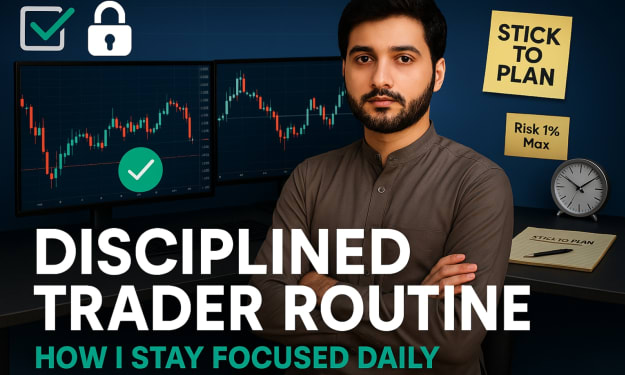
How I Stay Disciplined While Trading Forex
In the world of Forex trading, discipline isn’t optional — it’s survival. When I first started trading, I believed that learning technical analysis and watching enough YouTube videos would be enough to make consistent profits. I was wrong. The truth hit me hard: I didn’t have a strategy problem, I had a self-control problem. I knew the setups. I knew the rules. But in the heat of the moment, I broke them. And every time I did, I paid the price. Over the years, I’ve developed a system to stay disciplined no matter how the market behaves. Here’s exactly how I do it — and how you can too. 🎯 1. I Treat Trading Like a Business Discipline starts with mindset. I stopped treating Forex like a game and started treating it like a business. I have a daily routine I keep a trading journal I follow a written strategy I protect my capital like a business asset A disciplined trader doesn’t trade for fun. They trade for growth, consistency, and sustainability. 📜 2. I Follow a Written Trading Plan One of the biggest mistakes I made early on was trading based on feelings. Now, I have a written plan with clear rules for: Entry criteria Exit points Stop-loss and take-profit levels Risk-to-reward ratio Maximum trades per day If a trade doesn’t fit my plan — I skip it. No second guessing. ✅ If you don’t trade with rules, emotions will control you. ⏱️ 3. I Set a Daily Trading Time Limit Staring at charts all day increases anxiety and the urge to overtrade. That’s why I set fixed trading hours. For example: 7:30 AM to 10:30 AM (London session) After that, I review and close the charts This helps me stay sharp and avoid burnout. 💡 Discipline means knowing when to step back, not just when to jump in. 🔁 4. I Focus on 1–2 High-Quality Setups Per Day Not every candle is an opportunity. Not every move needs a reaction. I used to take 6–10 trades a day. Now? I wait for A+ setups — even if that means only 1 trade per day. This keeps my win rate higher and my stress level lower. 📉 5. I Accept Losses Without Emotion This was hard to learn. Losing trades used to trigger revenge trading, over-leveraging, or abandoning my plan. Now, I see every loss as part of the process. Here’s what helps: I remind myself that even pro traders lose 40–50% of the time I analyze every loss to see if I followed my rules I never double down to “win it back” 📌 You can’t control the market. But you can control your response. 📚 6. I Use a Trading Journal Religiously Every trade I take is documented — win or lose. My journal includes: Date, time, and pair traded Setup used and why I entered SL/TP, result, and emotions during the trade What I could’ve done better Over time, this helped me identify patterns in my mistakes — and fix them. 📓 Your journal is your mirror. It shows you the truth, even when you don’t want to see it. 🚫 7. I Have Strict Rules for “No Trading” Days Some days, the market is slow. Or I’m tired. Or emotional. I used to force trades anyway — and usually regretted it. Now, I have no-trade rules, such as: If I don’t sleep at least 6 hours If I’m stressed or angry If there’s high-impact news I don’t understand Discipline means knowing when to walk away. 🎯 Final Thoughts Discipline isn’t something you’re born with. It’s something you build — with effort, habits, and repetition. In Forex trading, discipline separates the 10% who succeed from the 90% who quit. Strategies can change. Markets can shift. But your ability to stay consistent is what keeps your account alive. So if you want to be a profitable trader in 2025 and beyond, don’t just learn the charts — master yourself. Because in the end, your biggest edge isn’t your strategy — it’s your self-control.
By Junaid Ali (Official)about a year ago in Trader
How I Manage Risk in Forex Trading
In Forex trading, profit is exciting, but risk management is everything. Early in my trading journey, I focused only on setups, signals, and strategy—until a single bad trade wiped out nearly 40% of my account. That’s when I realized: No strategy matters if your risk management is weak. Over time, I built a solid system to protect my capital and grow steadily. In this article, I’ll share exactly how I manage risk in Forex trading and the rules I never break, no matter what. These rules are the reason I’m still trading today — and not another blown account statistic. ⚖️ Rule #1: Never Risk More Than 1–2% Per Trade This is the golden rule of risk management. If you risk too much on a single trade, one bad setup can destroy weeks of progress. 🔢 How I apply it: If I have a $1,000 account, I risk only $10–$20 per trade I calculate my lot size based on stop-loss distance using position sizing tools Even 5 losing trades in a row won’t hurt me badly ✅ This keeps emotions low and survival high. 🔐 Rule #2: Always Use a Stop-Loss (No Exceptions) A stop-loss is your emergency brake. Without one, you're gambling. I never place a trade without it — not even on a strong setup. 🚫 What I avoid: Moving stop-losses out of panic Trading with mental stop-losses Widening SL just to “stay in the game” 📌 I place my SL at logical technical levels (below support, above resistance), not based on hope. 📊 Rule #3: Calculate Risk-to-Reward Before Every Trade I don’t enter any trade unless I see a minimum of 1:2 risk-to-reward ratio. That means for every $1 I risk, I aim to gain $2. 🎯 Example: If my stop-loss is 20 pips, my target must be at least 40 pips If I can’t find a setup with good RR, I skip the trade Why? Because with a 1:2 ratio, I can win only 40% of the time and still be profitable. 🚫 Rule #4: Never Overtrade This is one of the easiest ways to blow your account. More trades = more exposure = more stress. 🔒 My personal limits: Max 2–3 trades per day No revenge trading after a loss No trading out of boredom Instead, I wait for A+ setups. If they’re not there, I walk away. Patience is a skill. 💸 Rule #5: Don’t Risk Profits Like Free Money Early in my journey, I would make $50 profit, then risk it recklessly, thinking “It’s just profit.” But it’s still my money — and hard-earned. 🔁 Now, I treat every dollar equally: I follow the same rules on profits as I do on capital I compound profits slowly, not gamble them No emotional attachment — just process 📉 Rule #6: Respect News Volatility High-impact news events like NFP, interest rate decisions, or CPI reports can cause extreme price spikes. I learned the hard way not to enter trades 5 minutes before a big event. 🛡️ What I do: Check Forex Factory calendar daily Avoid entering right before high-impact news If already in a trade, I adjust or secure profits News can make or break a trade in seconds. Always be aware of what’s coming. 📓 Rule #7: Keep a Risk Journal
By Junaid Ali (Official)about a year ago in Trader
How to Build a Winning Forex Trading Routine
In Forex trading, consistency is everything. You can have the best strategies, the smartest indicators, and the biggest capital — but without a solid trading routine, you’re just gambling. The most successful Forex traders in the world don’t rely on luck. They follow a structured, disciplined, and repeatable process. That process is called a trading routine—a personalized system that governs how you approach the markets each day. In this article, I’ll walk you through how to build a daily Forex trading routine that actually works — one that fits your lifestyle, supports your goals, and improves your results over time. 🧠 Why You Need a Trading Routine A routine helps you: Stay disciplined Avoid emotional trading Improve focus and confidence Reduce overtrading and impulsive decisions Track your progress with consistency In 2025, with fast markets, AI bots, and real-time volatility, structure gives you the edge. 🛠️ Step-by-Step: Building Your Forex Trading Routine 1. 🕔 Choose Your Trading Session Decide when you’ll trade. Forex is open 24 hours, 5 days a week, but not all times are equal. London Session (8 AM – 4 PM GMT): Most volatile and liquid New York Session (1 PM – 9 PM GMT): Pairs like EUR/USD and GBP/USD move strongly Asian Session (11 PM – 7 AM GMT): Calmer, slower-moving pairs (e.g., AUD/JPY) ✅ Choose the session that matches your schedule and the pairs you trade. 2. 📅 Pre-Market Preparation (30 Minutes Before Trading) A winning routine starts before you place any trade. 🔍 Checklist: ✅ Check the Forex Economic Calendar (ForexFactory or Investing.com) ✅ Mark high-impact events (NFP, interest rate decisions, speeches) ✅ Review any overnight price action ✅ Note important support/resistance levels ✅ Scan for market sentiment (bullish/bearish) This part of your routine ensures you’re not caught off guard by news or volatility spikes. 3. 🧭 Chart Analysis (15–30 Minutes) Now it’s time to open your charts and apply your strategy. Key steps: Switch to higher timeframes (Daily, 4H) for big-picture context Drop to your execution timeframe (1H, 15M) for setups Use tools like: Moving Averages RSI / MACD Candlestick patterns Trendlines / Fibonacci ✅ Stick to ONE strategy and wait for full confirmation. Avoid forcing trades. 4. 🧾 Set Trade Plans (Before Execution) Once you see a valid setup: Mark your entry, stop-loss, and take-profit Calculate your position size based on 1–2% risk per trade Decide whether it’s a market order or pending order Write your trade idea down in your journal Pro traders don’t guess—they plan every move before entering. 5. 🧘 Stay Focused During Active Trading Once trades are running, your goal is to manage, not panic. Don’t stare at charts constantly Use alerts to notify you of key price levels Don’t touch your stop-loss or TP unless your strategy says so Avoid revenge trading if you take a loss If you feel stressed or emotional, step away and return with a clear mind. 6. 📚 End-of-Day Review (15–30 Minutes) At the end of each session, review what you did. In your journal, note: What trades you took (and why) Whether you followed your plan Mistakes made What you learned Total Pips / Win/Loss % This part is CRUCIAL for long-term growth. Over time, it reveals what works—and what doesn’t. 🧩 Sample Daily Trading Routine (for London Session Trader) Time Activity 7:30 AM GMT News check + chart scan 8:00 AM GMT Identify setups + plan trades 8:30–10:30 AM GMT Execute/manage trades 12:00 PM GMT Journal & review trades 🧠 Bonus Tips for a Strong Trading Mindset Trade less, but smarter Treat trading like a business, not a hobby Respect your routine even when tempted to “wing it” Backtest new strategies before adding to your live routine Don’t copy someone else’s routine blindly—adapt it to your life ✅ Final Thoughts A winning Forex trading routine is more than just charts and indicators—it’s a system of discipline, planning, and constant improvement. It’s how average traders become profitable traders. In 2025, the competition is fierce and the markets are fast. But the trader who shows up prepared every single day — with a clear process and a strong mindset — is the one who wins. Make your routine your edge. Master it, refine it, and let it guide you to consistency.
By Junaid Ali (Official)about a year ago in Trader
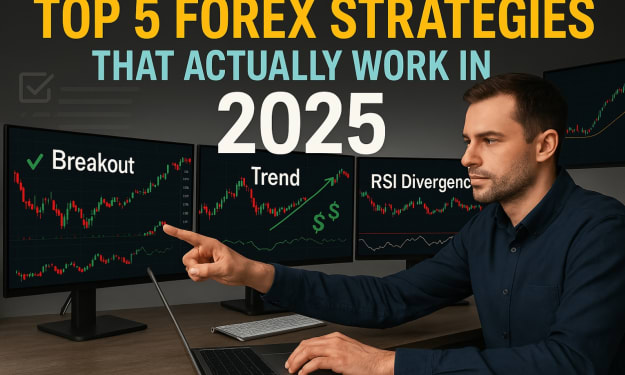
My Top 5 Forex Trading Strategies That Actually Work
As a Forex trader, I’ve tested dozens of strategies—from YouTube hype to high-risk tactics—only to realize that most don’t hold up over time. What does work is finding simple, proven strategies, mastering them, and applying them with consistency and discipline.
By Junaid Ali (Official)about a year ago in Trader
Beginner’s Guide to Earning Dividends from Stocks
* Thorough research needed for Muslim readers as some stocks are Haram to invest in. If you’re new to investing and looking for a way to earn passive income, dividend stocks can be a great place to start. Dividends offer a steady stream of income simply for owning shares of certain companies. This guide breaks down everything a beginner needs to know about earning dividends from stocks. What Are Dividends? Dividends are payments made by companies to their shareholders, typically from profits. Companies that are financially healthy and well-established often reward their investors with these regular payouts. Dividends are usually paid quarterly, though some companies pay them monthly or annually. There are two main types of dividends: Cash Dividends: Direct cash payments into your brokerage account. Stock Dividends: Additional shares instead of cash. Why Choose Dividend Stocks? Dividend stocks are appealing for several reasons: Steady Income: They provide regular income, even when the market is down. Compounding Growth: Reinvesting dividends can significantly boost your long-term returns. Lower Risk: Dividend-paying companies are often stable and less volatile. How to Get Started with Dividend Investing 1. Open a Brokerage Account To begin earning dividends, you’ll need a brokerage account. Choose a reliable platform that offers: - Low or zero commissions - Easy-to-use mobile and web interface - Dividend reinvestment options (DRIP) Popular beginner-friendly brokers include Webull, Robinhood, and eToro.
By Wealth Dropletsabout a year ago in Trader
8 Boring Businesses Quietly Making $50k/Month (Zero Online Competition)
The Secret World of ‘Boring’ Businesses In the age of TikTok influencers, dropshipping hype, and YouTube millionaires, it’s easy to forget that some of the most profitable businesses are hiding in plain sight. They don’t trend on social media. They don’t require complicated funnels or viral content. In fact, most people wouldn’t even look at them twice.
By Awais Qarni about a year ago in Trader
The Role of Purpose in Shaping Profitable Netflix Clones
The video streaming industry has grown significantly over the past few years. With changing viewer habits and increasing demand for flexible content consumption, platforms like Netflix have set the standard. In response, many entrepreneurs have built similar platforms often referred to as “Netflix Clones.” But creating a clone isn’t just about copying features. What really determines success is having a clear sense of purpose behind the platform. This article explores how a strong purpose can guide the development and long-term growth of a Netflix Clone.
By Michal steveabout a year ago in Trader
How AI Has Dominated Crypto Trading: Its Features Are Evolving
In the fast-evolving cryptocurrency landscape, AI-powered trading has quickly become a driving force in market innovation. Advanced machine learning in crypto and automated trading bots have transformed how traders analyze markets, execute orders, and manage risk. From retail investors to institutional players, the evolution of AI-driven strategies is reshaping the landscape and its capabilities continue to grow.
By smithtaylorabout a year ago in Trader