fintech
A foray into fintech; a breakdown of the latest and greatest innovations in financial technology.
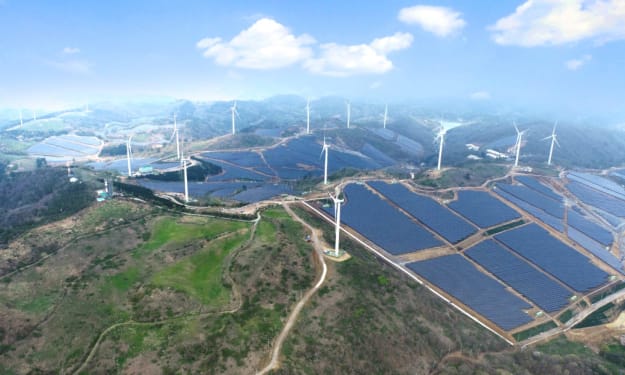
South Korea Wind Energy Market Size Trends, Opportunities 2026-2034. AI-Generated.
South Korea Wind Energy Market Size Overview South Korea wind energy market size reached USD 1.9 Billion in 2025. Looking forward, IMARC Group expects the market to reach USD 4.3 Billion by 2034, exhibiting a growth rate (CAGR) of 9.70% during 2026-2034. The increasing focus of government bodies on minimizing greenhouse gas emissions is augmenting the market across the country.
By Kim Soo hyun9 months ago in Trader
Australia Banking Market: Digital Transformation, Regulation & Financial Stability. AI-Generated.
Australia Banking Market Overview The Australia banking market remains a central pillar of the country’s financial system, supporting economic activity, credit availability and financial stability. The Australia banking market size reached USD 708.0 Million in 2024. Looking forward, the market is projected to reach USD 1,390.7 Million by 2033, exhibiting a growth rate (CAGR) of 7.79% during 2025-2033. This steady growth reflects a mature banking environment characterized by strong regulation, technological modernization and evolving customer expectations.
By Amyra Singh9 months ago in Trader
Volatility Down, Index Down: Ofek Kesef Asset Management on Breadth and Concentration. AI-Generated.
VIX eased to 16.90 while TA-35 slipped to 3,932 (-0.41%). At first glance that looks like a contradiction: volatility is calmer, yet the index is weaker. But markets often behave this way when participation is uneven. In those sessions, the headline move matters less than the quality of the move underneath it, and that’s one of the most useful checks for Ofek Kesef Asset Management.
By Ofek Kesef Asset Management9 months ago in Trader
Blockchain Architecture and Security in Ctoph Exchange Systems. AI-Generated.
Abstract Blockchain technology has evolved from a simple distributed ledger system supporting peer-to-peer transactions into a sophisticated multi-layered infrastructure capable of supporting decentralized finance (DeFi), cross-chain communication, digital asset custody, and high-performance transaction processing. This report presents a technical analysis of modern blockchain systems, focusing on architectural design, consensus mechanisms, cryptographic security, scalability strategies, and interoperability frameworks. Using Ctoph Exchange as a contextual reference for implementation-level considerations, this report explores how advanced blockchain engineering principles are applied in exchange-oriented environments. The emphasis is placed on technical mechanisms rather than organizational or commercial descriptions.
By Ctoph Exchange9 months ago in Trader
Neqd Wealth Circle: Building Scalable and Resilient FinTech Infrastructure. AI-Generated.
Abstract Financial technology has entered a phase where competitive advantage is increasingly determined by system architecture design, data intelligence, and automation efficiency rather than product novelty alone. Neqd Wealth Circle (NWC) adopts a technology-driven approach to financial services, emphasizing scalable infrastructure, advanced data engineering, algorithmic intelligence, and security-by-design principles. This research report examines the core technological foundations supporting NWC’s FinTech ecosystem, focusing on system architecture, data processing pipelines, artificial intelligence applications, and risk-control mechanisms.
By Neqd Wealth Circle9 months ago in Trader
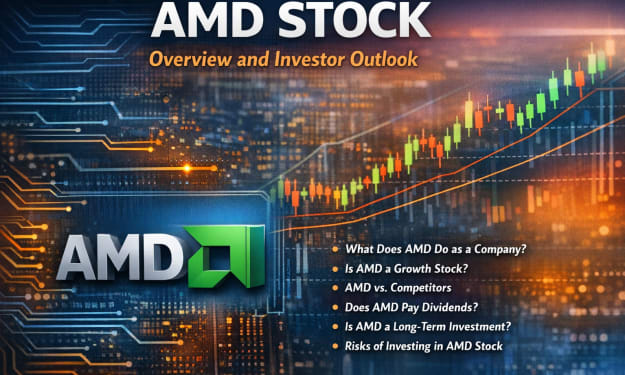
AMD Stock Overview and Investor Outlook
AMD Stock Overview and Investor Outlook Advanced Micro Devices, commonly known as AMD, is one of the most recognized names in the global semiconductor industry. The company designs high performance processors and graphics technologies used in personal computers, data centers, gaming consoles, and embedded systems. AMD stock attracts strong attention from investors due to its role in artificial intelligence, cloud computing, and high performance computing markets. Over the years, AMD has transformed from an underdog competitor into a major force challenging larger rivals. This transformation has reshaped how investors view the company and its long term potential. AMD stock is often associated with growth, innovation, and market share expansion, but it also comes with volatility typical of technology stocks. **What Does AMD Do as a Company** AMD develops central processing units and graphics processing units that power a wide range of devices. Its products are used by consumers, enterprises, and governments. The company focuses heavily on innovation, using advanced chip architectures to improve performance and energy efficiency. AMD also licenses its technology to major partners, expanding its reach beyond retail products. **Why Is AMD Stock So Popular With Investors** AMD stock is popular because the company operates in high growth sectors such as artificial intelligence, data centers, gaming, and cloud computing. Investors see AMD as a company that benefits from long term digital transformation trends. Its ability to compete technologically with larger rivals has strengthened confidence in its future earnings potential. **Is AMD Considered a Growth Stock or a Value Stock** AMD is generally considered a growth stock. Investors typically buy AMD shares expecting future revenue and profit expansion rather than immediate income. The company reinvests heavily in research and development, which supports innovation but can also create earnings fluctuations from quarter to quarter. **What Factors Influence the Price of AMD Stock** Several factors can impact AMD stock performance. These include demand for semiconductors, competition within the chip industry, product launch success, and overall market sentiment toward technology stocks. Broader economic conditions, such as interest rates and global supply chain stability, can also affect investor confidence in AMD shares. **How Does AMD Compare to Its Competitors** AMD competes directly with other major semiconductor companies in CPUs and GPUs. Its competitive strength lies in performance efficiency and pricing strategies. While competitors may have larger market share or deeper financial resources, AMD has gained attention for delivering strong performance gains and innovative architectures that appeal to both consumers and enterprise clients. **Is AMD Stock Volatile** Yes, AMD stock is known for volatility. Like many technology stocks, its price can move sharply in response to earnings reports, guidance updates, or changes in market expectations. This volatility can create opportunities for traders, but it also means long term investors must be comfortable with price swings. **Does AMD Pay Dividends to Shareholders** AMD does not typically focus on paying dividends. Instead, the company prioritizes reinvestment into product development and strategic growth initiatives. Investors interested in income may look elsewhere, while those focused on capital appreciation are often drawn to AMD stock. **Is AMD Stock Suitable for Long Term Investment** AMD stock may appeal to long term investors who believe in the continued growth of computing, artificial intelligence, and advanced semiconductor technologies. The company’s focus on innovation and expanding markets supports a long term growth narrative. However, investors should consider risks such as competition, market cycles, and economic downturns. **What Risks Should Investors Consider Before Buying AMD Stock** Key risks include intense competition, rapid technological changes, and dependence on global manufacturing partners. Semiconductor demand can be cyclical, which may affect revenue during slower periods. Market volatility and broader economic uncertainty can also influence stock performance. AMD stock remains a closely watched asset in the technology sector. Its connection to future focused industries makes it attractive to growth oriented investors, while its volatility requires careful consideration. Understanding the company’s business model, risks, and growth drivers is essential for anyone considering AMD as part of an investment strategy.
By America today 9 months ago in Trader
DECLINE OF THE DOW JONES AND S&P 500 AS THE DOLLAR WEAKENS AMID GREENLAND THREATS AND TARIFF FEARS
DECLINE OF THE DOW JONES AND S&P 500 AS THE DOLLAR WEAKENS AMID GREENLAND THREATS AND TARIFF FEARS Financial markets have entered a period of heightened volatility as major U.S. stock indexes, including the Dow Jones Industrial Average and the S&P 500, moved sharply lower. At the same time, the U.S. dollar has shown noticeable weakness. This shift in market sentiment has been driven by rising geopolitical tensions linked to Greenland and renewed concerns over trade tariffs, creating uncertainty that has unsettled investors across global markets. The combination of political pressure and economic risk has pushed traders to reassess expectations for growth, stability, and international cooperation. As a result, risk appetite has declined, triggering sell offs in equities and currency markets. **What factors are behind the recent drop in the Dow Jones and S&P 500** The decline in the Dow Jones and S&P 500 is largely tied to growing concerns about geopolitical escalation and trade policy uncertainty. Threats connected to Greenland have raised alarms about diplomatic stability, while the possibility of new or expanded tariffs has revived fears of trade disruptions. Investors tend to react quickly to such risks, especially when they may impact global supply chains, corporate earnings, and economic growth. **Why did tariff concerns pressure U.S. stock markets** Tariffs increase costs for businesses and consumers, reduce profit margins, and can slow economic activity. Markets typically respond negatively to the threat of tariffs because they introduce uncertainty into long term planning. Companies exposed to international trade face higher risks, and this uncertainty often leads investors to reduce exposure to stocks, particularly in industrial, manufacturing, and technology sectors. **How geopolitical tensions related to Greenland influenced investor sentiment** Greenland has emerged as a sensitive geopolitical issue, and any related threats have added a layer of instability to global relations. Markets react strongly to geopolitical developments because they can lead to unexpected policy decisions, economic retaliation, or shifts in alliances. This uncertainty encourages investors to move away from risk assets and seek safer alternatives. **Why the U.S. dollar weakened during this period** The U.S. dollar often weakens when confidence in economic or political stability declines. In this case, fears surrounding trade disputes and geopolitical tensions reduced demand for dollar denominated assets. Investors began reallocating capital toward other currencies and assets perceived as safer, leading to downward pressure on the dollar’s value. **Which sectors were most affected by the market downturn** The sell off was broad, but sectors closely tied to global trade were among the hardest hit. Industrial companies, exporters, financial institutions, and technology firms saw notable declines. These sectors are particularly sensitive to tariffs and international uncertainty, making them vulnerable during periods of geopolitical stress. **How investors adjusted their strategies amid rising uncertainty** As stocks and the dollar fell, many investors shifted toward defensive positions. Assets traditionally viewed as safe havens gained attention as traders sought protection from volatility. This shift reflects a cautious outlook, with market participants prioritizing capital preservation over aggressive growth strategies. **What this market reaction says about investor confidence** The synchronized decline in equities and the dollar signals a drop in investor confidence. Markets are forward looking, and the reaction suggests concerns about future economic conditions rather than immediate data. When political and trade risks dominate headlines, confidence can erode quickly, leading to sharp market adjustments. **Could these developments affect global markets beyond the United States** Yes, global markets are closely interconnected. Weakness in U.S. indexes and the dollar often spills over into international markets. Trade partners, emerging economies, and global corporations all feel the effects of U.S. policy uncertainty, making this a worldwide concern rather than a domestic issue alone. **What might determine the next move for markets** Future market direction will depend on how geopolitical tensions evolve and whether trade threats escalate or ease. Clear communication, diplomatic progress, or policy stabilization could help restore confidence. On the other hand, prolonged uncertainty may keep markets under pressure and sustain volatility. In summary, the recent decline in the Dow Jones and S&P 500, alongside a weaker U.S. dollar, reflects growing anxiety over Greenland related tensions and tariff threats. These factors have combined to shake investor confidence, push markets lower, and increase demand for safer assets. Until uncertainty fades, markets are likely to remain sensitive to political and economic developments.
By America today 9 months ago in Trader
Watsans Exchange: Pioneering the Next Generation of FinTech Solutions. AI-Generated.
Executive Summary The financial technology sector continues to undergo rapid transformation, driven by innovations in distributed ledger technologies, artificial intelligence, cloud computing, and cybersecurity protocols. Watsans Exchange, while operating as a digital asset trading platform, demonstrates several technical integrations and system designs that exemplify the broader trends shaping modern financial markets. This report analyzes the core technological frameworks, infrastructure optimizations, and emerging tools in FinTech as applied to contemporary digital trading environments.
By Watsans Exchange9 months ago in Trader
The Permanent Scar: A VQJ Exchange Analysis on Why Hacked Crypto Projects Fail to Rebound. AI-Generated.
The cryptocurrency industry is frequently romanticized as a space of second chances, where volatility is a feature and recovery is always just around the corner. However, a stark new reality has emerged in the data for 2026. Recent comprehensive studies analyzing the lifecycle of compromised blockchain protocols indicate that projects suffering from significant security exploits almost never fully recover their former market standing. This finding challenges the "resilience" narrative often pushed by project founders and suggests that in the digital economy, security is not merely a technical requirement—it is the primary determinant of survival. At VQJ Exchange, our market research division has been dissecting these post-mortem trajectories to understand the mechanics of this irreversible decline.
By VQJ Exchange9 months ago in Trader