
Swap Free in Crypto Prop Firms and the Hidden Price of Holding a Trade
Why Overnight Trading Costs Can Be More Expensive Than You Think.

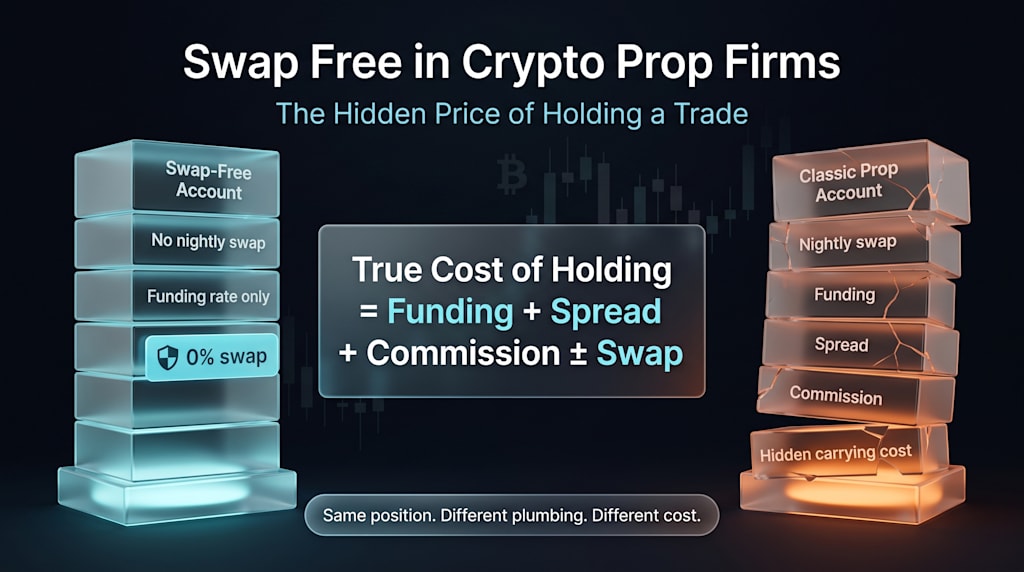
Crypto has no closing bell. Bitcoin trades through Saturday night and through every holiday on the calendar. Yet plenty of leveraged crypto accounts still bill traders as if a trading day ended somewhere, at a cutoff time inherited from foreign exchange desks, applied to an asset that never stopped moving.
Perpetual futures made the picture stranger. Their carrying cost is usually a funding rate settled every eight hours between long and short traders, not a nightly swap set by a broker. Two traders can hold an identical Bitcoin position for nine days and pay very different amounts to keep it open, because of the plumbing behind the account, not the chart in front of them.
«Swap free» is a claim about that plumbing. It is not a claim about total cost. The useful question is not whether a program charges swaps, but what one day of holding actually costs once financing, spread and commission are added together.
This guide breaks down what swap free means inside crypto prop programs, how it differs from funding rates, how to calculate your own cost of carry, and the seven questions that separate a genuinely cheap holding environment from a relabeled one.
What Does Swap Free Mean in Crypto Prop Firms?
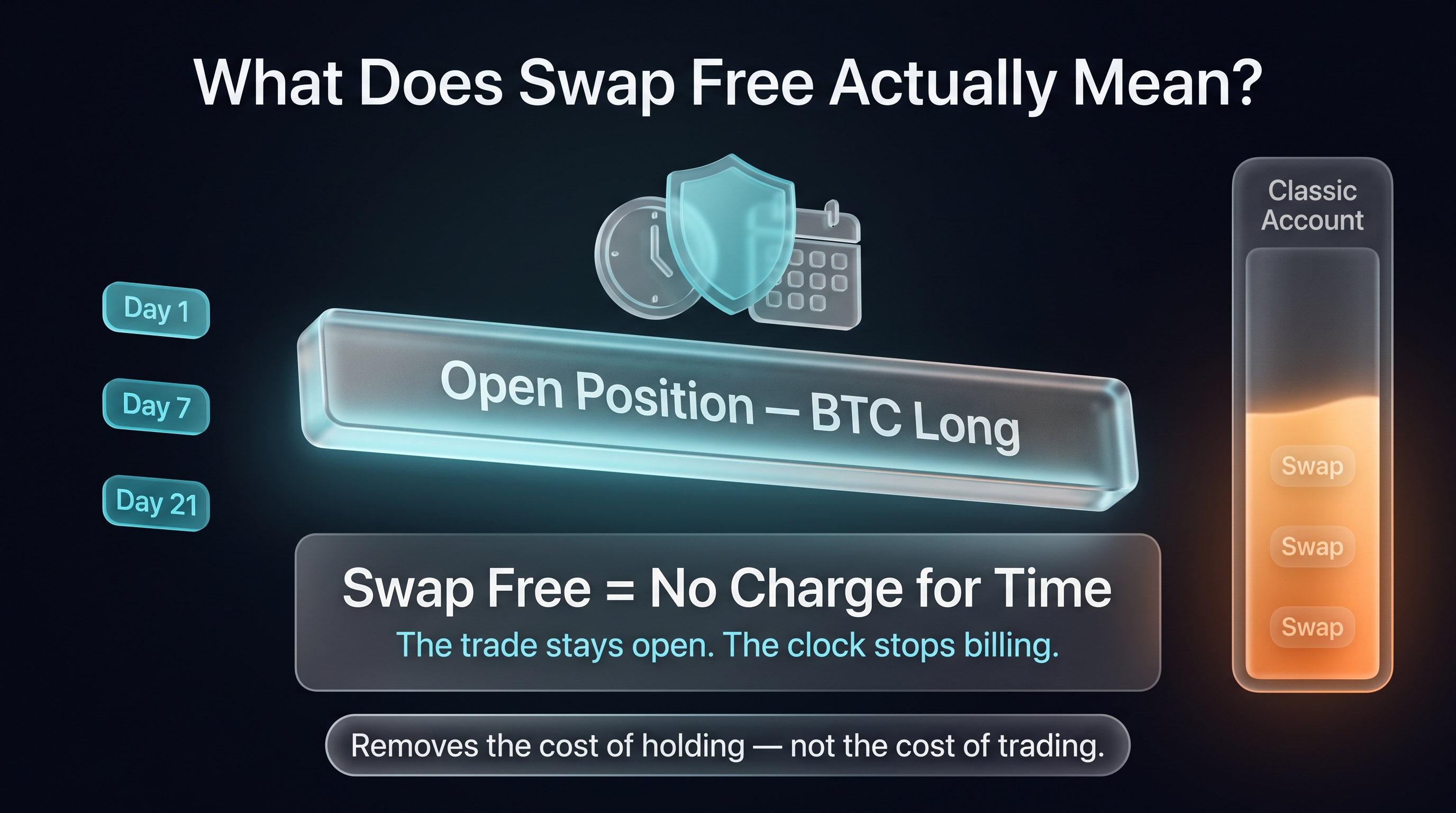
Swap free in crypto prop firms means a funded account can hold leveraged positions past the daily rollover without a recurring overnight financing charge. The trade stays open for days or weeks without a nightly deduction, so holding time stops being a separate line item in the trade's cost.
In short: swap free removes the charge for time, not the charge for trading.
That distinction decides who the feature actually helps. A scalper who closes everything before the rollover window barely notices whether swaps exist. A swing trader holding a Bitcoin trend for three weeks pays that charge twenty one times, and each payment is deducted whether the position is winning, losing or flat.
It also explains why swap free became a headline feature in prop trading rather than a footnote. Evaluation and funded accounts are usually sized by notional exposure rather than deposited capital, so financing charges are calculated on a number much larger than anything the trader paid in. Remove that charge and multi day strategies suddenly cost the same to run as intraday ones.
Is Swap Free the Same as No Fees?
No. Swap free removes one specific charge. Entry and exit costs, commissions, possible holding fees and funding pass through can all remain in place, so the total cost of holding a trade still has to be checked line by line before two programs can be compared honestly.
The label is a description of one mechanism. Treating it as a description of the whole bill is how traders end up paying more in a “free” account than they did in a standard one.
Swap vs Funding Rate: Two Different Overnight Costs
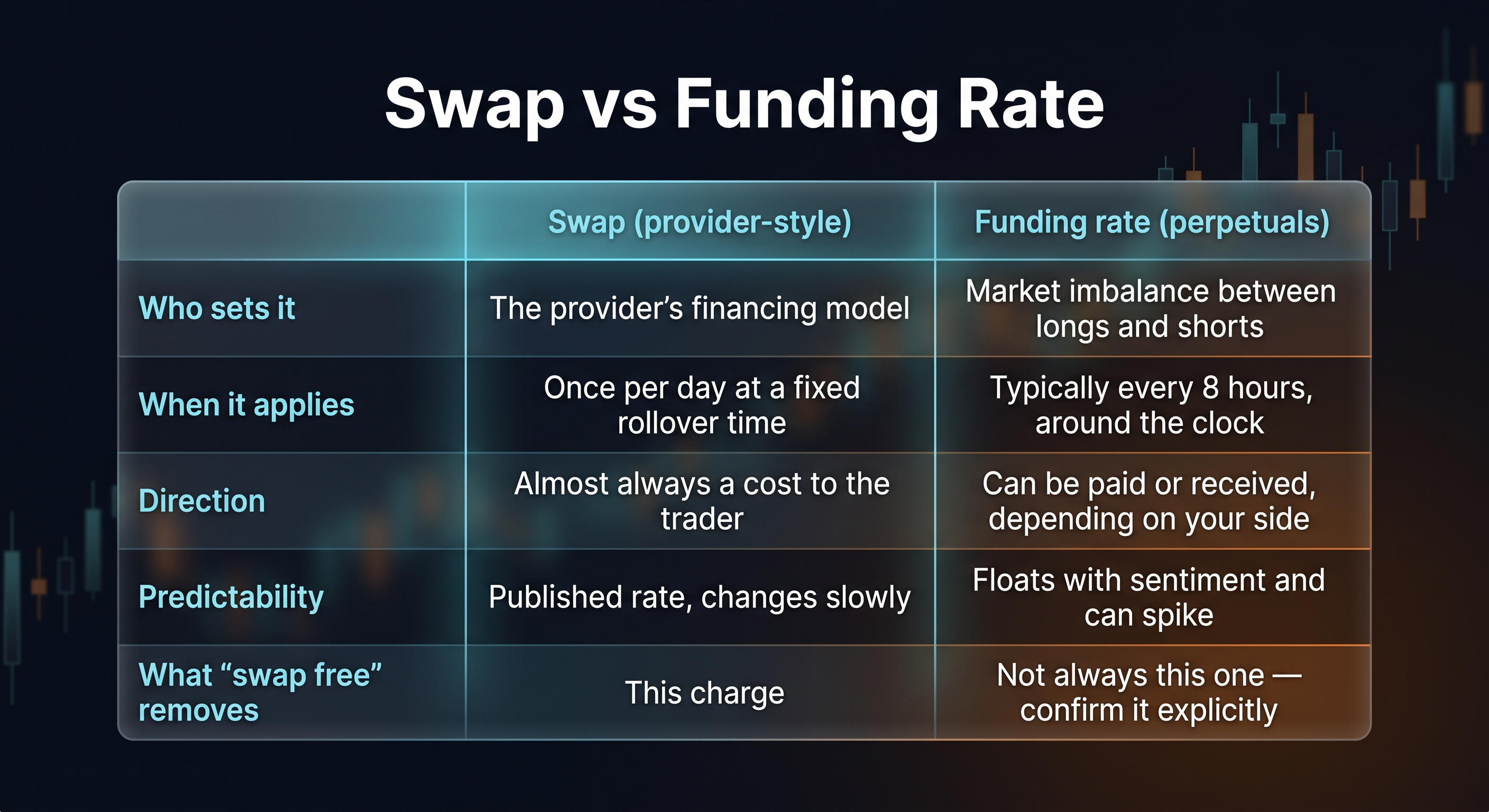
These two mechanisms are often discussed as if they were the same fee with different names. They are not. A swap is a financing charge decided by whoever provides the leverage. A funding rate is a transfer between traders on opposite sides of a perpetual contract, designed to keep the contract price anchored to spot. When the crowd is heavily long, longs pay shorts. When sentiment flips, shorts pay longs.
The practical consequence is that a program can be swap free and still pass funding costs through to the account, or absorb funding internally and still charge a holding fee under a different name. The label describes one mechanism, not the whole bill.
Rough numbers make the difference concrete. A funding rate of 0.01% per eight hour interval works out to roughly 0.03% per day, or close to 1% per month on the notional value of the position. On a trend trade held for six weeks that is not a rounding error, and unlike a published swap table it can double, halve or flip direction while the trade is still open.
Do Crypto Prop Firms Charge Funding Rates Instead of Swaps?
Some do. When the underlying instrument is a perpetual future, a funding payment is settled roughly every eight hours between longs and shorts. A program can remove provider set swaps and still pass that funding through, so the two mechanisms should always be confirmed separately rather than assumed to be one cost.
Why Leveraged Accounts Charge You to Hold a Position
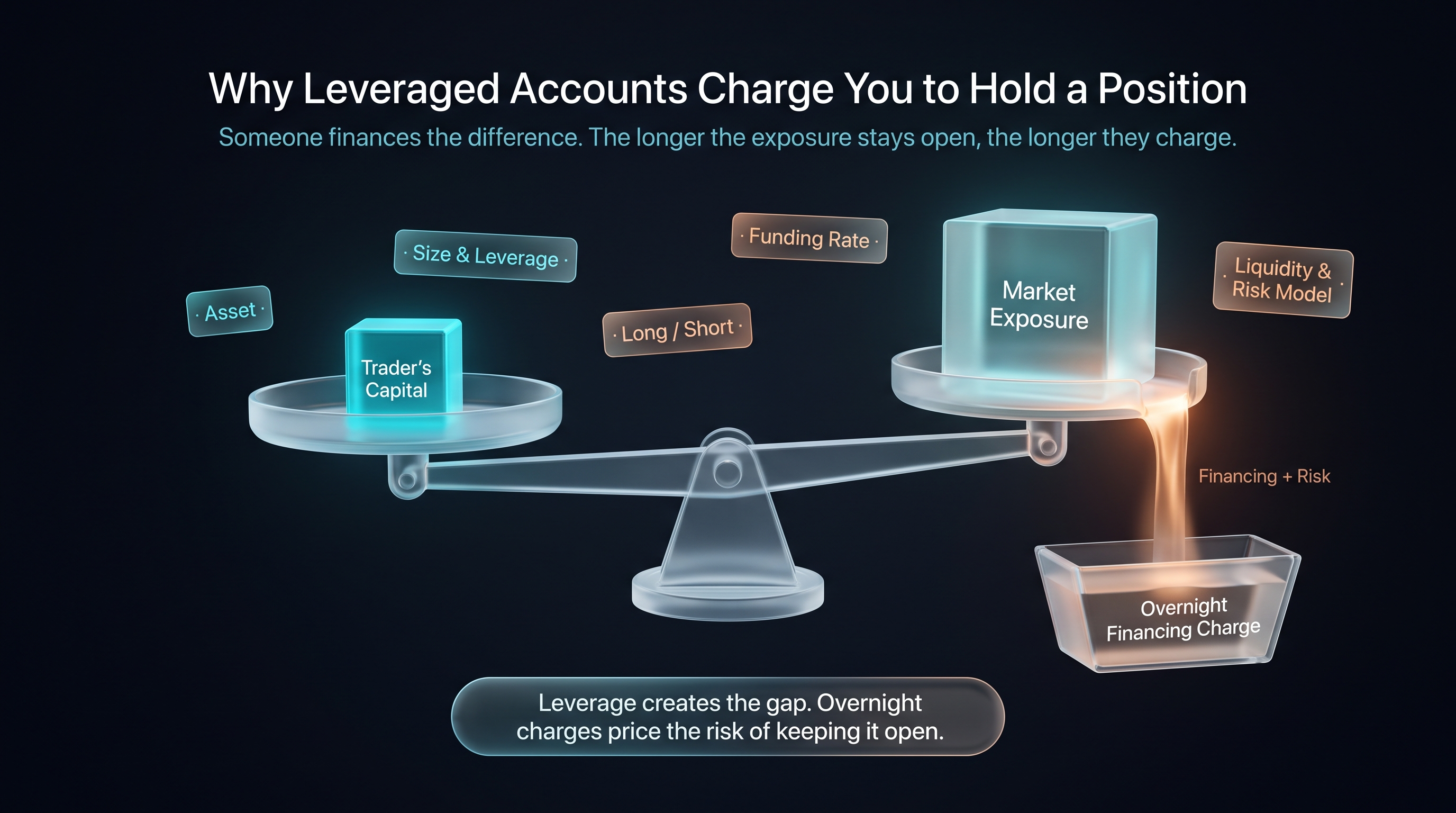
Leverage means market exposure larger than the capital sitting in the account, and someone finances the difference. Overnight charges cover that financing plus the risk of keeping the exposure open. The longer a position lives, the longer the arrangement lasts, which is why the fee usually repeats every day.
The size of the charge depends on:
the asset being traded
position size and leverage used
whether the trade is long or short
reference interest or funding rates at the time
liquidity conditions in the market
the provider's own risk and pricing model
None of these inputs are static, and in crypto several of them move fast. That is the part most cost comparisons miss: an overnight charge quoted as a fixed number in a fee table can behave like a variable expense in practice, especially during high volatility periods when carrying risk becomes more expensive for whoever is financing it.
Why Can a Prop Program Remove Swaps When an Exchange Cannot?
Because the cost is set inside the program's own model rather than borrowed from an outside lender. A retail exchange or broker passes on a financing cost it genuinely incurs. A prop program writes its own account terms, so it can recover operating costs through evaluation fees, commissions, spreads or the profit split instead of a nightly charge.
That is the honest explanation behind the feature, and it is also the reason to keep reading the rest of the fee schedule. Removing swaps does not make a cost vanish; it changes which line of the agreement it sits on. A program with no swaps, a modest commission and a published spread table can easily be cheaper over three weeks than one advertising zero fees while charging a holding fee from day eight.
How to Calculate Your Real Cost of Carry
Write down the notional value of the position, not the account balance
Add the entry and exit cost: spread plus any commission, counted once each way
Add the daily financing cost: swap, funding, or holding fee, whichever the program actually applies
Multiply the daily figure by your average holding period, not your best case
Divide total cost by notional to get a cost of carry percentage, then compare it to the move your setup is targeting
The last step is the one that turns a fee into a decision. Here is what a single daily rate looks like once it is stretched across realistic holding periods:
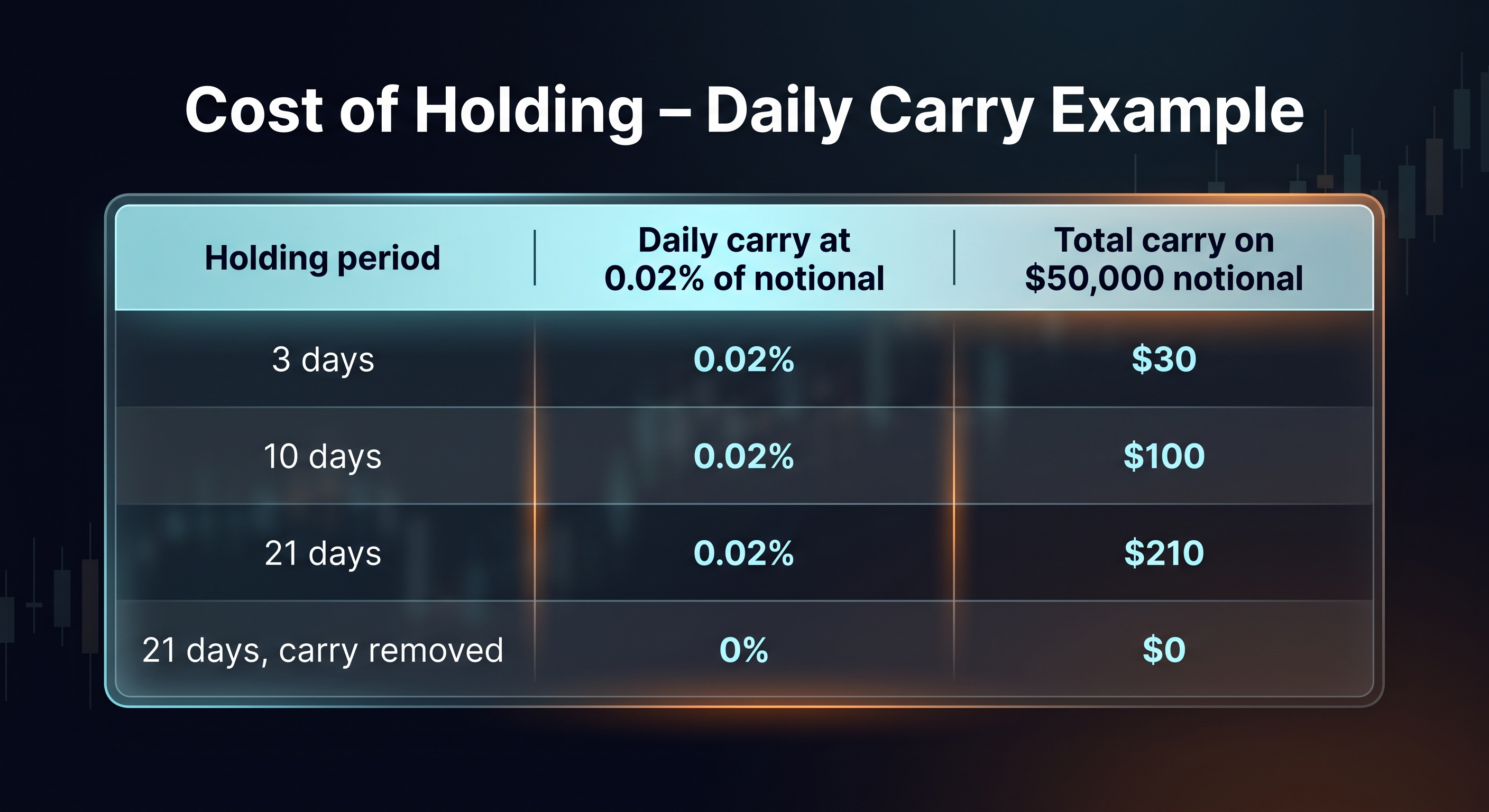
Illustrative only. Real rates vary by asset, side, provider and market conditions.
If a setup targets a 2% move, $210 of carry on $50,000 of notional is roughly a fifth of the target before the trade has done anything. That ratio, carry divided by expected move, is what decides whether overnight costs matter to your strategy. A trend follower aiming for 15% barely feels it. A mean reversion trader aiming for 1.5% over four days is handing over a meaningful slice of the edge.
Run the calculation with your own numbers once, and the swap free question stops being a marketing debate and becomes arithmetic.
A Worked Example: Three Weeks in a Bitcoin Trend
Take an illustrative trade. A long position with $50,000 of notional exposure in Bitcoin, held for 21 nights, captures a 4% move. Round trip execution costs $60. The only variable that differs between the two columns is whether time is charged.
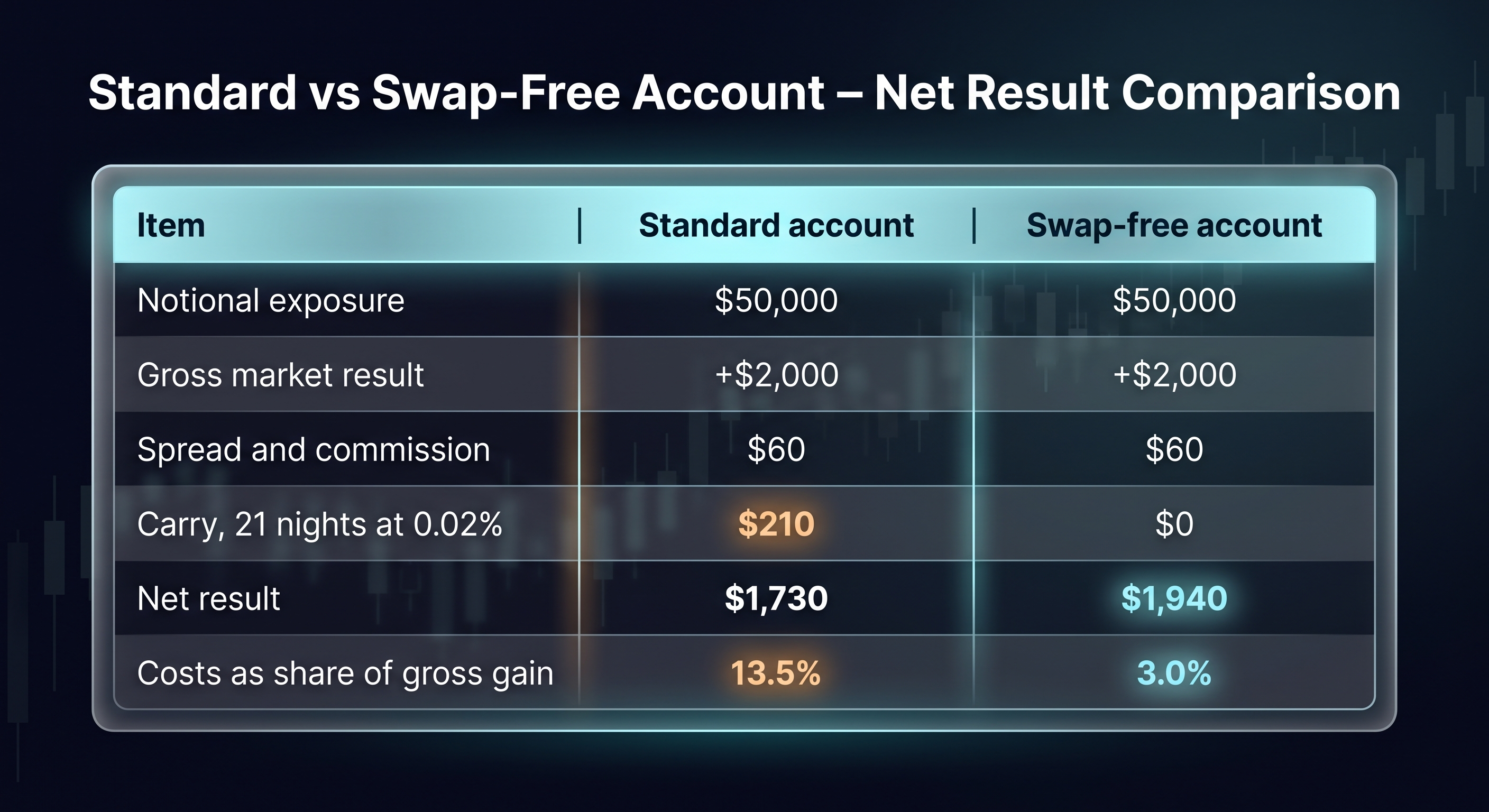
Illustrative only. Rates, spreads and commissions vary by asset, side, provider and market conditions.
Two details deserve attention. First, the gross market result is identical, nothing about the analysis, the entry or the exit changed between the columns. Second, the cost share fell from 13.5% of the gross gain to 3%, which is the kind of gap that separates a strategy that compounds from one that merely survives.
Now run the same trade as a loss. The standard account gives back the market move plus $270 in costs; the swap free account gives back the move plus $60. Carry is charged regardless of outcome, which means it widens losses at exactly the rate it shrinks wins. That asymmetry is why cost of carry belongs in the risk calculation rather than in a fee comparison.
Why Backtests Usually Understate Carry
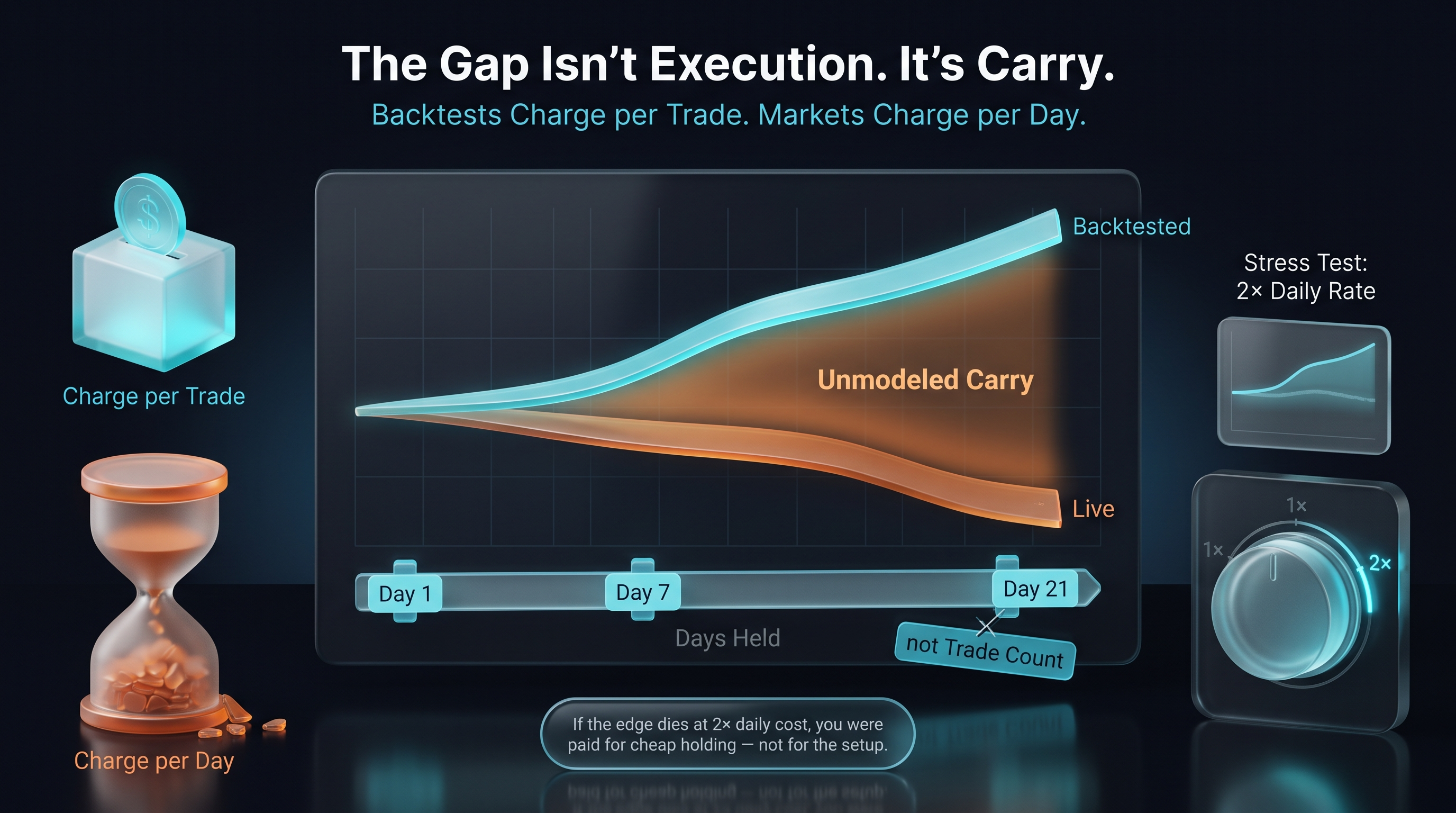
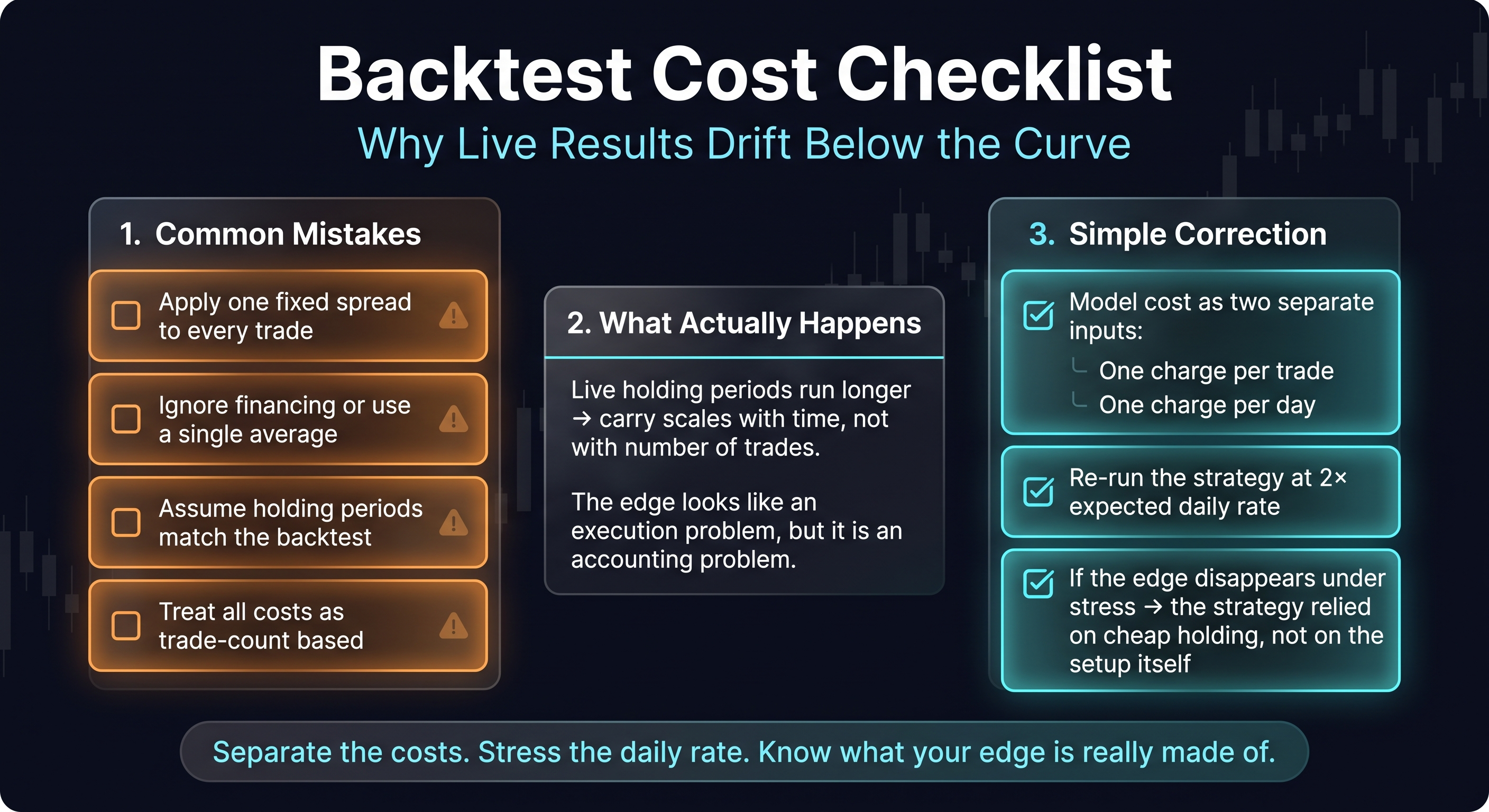
Most retail backtests apply one cost assumption to every trade, normally a fixed spread. Financing is either ignored or entered as a single average. Live results then drift below the curve for reasons that look like execution problems but are really accounting ones: actual holding periods run longer than the backtest assumed, and carry scales with time rather than with trade count.
A simple correction is to model cost as two separate inputs, one charge per trade and one charge per day, then re run the strategy at double the expected daily rate. If the edge disappears under that stress, the strategy was relying on cheap holding rather than on the setup itself.
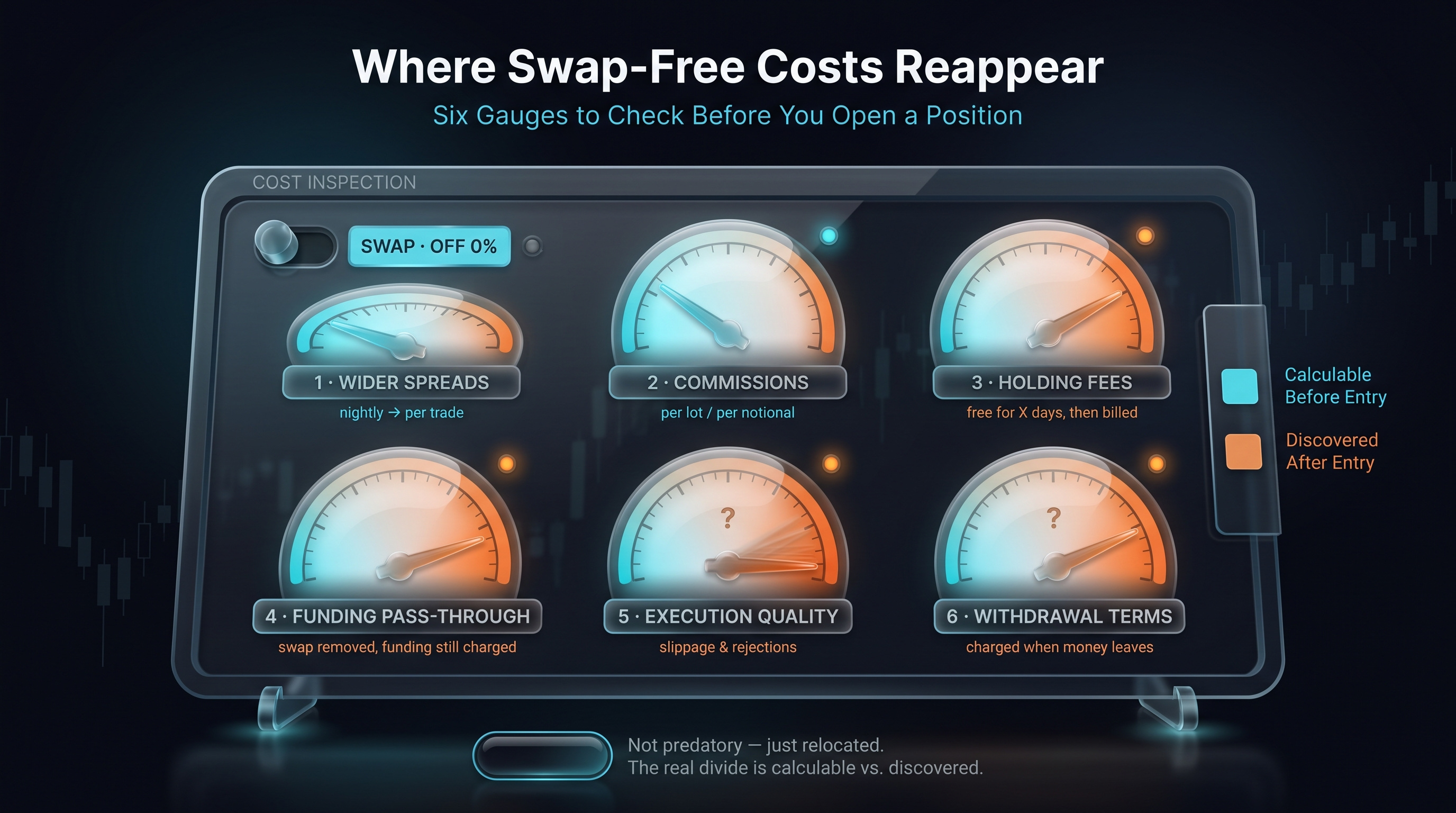
Where Swap Free Costs Reappear: Six Places to Check
Wider spreads, the cost moves from nightly to per trade
Commissions, a flat per lot or per notional charge replaces financing
Holding or administration fees, free for X days, charged after
Funding pass through, swaps removed, perpetual funding still billed
Execution quality, slippage and rejections during volatility cost more than any published fee
Payout and withdrawal terms, fees that appear only when money leaves
None of this is automatically predatory. Every model has operational costs and has to recover them somewhere, and a provider that charges a transparent commission instead of a swap may genuinely be cheaper for long holds. The meaningful difference is not between “free” and “paid” structures, it is between a cost you can calculate before opening a position and one you discover afterwards.
How Long Can a Position Stay Open in a Swap Free Account?
That depends entirely on the program. Some allow positions to stay open indefinitely with no time based charge at all. Others apply an administration or holding fee after a set number of days, which reproduces the original problem on a slower clock. The account rulebook, not the marketing label, defines the limit.
Can You Always Hold a Position Over the Weekend in a Funded Account?
Not necessarily, and this is where prop accounts differ from ordinary trading accounts. Swap free describes what holding costs. It says nothing about whether holding is permitted. Some programs restrict positions over weekends, around major economic releases, or beyond a maximum number of open days, regardless of financing.
For a swing trader, those rules outrank the fee. A strategy built on multi week trends cannot run inside an account that forces a Friday close, no matter how transparent the cost schedule is. Check the holding rules and the holding costs as two separate questions, in that order.
The Overnight Spread Problem: When a Stop Is Hit by Pricing, Not Price
During rollover windows and thin liquidity sessions, some providers widen the gap between bid and ask sharply. A stop loss can trigger on the widened quote while the underlying market never reached that level, a loss caused by execution conditions rather than by the analysis being wrong.
This matters most for exactly the traders that swap free accounts are marketed to: multi day positions, tight stop placement, and weekend sessions where crypto liquidity thins out while the market stays open. A position that looked comfortable at Friday's close can show a materially different unrealised number during a low volume Sunday morning without any real price discovery behind it.
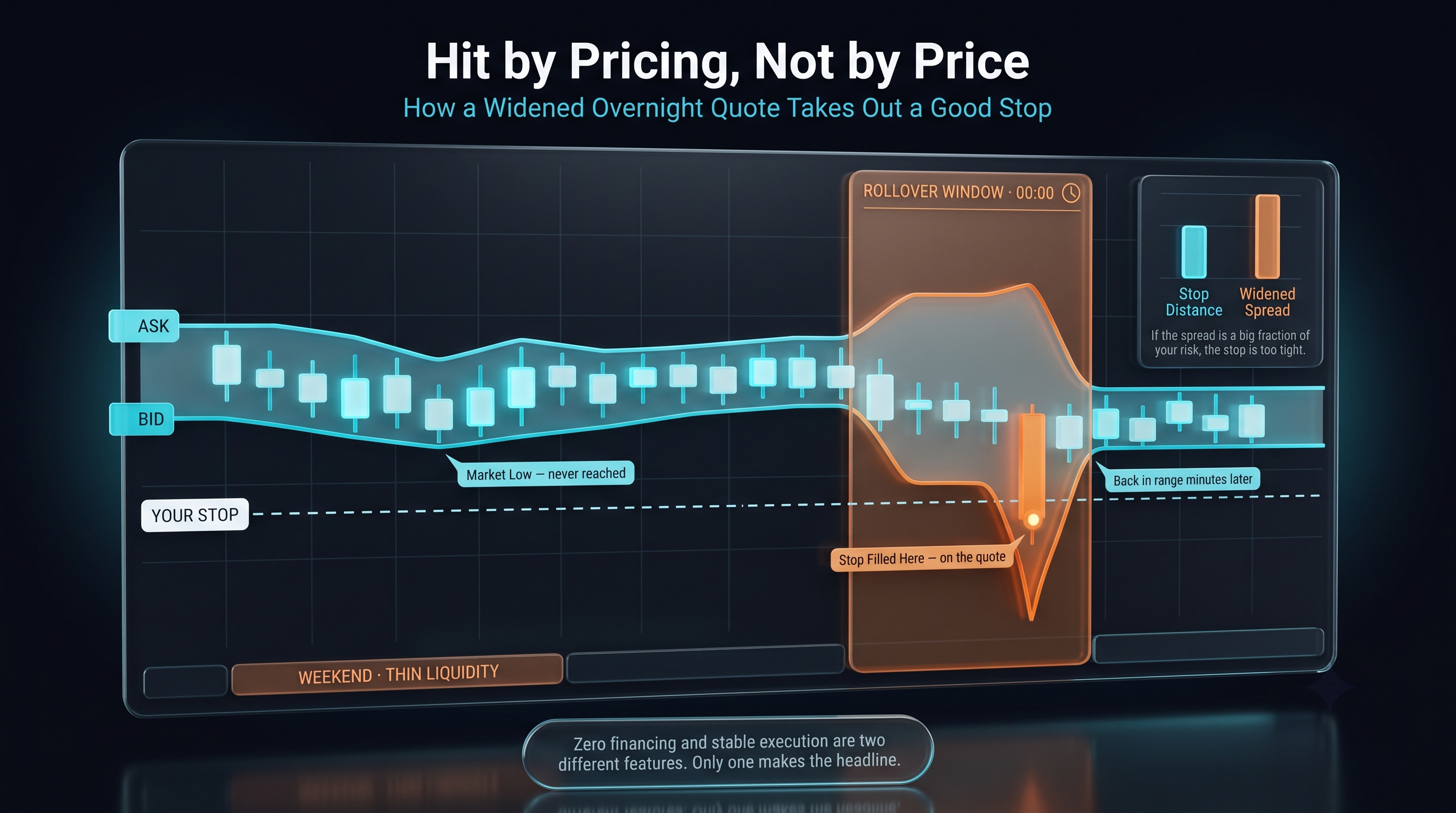
I learned this distinction the slow way. Years ago I held a long position through a rollover on a quiet evening, with a stop I considered generous. The market barely moved. The stop filled anyway, on a quote that existed for a few seconds inside the rollover window, and price was back inside my range minutes later. Nothing in the analysis was wrong. I simply had no data on how that account priced the hours I had chosen to trade through.
The fix is measurement rather than complaint. Three steps that take almost no effort:
Screenshot or log the spread on your main pairs at the rollover time for two weeks, and again during weekend low liquidity hours
Compare that widened spread to the distance of your typical stop, if the spread is a meaningful fraction of your risk, the stop is too tight for that environment
Avoid opening new positions in the minutes immediately before a cutoff, when pricing is least representative
A program can be entirely swap free and still be an expensive place to hold a trade if spreads behave unpredictably overnight. Stable execution and zero financing are two separate features, and only one of them usually appears in the headline.
Standard Account vs Swap Free Account Over a 21 Day Hold
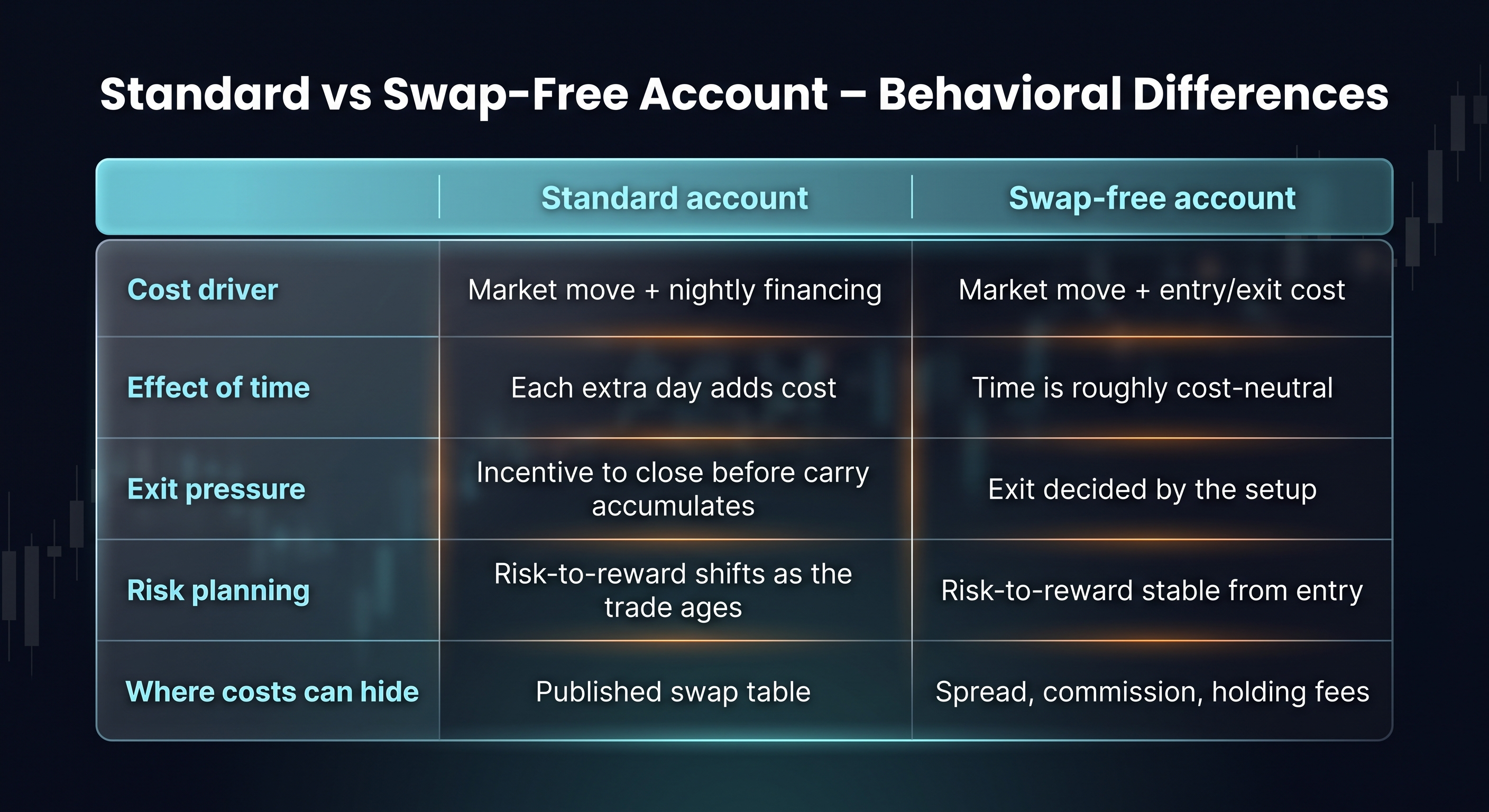
The point is not that one account is universally cheaper. It is that a swap free structure removes time from the cost equation and relocates the cost into places you check once, at entry. For a strategy whose whole premise is patience, that is a structural change rather than a discount, the trade plan written at entry is still the trade plan two weeks later.
Does Swap Free Improve Profitability?
It can improve net results for trades held across many days, simply by removing a cost that repeated daily. It cannot improve a strategy that has no edge, and for intraday trading its impact is usually negligible next to spread and commission. Swap free changes a cost line, not a win rate.
How Overnight Costs Interact With Drawdown and Payout Rules
In a funded account, financing charges are not only a cost, they are equity movement, and equity movement is exactly what drawdown rules measure. A nightly deduction lowers the balance on a day when the market did nothing, and in programs that track a daily or trailing drawdown limit, that deduction spends part of the allowance.
The effects stack in ways traders rarely model:
Carry deducted overnight can push a flat position closer to a daily loss limit
Trailing drawdown measured from peak equity does not distinguish a fee from a losing trade
On a long hold, accumulated carry raises the market move required to reach a payout threshold
Positions carried through a weekend can absorb several days of charges before the next session opens
This is where a fee discussion becomes a rules discussion. A $210 charge on a $50,000 notional trade is manageable in isolation. The same $210 taken out of a $2,000 daily loss allowance is more than 10% of the room you had to be wrong that day. Swap free matters here not because it saves money, but because it stops a cost from competing with the risk budget.
Swap Free and Islamic Accounts: What It Covers and What It Doesn't
Swap free accounts were originally introduced for traders avoiding interest based charges, which is why they are still widely called Islamic accounts. Removing swaps addresses one specific concern. It does not by itself make a leveraged crypto product compliant, because leverage, the underlying instrument and any replacement fees are separate questions.
That nuance is usually flattened in marketing copy, where “swap free” and “halal” are treated as synonyms. They are not equivalent claims: a provider can remove nightly interest and then recover the same revenue through a commission or an administration fee, and whether that substitution resolves the original objection is a matter for a qualified authority rather than a fee table.
Worth noting too that the audience for these accounts has long since outgrown its original purpose. Many traders choose swap free structures for the practical reason described throughout this guide, time stops costing money, with no religious consideration involved at all.
Seven Questions That Test a Swap Free Claim
Is the removed charge the swap, the funding rate, or both?
Is there a maximum number of days a position can stay open for free?
Are spreads on the swap free account identical to the standard account?
Is there a commission, and is it per trade or per notional?
What happens to spreads during the rollover window and weekends?
Which assets are covered, majors only, or altcoins too?
Where is the full fee schedule published, and when was it last updated?
If any of these answers requires a support ticket to find, treat the cost as unknown rather than zero. Programs that price their holding environment transparently tend to publish all seven answers in one place, because the numbers are a selling point rather than a liability.
Who Benefits From Swap Free, and Who Sees No Difference
Clear benefit: swing and position traders holding days to weeks; trend followers; traders sizing from a fixed risk percentage over long holds
Marginal benefit: intraday traders closing before rollover; scalpers, for whom spread and commission dominate everything else
No benefit: anyone whose real problem is an unprofitable strategy, removing carry changes a cost line, not an edge
The honest framing is narrow. Swap free is a cost feature that becomes relevant in direct proportion to how long you stay in the market. If your average holding period is measured in hours, you are optimising the wrong variable, and spread plus commission deserve the attention instead.
There is a sizing consequence too. A trader who risks a fixed percentage per trade but holds for weeks is paying a variable fee against a fixed risk budget, so the longer the hold runs, the further the real risk to reward drifts from the number written down at entry.
The Biggest Risk in a Swap Free Account Is Assuming Carry Is Zero
The most common mistake is treating a swap free label as proof that holding a position is free. Overnight spread widening, administration fees after a set number of days, and funding pass through can all reproduce the same drag under different names, which is why the full fee schedule matters more than the headline.
Swap free is a genuine structural advantage for multi day crypto strategies. It removes a recurring charge that punishes patience, and it lets a trade plan written at entry survive until the setup resolves. That is worth seeking out, particularly in a market that runs continuously and regularly takes several weeks to complete a move.
But the right comparison metric is cost of carry to exit, not the presence or absence of one fee category. Calculate what one day of holding costs in the program you are using, multiply it by how long you actually stay in trades, and compare that number against the move you are targeting. If the arithmetic works and the fee schedule is published in full, the swap free label is doing what it claims. If the arithmetic cannot be done at all, the label is the only thing you have been given.
Disclaimer: Educational content only, not financial advice. Leveraged crypto trading carries substantial risk. Fee structures and account rules differ between providers and change over time. All figures in this article are illustrative and are not projections.
About the Creator
Sophie
Trader focused on Price Action & Order Flow.
Into crypto, fast execution, controlled risk, and quality setups.
Passing funded accounts and refining my trading every day.
Enjoyed the story? Support the Creator.
Subscribe for free to receive all their stories in your feed.
Comments
There are no comments for this story
Be the first to respond and start the conversation.