
Surviving Crypto Prop Firm Challenge
What Separates Funded Traders From Everyone Else


Most traders who attempt crypto prop firm challenges fail, and it is rarely because they lack skill. It is because they let pressure change their behavior. This article breaks down the risk rules, pair selection, and mindset shifts that separate funded traders from those who blow their accounts chasing one big win.
Why Most Traders Blow Their Crypto Prop Challenge
What people don’t get about crypto prop firm challenges are: The rules, drawdown limits, daily loss caps, profit targets with a deadline, they mess with your head. You take a loss and suddenly it’s not just a loss anymore. It’s like you lost progress. You feel like you’re falling behind. And that feeling? It makes you do stupid things.
I’ve seen this happen over and over. A trader knows their stuff, they can read charts, they know where support and resistance is, they understand momentum. But then they enter a prop challenge and… they fall apart.
And it’s not because the challenge is some impossible thing. It’s because of how they act under pressure.
You start taking more trades. Bigger size. Jumping in faster without waiting for a proper setup. You start seeing trades that aren’t really there because you need to make it back. One bad decision leads to another and then another and before you know it you’ve broken a rule you knew by heart.
That’s the thing, nobody breaks the rules because they forgot them. They break them because in that moment they couldn’t stop themselves.
I think the challenge is hard on purpose but not in the way people think. The profit target isn’t crazy. What’s crazy is maintaining discipline when everything in your brain is screaming at you to do something, anything, to fix the situation. Most traders just haven’t built that muscle yet.
So yeah, The thing that filters people out isn’t whether they can trade. It’s whether they can hold themselves together when it counts. Structure over skill, basically. Though I hate how clean that sounds lol, it’s messier than that in practice.
It’s Not About Skill, It’s About Structure
There’s this thing most traders believe going into a prop challenge, that if you’re good enough at reading charts, you’ll pass. Like, just get better at TA and the funded account will come.
I used to think this too, honestly. It’s wrong though. Pretty expensively wrong for a lot of people.
Here’s something that kind of broke my brain when I first heard it: a trader with a 50–55% win rate can pass a prop challenge. That’s barely better than a coin flip. Like you’re almost guessing direction and you can still make it work. So clearly the win rate isn’t the main thing. What actually matters is how you handle the trades you do take, position sizing, how you react when you’re down three in a row, whether you stick to your rules when you’re frustrated.
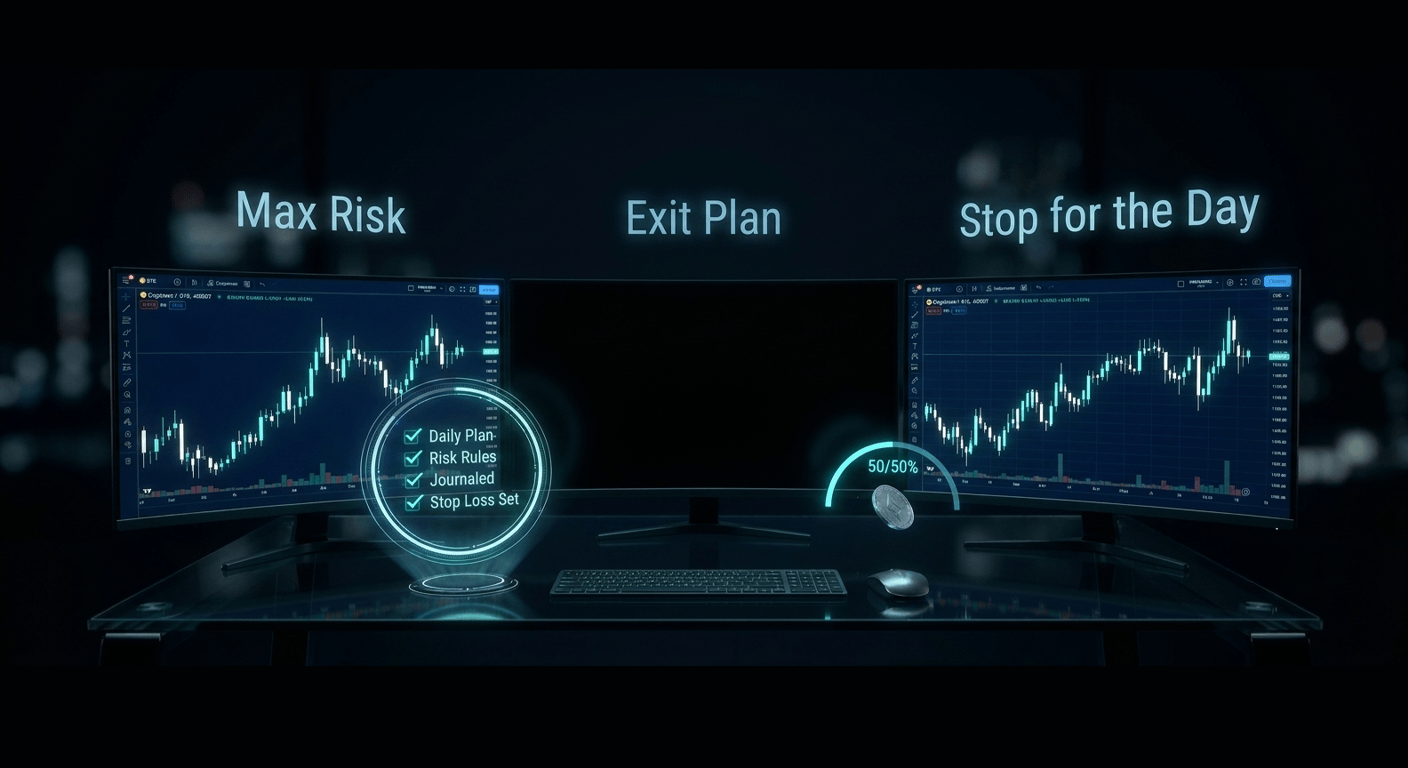
That’s what structure means. Not some fancy system. Just… rules that you actually follow when things get uncomfortable. Knowing your max risk before you even open the chart. Having an exit plan before you’re in the trade (not during, not after). And stopping for the day when you hit your limit, even when your brain is telling you the next trade is definitely the one that fixes everything.
(It’s never the one that fixes everything, by the way.)
Skilled traders fail challenges all the time because they don’t have this. Traders who are honestly pretty average technically pass because they do. The challenge is kind of designed to find this out about you.
The thing is, and this is the part I actually find encouraging, structure isn’t some talent you either have or don’t. It’s habits. Rules you build on purpose. Which means it’s fixable. That’s what the rest of this is about.
The Myth of the Big Win in Crypto Challenges
Most traders get wrong before they even start a challenge. They look at the profit target, let's say 8 or 10 percent, and their brain immediately goes to: how do I get there fast?
So they start thinking bigger. Bigger size, bigger trades, fewer setups but more aggressive ones. The logic feels solid. If I can just land two or three really good trades, I'm done. Challenge passed. Easy.
Except it doesn't work like that. And the reason it doesn't work is actually pretty simple once you see it.
The challenge isn't testing whether you can find one great trade. It's testing whether you can make good decisions repeatedly, under pressure, without blowing up. Those are completely different skills. One is luck dressed up as strategy. The other is actual trading.
When you go in hunting for the big win, you start taking setups you wouldn't normally take. You hold trades longer than you should because you want more. You size up because you're impatient. And then one trade goes wrong and suddenly you're not just behind on the profit target, you're dangerously close to a drawdown limit you weren't even thinking about five minutes ago.
That's how challenges end. Not with a dramatic blowup. With a slow series of slightly too aggressive decisions that compound into a rule violation.
The document puts it well: passing a challenge is about stacking disciplined decisions while protecting your account, not finding one huge trade. That's the whole game.

Small Gains Compound Faster Than You Think
This is the part that actually surprised me when I first thought about it properly.
A trader with a 50 to 55 percent win rate can pass a prop challenge. That's the number. Barely better than a coin flip. Which means you don't need to be right most of the time, you just need your winners to be bigger than your losers, and you need to not do anything catastrophically stupid in between.
If you're risking 1 percent per trade and targeting 2 percent, you only need a handful of clean wins to make real progress toward an 8 to 10 percent target. You don't need a 5R trade. You don't need to nail the exact top or bottom. You just need to execute the same boring, disciplined process over and over.
Small gains don't feel exciting. That's kind of the point. The challenge is designed to reward the traders who can stay boring when everything in them wants to do something dramatic.
So instead of asking how do I find the big trade, the better question is: how do I take 15 clean trades without doing anything stupid? That shift in framing changes everything about how you approach the challenge.
Risk Management That Actually Passes Challenges
Let me be blunt about something. Most traders think risk management is the boring part. The thing you learn about, nod along to, and then quietly ignore when you are in the middle of a challenge and feeling behind.
That is exactly why most traders fail.
In a crypto prop challenge, risk management is not a safety net you hope you never need. It is the actual mechanism that keeps you in the game long enough to pass. Without it, even a great strategy falls apart because one bad day eats through your drawdown and suddenly you are done.
The firms know this. That is why they set drawdown limits in the first place. They are not trying to make things harder for fun. They want to see if you can generate returns without taking reckless risks. That is literally the skill they are paying for.
So when you treat risk management as an afterthought, you are basically telling the firm you do not have the one skill they actually care about.
Here is what disciplined risk looks like in practice. You risk between 0.5 and 1 percent of your account on any single trade. That is it. Not 2 percent because you feel confident. Not 3 percent because the setup looks perfect. Half a percent to one percent, every single time, regardless of how good the trade looks.
That might sound overly conservative. But think about what it actually gives you. At 1 percent risk per trade, you can take ten consecutive losses and still only be down 10 percent. At 0.5 percent, you can take twenty losses in a row and still be alive. That kind of breathing room is what separates traders who pass from traders who blow up in week two.
The math is not complicated. The discipline to actually follow it when you are stressed and behind schedule, that is the hard part.
Why Drawdown Limits Are Not Optional
Here is something that catches a lot of traders off guard. Drawdown limits do not work the way most people think they do.
Most traders treat them as something to worry about later. Like a distant wall they probably will not hit. So they do not track them actively. They just trade and assume they will notice if things get bad.
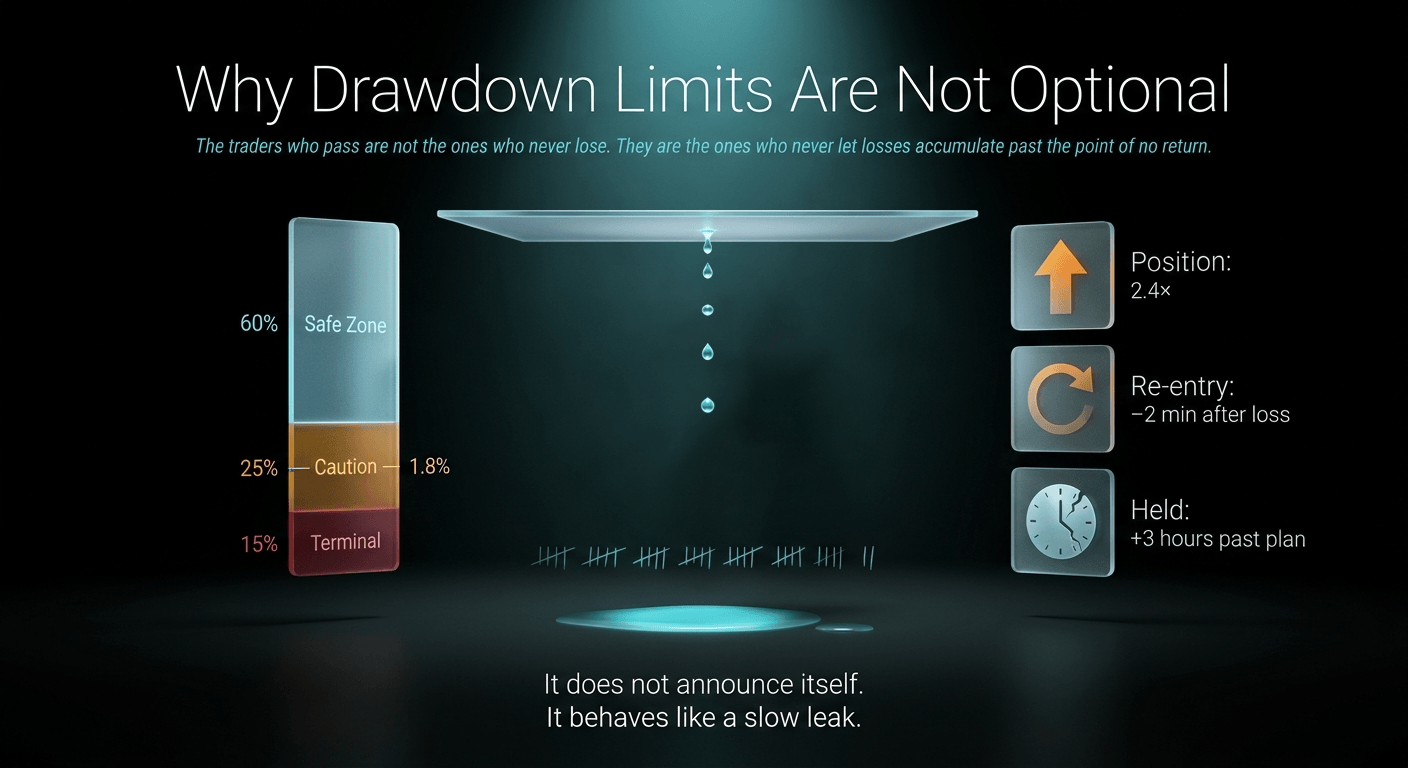
The problem is that drawdown does not announce itself. It does not show up as one dramatic loss. It behaves like a slow leak. A couple of slightly oversized trades that did not work. A revenge trade after a frustrating morning. A position you held too long because you did not want to take the loss. None of those feel like disasters in the moment. But they add up quietly, and by the time you check your remaining drawdown, you realize you have almost no room left.
At that point, you are stuck. You cannot trade normally because any loss might end the challenge. So you either freeze up completely or you take a desperate swing trying to recover, which usually makes things worse.
The fix is boring but effective. Track your remaining daily drawdown and your remaining total drawdown before every single session. Know exactly how much room you have. And if you are getting close, reduce your risk from 1 percent to 0.5 percent or just stop trading for the day.
Protecting available drawdown is not being timid. It is preserving your ability to take good setups later. The traders who pass challenges are not the ones who never lose. They are the ones who never let losses accumulate past the point of no return.
Position Sizing in Practice
Position sizing sounds simple on paper. You calculate your risk, figure out your stop distance, and set your size accordingly. But under the pressure of a live challenge, this is where a lot of traders start cutting corners.
What usually happens is something like this. You spot a setup, you feel good about it, and instead of running the numbers properly you just throw on a size that feels right. Maybe you round up because the trade looks strong. Maybe you skip the calculation entirely because you have done it enough times to eyeball it.
That is how accounts blow up quietly. Not from one massive mistake, but from a series of slightly oversized positions that all seemed reasonable at the time.
The correct approach is mechanical. You take your account balance, multiply by your risk percentage, and divide by your stop loss distance in dollar terms. That gives you your position size. Every single time. No exceptions, no rounding up, no gut feeling adjustments.
For example, if your challenge account is 50,000 dollars and you are risking 1 percent, your max loss on any trade is 500 dollars. If your stop is 2 percent away from entry, your position size is 25,000 dollars. Not 30,000 because the setup looks clean. Not 35,000 because you want to make up for yesterday. Exactly 25,000.
This matters even more in crypto because volatility can expand fast. A position that felt safe at 3x leverage during a quiet London session can turn dangerous the moment a news candle hits. If you sized correctly from the start, that spike hurts but does not kill you. If you oversized even slightly, that same candle might push you past your daily drawdown.
The traders who pass challenges are not doing complex math. They are doing simple math consistently. They treat position sizing like a non negotiable step before every entry, the same way a pilot runs a checklist before takeoff. It is not exciting. But it is what keeps the account alive long enough to reach the profit target.
Focus Your Pairs, Sharpen Your Edge
Most traders come into a crypto prop challenge with a watchlist of 15 or 20 coins. They jump between charts, chase whatever is moving, and end up taking trades on assets they barely understand. It feels productive. It is not.
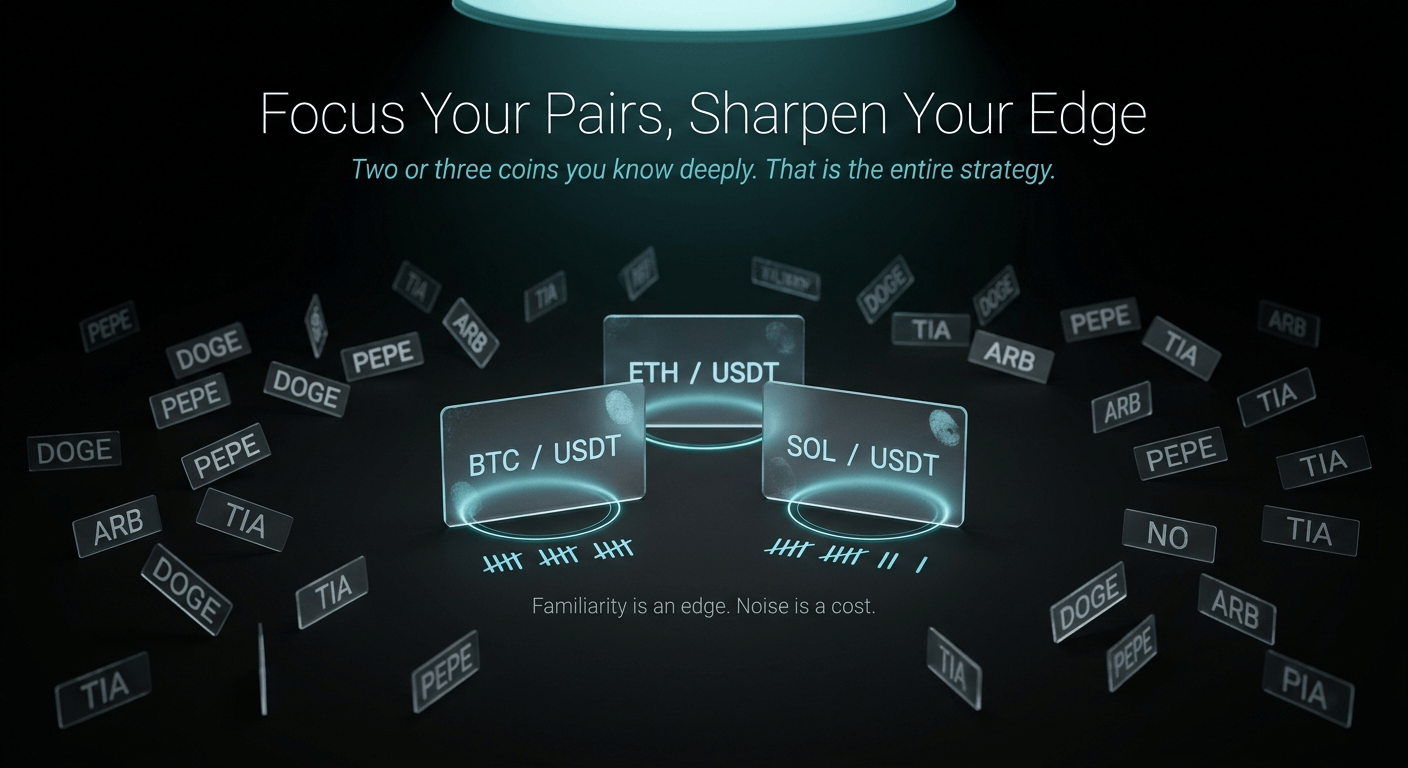
The traders who pass challenges tend to do the opposite. They pick two or three coins they know well and they stick with them. That is it. No scanning for the next hot altcoin. No switching pairs mid-session because something else looks better. Just a small, focused list and deep familiarity with how those assets move.
BTC and ETH are the obvious starting point. They are the most liquid, the most predictable in terms of structure, and the most covered by analysis. If you have been trading crypto for any amount of time, you already have a feel for how they behave around key levels. That familiarity is worth more than you think.
The other piece of this is risk-to-reward. Specifically, targeting setups with at least a 1:2 ratio. You are not trying to win every trade. Nobody does. But if you risk 1 percent to make 2 percent, you only need to be right slightly more than half the time to stay profitable. That math works in your favor over a full challenge. Chasing setups with poor ratios, like risking 2 percent to make 1.5 percent, means you need a very high win rate just to break even. That is a hard game to play under pressure.
Pair focus and risk-to-reward are not separate ideas. They work together. When you know your pairs well, you spot clean setups faster. And when you only take clean setups, your risk-to-reward stays healthy.
Why Fewer Pairs Means Better Results
There is a version of trading where more options feel like more opportunity. In a challenge, that thinking will cost you.
Every new pair you add is a new set of behaviors to track, a new set of support and resistance levels to learn, and a new source of noise pulling your attention away from your best setups. When you spread across too many coins, your reads get shallower. You start taking trades based on surface-level signals instead of genuine edge.
Narrowing to two or three familiar coins forces a different kind of discipline. You stop looking for trades and start waiting for the right ones. You know how BTC reacts at a certain level. You know how ETH behaves during a London open. That knowledge builds over time and it shows up in cleaner entries, tighter stops, and better execution overall.
Familiarity does not sound exciting. But in a challenge environment, it is one of the most reliable edges you can have.
The Mindset Shift That Separates Funded Traders
Here is the part most traders skip over because it does not feel like a real edge. It does not involve indicators or chart patterns or some new strategy. It is just how you think while you trade.
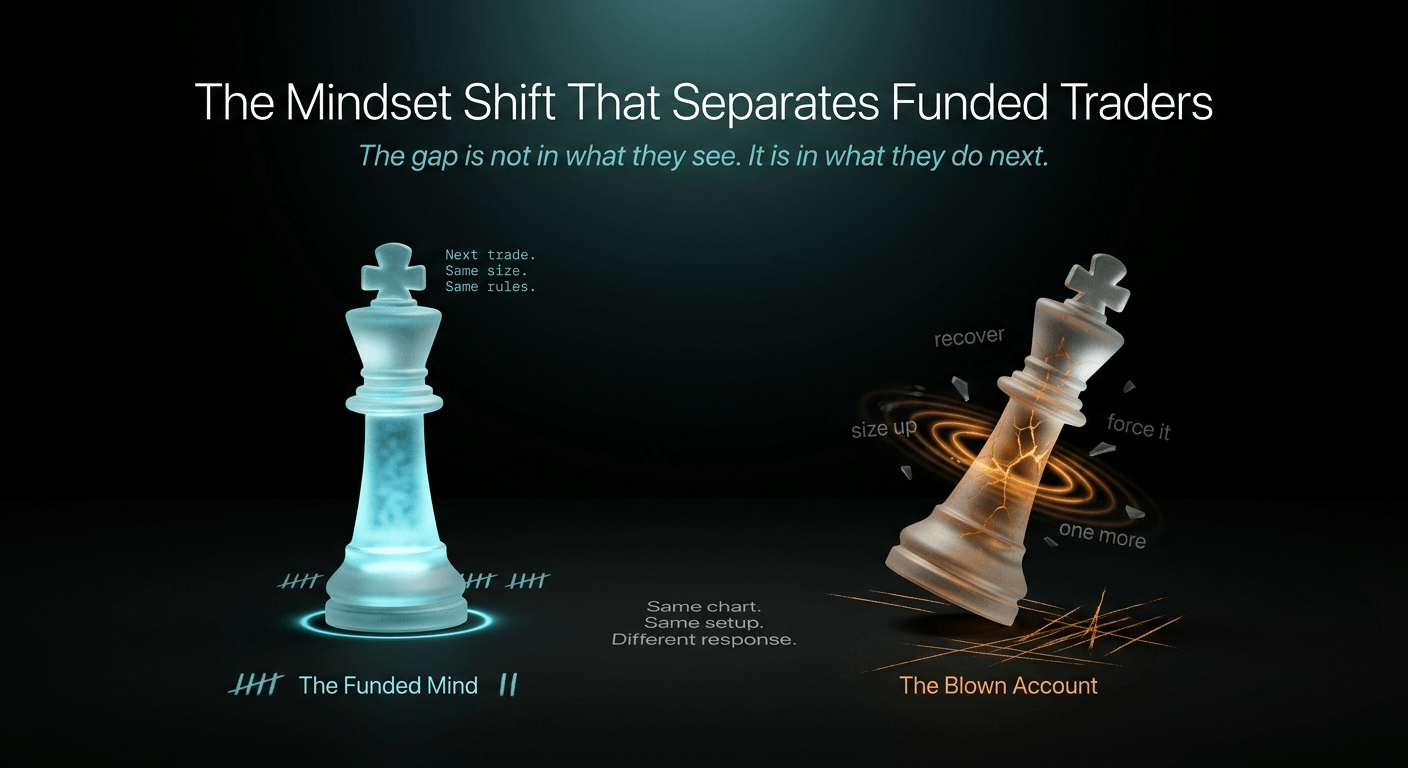
The difference between traders who get funded and traders who blow challenges is not skill. Both groups can read a chart. Both can identify a setup. The gap is in what happens after the setup plays out, especially when it plays out badly.
Amateur traders treat a losing trade as a problem that needs to be fixed immediately. They force the next entry. They size up to recover. They start scanning for anything that looks like it might move. The document puts it clearly, after several losses many traders unconsciously shift into emotional decision making, forcing setups, increasing position size, or trying to recover losses quickly. That sequence is the single most common way challenges end.
Funded traders do something that feels counterintuitive. They slow down. They accept the loss as a normal cost of doing business. They know that a 50 to 55 percent win rate with disciplined execution still performs well over time because winners become larger than losers. That math only works if you let it play out. If you interrupt the process with emotional trades, the edge disappears.
The real shift is this. Professional traders accept that missing a setup is normal. In crypto, another opportunity always appears. That sentence sounds simple but living it under challenge pressure is genuinely hard. Your brain wants action. It wants to feel like you are making progress. Sitting on your hands after a loss feels like falling behind. It is not. It is the discipline that keeps you in the game long enough for your edge to show up in the results.
Discipline is not exciting. It does not make for good screenshots. But it is the single trait that shows up again and again in traders who actually pass.
Think Like a Risk Manager, Not a Gambler
The frame you bring into a challenge matters more than you expect. If you sit down thinking, I need to hit my profit target, every decision filters through urgency. You start evaluating setups by how much they could make rather than how much they could cost.
Flip that frame. Walk into each session asking, what is the maximum I am willing to lose today. That is how a risk manager thinks. Protect the drawdown first. Let profits come as a byproduct of survival.
Practically, this means risking 0.5 to 1 percent per trade, stopping after a set number of losses, and walking away when your head is not right. Walking away protects both your account and your mindset. The market will still be there tomorrow. That last part is easy to forget when the challenge clock is ticking, but it remains true. A day off costs you nothing. A revenge trade can cost you the entire challenge.
The gamblers ask, how do I win this. The risk managers ask, how do I not lose this. In a prop challenge, those two questions lead to very different outcomes.
What It Really Takes to Get Funded in Crypto Props
Passing a crypto prop challenge is not about finding the perfect strategy or catching the perfect move. It is about doing ordinary things with unusual consistency. Risk small amounts. Trade familiar pairs. Follow your rules even when the market tempts you to improvise.
The traders who fail are not less intelligent. They just let pressure change their behavior. They chase setups because sitting still feels like falling behind. They size up because the target feels far away. They ignore drawdown limits because acknowledging them means admitting the day is over. Every one of those impulses is natural. Every one of them ends challenges.
FOMO is the quiet killer in crypto specifically. The market runs 24/7. There is always something moving. There is always a coin pumping that you are not in. That feeling of missing out pulls you away from your plan and into trades you would never take on a calm day. The antidote is simple but not easy. Trust your process. Accept that you will miss moves. Know that the opportunities you skip are the price you pay for the ones you execute well.
Consistency beats intensity. Patience beats speed. Structure beats talent. If you remember nothing else from this, remember that the challenge is not testing whether you can trade. It is testing whether you can trade under pressure without becoming someone else.
About the Creator
Sophie
Trader focused on Price Action & Order Flow.
Into crypto, fast execution, controlled risk, and quality setups.
Passing funded accounts and refining my trading every day.
Enjoyed the story? Support the Creator.
Subscribe for free to receive all their stories in your feed.
Comments