
STOXX Europe 600: Europe’s Broadest Benchmark for Equity Market Performance
Explore the STOXX Europe 600 index, how it tracks European stocks, what drives its performance, and how it compares with the Dow Jones Industrial Average and S&P 500 Total Return.

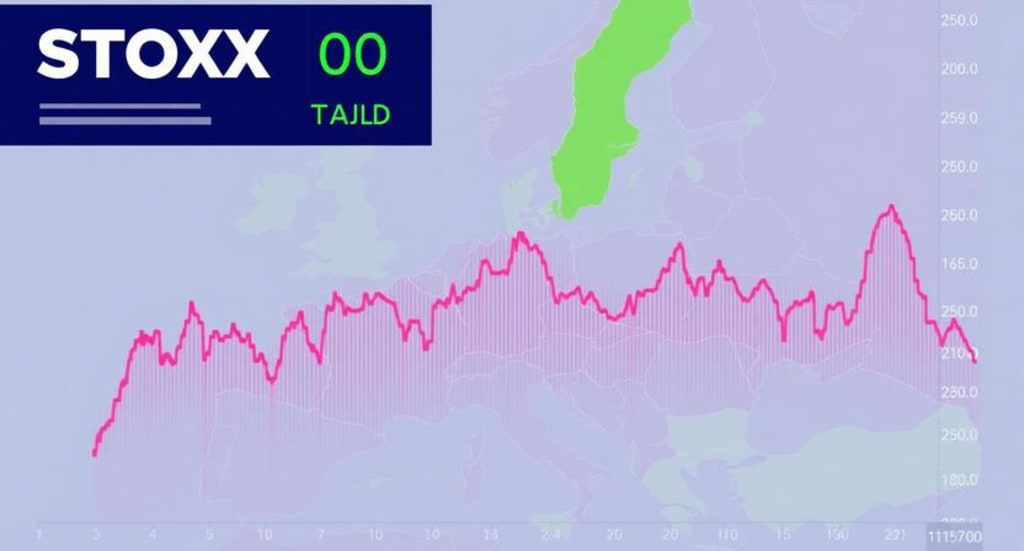
STOXX Europe 600
The STOXX Europe 600 is one of the most widely used equity benchmarks for measuring the performance of European stock markets. It represents a broad cross-section of companies across Europe and is designed to give investors a clear, diversified view of regional market trends
In global investing, the STOXX Europe 600 is often analyzed alongside major U.S. benchmarks such as the Dow Jones Industrial Average and the S&P 500 Total Return. This comparison helps investors understand how European equities perform relative to American markets and how global economic conditions influence regional returns.
Because it includes companies from multiple countries and sectors, the STOXX Europe 600 plays a key role in international portfolio construction and macroeconomic analysis.
What Is the STOXX Europe 600?
The STOXX Europe 600 tracks 600 publicly listed companies across 17 European countries, including major economies like Germany, France, the United Kingdom, Switzerland, and the Netherlands.
Unlike narrow indexes that focus only on large corporations, this index includes:
Large-cap companies
Mid-cap companies
Small-cap companies
This structure makes it one of the most representative and diversified benchmarks of the European equity market.
It is widely used by global investors, asset managers, and exchange-traded funds (ETFs) as a standard reference for European stock performance.
How the STOXX Europe 600 Works
The STOXX Europe 600 is weighted by free-float market capitalization. This means that companies with higher market value and more publicly available shares have a larger influence on the index’s performance.
The index is reviewed regularly to ensure it accurately reflects current market conditions. Companies can be added or removed based on liquidity, size, and eligibility criteria.
This dynamic structure helps the index stay aligned with real-time developments in European financial markets.
Why the STOXX Europe 600 Matters
The STOXX Europe 600 is important because it provides a comprehensive snapshot of European economic health and corporate performance.
When the index rises, it often signals strong earnings growth, investor confidence, and positive economic momentum across Europe. When it falls, it may reflect concerns such as inflation, weak growth, or geopolitical uncertainty.
Just as the Dow Jones Industrial Average reflects the performance of major U.S. companies, the STOXX Europe 600 represents a broad picture of European business activity and investor sentiment.
Key Drivers of STOXX Europe 600 Performance
Several major factors influence the performance of the STOXX Europe 600, including:
European Central Bank (ECB) interest rate decisions
Corporate earnings across major sectors
Inflation trends within European economies
Global trade conditions and supply chain dynamics
Political developments and geopolitical risks
Because many companies in the index operate globally, international economic trends also play a significant role in performance.
STOXX Europe 600 vs Dow Jones Industrial Average
The STOXX Europe 600 and the Dow Jones Industrial Average are both important benchmarks, but they differ significantly in structure.
The STOXX Europe 600 includes 600 companies across multiple countries and industries, offering broad diversification. In contrast, the Dow Jones Industrial Average tracks only 30 large U.S. companies and provides a more concentrated view of American blue-chip stocks.
This makes the STOXX Europe 600 more representative of regional market breadth, while the Dow focuses more on headline corporate performance in the United States.
Investors often compare both indexes to understand global market trends and regional performance differences.
STOXX Europe 600 vs S&P 500 Total Return
The STOXX Europe 600 is also frequently compared with the S&P 500 Total Return, which tracks 500 U.S. companies and includes reinvested dividends.
While the S&P 500 Total Return reflects long-term wealth creation in the U.S. market, the STOXX Europe 600 provides a broader view of European equity performance across multiple economies.
Together with the Dow Jones Industrial Average, these benchmarks help investors evaluate global diversification opportunities and compare regional market strength.
Why Investors Use the STOXX Europe 600
Investors prefer the STOXX Europe 600 because it offers:
Wide exposure to European markets
Inclusion of multiple company sizes
Strong sector diversification
Reliable benchmarking for fund performance
It is commonly used by ETFs, pension funds, and institutional investors seeking exposure to European equities.
Future Outlook for STOXX Europe 600
The future performance of the STOXX Europe 600 will depend on European economic growth, corporate earnings, and global market stability. Key growth drivers include innovation in technology, renewable energy expansion, healthcare advancements, and financial sector development.
However, risks such as inflation pressures, geopolitical uncertainty, and changes in monetary policy may create volatility in the short term.
Despite these challenges, the index is expected to remain a key benchmark for European equity markets.
Conclusion
The STOXX Europe 600 is one of the most important indicators of European stock market performance. Its broad structure and diversified composition make it a valuable tool for understanding regional economic trends and investment opportunities.
When analyzed alongside the Dow Jones Industrial Average and the S&P 500 Total Return, it provides a complete global perspective on equity markets, helping investors compare performance across Europe and the United States.
Overall, the STOXX Europe 600 remains a critical benchmark for global investors focused on diversification, market analysis, and long-term portfolio strateg
About the Creator
Hammad Nawaz
Hammad here, sharing stock market insights, trading strategies, and tips. Helping traders understand trends, risk, and opportunities in equities, forex, and commodities.
Enjoyed the story? Support the Creator.
Subscribe for free to receive all their stories in your feed.
Comments
There are no comments for this story
Be the first to respond and start the conversation.