
Scaling Up in Crypto Prop Firms Without Raising Your Risk
How scaling plans expand funded crypto accounts, not bigger personal deposits.

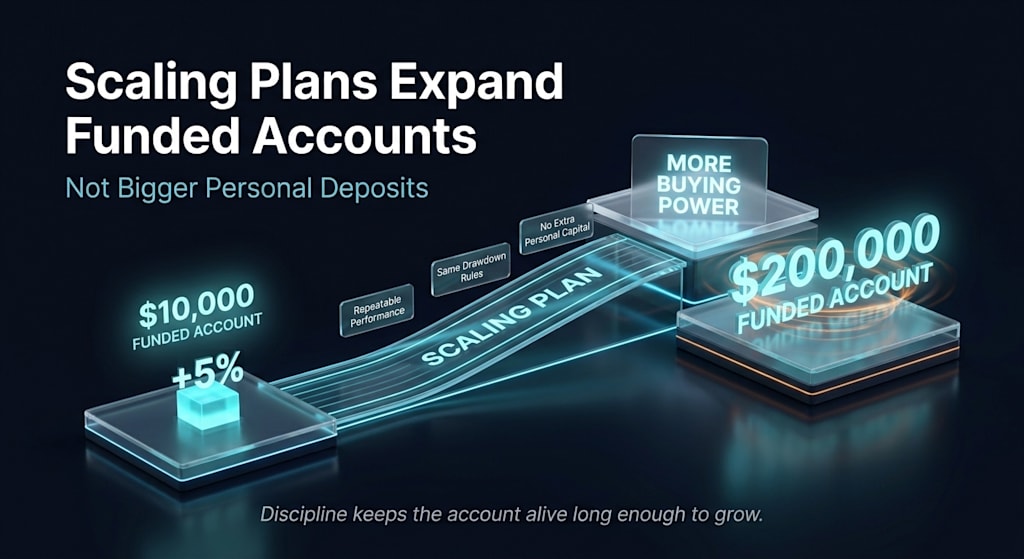
A 5% month on a $10,000 funded account is a few hundred dollars. The same 5% on a $200,000 account is a different professional problem: larger dollar swings, the same drawdown rules, and a psychological tax traders call dollar shock.
That gap is the real job of scaling up in crypto prop firms. It is not a prize for one explosive month. It is the process of earning more buying power through repeatable performance, without depositing more personal capital.
Most retail traders still ask, “How much can I extract from this account this week?” Traders who last through multiple growth cycles ask something else: “Can this process still work when the numbers on the screen are five or ten times larger?”
This article explains how scaling up works, how scaling plans create that path, and why discipline, not bigger risk, is what usually keeps the account alive long enough to grow.
How Scaling Up Works in Crypto Prop Firms
Scaling up in crypto prop firms works by expanding a trader’s buying power after consistent performance and risk control, instead of requiring a larger personal deposit. A scaling plan is the rule set that decides when that extra capital is granted.
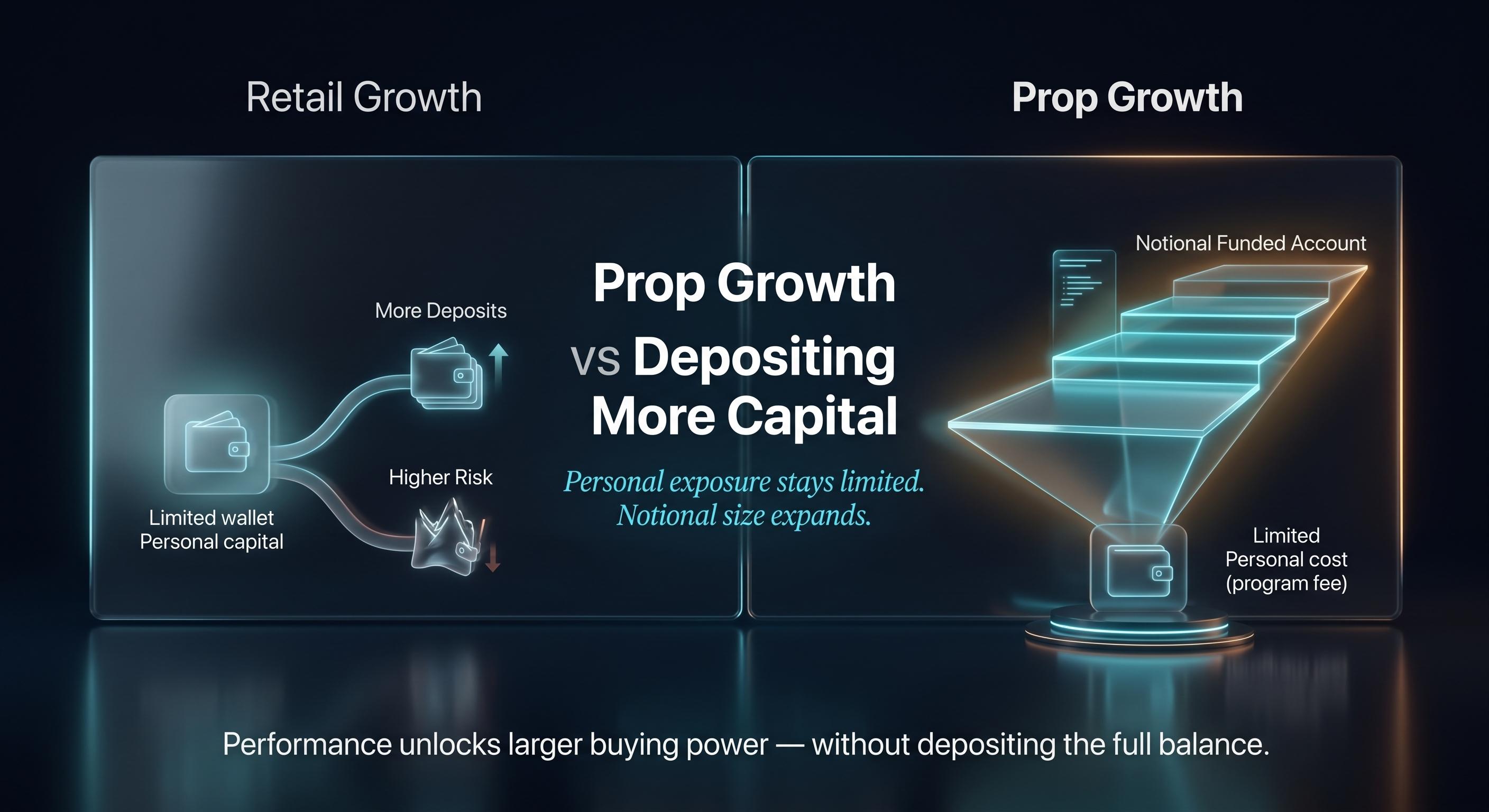
Prop Growth vs Depositing More Capital
Retail crypto trading grows an account mainly through deposits or through taking more risk on a small personal balance. Prop programs work on a different mechanic. If the trader meets the firm’s performance and risk tests, the notional account can expand while personal financial exposure stays limited to program costs, not the full displayed balance.
What a Larger Account Label Actually Changes
A larger label on the dashboard is not automatically cash in a personal wallet, and it is not a license to raise risk per trade. It is a test of whether the same process still holds when dollar swings get louder.
Futures and forex prop programs often scale by contract count or lot cap. Crypto programs more often scale the displayed balance or buying power. In both cases, the useful question is not “How big is the headline?” It is “What actually changed, loss room, position limit, payout terms, or only the number on the screen?”
Does Scaling Mean the Trader Receives More Personal Cash?
Usually no. It typically increases program buying power. Whether that balance is simulated or live depends on the firm’s model. The label on the account is not the same as cash in a personal wallet.
Scaling Up vs a Scaling Plan: Destination vs Engine
Scaling up is the trader’s destination: managing larger capital without raising personal deposits or per trade risk. A scaling plan is the engine: the firm’s time window, profit and risk tests, and staged capital increase that make that destination possible.
How the Two Terms Differ
Scaling up is the trader’s destination: managing larger capital without raising personal deposits or per-trade risk. A scaling plan is the engine: the firm’s time window, profit and risk tests, and staged capital increase that make that destination possible.
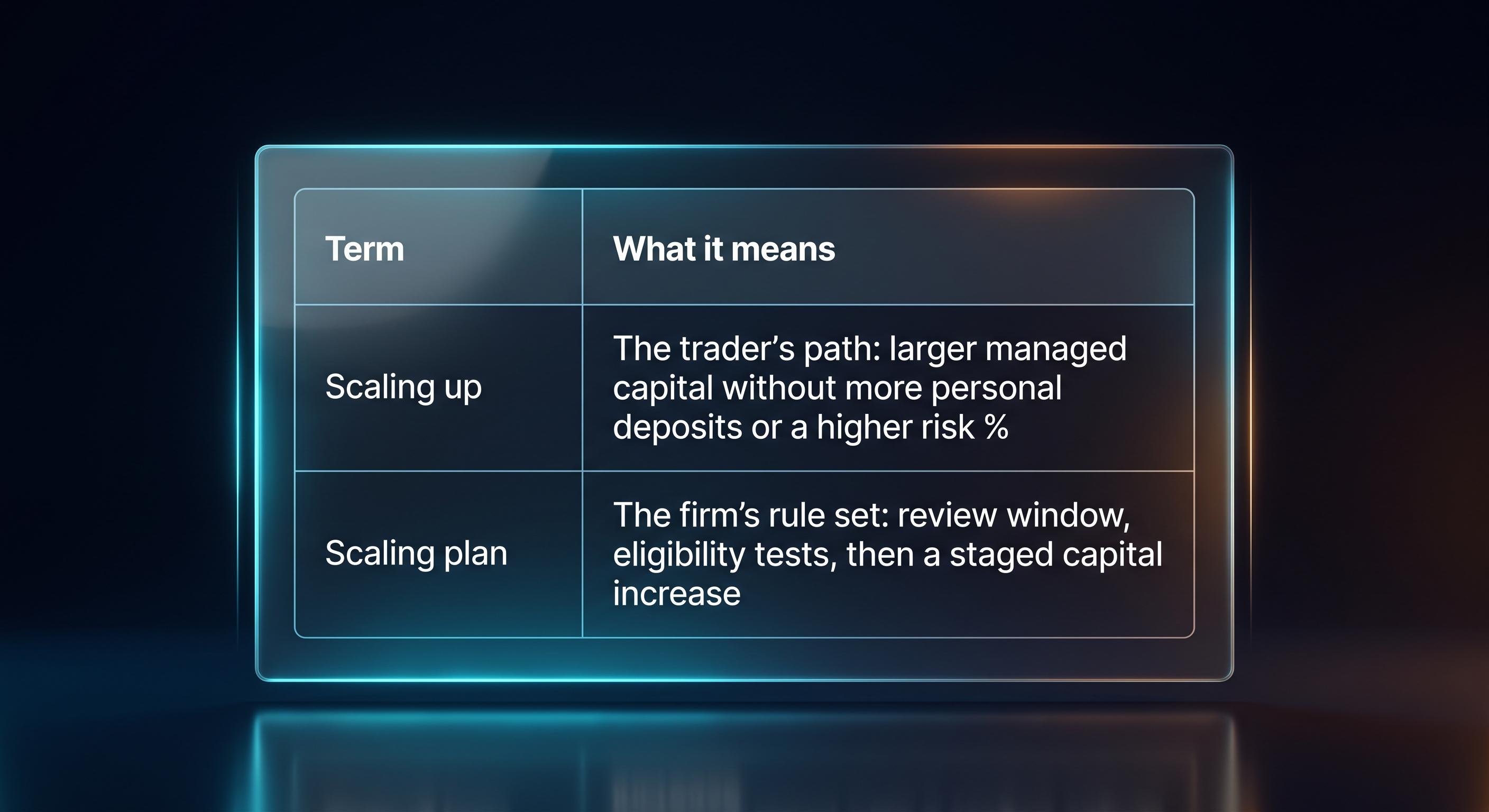
Without a plan, account growth usually means depositing more money or taking more risk. With a plan, growth is supposed to be earned through measured behavior over a defined window.
Why Marketing Treats Them as Synonyms
The two ideas get mixed because marketing uses them as synonyms. They are not. A trader can want to scale up and still fail a scaling plan. A firm can publish an attractive ceiling and still keep the next increase conditional, delayed, or discretionary. Read the contract, not the headline.
Are Scaling Plans Guaranteed in Prop Firms?
No. They are conditional. Most firms require a mix of profit, time, drawdown control, and rule compliance. A profitable month that breaks risk rules often delays or blocks the increase.
Do All Crypto Prop Firms Offer Scaling?
No. Some keep a fixed account size and only pay a profit split. Scaling is more common in programs built around longer trader development. Compare the contract, not the marketing headline.
Why Crypto Prop Scaling Feels Different From Small Account Trading
Crypto prop scaling feels different because the same percentage process produces much larger dollar swings, while crypto markets stay open around the clock and drawdown clocks do not pause for a “good setup.”
Dollar Shock on a Larger Funded Balance
On a small personal account, a 1% loss can feel like tuition. On a six figure funded balance, the identical 1% is the same risk model with a louder number. Many traders then start managing the dollar instead of the process. That is dollar shock, and it shows up as early exits, skipped valid entries, or the opposite error: treating the bigger balance as spare room for aggression.

Why 24/7 Crypto Makes Scaling Harder
Crypto adds a second pressure that equity hours traders do not face in the same way:
Weekend and news volatility can move the book when the trader wanted “just one more setup”
Identical risk % now prints a much larger P&L in dollars
Daily loss and trailing drawdown rules do not care that the thesis still looks clean
A market that never closes makes overtrading easier to justify
The strategy on the chart may not need to change. The job does. Scaling up is less about finding a more advanced indicator and more about keeping execution quality when the numbers stop looking small.
How Scaling Plans Increase Account Size Over Time
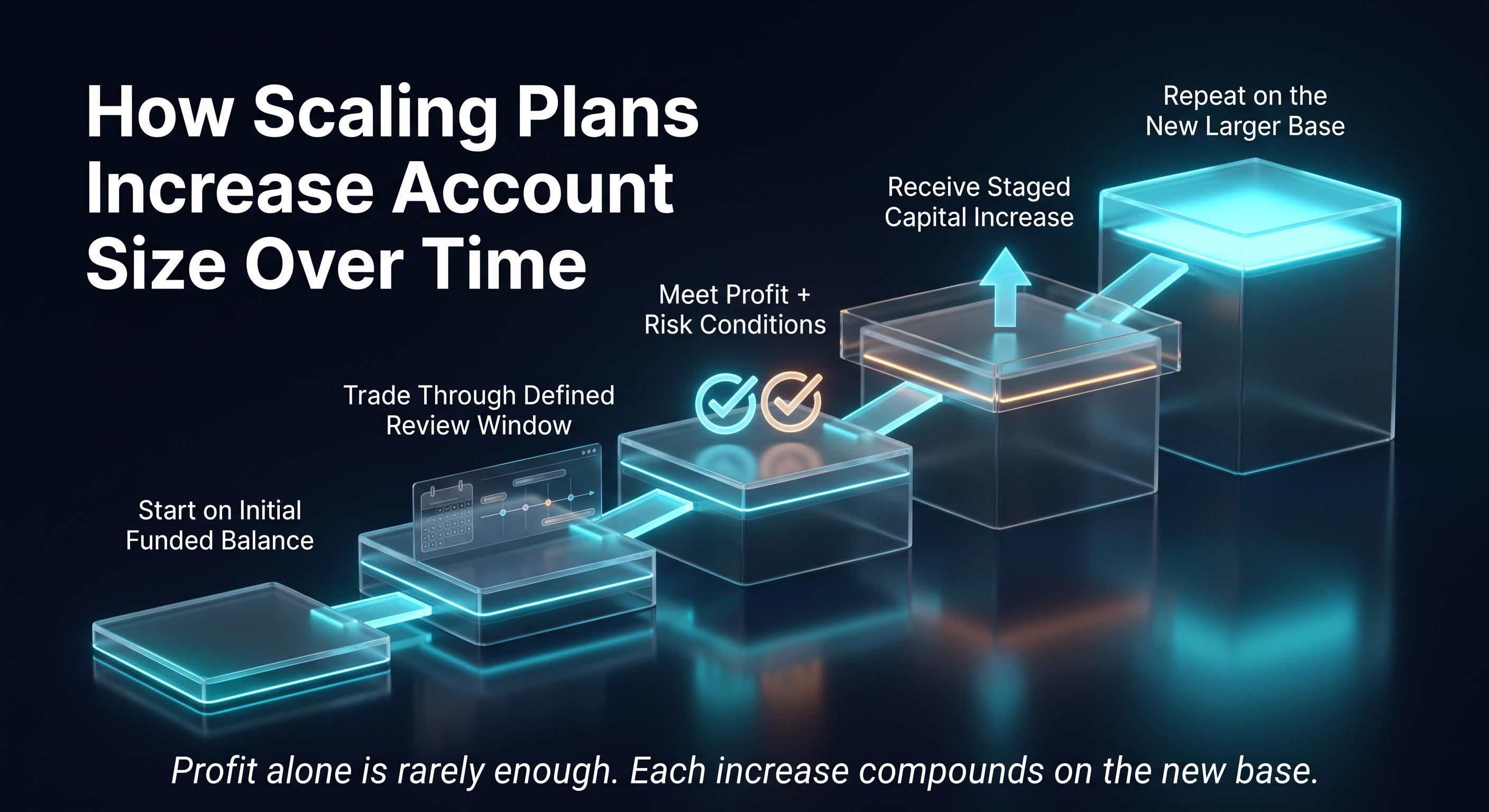
Scaling plans increase account size in stages: the trader starts on an initial funded balance, trades through a defined review window, meets profit and risk conditions, receives a capital increase if rules stay intact, then repeats the cycle on the larger base.
The Five Step Increase Cycle
Start on the initial funded balance.
Trade through a defined review window (often measured in months, not days).
Meet profit and risk conditions, profit alone is rarely enough.
Receive a staged capital increase if rules stay intact.
Repeat; each increase compounds on the new base.
Fixed Schedules vs Rule Based Upgrades
Two common designs sit under that sequence.
Fixed or calendar models publish a schedule in advance, for example, a percentage increase after a set period if the account stays profitable and inside drawdown. The path is easier to plan. The tradeoff is rigidity: a strong process that misses one calendar checkpoint may wait for the next window.
Rule based models trigger an increase only after metrics clear: risk adjusted results, consistency, drawdown quality, activity, or strategy compliance. These can fit different trading styles. They also feel less predictable, because several variables, not a date, decide the upgrade.
Neither design is automatically better. Both exist to filter behavior. A trader who prints a large return by risking a wide slice of the account on a handful of trades may look identical, on a profit line, to a trader who got there with stable size. Firms usually treat those two records as different products.
The 90 Day Filter: What Firms Are Actually Testing
A 90 day review is not a race to a profit target. It is a filter: long enough to see whether results survive more than one volatility regime, and whether the trader still respects risk when the easy tape disappears.
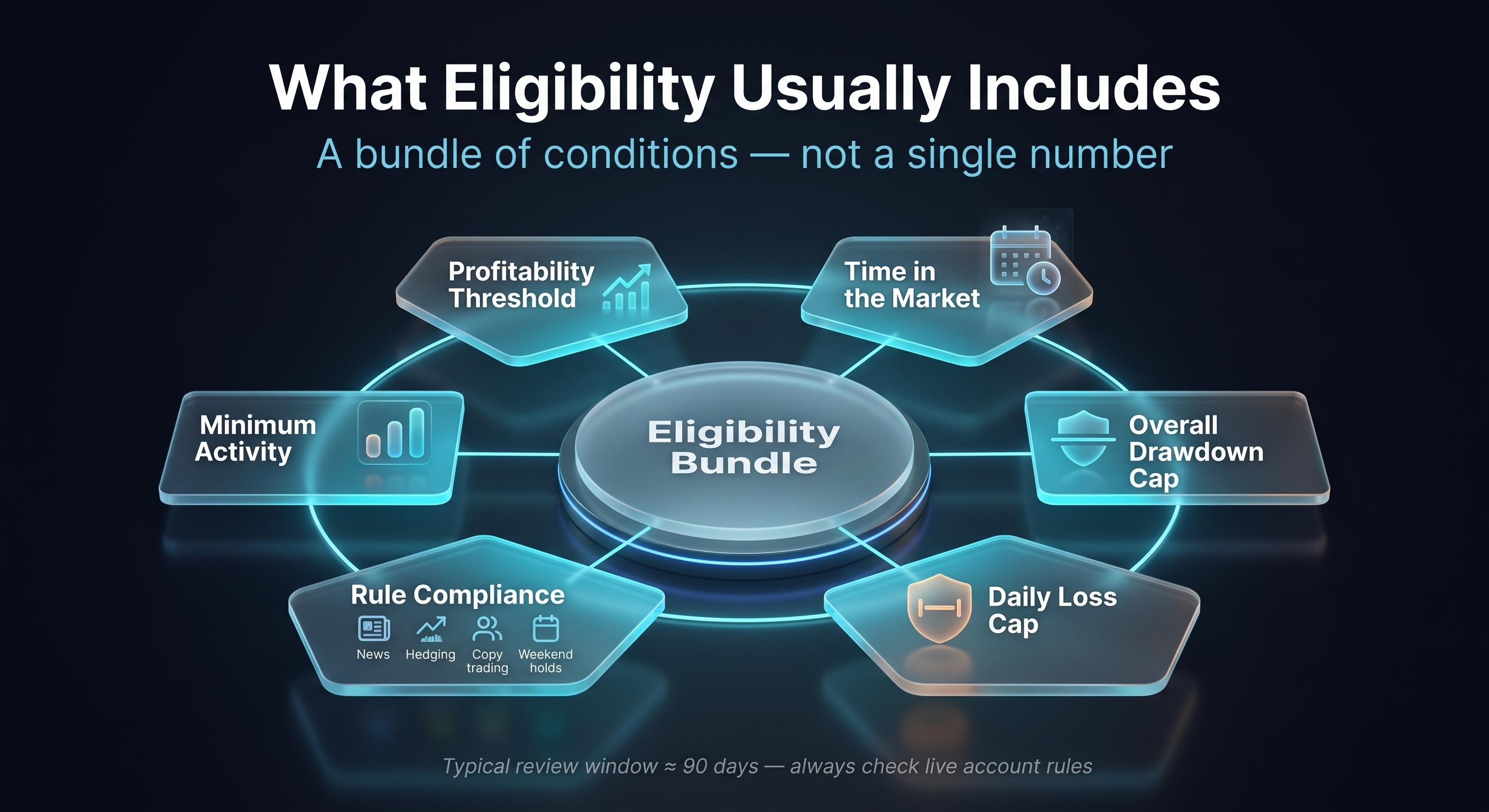
What Eligibility Usually Includes
Some crypto prop programs review on a roughly 90 day cycle. Exact windows vary. Always read the live account rules, not a blog illustration.
Eligibility is usually a bundle, not a single number:
A profitability threshold over the window
Time in the market, not a handful of lucky sessions
Overall drawdown cap
Daily loss cap
Rule compliance (news, hedging, copy trading, weekend holds, whatever the contract names)
A minimum activity requirement, so the book is not a one trade screenshot
Why a Longer Window Filters Luck
A longer window removes the incentive to force trades in week two. It also exposes the common failure mode: the trader who is excellent in a trend week and unstructured once ranges return. Scaling is supposed to answer that second question.
Drawdown rules get stricter in effect as the balance grows, even when the percentage stays the same, because the dollar path to a breach is now large enough to rattle decision making. Traders who treat a bigger account as permission for bigger risk % usually do not get many cycles.
Does a Withdrawal Stop Scaling?
Not automatically. Some programs need a minimum equity or retained profit level inside the cycle. Withdrawing too much can slow eligibility even when withdrawals are allowed. The live rulebook decides.
A Hypothetical 12 Month Path: Same Process, Larger Base
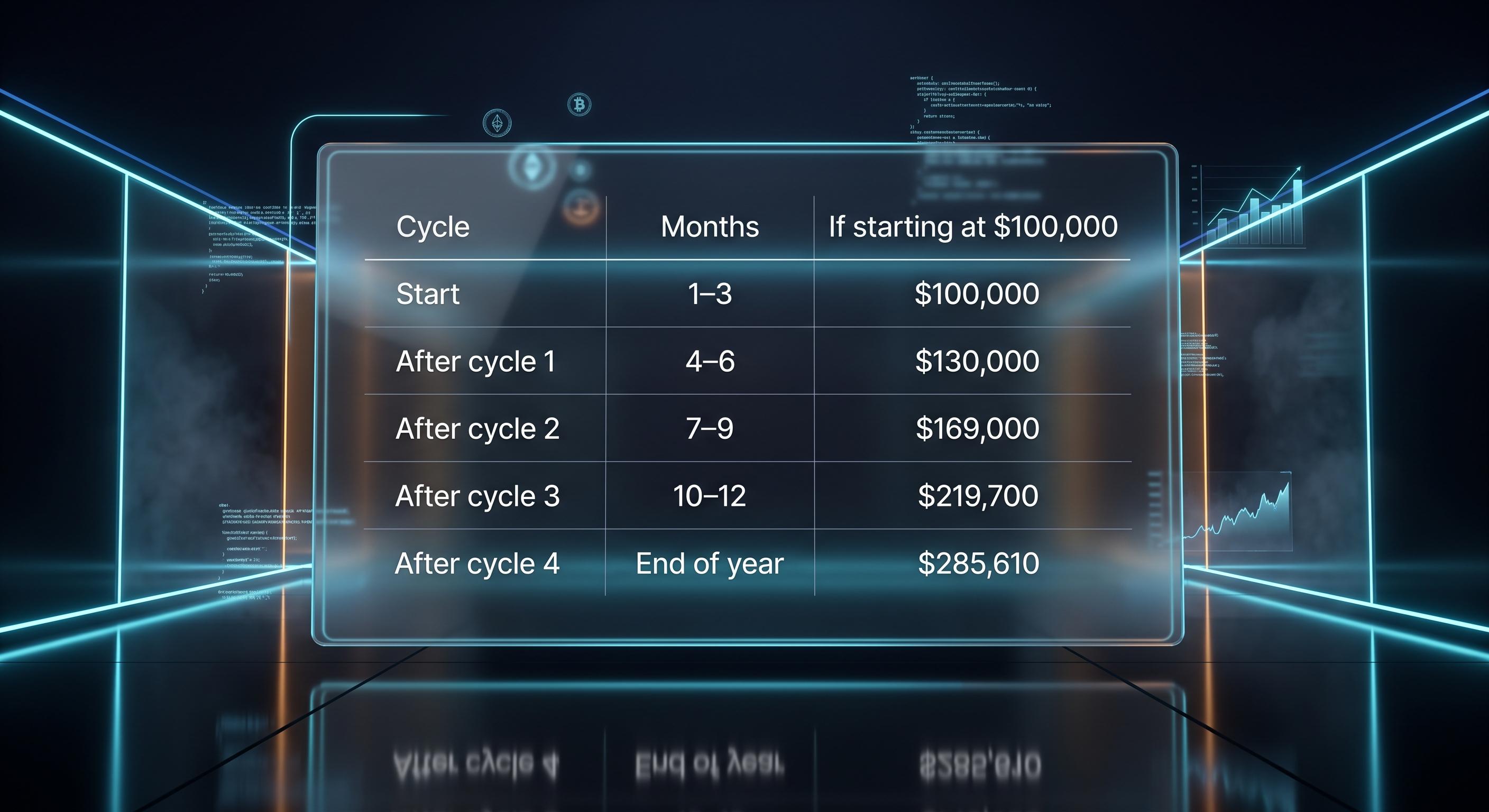
The following path is illustrative only. It assumes a 30% capital increase after each successful quarterly cycle, with no rule breach. Real programs differ, and missing one cycle resets the path. This is a simplified illustration, not a forecast or an offer.
A Sample Quarterly 30% Path
Start with a $100,000 funded balance and assume each successful quarter adds 30% to that base. After four clean cycles the notional account moves from $100,000 to $130,000, then $169,000, $219,700, and $285,610. The table shows only the capital step up. It does not assume higher risk, a new strategy, or a guaranteed year.
How to Read the Math Without Treating It as a Forecast
Read the table the right way. The strategy did not need a new indicator at each step. If the trader kept qualifying, the base got larger. A stable percentage return on $285,610 is a different income problem than the same percentage on $100,000, still with the original risk model, still with no extra personal deposit.
Live results are not this linear. A drawdown, a missed window, a payout that reduces retained equity, or a rule change can break the compounding. The point of the math is the mechanic, not a promised year end balance.
How Long Does Scaling Take?
There is no universal clock. Many plans use multi month review windows. Missing a cycle, hitting drawdown, or changing rules can stretch a 12 month illustration into much longer.
A 3 Phase Scaling Cycle: Buffer, Execute, Defend
A practical way to trade a scaling window is a three phase cycle: build a profit buffer early, execute the original playbook at the same risk % in the middle, then defend eligibility near the review instead of sprinting for extra return.
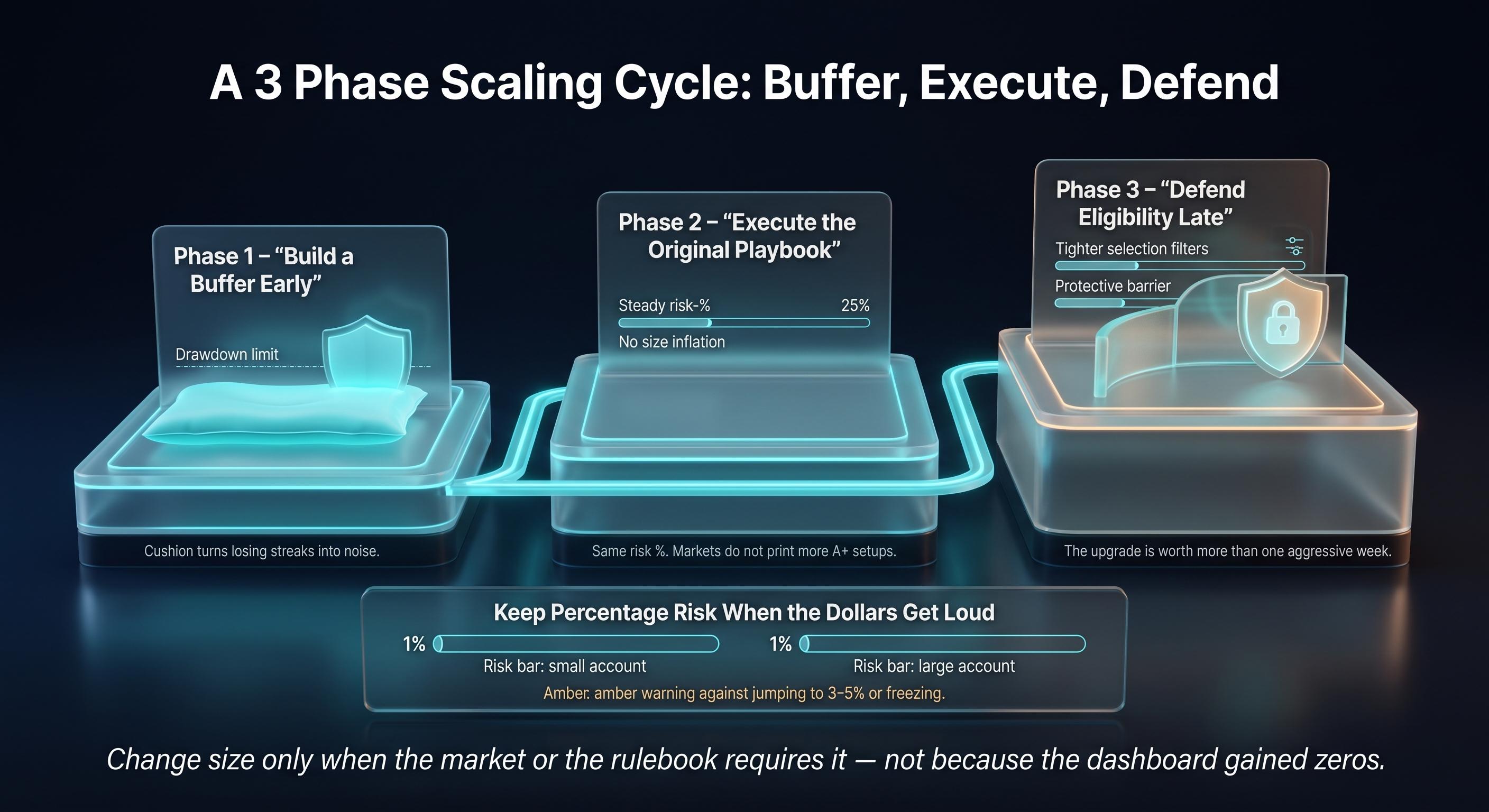
Phase 1: Build a Buffer Early
Build distance from drawdown limits. The goal is stability, not maximum return. A cushion turns normal losing streaks into noise instead of a breach threat.
Phase 2: Execute the Original Playbook
Trade the original playbook at unchanged risk %. Do not inflate size because the balance looks bigger. Markets do not print more A+ setups because the account was upgraded.
Phase 3: Defend Eligibility Late
Tighten selection, cut marginal setups, and protect eligibility. The upgrade is usually worth more than one extra aggressive week.
Keep Percentage Risk When the Dollars Get Loud
Position sizing should stay percentage based. Risking 1% of $10,000 and 1% of $200,000 is the same rule with a different emotional load. The error is treating the larger notional as permission to jump to 3–5% “because there is more room,” or freezing and taking no valid risk because the dollar stop looks expensive.
Keep the stop, the thesis, and the invalidation. Change the size only when the market or the rulebook requires it, not because the dashboard number got more zeros.
Five Mistakes That Break Scaling Progress
Most scaling setbacks come from behavior after the account grows, not from a strategy that suddenly stopped working. The five mistakes below show up repeatedly once the balance looks large enough to feel like a new career.
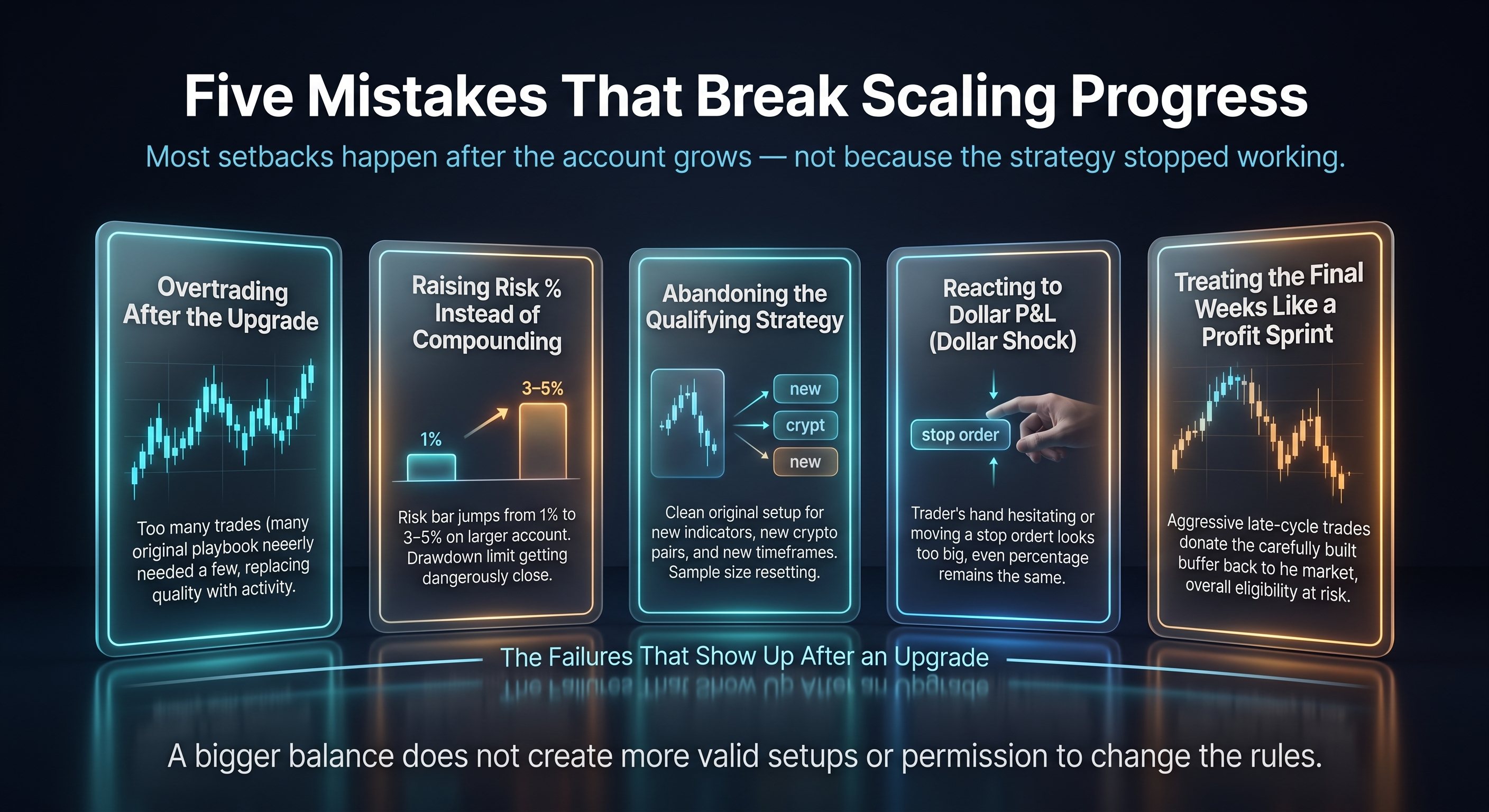
The Failures That Show Up After an Upgrade
Overtrading after the upgrade. A bigger account does not create more valid setups. Taking ten trades where the playbook used to take three replaces quality with activity.
Raising risk % instead of letting capital compound. The plan’s job is to enlarge the base. Raising risk per trade fights the whole point and shortens the distance to a drawdown breach.
Abandoning the strategy that qualified the account. “Now I need a more advanced system” is a common story. New indicators, new pairs, and new timeframes reset the sample size at the worst moment.
Reacting to dollar P&L instead of the percentage process. Closing winners too early, skipping entries, or moving stops because the dollar amount “looks too big” is dollar shock, not analysis.
Treating the last two weeks of a cycle like a profit sprint. Eligibility is often closer than one more aggressive week is worth. This is where buffers get donated back to the market.
Why Traders Abandon the Process That Qualified Them
The pattern is consistent: the process that earned the increase gets replaced by a process designed to use the increase. Scaling plans reward the first process, repeatedly.
What Is the Biggest Risk After an Account Increase?
Behavioral, not technical. Overtrading, raising risk, and dollar shock cause more failed cycles than a strategy that suddenly stopped working.
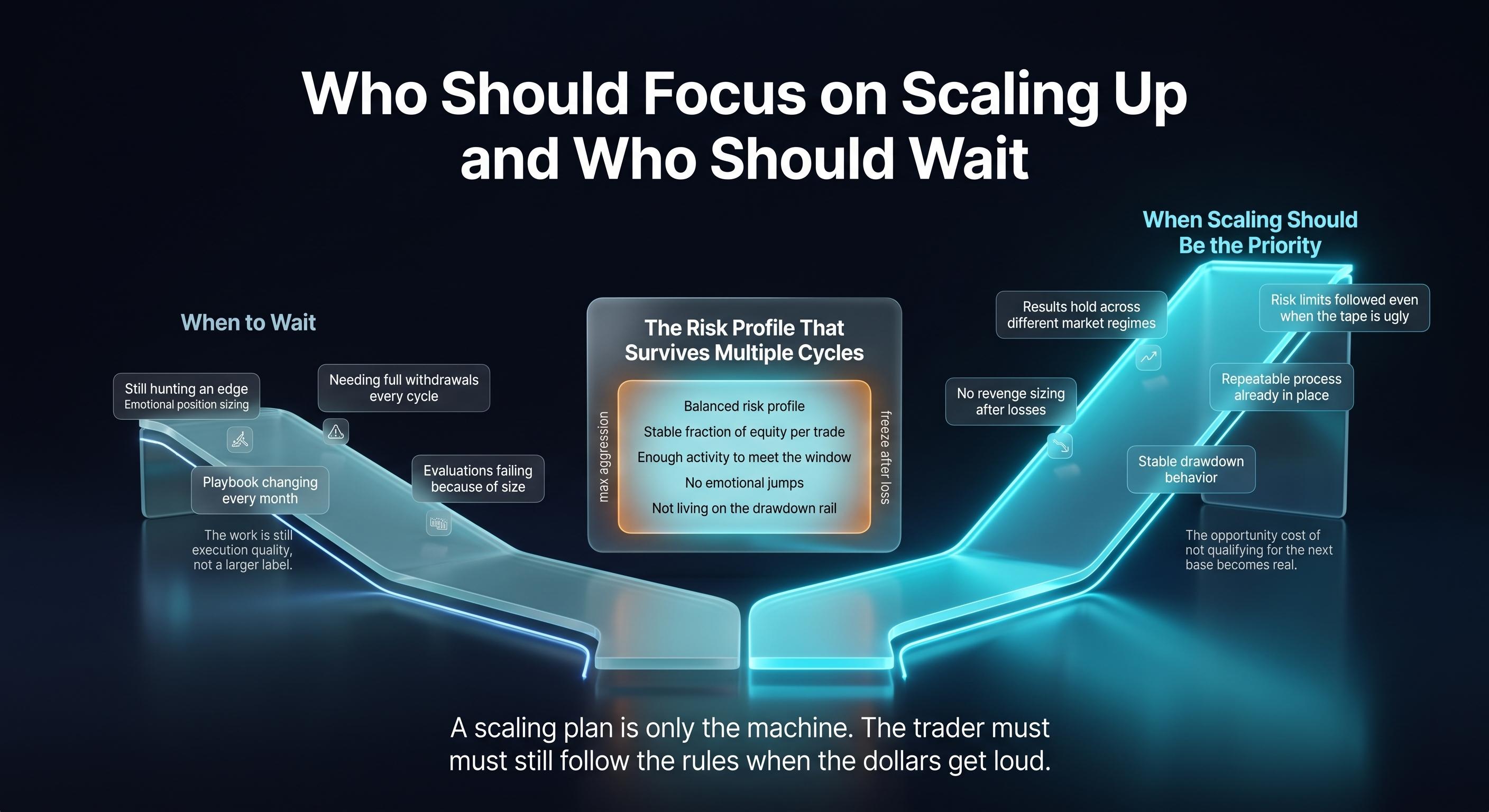
Who Should Focus on Scaling Up and Who Should Wait
Scaling up is a fit for traders who already have a repeatable process and stable drawdown behavior. It is a distraction for traders who are still hunting an edge, sizing emotionally, or needing every dollar withdrawn immediately.
When to Wait
Wait if evaluations still fail because of size, the playbook changes every month, or cash flow needs force full withdrawals that keep the account near the floor. In that stage, the work is execution quality, not a larger label.
When Scaling Should Be the Priority
Prioritize scaling if results hold across more than one market regime, risk limits are followed when the tape is ugly, and losses do not trigger revenge size. Then the opportunity cost of not qualifying for the next base becomes real.
The Risk Profile That Survives Multiple Cycles
The risk profile that usually survives multiple cycles is moderate and rules based: a stable fraction of equity per trade, no emotional size jumps, enough activity to meet the window, not enough aggression to live on the drawdown rail. Max aggression books are too noisy to qualify reliably. Freeze after loss books often grow too slowly to clear the same gates.
Scaling up in crypto prop firms is the work of managing a larger base with the same process. A scaling plan is only the machine that can enlarge that base. The machine does not trade. It records whether the trader can still follow the rules when the dollars get loud.
Disclaimer: Educational only. Not financial advice. Crypto trading is risky and can result in loss. Prop accounts follow firm specific rules; some balances are simulated buying power rather than personal cash. Hypothetical figures above are not typical, not guaranteed, and not an offer.
About the Creator
Sophie
Trader focused on Price Action & Order Flow.
Into crypto, fast execution, controlled risk, and quality setups.
Passing funded accounts and refining my trading every day.
Enjoyed the story? Support the Creator.
Subscribe for free to receive all their stories in your feed.
Comments
There are no comments for this story
Be the first to respond and start the conversation.