
Rich Dad Owes 1.2 Billion
He taught millions to get rich with debt — but his own debt is not what it seems.
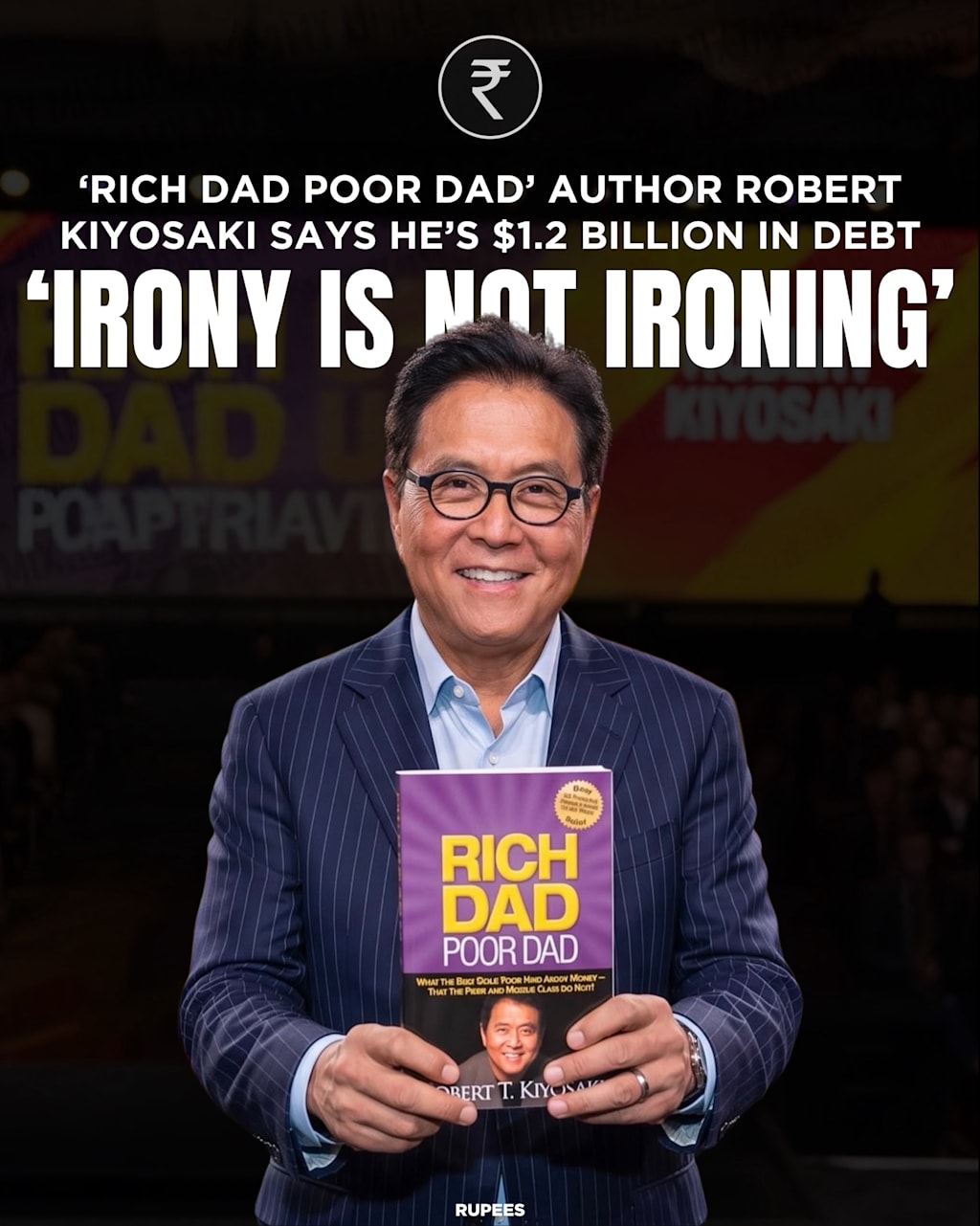
In 2012, I paid eight yuan at a street stall behind my university for a copy of Rich Dad Poor Dad with a folded corner on the cover. I skipped my elective that afternoon and sat on my dorm bunk bed. When I got to the page that said "a house is not an asset," I closed the book and stared at the mildew stains on the ceiling for a long time. I had 4,300 yuan saved up. Three thousand was for next quarter's rent. The rest would buy me forty meals in the cafeteria. The book said the difference between the poor and the rich is the difference in thinking. I thought about my situation and figured he was right. I didn't have the nerve.
I read that book four times, underlined twelve passages with a ballpoint pen, and wrote "change your mindset" on the title page. Over the next few years, I changed jobs three times. My salary went from 3,000 to 8,000, and my savings crawled from 4,300 to 62,000. Every time I hit a round number, I remembered that line from the book—"saving is for losers"—and I'd stare at my balance, not knowing whether to spend it or keep it.
By 2020, I was getting Kiyosaki clips on my phone. He'd be wearing a Hawaiian shirt and silver-rimmed glasses, saying "debt is fuel for making money." I looked at my own mortgage. After the fixed bills each month, I had 2,000 left. Barely fuel. But I wasn't taking notes like I did sophomore year. Something felt off.
The off feeling started with "Rich Dad" himself. I spent maybe half an hour searching "Rich Dad real identity." Nothing. Wikipedia said, "According to Kiyosaki, he is the father of his best friend." One lead came from a 2007 article where a reporter mentioned a name—"Richard Kimi"—but the link was dead. I closed the search page and texted my dad: "Dad, was the way you taught me to save wrong?" He didn't reply.
By then I'd stopped reading Kiyosaki, but the algorithm still fed me his videos. Once I clicked into the comments. Someone said "Rich Dad never existed," and four hundred replies argued underneath. I scrolled through them. Some said it was marketing. Some said it didn't matter, what mattered was the lesson. I thought the lesson was probably fine, but a guy using a fictional character as a mascot while teaching me how to spot fake assets—that bugged me. I pulled Rich Dad off the second shelf of my bookcase, flipped to the title page where I'd written those words seven years earlier, and tried to erase them with a rubber. It smudged. I put it back.
Then came this summer. I heard the clip on a podcast. The host asked if he really owed 1.2 billion. Kiyosaki smiled and said, "I've never saved money. Saving is for losers." He smiled like he'd just told a good joke. I was washing dishes at the time, the tap still running, both hands in the soapy foam. I froze for a few seconds, then caught myself glancing at my wedding ring—I'd just finished paying it off last month. Buying it a year ago had cost me thirty thousand in savings. The first time my savings had dipped below fifty thousand.
I replayed that audio four times, trying to catch exactly what he said. In the comments, people posted numbers—that 1.2 billion was corporate debt, not personal; that he owned fifteen hundred apartments; that he was finished; that he did it on purpose. I closed the comments, opened my notes app, converted 1.2 billion into yuan, and ran the math seven or eight times. Same number every time. Then I tapped the divide sign on my calculator and entered my monthly take-home pay. Forty thousand. Forty thousand months. 3,300 years. I stared at that number for half a minute, turned my phone face-down on the table, went to the kitchen, poured a glass of cold water, drank it, and poured another.
Later I looked up the structure of that debt. He didn't borrow in his own name. He used limited-liability companies—one shell per project. Banks lent to the shells. If a shell went down, the bank could auction the building under that shell's name, but they couldn't touch his couch. In real estate, they call it a firewall. He'd spent twenty years writing books teaching people how to build that wall. But after 2022, the Fed hiked rates from 0.25 to 5.5. U.S. office vacancy rates broke 30%. Rent couldn't cover the interest anymore. The wall started to crack. That 1.2 billion he owed came out to an 8-billion-yuan hole.
At the same time, I calculated his royalties. Rich Dad Poor Dad sold 44 million copies. Even if he made just one dollar per copy, that would have filled a third of the hole. And that doesn't count the courses, speeches, board games, and the books he co-wrote with Trump. Trump's book—Why We Want You to Be Rich—has a 6.8 on Douban. Still spent four months on the bestseller list.
I didn't sleep that night. One thought kept circling: if that 1.2 billion were my debt, I wouldn't be smiling. I'd hesitate to go to the dentist. But he could say it on a podcast, out loud, and smile, because he had 44 million books underneath him, a dozen LLCs as a shield, and an entire legal team to patch the cracks. What did I have underneath me? Sixty-two thousand in savings and a nine-year-old used Fit.
The next day, I was on the subway when his latest post showed up. A different Hawaiian shirt, sitting at a desk, looking straight into the camera: "They say I'm going broke. Can a broke man smile this wide?" Nine thousand comments underneath. Some called him a fraud. Some analyzed the debt structure. Some asked where to buy his new course. I didn't like or comment. I flipped my phone over and watched my own face reflected in the subway window, flickering as the train moved through tunnels.
When we pulled into the station, I remembered a detail from the book. As a kid, he'd watched Rich Dad sign loan papers, then pick up a cold coffee and keep reading the newspaper like nothing had happened. I'd held on to that image for ten years. I thought it was cool. I thought it was composure. Now when I looked back, I only noticed one thing: the coffee was cold. A cold cup sitting there meant he'd been sitting there a while. He'd probably read that document several times, run his finger over the clauses, and then signed. The book just didn't show that part.
I pulled Rich Dad off the second shelf again. This time I didn't open it. I just slid it between The Complete Cooking Guide and The Electrician's Handbook. It sat a half-inch out of alignment, but I didn't feel like nudging it back. There were three eggs left in the fridge. I fried two, ate them, and left for work. The subway was on the same schedule. The seat looked the same. Across from me, a young woman was reading a book, her hand covering half the cover, with only the top-right corner of the Chinese character for "rich" visible.
My toes moved slightly inside my slippers.
About the Creator
Jin
Writer of reamstories
https://reamstories.com/jin
Enjoyed the story? Support the Creator.
Subscribe for free to receive all their stories in your feed. You could also become a paid subscriber, letting them know you appreciate their work.
Comments
There are no comments for this story
Be the first to respond and start the conversation.