
Reverse Trading Crypto Prop Firm: Strategy, Risks, and Rules
What Reverse Trading Involves, How It Affects Risk, and Which Prop Firm Rules Matter

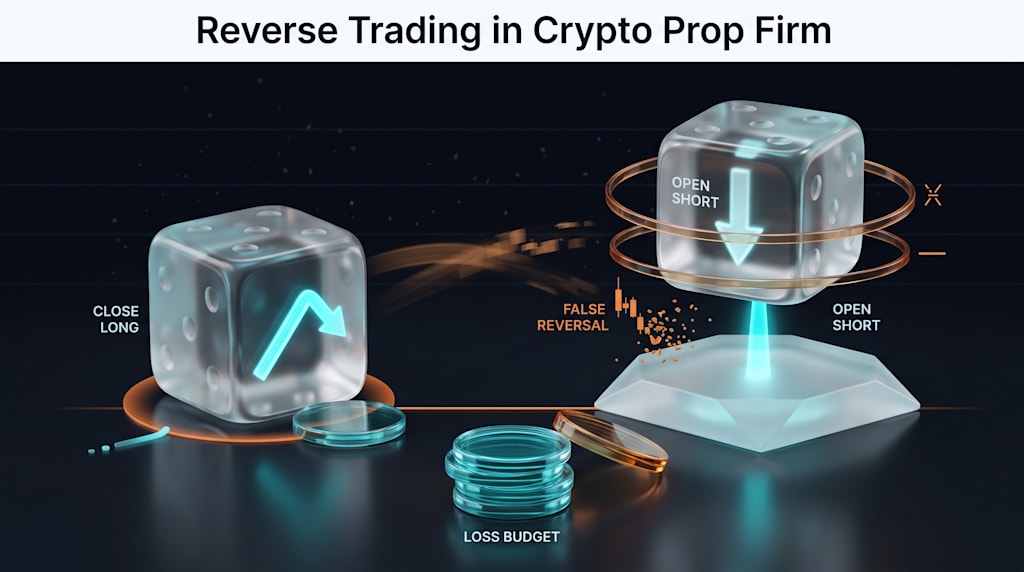
A reversal trade begins with two decisions, not one. First, the trader admits that the original position is wrong. Then, often within seconds, the same trader decides that the opposite position is right.
That second decision is where a manageable loss can become a drawdown event. Closing a long stops one risk. Opening a short immediately creates another, with a new spread, possible slippage and a new stop loss, all while the trader may still be reacting emotionally to the first mistake.
Inside a prop account, the question is therefore not whether a position can be reversed quickly. It is whether the second trade has independent evidence strong enough to justify spending more of the account’s limited loss budget.
This distinction matters in crypto because price can change direction abruptly. A breakout can fail, a crowded move can unwind, or a liquidity sweep can push price through a visible level before it returns to the previous range. These conditions create valid reversal opportunities, but they also produce convincing false signals.
This guide explores reverse trading in crypto prop firm accounts, separates position reversal from mean reversion and martingale, then builds a rule-based framework for deciding when a flip is valid, when waiting is safer, and how prop firm restrictions can change the trade.
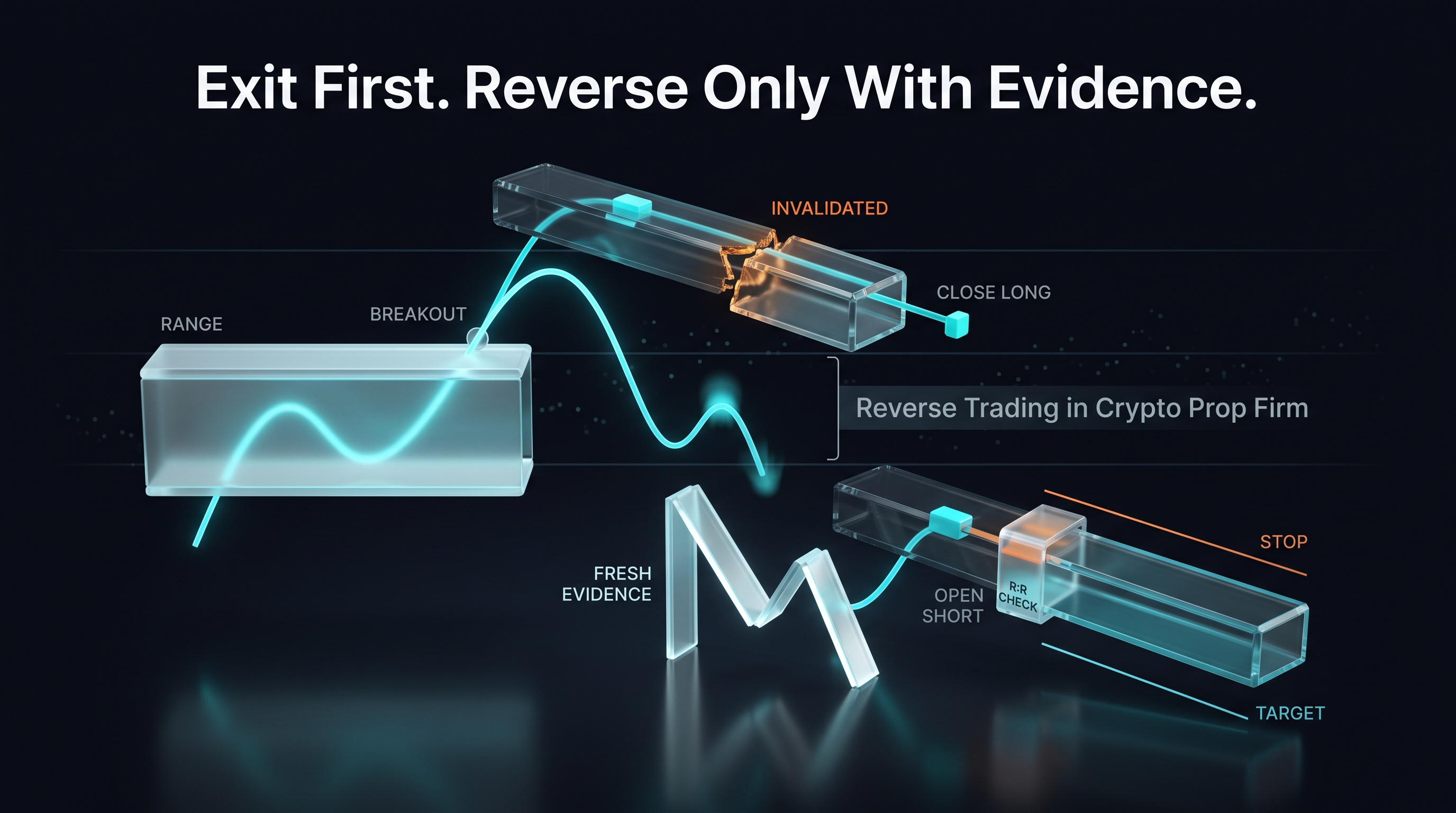
Reverse trading in a crypto prop firm means closing an existing position and opening a new trade in the opposite direction after fresh evidence invalidates the original setup. It is different from merely exiting a loss, trading every pullback, or increasing position size as price moves against the account.
Assume a trader opens a long position because Bitcoin has broken above a range. Price then returns below the breakout level, buyers fail to reclaim it, and the lower timeframe structure turns bearish. The trader may close the long and consider a short.
The long exit and the short entry are separate decisions. The failure of the first setup can justify closing the position, but it does not automatically prove that the opposite trade has a favorable risk to reward ratio.
This is where three commonly confused approaches need to be separated:
Position reversal
What changes? The trader closes one direction and opens the opposite direction.
Main risk: Emotional overreaction and paying two sets of execution costs.
Mean reversion
What changes? The trade targets a return toward an average or value area.
Main risk: Entering before momentum has actually weakened.
Martingale
What changes? Exposure increases after a loss or adverse price movement.
Main risk: Nonlinear drawdown and an account rule breach.
A reverse trade may use a mean reversion thesis, but it does not have to. A trader can also reverse after a failed breakout, a confirmed trend change or a news driven move that invalidates the original setup.
Martingale is different again. It changes the amount of exposure rather than simply changing direction. Combining aggressive scaling with repeated position reversals can make risk expand faster than the trader realizes.
The Hidden Cost of Flipping a Crypto Position
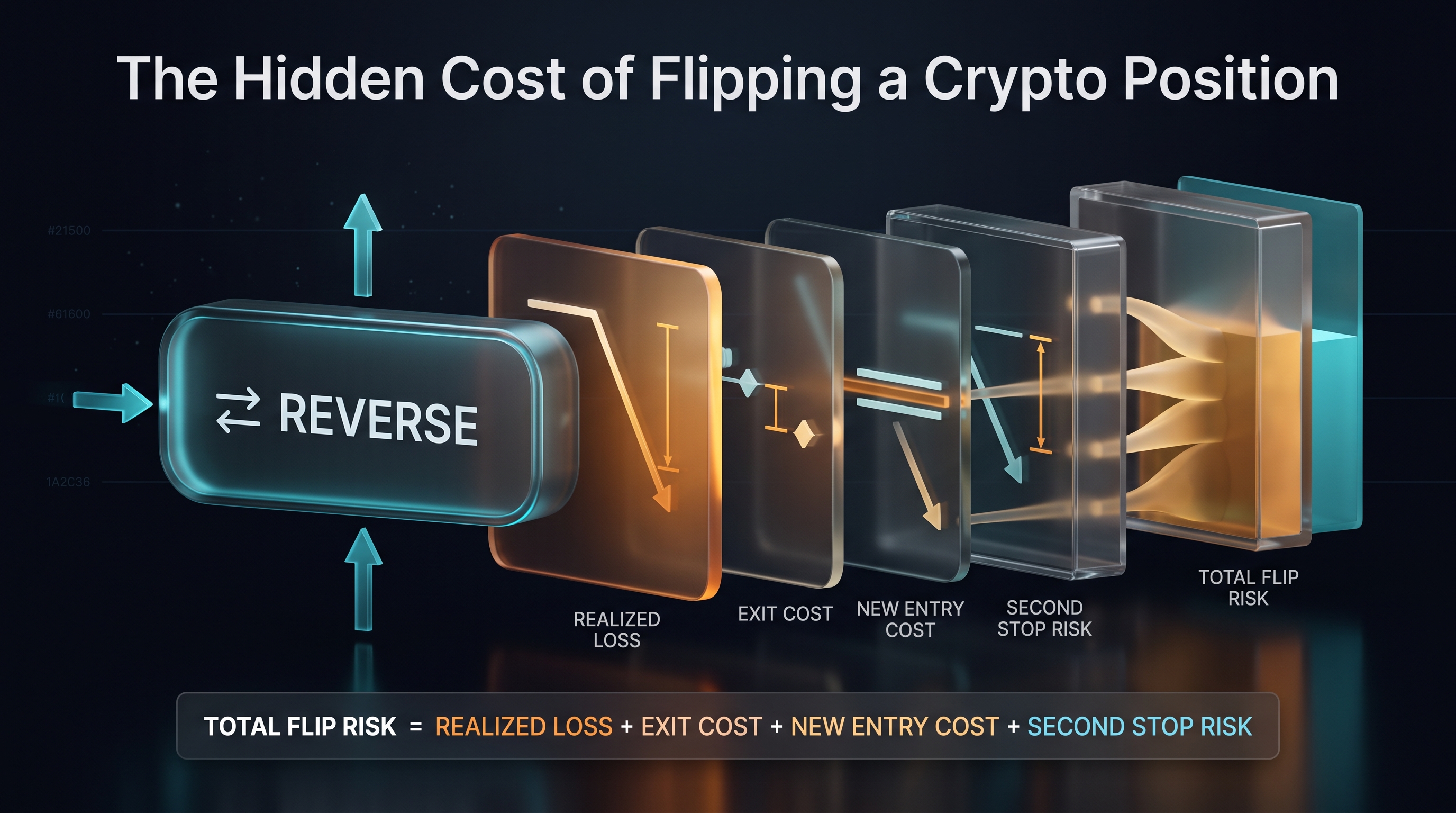
A position flip creates more cost than a normal exit because the trader pays to close one exposure and establish another. The complete cost includes the first loss, exit slippage, a second spread or commission, and the risk allocated to the new stop loss.
A one click reversal may look like a single action on the screen, but financially it contains multiple transactions. The original trade is closed, its result becomes realized, and a new trade starts from the current bid or ask price.
A simple way to model the decision is:
Total Flip Risk = Realized Loss + Exit Cost + New Entry Cost + Risk to the Second Stop
Consider an illustrative example:
Loss on the original trade
Illustrative amount: $180
Exit slippage and fees
Illustrative amount: $20
New entry cost
Illustrative amount: $15
Risk to the reversal stop
Illustrative amount: $135
Total flip risk
Illustrative amount: $350
The trader may think the reversal risks only $135 because that is the distance between the new entry and the second stop. From the account’s perspective, however, the complete sequence has already placed $350 at risk.
That difference becomes important under a daily loss limit. Several small flips can consume more of the loss budget than one deliberately planned trade, even when no individual position appears unusually large.
The second position should therefore be judged by its total sequence risk, not only by its standalone stop loss.
Illustrative only. Fees, slippage and account rules differ by provider, instrument and market conditions.
Five Conditions That Must Exist Before a Position Flip
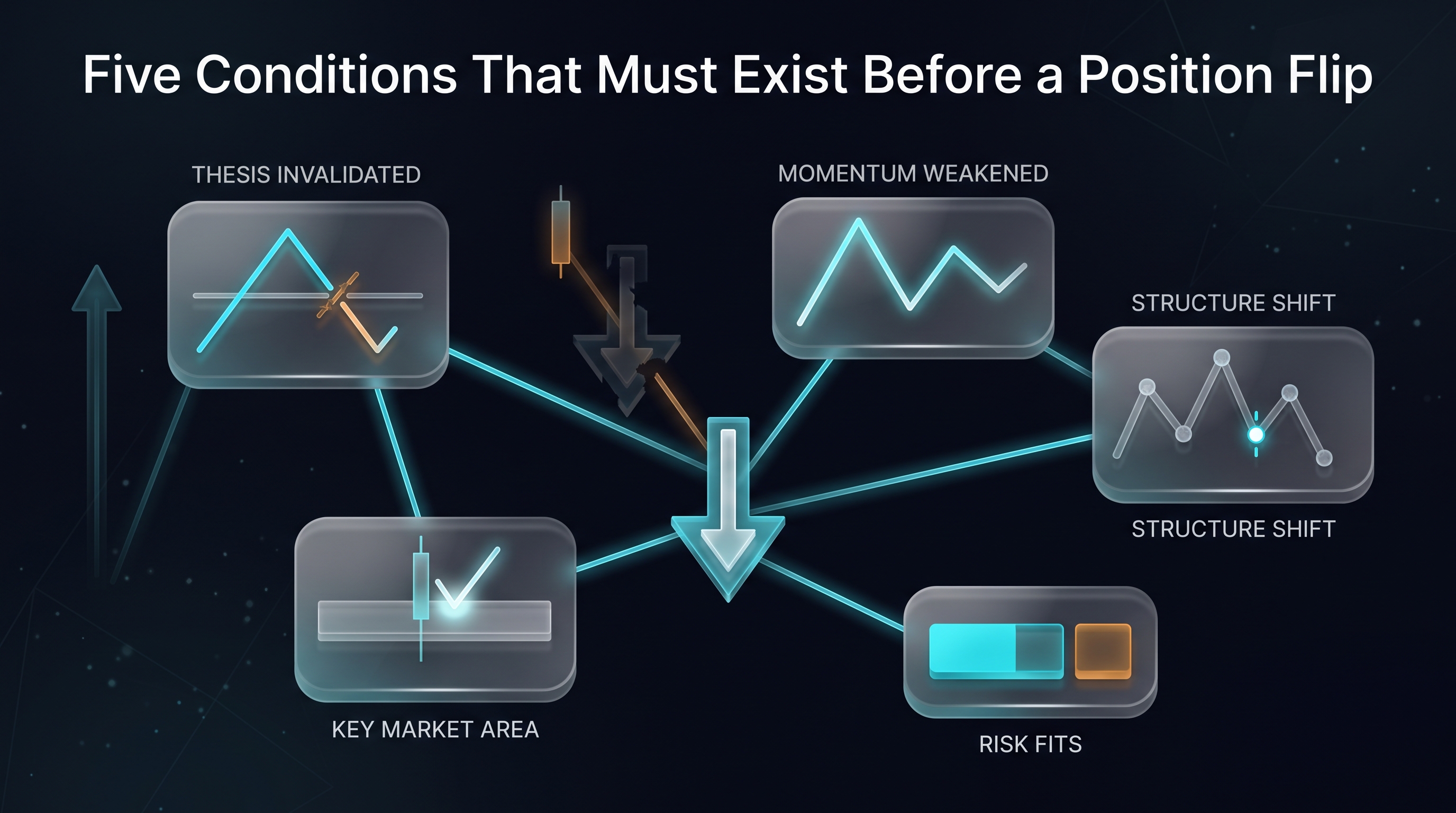
A disciplined reversal needs more than an uncomfortable loss or a candle moving in the opposite direction. Five conditions help separate a fresh setup from an emotional reaction:
The original thesis has been invalidated.
Price has reached or rejected a meaningful market area.
Momentum has weakened rather than merely paused.
Market structure has changed on the execution timeframe.
The second stop fits inside the remaining daily risk budget.
The Original Thesis Must Be Invalidated
A position being temporarily negative is not the same as a setup being wrong.
Before entering, the trader should define what would invalidate the original idea. For a breakout trade, that may be a close back inside the previous range. For a trend following entry, it may be the loss of a higher low. For a support trade, it may be acceptance below the support zone rather than a brief wick through it.
Without a predefined invalidation point, every pullback can feel like a reversal and every reversal can feel like another reason to trade.
Price Should Be at a Meaningful Area
Reversals are more credible when they develop around areas where other market participants are likely to make decisions. These may include:
Previous swing highs or lows
Range boundaries
High volume areas
Supply or demand zones
Breakout and breakdown levels
Large imbalances or fair value gaps
Session highs and lows
These areas are not guaranteed turning points. They provide context, not certainty.
A brief move above a previous high may indicate that clustered orders were triggered, but it does not prove manipulation or guarantee a bearish reversal. Price can sweep a level and continue in the same direction if genuine demand remains strong.
Momentum Should Show Measurable Weakness
A sharp price move can slow without reversing. Traders need evidence that the imbalance behind the move is weakening.
Possible clues include:
Price making a new high while RSI or MACD makes a lower high
Increasing volume with limited additional price progress
Repeated rejection wicks near the same level
Smaller candle bodies after an extended move
A failed attempt to continue beyond the extreme
Divergence is supporting evidence rather than a complete signal. Strong trends can remain divergent for long periods while price continues moving against an early reversal trade.

Structure Should Change Before Entry
A lower timeframe change of character can help confirm that control is shifting.
For example, after an extended move upward, a trader might wait for price to break the most recent higher low, fail to reclaim it, and form a lower high. That sequence provides more information than shorting the first bearish candle near the top.
Waiting for structure means sacrificing part of the potential move. The benefit is that the trader is no longer trying to identify the exact turning point with no confirmation.
The Second Trade Must Fit the Remaining Budget
A high quality setup can still be inappropriate if the first position has already consumed too much of the daily risk allowance.
Before reversing, the trader should calculate:
Loss realized on the first trade
Fees and slippage already paid
Risk to the new stop
Remaining internal daily loss allowance
Distance to the prop account’s formal daily loss limit
The firm’s maximum loss limit should be treated as an emergency boundary, not as a daily target.
The Exit Reset Re enter Framework
A controlled reverse trade has three stages: exit the invalidated position, reset the decision process, and re enter only when the opposite setup has independent confirmation. Separating these stages reduces the risk of turning one losing trade into a rapid sequence of emotional positions.
1. Exit the Invalidated Trade
The first task is to manage the position that already exists.
If the original thesis is invalid, the trade should be closed according to its plan. The trader does not need a confirmed setup in the opposite direction before accepting that the first position is wrong.
This distinction prevents a common mistake: refusing to exit a losing long until there is enough evidence to short. The market does not owe the trader an immediate opportunity in the opposite direction.
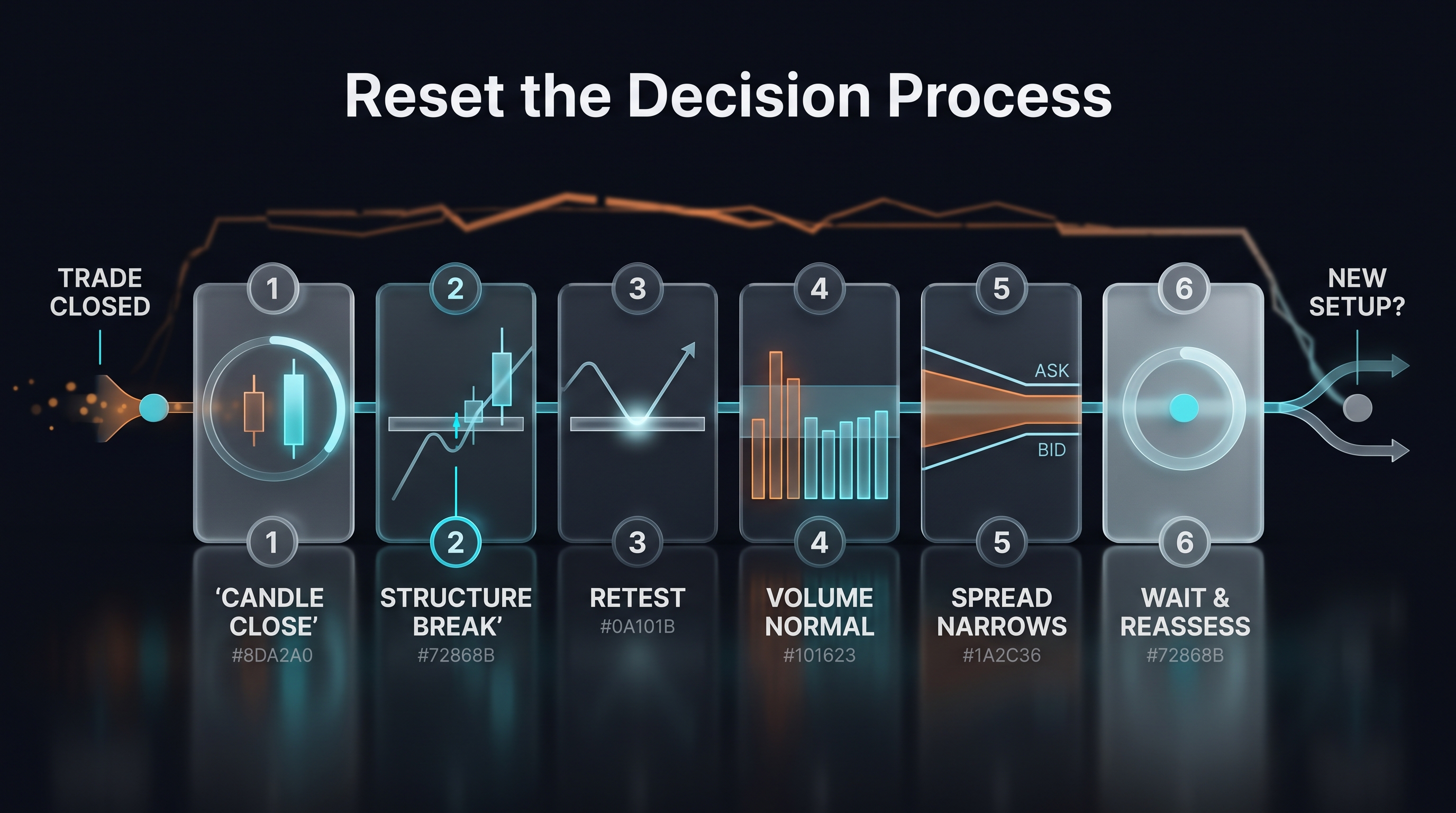
2. Reset the Decision Process
A reset introduces distance between the loss and the next order.
The reset does not need to be a long break. Depending on the strategy, it may mean waiting for:
A candle to close
A structure level to break
A retest of the broken level
Volume to return to normal
The spread to narrow after a volatile move
A fixed number of minutes before reassessment
The purpose is to replace urgency with a defined trigger.
During the reset, the trader should ask: Would I take this opposite setup if I had started the session with no position?
If the answer is no, the new trade is probably an attempt to repair the emotional impact of the first one.
3. Re enter With Independent Risk
The reversal entry needs its own thesis, invalidation level, position size and profit target.
The second trade does not have to use the same size as the first. If the reversal stop is wider, equal position size creates greater dollar risk. If market volatility has increased, a smaller position may be necessary even when the trader’s confidence feels higher.
Closing a long does not automatically create a short setup. The exit and the reversal are two separate decisions.
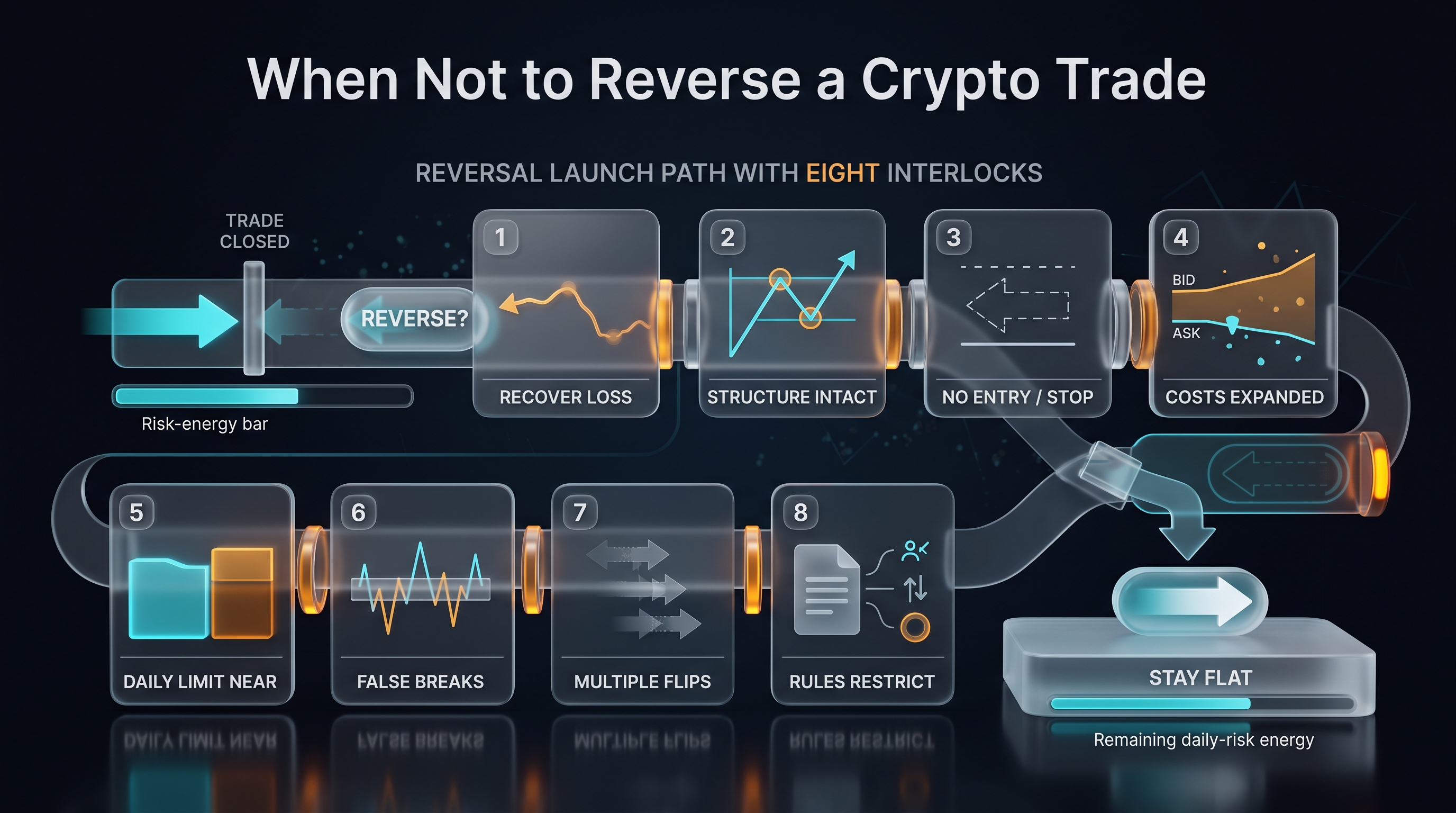
When Not to Reverse a Crypto Trade
A crypto position should not be reversed when the only objective is to recover the first loss, market structure has not changed, execution costs have expanded, or the second stop would place the account too close to its daily loss limit. In those conditions, staying flat may be the more disciplined decision.
Avoid an immediate reversal in the following situations:
The main reason is to recover the loss quickly.
The original stop was hit, but the underlying market structure remains intact.
The opposite trade has no independent entry or invalidation level.
Spread and slippage have expanded during a news event or liquidation move.
The reversal would threaten the internal daily stop.
The market is producing repeated false breaks in both directions.
The trader has already flipped more than once during the session.
The live account rules restrict hedging, martingale or rapid fire execution.
Sideways markets are particularly dangerous for undisciplined reversal trading. Price breaks above a local high, returns to the range, breaks below a local low, and then returns again. A trader who interprets every failed move as a new directional signal can pay spread and commission repeatedly while accumulating small losses.
A rule such as “no third flip” can limit this damage. If the original position and the first reversal both fail, the trader stops for the session or waits for a completely new market structure.
The goal is not to reverse faster than the market. It is to avoid becoming the trader who provides liquidity on every side of a range.
How Prop Firm Rules Change a Reverse Trade
Prop firm rules affect a reverse trade because the first loss, the second position and any overlapping exposure may all count toward drawdown. Traders need to verify daily loss calculations, hedging restrictions, consistency requirements and prohibited strategies before using repeated position flips.
Daily loss limit
Why it matters during a flip: Both the initial loss and new position may count.
What to verify: Whether the limit uses balance, equity, or start-of-day equity.
Maximum drawdown
Why it matters during a flip: Repeated flips consume the total account buffer.
What to verify: Whether the floor is static or trailing.
Consistency rule
Why it matters during a flip: One large reversal win may affect eligibility.
What to verify: Whether the rule applies during evaluation, funding, or both.
Hedging rule
Why it matters during a flip: Opposite positions may create overlapping exposure.
What to verify: Whether both positions may remain open simultaneously.
Strategy restrictions
Why it matters during a flip: Scaling can be classified as martingale or grid trading.
What to verify: The provider’s exact definitions.
News trading
Why it matters during a flip: Fast reversals around events may be restricted.
What to verify: Blackout periods and execution conditions.
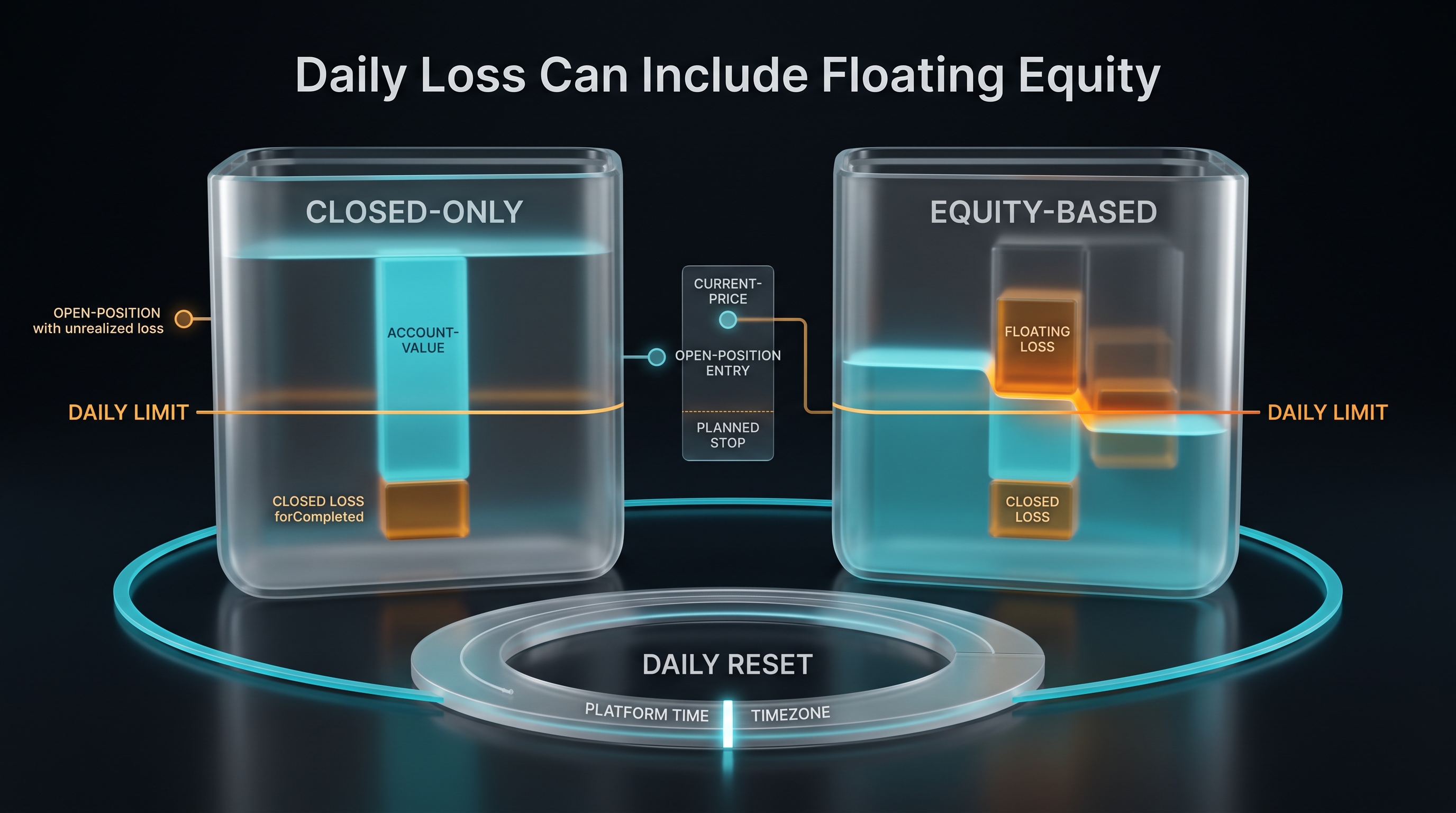
Daily Loss Can Include Floating Equity
Some accounts calculate daily loss from closed trades only, while others include unrealized losses. In an equity based model, the second position can breach the limit before it reaches its planned stop.
Traders also need to know when the daily threshold resets. A crypto market trades continuously, but an account may use a specific platform time or timezone to calculate the trading day.
Static and Trailing Drawdown Behave Differently
A static drawdown floor remains fixed relative to the starting balance. A trailing floor may rise as the account reaches new equity highs.
This difference matters after a profitable reversal. If a trailing threshold moves upward with open profit, giving that profit back can reduce the remaining buffer even when the account is still above its starting balance.
Opposite Positions May Be Treated as Hedging
A clean reversal usually closes the original position before opening the new one. If both positions remain open, even briefly, the account may classify the sequence as hedging.
Some programs allow this. Others restrict it, especially when positions are opened across correlated accounts or designed to offset risk artificially. The label “Reverse” on an execution tool does not override the written account rules.
Strategy Freedom Is Not Universal
Reverse trading, scaling, grid systems and martingale are not treated consistently across providers. A tactic permitted during an evaluation may be restricted after funding, or the reverse may apply.
Live rules should be checked before the first trade rather than after a payout review.
Reverse Trading vs Martingale: Where Scaling Becomes Dangerous
Reverse trading changes market direction after the original thesis fails. Martingale increases exposure after a loss or adverse move. They can appear in the same sequence, but they are not the same strategy. A controlled reversal has predefined risk; martingale can expand risk as the position becomes less successful.
Scaling into a position is not automatically martingale. The difference lies in how the total exposure is planned.
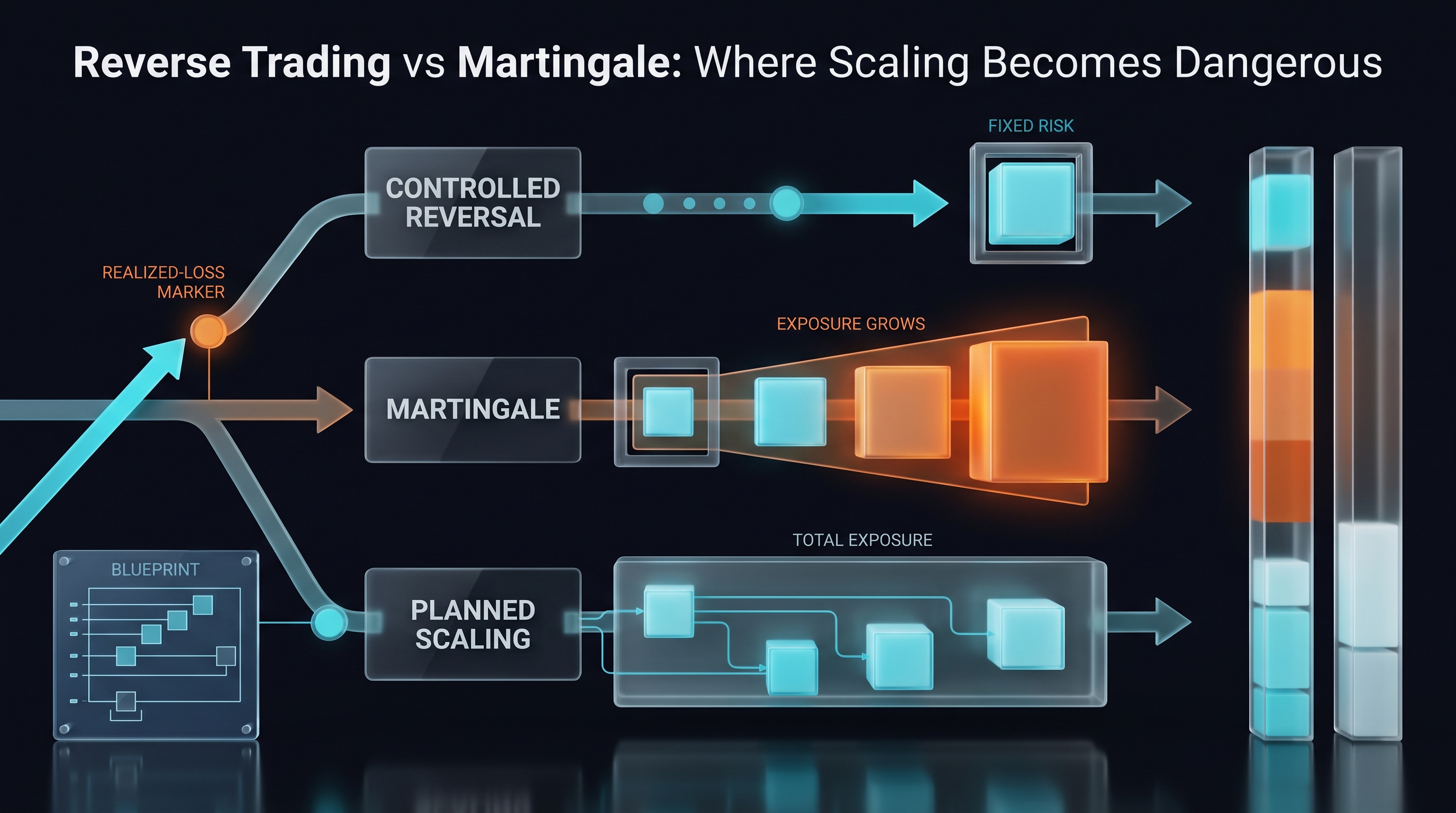
Controlled Scaling
In controlled scaling:
The maximum total position size is defined before entry.
Total risk remains within one fixed amount.
Each additional entry requires new confirmation.
All entries share a clear invalidation point.
Adding a layer does not move the emergency stop farther away.
Martingale Escalation
In martingale style escalation:
Position size increases after loss or adverse movement.
Total risk grows with each new layer.
The strategy depends increasingly on price returning.
The loss can become nonlinear if the trend continues.
The trader may reach the drawdown limit before the expected reversal occurs.
Adding to a losing position does not improve the probability that price will reverse. It changes the average entry and increases the size of the outcome if price continues moving in the wrong direction.
This is especially dangerous in crypto, where an apparently extended move can extend much farther during liquidations, low liquidity periods or major news.
Manual Reversal vs One Click Reverse Tools
Some trading panels include a one click reversal function that closes the current position and opens an equal sized position in the opposite direction. Speed can reduce execution delay, but equal size is not automatically the correct risk size for the second trade.
Manual close and re-entry
Potential advantage: Allows a new position size calculation
Main risk: Slower during rapid moves
One-click position reversal
Potential advantage: Reduces delay between closing and reopening
Main risk: May reuse an unsuitable position size
Close first, conditional re-entry
Potential advantage: Separates the exit from the next decision
Main risk: Part of the reversal may occur before entry
Partial close before reversal
Potential advantage: Reduces immediate exposure
Main risk: Creates more complex execution and accounting
A one click tool solves an execution problem. It does not solve a decision problem.
If the first trade used a 0.5% stop and the reversal requires a 1% stop, reopening the same quantity doubles the dollar risk unless position size is adjusted. The faster order may therefore create a larger risk than the trader intended.
Slippage also matters. During a sharp reversal, the original position may close below the expected price while the opposite position opens farther from the ideal entry. The actual risk to reward ratio can be worse than it appeared when the button was pressed.
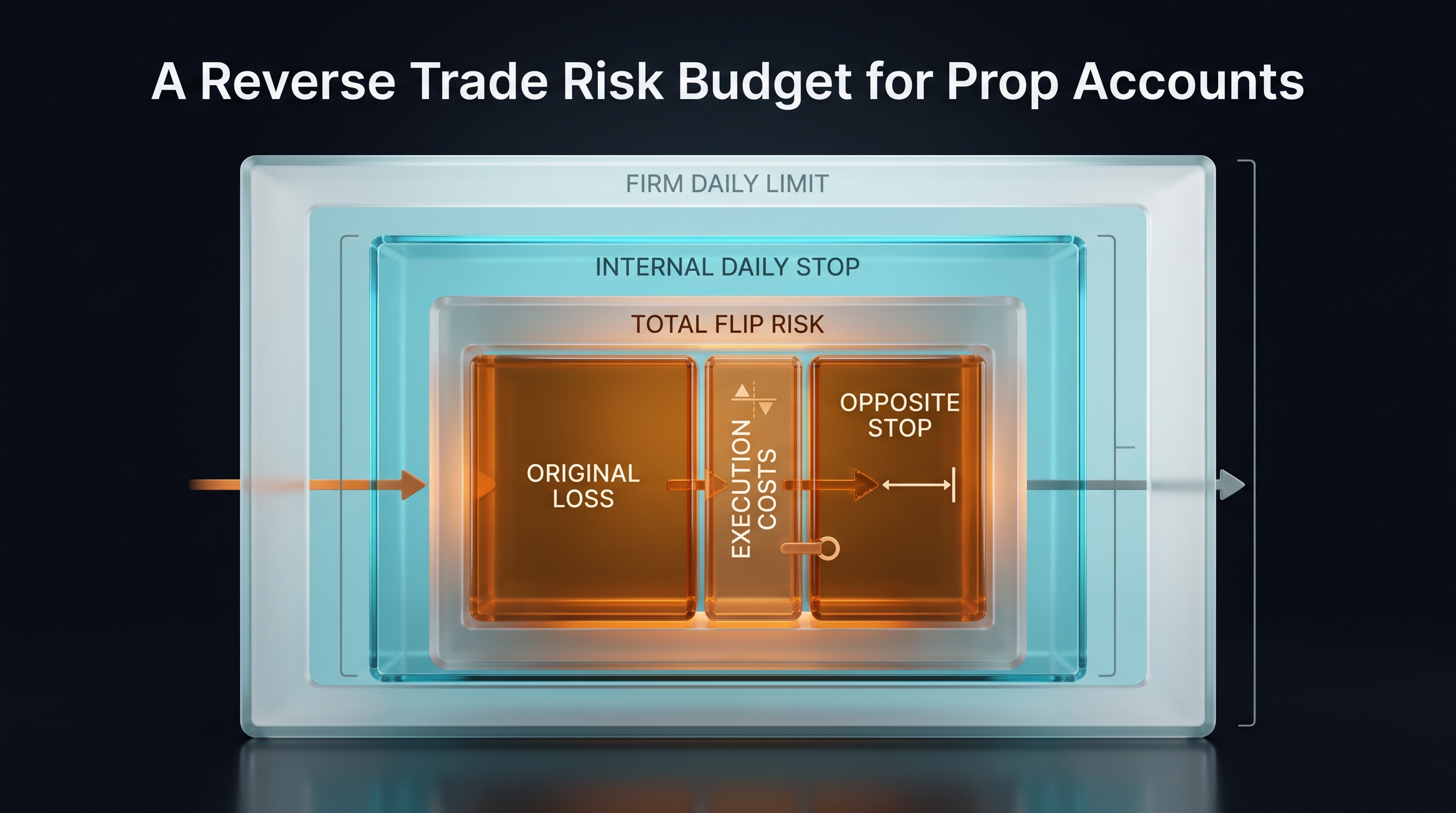
A Reverse Trade Risk Budget for Prop Accounts
A reverse trade risk budget should include the original loss, execution costs and the maximum loss on the opposite position. The combined amount should remain below the trader’s internal daily stop, which is normally more conservative than the prop firm’s formal daily loss limit.
Consider an illustrative $100,000 account with a 3% daily loss limit.
Using the full $3,000 as a normal daily budget would leave no margin for slippage, platform issues or calculation differences. A trader might instead create a 1% internal daily stop, equal to $1,000.
One possible plan could look like this:
Initial trade risk: 0.35%, or $350
Maximum reversal risk: 0.35%, or $350
Reserved allowance for fees and slippage: 0.10%, or $100
Unused safety buffer inside the internal stop: 0.20%, or $200
If both trades fail, the planned sequence loses approximately $800 including estimated execution costs. Trading stops before the formal 3% account limit becomes relevant.
This is not a recommended position size or a universal formula. It demonstrates the difference between an operating limit and an account failure limit.
A practical reversal plan can also include:
No more than one reversal per initial setup
No new trade after two invalidated theses
Reduced size after the first loss
A mandatory reset before the opposite entry
A wider safety margin during news or thin liquidity
A complete stop for the day after the internal limit is reached
The trader’s objective is not to use every dollar of permitted drawdown. It is to stay far enough from the boundary that one imperfect execution cannot end the account.
Illustrative only. Real account rules and appropriate risk levels vary.
Reverse Trade Checklist Before the Order Is Sent
Before opening the opposite position, ask:
What specific evidence invalidated the first trade?
What new evidence supports the opposite direction?
Has market structure changed, or has price only paused?
Is the reversal occurring at a meaningful market area?
Where is the second trade invalidated?
What is the combined loss if both trades fail?
Does that amount fit the internal daily risk budget?
Do the live rules permit the execution method and position structure?
Has spread or slippage changed since the first entry?
Would this trade still be worth taking from a flat account?
The final question is the most important. If the opposite trade would not be opened from a flat account, it should not be opened merely because the first trade lost.
Disclaimer: This article is for educational purposes only and does not constitute financial advice. Leveraged crypto trading involves substantial risk. Prop account rules differ between providers and may change over time. All figures and scenarios are illustrative rather than offers, projections or typical results.
About the Creator
Sophie
Trader focused on Price Action & Order Flow.
Into crypto, fast execution, controlled risk, and quality setups.
Passing funded accounts and refining my trading every day.
Enjoyed the story? Support the Creator.
Subscribe for free to receive all their stories in your feed.
Comments
There are no comments for this story
Be the first to respond and start the conversation.