
Prop Trading Compensation in a Crypto Prop Account
How profit becomes take home pay, and what the rules keep.

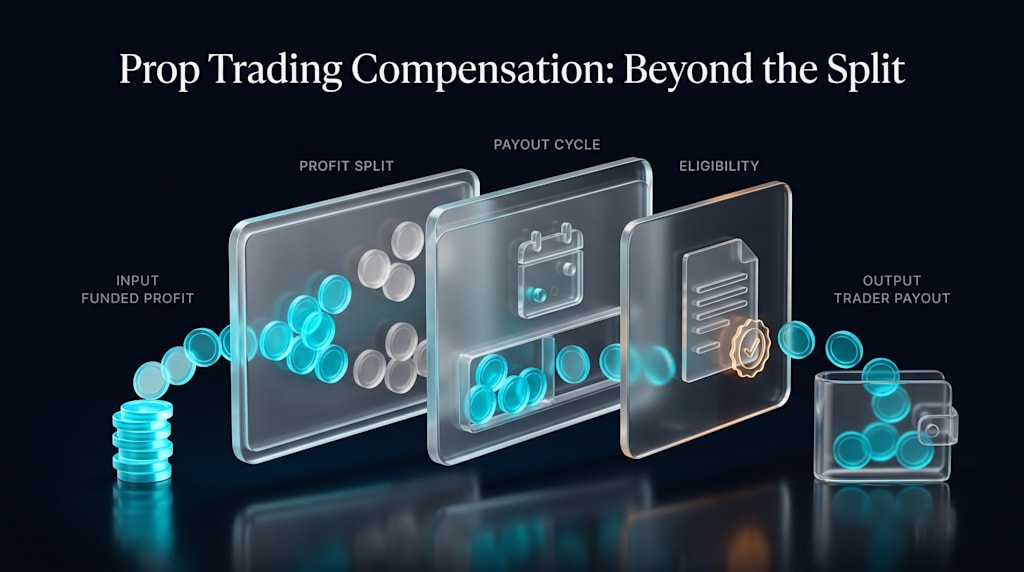
Two traders sign for the same 90/10 profit split and close the same month with $4,000 in realized profit. One receives $3,600 within three days. The other has part of the balance held back for a buffer, waits out a monthly cycle, and keeps a different number. Same trades, same split, different pay.
A profit split only describes how profit is divided. It says nothing about when money is paid, what must be true on the day you request it, or how much is reserved before anything is withdrawable. In a crypto prop firm, prop trading compensation is not a percentage, it is a pipeline, and every stage of that pipeline has a rule attached.
That is why the useful question is not "how high is the split" but "what does a funded account pay per unit of risk and time." Only one of those parts is the headline number.
Prop trading compensation in crypto prop firm is built on four moving parts, split, payout cycle, scaling, and the rule set that gates them, and every one of them can be tested with a five minute audit before you trust the headline.
Prop Trading Compensation: The Number You See vs the Number You Keep
Prop trading compensation is what a trader is paid for generating profit on a prop firm's funded account. It combines a profit split, a payout cycle, and the risk rules that decide when profits become withdrawable. The advertised split is only one input, payout timing and eligibility rules change the number that actually reaches the trader.
Paid for Performance, Not Ownership
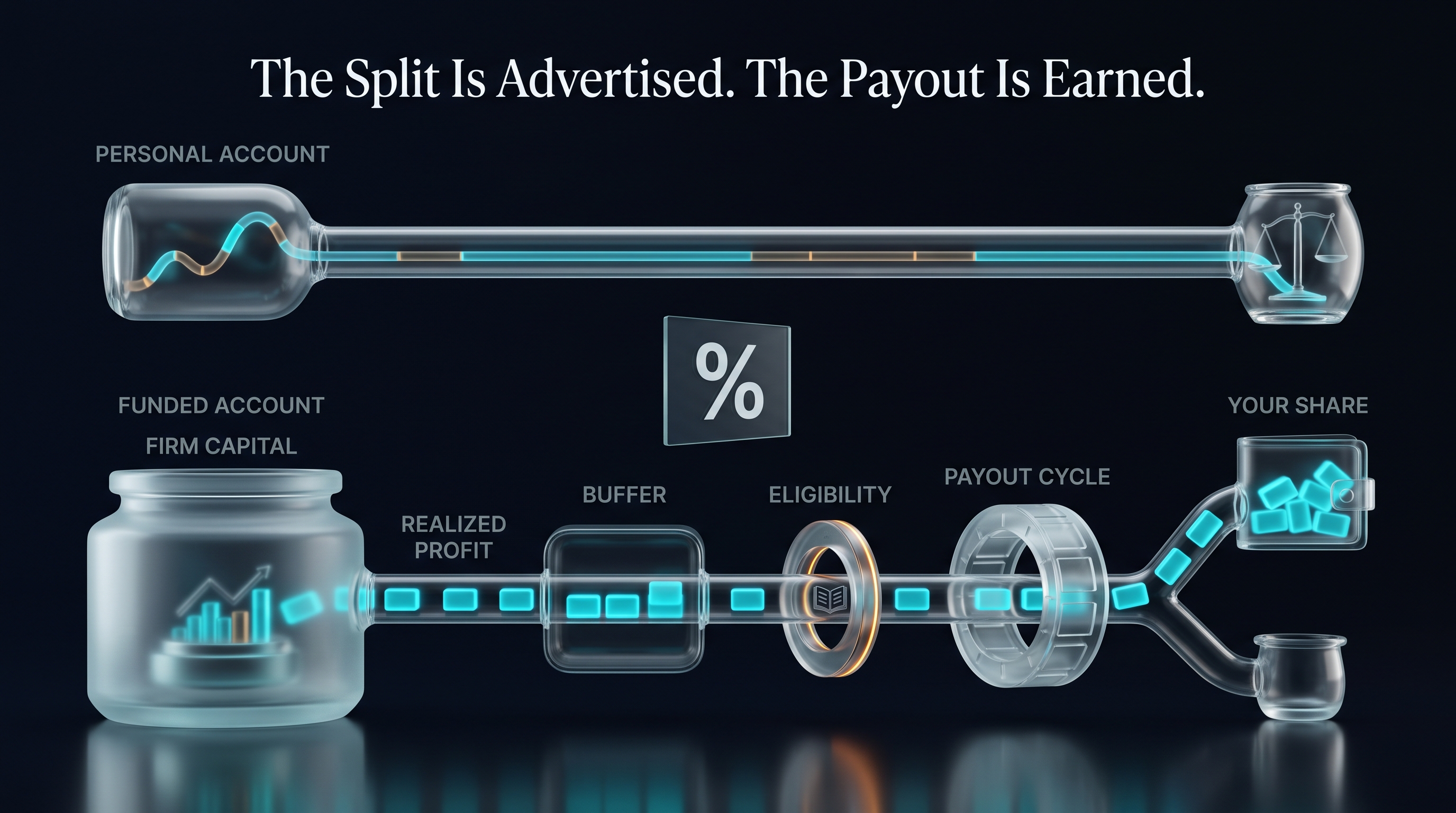
In a funded account, the trader is not paid for owning capital. They are paid for performance on capital the firm allocates. That distinction matters more than most traders expect. A personal account earns whatever the market gives, minus losses, with no outside structure wrapped around it. A funded account earns a share of profit, but only the profit that survives the account's own rulebook first.
What the Headline Leaves Out
The gap between those two positions is the entire topic of prop trading compensation. The split printed on a landing page sits at the far end of a chain that begins with realized profit and passes through buffers, eligibility conditions, and a payout schedule before it becomes cash. The headline belongs to the firm's offer. The number you keep belongs to the rules.
How Do Crypto Prop Firms Work in Practice?
In practice, a crypto prop firm works in a simple loop: a trader buys an evaluation, proves the profit target inside the risk rules, and receives a funded account. From there, the trader generates profit, keeps an agreed share, withdraws on a set payout cycle, and can scale the account with consistent results.
The Evaluation Stage
Buy an evaluation or choose an entry model, one step, two step, or instant funding.
Trade a simulated account toward the profit target while staying inside daily loss and drawdown limits.
Pass the evaluation and receive a funded account under ongoing risk rules.
The Funded Stage
Generate profit, which is divided by the agreed compensation share.
Request payouts on the program's cycle, subject to buffers and eligibility rules.
Scale the account as consistency unlocks larger capital.
Every section that follows zooms into one of these stages, because each stage has its own rules that change how much of the profit becomes real pay.
What an Evaluation Pays You Before It Pays Anything
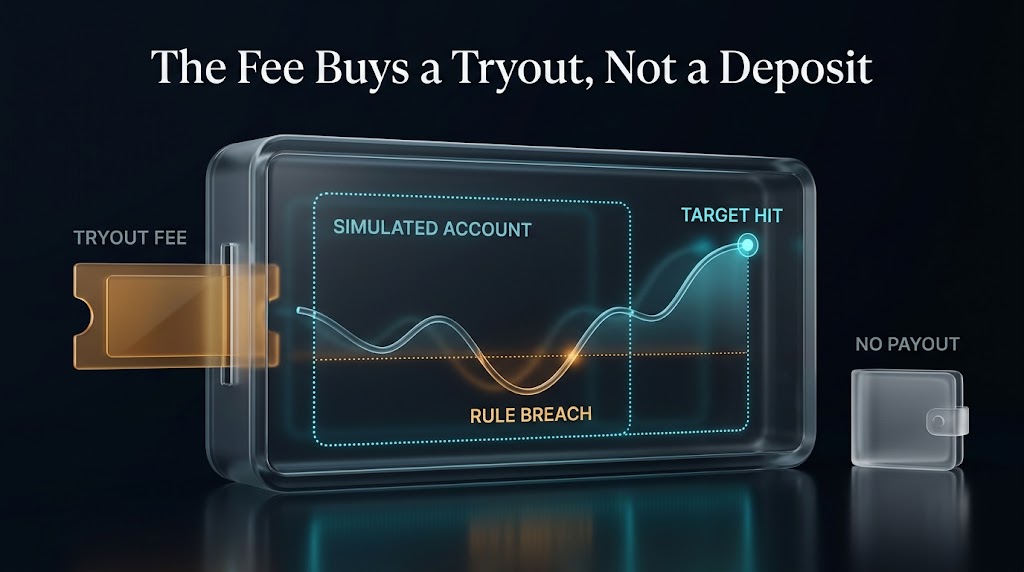
During an evaluation phase, a trader usually earns no cash. The fee paid for the challenge buys eligibility, not income. Profit is measured against the target and risk limits, but nothing is withdrawable until the evaluation is passed. Compensation begins only after funding, when the profit split is applied to funded stage performance.
The Fee Buys a Tryout, Not a Deposit
Think of the evaluation fee as the cost of a tryout, not a deposit into working capital. The account being traded in most evaluations is simulated buying power, and the profit on it is a measurement, not a withdrawal balance. A trader can hit every number on the screen and still leave with nothing if a rule was breached along the way.
Two Contracts, Two Objectives
The switch to compensation happens at funding. The objective changes from reaching a target once to staying eligible for payouts repeatedly. That is why the evaluation phase rules and the funded phase rules should be read as two different contracts, one measures a pass, the other measures a paycheck.
Four Levers Behind Every Prop Firm Paycheck
The Four Levers
Profit split, the percentage of realized profit kept by the trader, typically 70%–95% depending on the tier.
Payout cycle, how often eligible profit is actually paid, from monthly to on-demand.
Scaling, whether a clean track record unlocks a larger account, multiplying the same split.
Rule gating, drawdown limits, minimum days, and consistency rules that decide whether profit becomes withdrawable at all.
Why the Split Alone Misleads
Raise the split and you change one line. Change the cycle or the rules and you change the entire paycheck.
Most evaluation pages fixate on the first lever because it is the easiest to print large. The other three are quieter, but they are the parts that determine cash flow, eligibility, and long term growth. A trader comparing two offers should read all four together, because the first lever cannot be evaluated honestly in isolation. A 95% split behind a wall of payout gates is a different product from an 80% split that pays on demand.
Profit Split: Headline Rate vs Effective Rate
A profit split is the percentage of a funded account's realized profit paid to the trader, with the firm keeping the rest, an 80/20 split pays the trader 80%. The effective split is lower whenever a buffer is rebuilt, fees are deducted, or eligibility rules reduce the profit before the percentage is applied.
The Split Ladder
Splits are usually tiered. The structure in many programs runs through a familiar ladder:
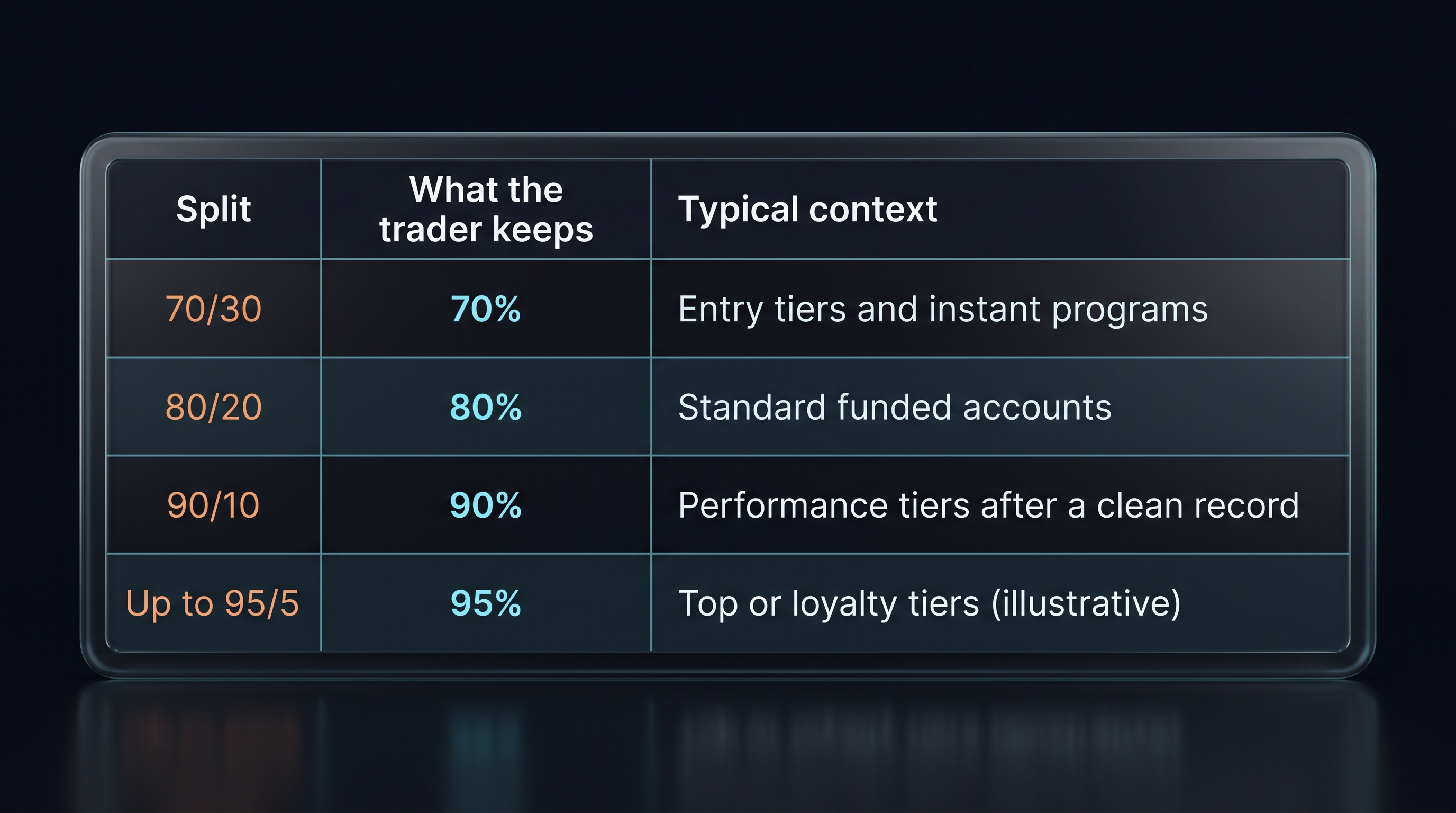
A 95% split with a rebuilt buffer and a long cycle can pay less cash this month than a 90% split with on-demand payouts. The percentage is only honest once the gates around it are counted.
Fixed vs Conditional Models
Compensation models also differ in how fixed the split actually is. Some programs use a locked percentage that never changes, whatever the performance. Others use a conditional or hybrid structure: a baseline split for everyone, with higher percentages, faster payouts, or larger capital unlocking after measured consistency. Fixed structures are simpler to plan around. Conditional structures reward durability but add another set of conditions to track. Neither is automatically better, the question is whether the conditions fit the trader's actual style rather than the brochure.
The Payout Math: From Realized Profit to Cleared Payment
The distance between "profitable" and "paid" is where most of the misunderstanding lives. Follow the money through the same five steps every program applies in some form:
Start with realized profit for the period, not floating equity.
Apply the eligibility rules first, minimum trading days, consistency, and any profit to drawdown requirement.
Rebuild or retain any required buffer before the split is applied.
Apply the profit split to the remaining amount.
Apply the payout schedule, request window, review, and processing time, to reach the date the money actually lands.

An Illustrative Performance Stack
An illustrative performance stack makes the shape of a strong program concrete. The trader qualifies for on demand payouts once eligible, requests are reviewed inside a five trading day ceiling, and funds typically transfer within hours of approval. Splits climb toward 95% at higher tiers, and scaling raises the funded balance without another evaluation. Illustrative only, live terms vary and change.
Why Payout Speed Beats Extra Points
The payout cycle decides the present value of the split. A slower cycle costs more in a market that moves around the clock, because profit that has not yet been paid can still be clawed back by the next drawdown window. Cash still sitting inside the account is not income yet; it is exposure. For an active crypto trader, payout speed is often worth more than a few extra points of split, because liquidity changes how confidently the account can be run without fear of losing unrealized gains before they are collected.
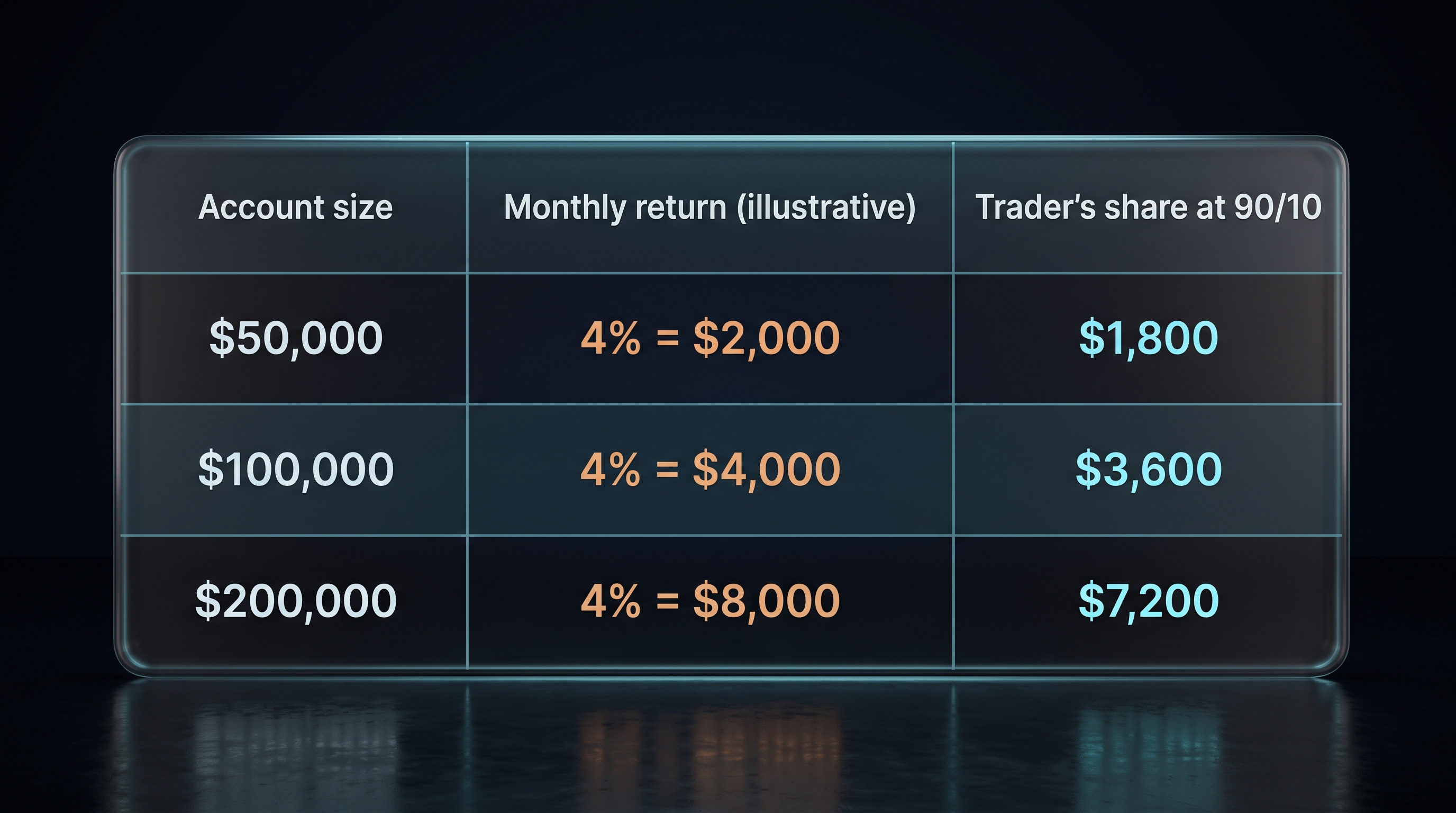
Scaling: The Same Split on a Bigger Account
Scaling does not change the split; it changes the base the split multiplies. For most funded traders that is the fastest route to higher pay, but it arrives only after consistent, rule clean performance.
What Actually Unlocks a Bigger Account
Nothing about the trader's skill changed between the rows. The split stayed at 90/10. Only the allocated capital moved, and the payout doubled twice. That is why scaling is treated as the long term layer of compensation rather than a bonus feature.
Scaling is typically tied to milestones rather than a single winning month: reaching a defined profit percentage over a period, keeping drawdowns stable, or completing several clean payout cycles. Programs designed this way are testing whether results can be repeated, not whether one run of luck happened. Some programs also tier conditions for long, consistent records, better splits, larger capital, more flexible account settings. None of it requires a fresh evaluation; it is earned inside the account the trader already runs.
What Pauses the Path
The mirror image matters just as much: a rule breach can pause or reset the scaling path. A trader chasing one large month but breaching rules along the way keeps none of the benefit. That is why scaling rewards stability more than raw profit spikes.
Worked Example: Two Traders, Same Split, Different Pay
Return to the two traders from the opening, with concrete numbers. Both hold a $100,000 funded account on a 90/10 split, and both close the month with $4,000 in realized profit. The difference is entirely in the payout design.
The Same Month, Two Different Payouts
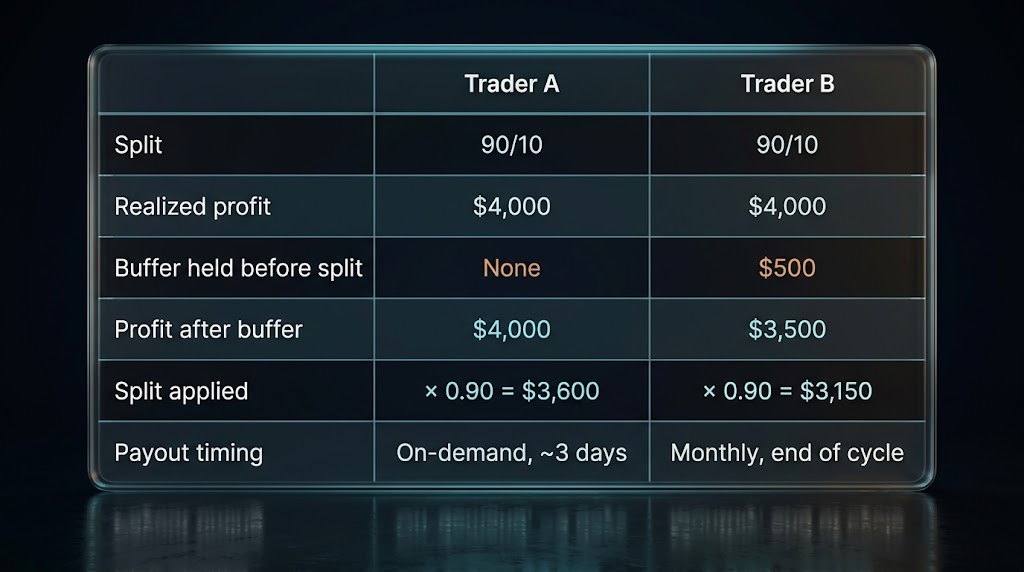
Same split, same profit, same month, $450 apart and a full cycle behind. That gap is invisible in any headline number and visible in every payout schedule.
Why the Gap Compounds
The example is deliberately small. Scale it to a $200,000 account or a six month run and the difference compounds: the trader on slower cycles is financing the firm's buffer with their own patience, and any drawdown during the wait can reduce the very profit that was already earned. Illustrative only, buffers, cycles, and thresholds differ by program.
Prop Trading Pay vs Trading Your Own Money
Trading your own money keeps 100% of profit and 100% of the risk. Prop trading compensation shares profit with the firm but moves personal capital out of the loss equation and raises the ceiling on the size traded. One model charges risk to your savings; the other charges it to rules.
The Trade Off at a Glance
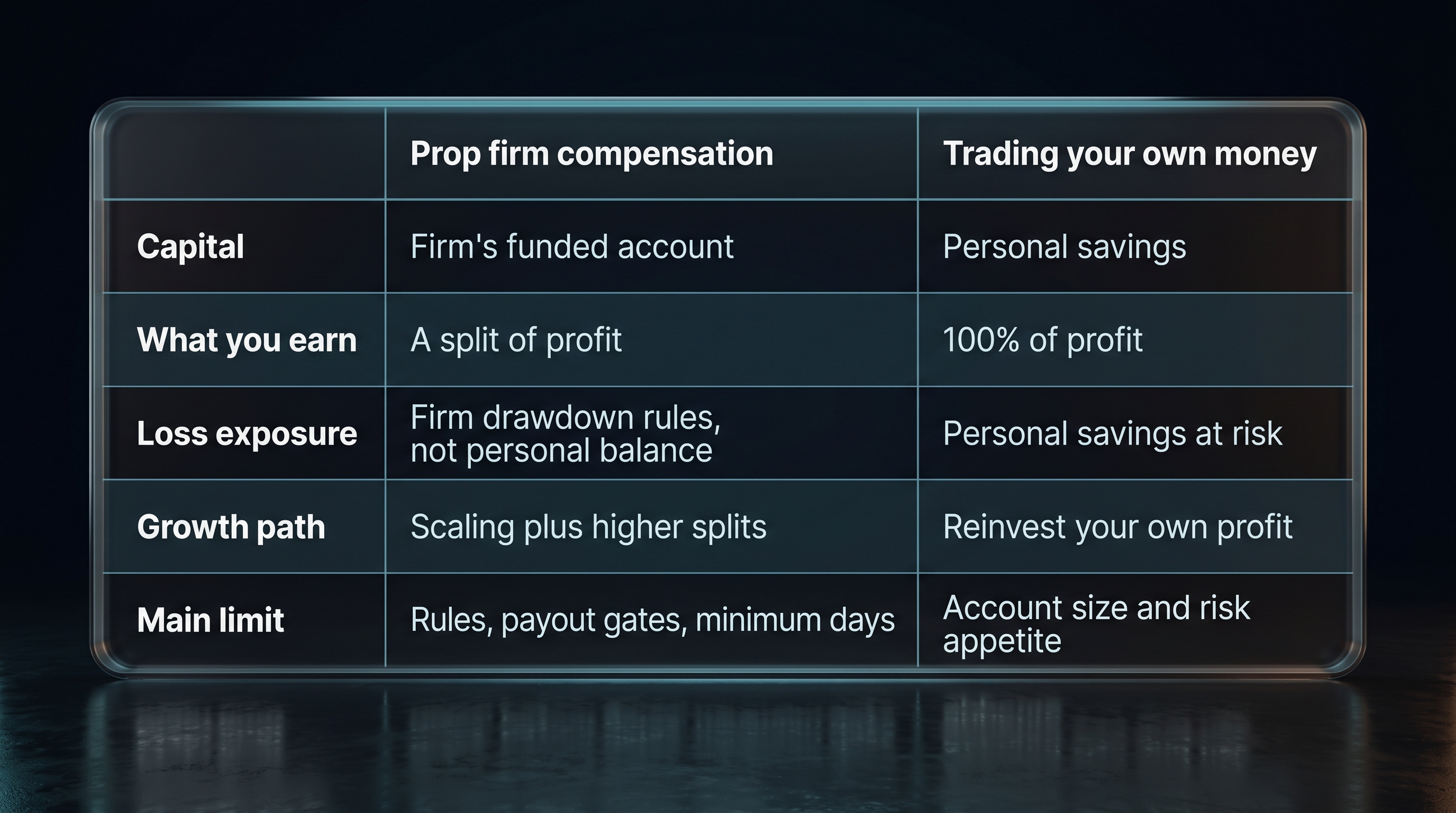
Neither model wins on paper. Solo trading preserves full ownership of every result. Prop trading trades a share of profit for capital amplification and bounded personal loss. The decision is not about percentages, it is about which limit a trader can work inside: a balance they saved themselves, or a rulebook they were given.
The Emotional Difference
The emotional difference matters too. A drawdown in a personal account is a direct wound to savings, and that pressure tends to bend decisions in volatile markets like crypto. A drawdown in a funded account is a rule event, governed by thresholds the trader knew before the trade. It still has to be managed, but it is managed against a definition instead of a bank balance.
Who Each Compensation Style Rewards
Compensation is not one structure; it is a set of structures, and the right one depends on how the trader produces returns. The same split rewards a swing trader and starves a scalper differently, because each style interacts with payout timing, holding rules, and costs on a different timetable.

For Intraday and Scalping Traders
For a trader who is flat by the close, payout frequency and per trade cost shape real income more than the headline number. The fitting structure combines a frequent or on demand cycle with low spread and commission, because those recurring costs sit closest to the edge.
For Swing Traders
A swing trader holds positions for days or weeks, so overnight holding rules, buffers, and scaling are the real salary variables. The right structure allows weekend holding, keeps buffers reasonable, and offers a clear scaling path that rewards multi day consistency.
For News and Event Traders
Traders who build strategies around volatility need freedom most. Programs with heavy news bans or unclear event windows quietly remove part of the edge. For them, a smaller headline number on a more permissive structure is often the better paying option.
The best fit is not the largest split. It is the stack whose gates do not sit directly on top of the trader's edge. A news trader inside a program that bans news trading is earning less, in practice, than a smaller split would pay elsewhere.
The Rules That Quietly Cap Your Pay
Earnings in a prop program are shaped as much by constraints as by performance. The rules below never appear next to the split, but they determine whether the split ever gets paid:
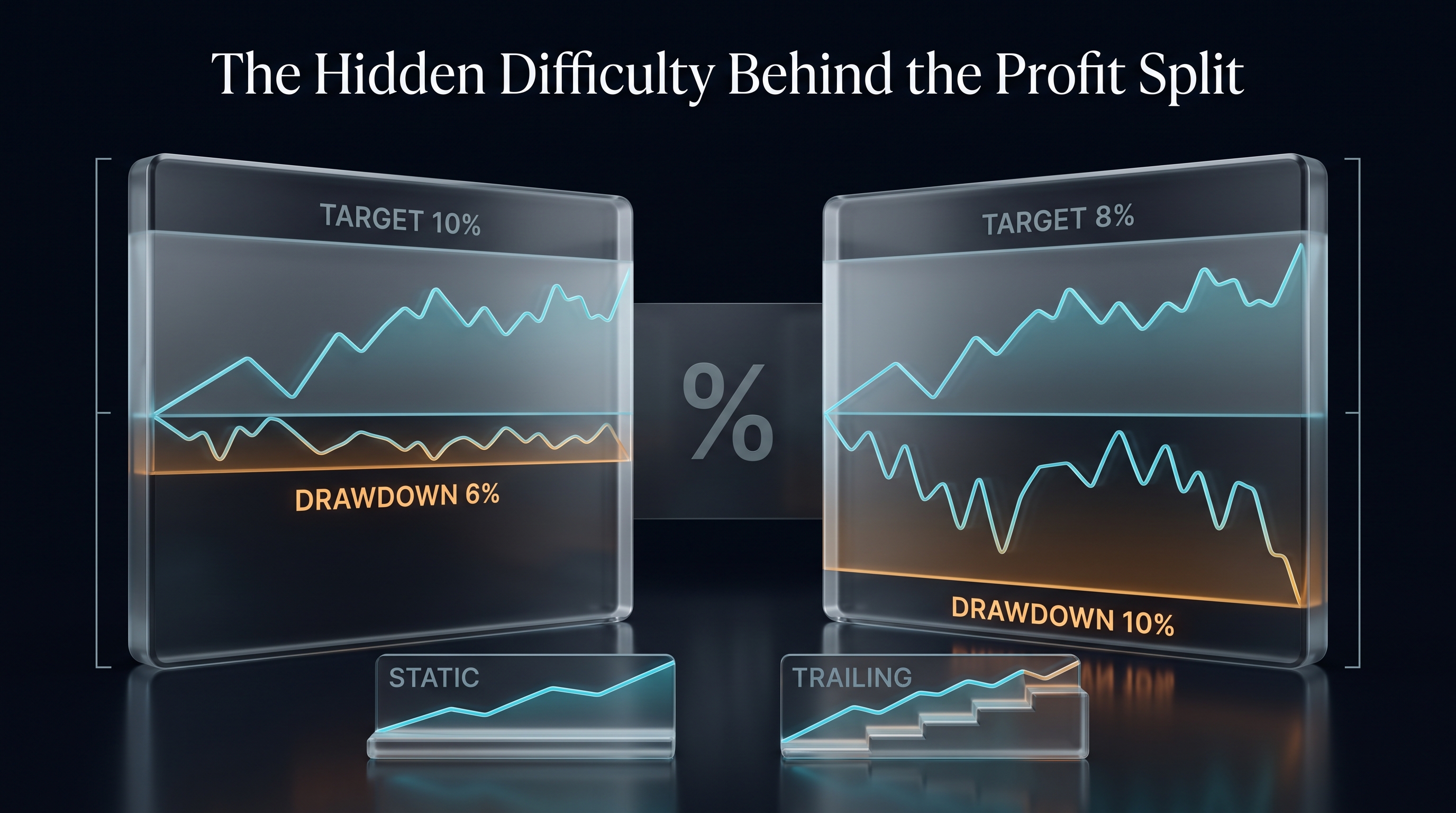
Profit target and drawdown, the ratio sets how little room exists to be wrong while chasing a qualification target.
Payout gates, minimum days, consistency rules, and buffer requirements before a request is accepted.
Withdrawal limits, caps on how much or how often profit leaves the account.
Trading restrictions, weekend holding, news bans, and strategy bans that block part of the edge.
Hidden fees, account, add-on, or withdrawal fees that reduce effective pay.
The Ratio That Sets the Difficulty
Every rule that can delay or reduce a payout is part of the compensation structure, even though none of them appears next to the split in the brochure.
The most consequential of these is the profit target to drawdown ratio. A program that demands a 10% target against a 6% drawdown is testing a different trader than one demanding 8% against 10%. The first leaves a thin margin for being wrong; the second gives the strategy room to breathe. Drawdown design adds another layer: a static floor stays where it was set, while a trailing floor climbs with equity and can sit just behind the current balance. The ratio is the quiet difficulty setting of the entire compensation plan, and it changes real earnings more than the advertised split usually does.
Red Flags: When the Split Is a Headline, Not a Plan
Some offers look strong only because the difficult parts are missing from the page. These signs separate a split from a plan:
The split is the only number published, no payout terms, drawdown, or consistency rule on the same page.
Eligibility conditions are discoverable only after purchase or through a support ticket.
Payouts are described as "up to X" with no worked example of a full cycle.
Scaling is advertised with no stated milestones and no stated invalidators.
Fees are spread across pages, add-ons, withdrawal fees, account fees, instead of one schedule.
The language promises income ("earn thousands") rather than describing a structure.
The Rule of Thumb
A structure that cannot be fully described before payment will usually reveal its cost after it.

A Five Minute Audit of Any Compensation Stack
Before trusting a headline, run the same five checks against the full terms:
Split, write down the headline split, then recompute it on a realistic month after buffers and gates.
Payout, find the exact cycle length, minimum days, consistency rule, and first payout wait.
Level, divide the profit target by maximum drawdown to read the real difficulty of the account.
Interference, list every restriction (weekends, news, strategy bans) and mark what touches your edge.
Timeline, map how scaling and higher splits actually unlock, and what invalidates them.
What the Audit Changes
The audit changes the conversation from "how much can I win" to "how much of the profit survives to my account."
That final sentence is the whole point. Compensation quality is not the largest number on a features page. It is the combination of split, timing, difficulty, and growth that decides how much of the trader's work gets converted into cash, and how much stays inside the account as risk.
Prop trading compensation is a structured system, not a single ratio. The split is the most visible part and the least informative on its own. The payout cycle decides when profit becomes real. The risk rules decide how much of it exists to begin with. Scaling decides whether the same performance pays more later. Read them together, and a compensation offer stops being a slogan and becomes a cash flow model.
Disclaimer: Educational content only, not financial advice. Leveraged crypto trading carries substantial risk. Prop firm rules, splits, and payout terms differ between providers and change over time. All figures and examples are illustrative and not projections.
About the Creator
Sophie
Trader focused on Price Action & Order Flow.
Into crypto, fast execution, controlled risk, and quality setups.
Passing funded accounts and refining my trading every day.
Enjoyed the story? Support the Creator.
Subscribe for free to receive all their stories in your feed.
Comments
There are no comments for this story
Be the first to respond and start the conversation.