
Prop Slippage Matters More Than Most Funded Traders Realize
The Hidden Cost That Quietly Drains Crypto Prop Accounts


You hit buy at one price and the market hands you another. That tiny gap is prop slippage, and inside a crypto prop firm account it adds up faster than most traders admit. This piece digs into where it really comes from, why crypto sharpens it, and how to read the order book before it quietly eats your edge.
How Slippage Got You When Everything Had Been Right
You waited for the setup. You sized the position properly. You clicked at the right level. And the fill still landed somewhere you did not plan for. That is the moment most funded traders encounter prop slippage in crypto prop firm environments for the first time, and the first instinct is to blame the platform or call it bad luck.
It is neither. Slippage is the gap between the price you expected and the price you actually got, and it shows up even when your execution was flawless. The trade was right. The market just moved between your decision and your fill.
Perfect Entry, Poor Execution: The Gap Between Charts and Reality
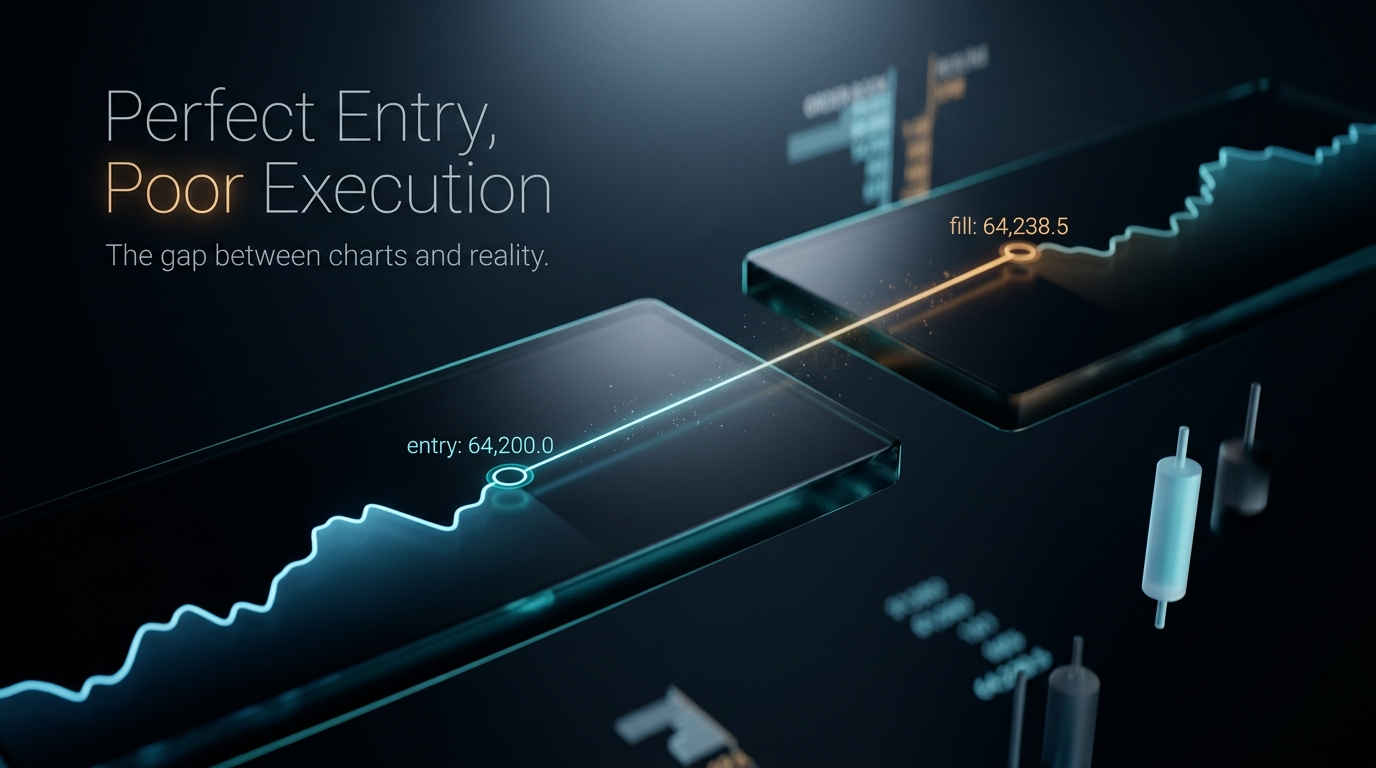
There are two prices in every trade, and most traders only watch one of them.
The chart price is what you see on screen. It is clean, obvious, and the number you build your plan around. The execution price is what your order actually fills at once it reaches the market. In a calm, liquid market those two numbers sit almost on top of each other. In a fast market they drift apart, and that drift is your slippage.
So when your journal says you entered late or exited worse than planned, it is not always a discipline problem. Sometimes the chart was telling you one story and your fills were quietly telling you another.
Slippage Hits Funded Accounts Harder Than Retail
A small retail account barely notices slippage. A funded account feels it on every trade.
The reason is size. When you are managing something like $500k in exposure, your order is no longer a rounding error in the order book. It has to be absorbed by the liquidity sitting at each level, and the bigger the order, the further it walks into the book to get filled. That walk is slippage, and it scales with your position.
On top of that, prop challenges run on tight margins. A few ticks of slippage per trade that retail would shrug off can be the difference between passing an evaluation and blowing the daily loss limit. Same market, same slippage, very different stakes.
The Market Does Not Owe You That Price
Here is the hard truth nobody puts on a trading course flyer. The price you see is an invitation, not a contract. The market is under no obligation to fill you there, and it never agreed to in the first place.
That sounds harsh, but once it clicks, slippage stops feeling like a betrayal and starts feeling like physics. You are not entitled to the number on the screen. You are entitled to whatever liquidity is actually available the instant your order arrives. Everything else is hope.
What Slippage Is Actually Doing Between Your Click and Your Fill
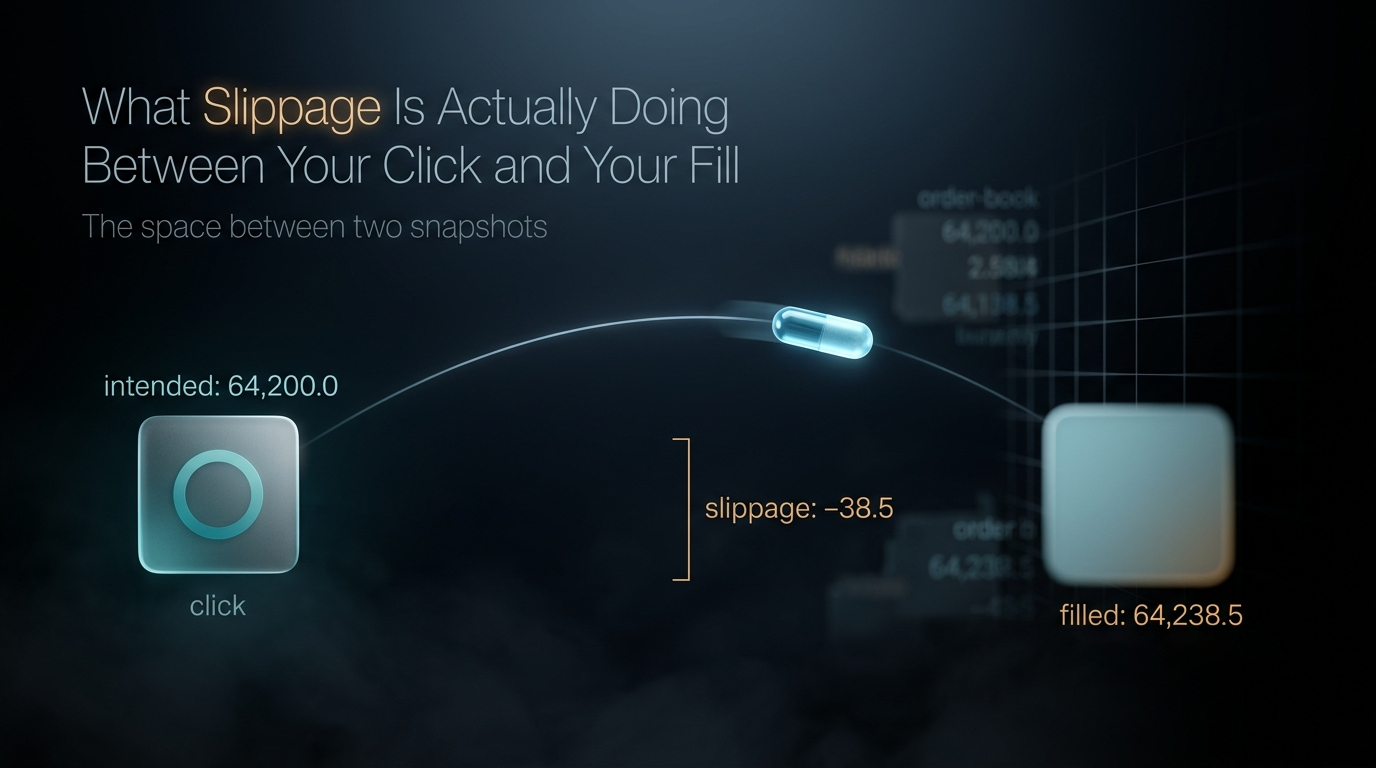
The moment you hit buy, your order does not teleport into a fill. It travels.
It leaves your machine, crosses the network, reaches the exchange, and gets matched against whatever orders are sitting on the other side right then. That whole journey takes time. Not a lot, but enough. And in that sliver of time the market keeps moving, orders get pulled, new ones come in, and the price you aimed at may already be gone by the time you arrive.
So slippage is really just the cost of that gap between intention and execution. Your click is a snapshot of what you wanted. Your fill is a snapshot of what was left when you got there. The space between those two pictures is where slippage lives.
Liquidity Is a Snapshot, Not a Promise
People look at the order book and treat it like a menu, as if those resting orders are guaranteed to be there when they want them. They are not.
Liquidity is a snapshot of one instant. The bids and asks you see can vanish before your order touches them, especially when something starts moving. Traders pull their orders, market makers widen up, and the depth that looked solid a second ago thins out fast. You were never trading against a fixed wall of liquidity. You were trading against a moving picture that happened to look still.
That is why the same trade can fill perfectly at 2pm and slip badly at 2:00:03. Nothing about your skill changed. The snapshot did.
Crypto Turns Slippage From a Small Problem Into a Bigger One
Everything we just talked about exists in every market. Stocks slip. Forex slips. But crypto takes that ordinary gap between your click and your fill and stretches it wide open.
The reason is simple. Crypto moves faster, trades nonstop, and runs on liquidity that is often thinner than it looks. Put those three things together and slippage stops being an occasional annoyance. It becomes part of the terrain.
Volatility Means the Price Can Change Before You Finish Blinking
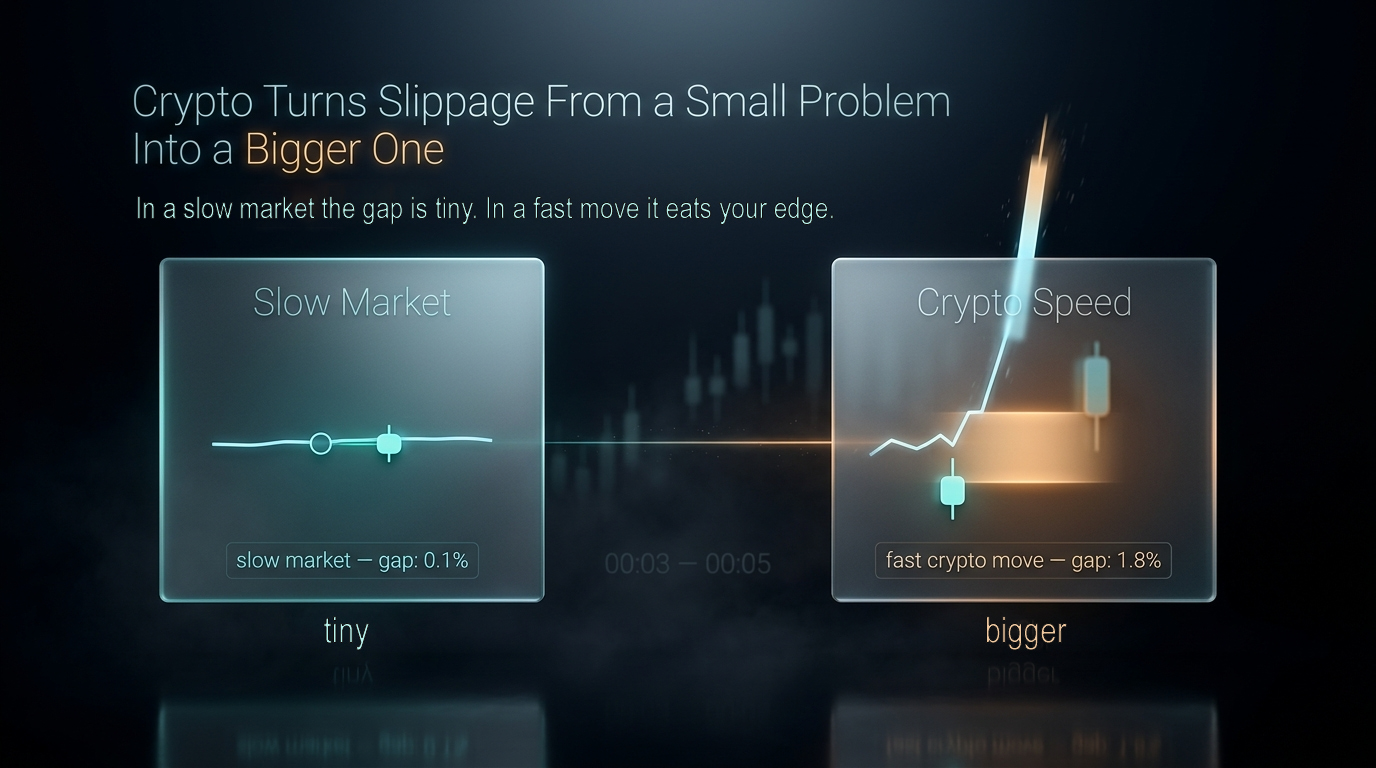
In crypto, a 1 to 2 percent move in a matter of seconds is not unusual. It is Tuesday.
That kind of speed is exactly what punishes you on entry and exit. By the time your order completes its short journey to the exchange, the price you aimed at may already be a step or two away. In a slow market that gap is tiny. In a fast crypto move it can be the difference between a clean fill and a fill that quietly eats part of your edge before the trade even starts.
The Market Never Closes, So the Risk Never Sleeps
Traditional markets have closing bells. They have circuit breakers. They have moments where everyone steps back and the dust settles.
Crypto has none of that. It runs all day, all night, weekends included. There is no pause where execution conditions reset, no safe window where you know liquidity will be deep and stable. Slippage risk is simply always on, and the worst moves often land at the hours when the fewest people are watching.
Thin Order Books Make Your Own Order the Problem
On the bigger coins, liquidity is usually deep enough to absorb a normal trade. Step down into lower volume altcoins and the picture changes fast.
Here the order book is shallow. There are gaps between price levels, and not much sitting at each one. A single order can push straight through several levels before it fills, and suddenly you are slipping 1 to 2 percent or more, not because the market moved against you, but because your own order had to climb the ladder to find enough sellers. On thin books, size becomes its own enemy.
Your Order Size Is Part of the Slippage Equation
Most traders think of slippage as something the market does to them. A sudden move, a bad moment, bad luck. But there is another version of slippage that comes entirely from you, specifically from how much you are trying to buy or sell at once.
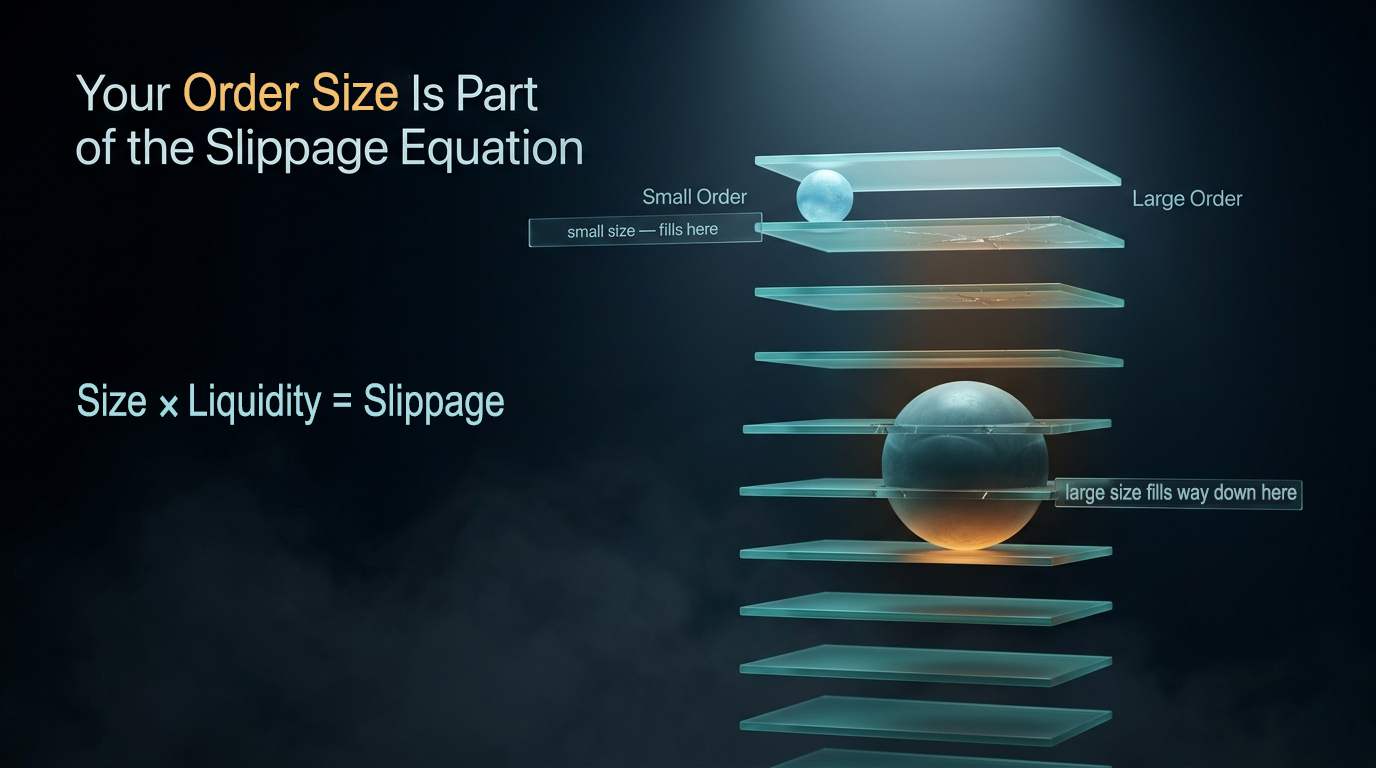
Order size and slippage are connected. The bigger your order, the more liquidity it needs to consume, and the further it may have to travel through the order book to get fully filled.
How Size Sweeps Through the Book
Think of the order book as a stack of sellers, each one sitting at a slightly different price. A small order finds enough sellers near the top and fills cleanly. A large order eats through the first layer, then the next, then the next, each one at a slightly worse price than the one before.
By the time the order is complete, the average fill price is not what you saw when you clicked. It is the weighted average of every level your order had to consume. That average is almost always worse than the price that was showing on your screen.
When Your Order Becomes the Market Move
On deep, liquid pairs like BTC or ETH, a normal-sized trade barely makes a dent. The book is thick enough to absorb it without much movement.
On thinner coins the math changes. Your order does not just consume liquidity, it depletes it. And as it depletes it, the price moves. You are not reacting to the market at that point. You are the market move. The slippage you experience is not external. It is the direct result of your own order pushing price away from you.
Estimating Your Slippage Before You Click
The traders who survive funded accounts have one habit in common. They do not find out about slippage after the fill. They estimate it before they ever click buy.
The file makes this point directly. Slippage is not random bad luck waiting to ambush you. It can be anticipated from the liquidity conditions sitting right in front of you, if you know where to look.

Reading Order Book Depth as a Slippage Signal
The order book is the clearest signal you have. Before entering, the question is simple: is there enough depth at and near my target price to absorb my full order without sweeping through multiple levels?
A deep book means lower expected slippage. The liquidity is thick enough to fill you without dragging price. A shallow book means the opposite. Your order will punch through level after level, and each one fills worse than the last.
So the read happens before the trade, not after. Deep book, you can size up. Thin book, you reduce size, switch to a limit order, or skip it entirely. The book tells you what kind of fill to expect, and the pros listen to it.
A Simple Formula to Gauge Price Impact
The document includes a section built around a slippage calculator, a simple way to estimate execution cost before committing. The idea is not complicated math. It is comparing your order size against the available liquidity at each price level.
If your size is small relative to the depth, your order fills near the top and your slippage stays tight. If your size is large relative to that depth, the order has to consume deeper levels, and the average fill price drifts away from the price you wanted.
That weighted average is your real cost. Not the number on the screen, but the blended price across every level your order touched. Running that comparison in your head, or with a quick calculation, turns slippage from a surprise into a number you already accounted for.
The Distance Between You and the Exchange Is Slippage Too
Here is the part most traders never think about. Slippage does not only happen in the order book. Some of it happens in the wires.
When you click buy, your order does not teleport to the exchange. It travels. From your platform, through the network, all the way to the exchange matching engine where it finally gets filled. That journey takes time, and in a market moving 1 to 2 percent in a second, time is price.
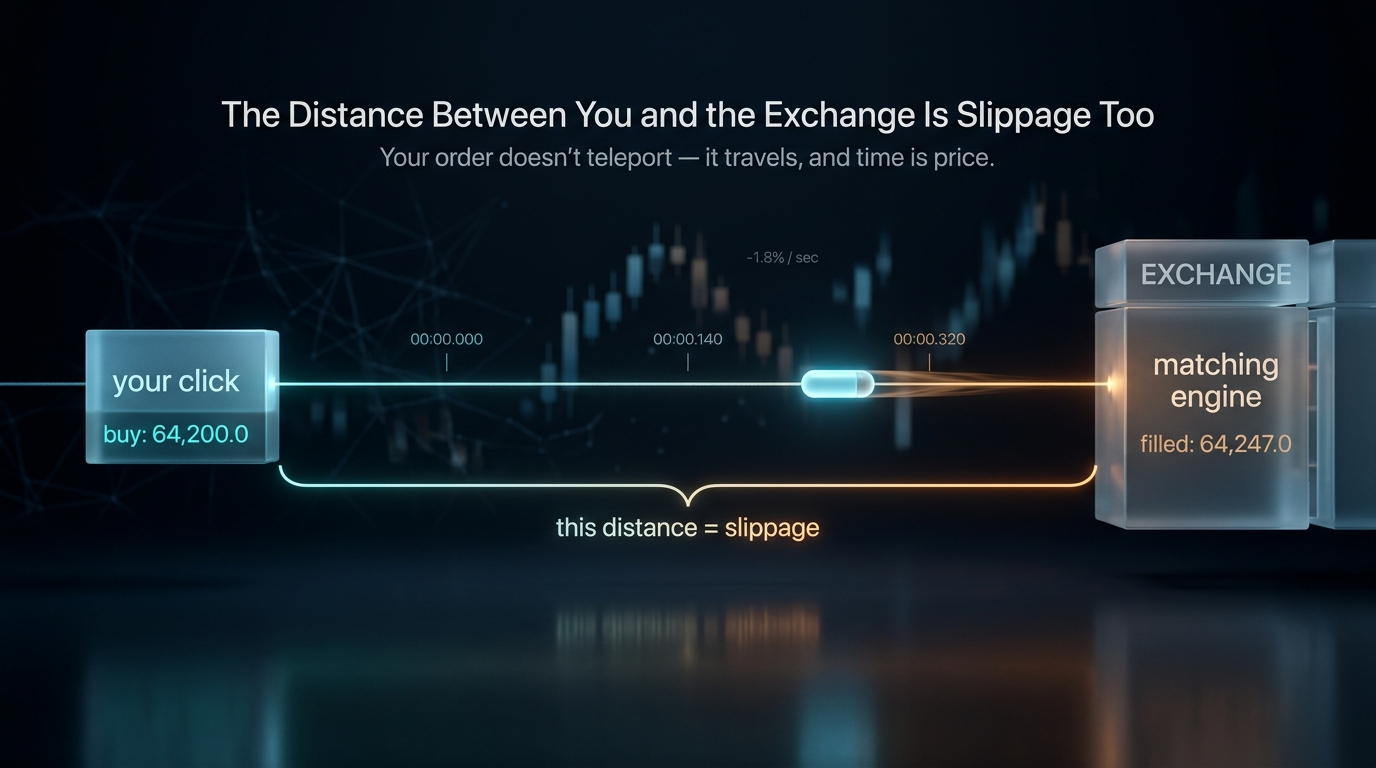
The Signal Path From Your Click to the Fill
The file traces this path clearly. Execution speed directly affects slippage. Even when your signal is right and your timing is perfect, a delay between the click and the fill gives the market room to move against you before your order lands.
Faster execution shrinks that window. The less time your order spends in transit, the less the price can drift while it waits. Slower paths do the opposite. They hand the market extra seconds to walk away from the price you wanted.
So part of your slippage was decided before the order book ever got involved. It was decided by how fast your order could get there.
Speed of Light, Server Proximity, and Why Distance Costs You
This is where physics quietly enters the conversation. The document points out that data moves through fiber at roughly two-thirds the speed of light. Fast, but not instant. The farther your order has to travel, the more latency stacks up along the way.
That is why server proximity matters. Being physically closer to the exchange infrastructure cuts transmission delay, and in fast crypto markets that delay is the difference between a clean fill and a slipped one. The file frames it under a heading worth remembering: infrastructure is the invisible edge.
It also calls out direct exchange connectivity as a way to eliminate unnecessary delays. Direct connections skip extra routing hops, so the order reaches the matching engine faster and fills closer to your intended price. You never see this layer on the chart, but it is shaping every fill you get.
For a funded trader, this is not a technical footnote. The file is explicit that slippage costs more in prop trading because positions are larger and profits are measured against tight risk limits. When a small execution difference can move your result, the quality of the path your order travels stops being invisible and starts being part of your edge.
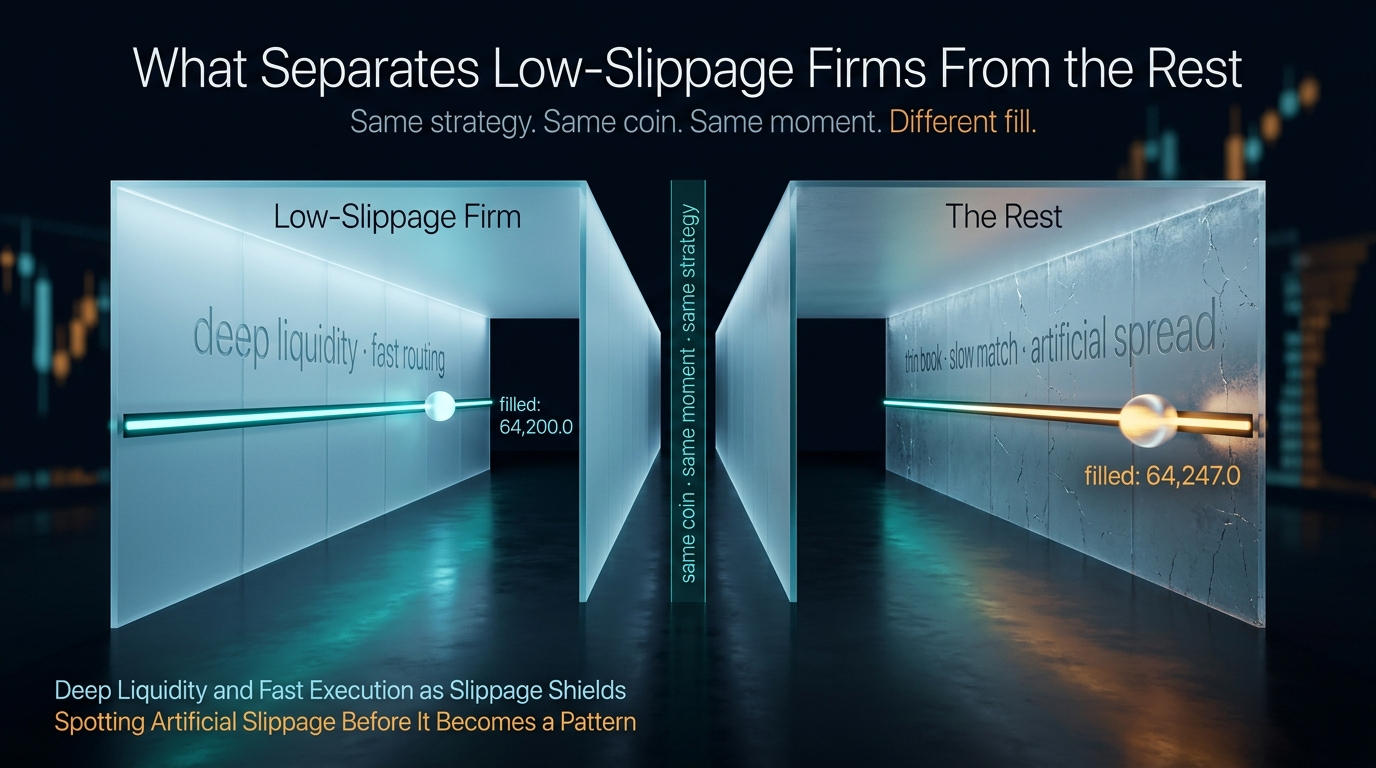
What Separates Low-Slippage Firms From the Rest
Not every firm hands you the same slippage. Two traders can run the identical strategy, on the same coin, at the same moment, and walk away with different fills simply because of who is sitting between them and the market. The file is clear on this: the gap between a clean fill and a slipped one often comes down to the firm behind the account.
Deep Liquidity and Fast Execution as Slippage Shields
The document points to two qualities that do most of the heavy lifting here, and they work as a pair.
The first is deep liquidity. Firms with access to deeper order books can absorb a larger order without sweeping through level after level. Fewer levels touched means a better average fill, and a better average fill means less slippage. When the book underneath you is thick, your order has somewhere to land before it starts moving the price.
The second is fast execution, and the file keeps coming back to it. The quicker your order reaches the exchange, the less time the market has to drift away from your intended price. In a market that can move a full percent while you exhale, that speed is not a luxury. It is a shield. The same idea shows up in how the file treats routing quality and direct exchange connectivity. Cleaner routing and direct connections cut out unnecessary hops and delays, so your order reaches liquidity faster and fills closer to where you clicked.
Put plainly, the better firms combine deeper books, quicker fills, and tighter routing. That combination is what quietly keeps your slippage low without you ever seeing the machinery behind it.
Spotting Artificial Slippage Before It Becomes a Pattern
Then there is the kind of slippage that should make you uncomfortable. The file draws a line between normal slippage, which comes from real market friction, and artificial slippage, which it treats as a red flag.
Normal slippage has an explanation. The market moved, the book was thin, your size was large. Artificial slippage does not. It shows up when execution quality is poor or when a platform’s behavior works against you, and the file frames it as a warning sign rather than a cost of doing business.
The practical takeaway is to watch for the pattern, not the single bad fill. One slipped order in a fast market is normal. Repeated fills that drift the wrong way in calm conditions, on liquid pairs, with reasonable size, are not. The firms worth trusting are the ones with transparent execution and no fingerprints of artificial slippage. Spotting that difference early protects your edge before a quiet pattern turns into a real cost.
How Much Slippage Is Normal in Crypto Prop Trading?
This is the question every funded trader eventually asks, usually right after a fill that stung. The file answers it without hand-waving: there is a normal range, and there is a range that should make you stop and look closer.
Near-Zero, Acceptable, and the Kind That Should Raise a Flag
On deep books, near-zero slippage is the baseline. When liquidity is strong and routing is clean, your fill should land right where you expect it, and the file treats that as the standard a good execution environment delivers, not a lucky outcome.
From there, a little slippage is acceptable, and the file ties how much to four things: liquidity depth, order size, volatility, and routing quality. Small, explainable slippage is just market friction. If the book was thin, your size was large, or the market was moving fast, a few ticks of slip has a reason behind it. That is the cost of doing business, and you can account for it.
What should raise a flag is slippage that has no explanation. Excessive slip on liquid pairs, with reasonable size, in calm conditions, is the signal the file warns about. The further your fills drift from near-zero without a market reason, the more it points to thin liquidity, weak routing, or the artificial slippage covered earlier. Normal slippage you can plan around. The unexplained kind is the one worth investigating.
Negative Slippage, Positive Slippage, and What Each Tells You
The file splits slippage by direction, and the distinction matters more than it first looks.
Negative slippage is the classic case: your fill comes in worse than expected, and the execution price moves against you. This is the one that eats your edge and the one most traders mean when they complain about slippage at all.
Positive slippage runs the other way. The market moves in your favor between click and fill, and you get a better price than you asked for. The file notes it as a real outcome, not a fantasy. It happens when conditions shift to your benefit in that brief window before execution.
Reading both together tells you something about your environment. If you only ever see negative slippage, that one-sidedness is itself a signal worth questioning. A healthy execution setup produces slip in both directions, because real market friction is not biased against you. When the slip only ever goes one way, that is closer to the artificial pattern than to normal trading.
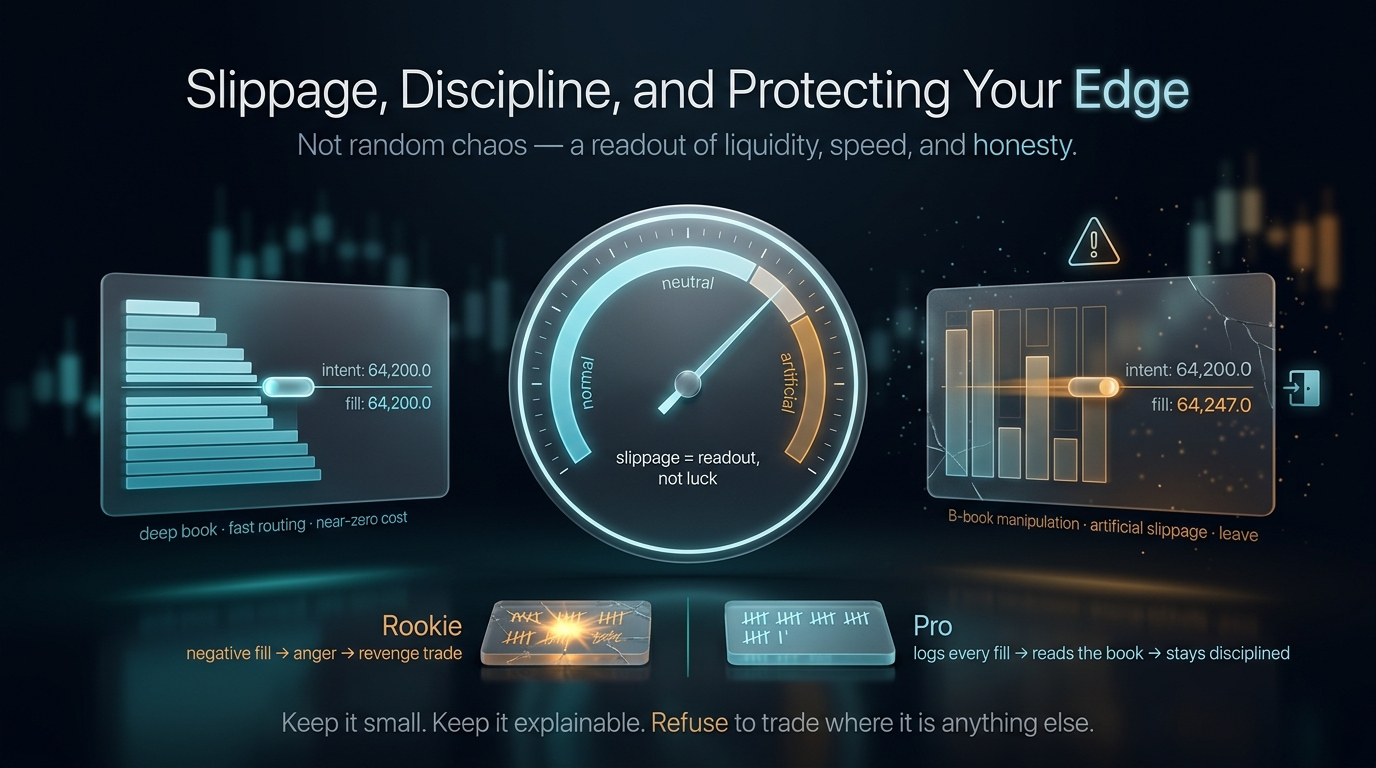
Slippage, Discipline, and Protecting Your Edge
Slippage isn’t random chaos, it’s a direct measure of liquidity depth, execution speed, and platform honesty.
Slippage is not bad luck and it is not the market singling you out. It is a readout. Every fill tells you something about how deep the book was, how fast your order moved, and whether the platform behind it is playing straight. Once you see it that way, slippage stops being something that happens to you and becomes information you can use.
The normal case is quiet. In crypto prop trading, normal slippage is near zero on deep books. When liquidity is strong and execution is fast, your fills land where you expect, and good routing keeps the hidden costs low. That is the environment you want, and it is the one a serious firm is supposed to provide.
The unacceptable case is the one the document tells you to act on. Artificial slippage, the kind that comes from B-book manipulation, is the red flag that makes smart traders switch firms fast. This is not friction you manage or plan around. It is a sign the execution itself is working against you, and the correct response is to leave, not to adjust your strategy.
Then there is the part most traders underestimate: the psychology. The section on the psychological impact of slippage draws a sharp line between rookies and pros.
Negative slippage often triggers anger and revenge trading. The fill stings, the emotion takes over, and the next decision is worse than the one that started it.
Positive slippage gets ignored by rookies but logged by pros as proof the platform is fair. Pros track the wins too, because both directions together tell them their environment is honest.
The through line is discipline. Professionals treat slippage as the cost of doing business, not an emotional event. They manage their expectations, read the order book before they click, size their orders to the liquidity in front of them, and choose firms with deep books and clean execution. That combination, liquidity depth, execution speed, platform honesty, and discipline, is what protects the edge.
Slippage will always be there. The goal was never to eliminate it. The goal is to keep it small, keep it explainable, and refuse to trade where it is anything else.
Note: This article is for educational purposes only. It explains how slippage works in crypto prop trading and is not financial, investment, or trading advice. Markets carry risk, and your own results will vary.
About the Creator
Sophie
Trader focused on Price Action & Order Flow.
Into crypto, fast execution, controlled risk, and quality setups.
Passing funded accounts and refining my trading every day.
Enjoyed the story? Support the Creator.
Subscribe for free to receive all their stories in your feed.
Comments