
Prediction Markets vs Traditional Betting: Key Insights for New Traders
Before you put money on any platform, understand the fundamental structural difference that separates these two worlds — and why it matters more than picking the right outcome.

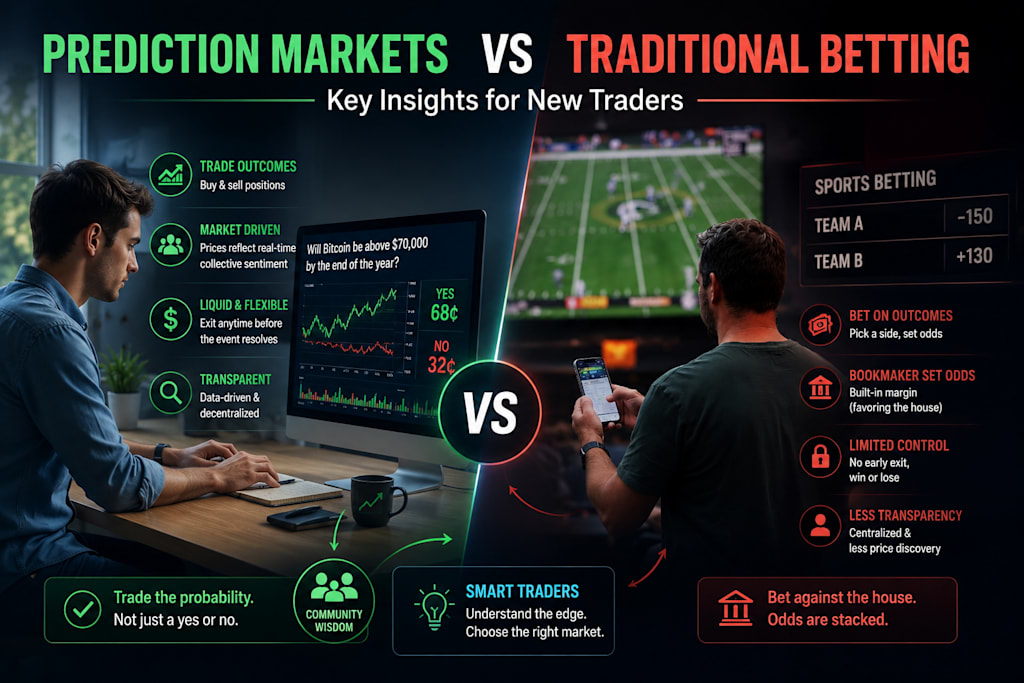
There's a moment every new trader experiences. You've done your research, you feel confident, you place your bet — and you still lose money. Not because your prediction was wrong. Because the system itself was working against you before the event even started.
That realization is what's driving a growing wave of traders toward prediction markets in 2026. Platforms like Kalshi and Polymarket are rewriting the rules of how people engage with uncertainty. And if you're just getting started, understanding the structural difference between these platforms and traditional sportsbooks isn't just interesting — it's the most important financial decision you'll make in this space.
Two Systems, Two Completely Different Games
At their core, prediction markets and traditional betting differ in one fundamental way: who you're playing against.
In traditional betting — DraftKings, FanDuel, or any sportsbook — you're wagering against the house. The operator sets the odds, controls the margin, and guarantees their own profit regardless of the outcome. That margin, called the vig or juice, typically sits between 4% and 10% on every single bet. Before you've even started, you're already behind.
Prediction markets operate as peer-to-peer exchanges. The platform — Kalshi, Polymarket — doesn't take a position on outcomes. It's simply infrastructure. Traders buy and sell event contracts directly with each other, and the platform earns a small transaction fee for facilitating the trade. That's it. There's no house building a margin into your odds. No operator quietly profiting every time you place a wager.
The analogy that makes this click immediately: traditional betting is blackjack. You and every other player at the table are against the dealer — the house. Prediction markets are poker. You're competing against the other players at the table. The casino just rents you the room.
Same adrenaline. Completely different math.
What the Prices Are Actually Telling You
Walk into any sportsbook and you'll see odds like -175 or +130. Those numbers feel intuitive if you've been around sports betting long enough, but they contain something important hidden inside them — the operator's margin. The odds you see are not a pure reflection of the likely outcome. They're a number engineered to balance the book and ensure the platform profits on both sides of every event.
Prediction markets price things differently. Contracts trade on a scale of $0.01 to $0.99. A contract sitting at $0.72 means the market collectively believes there's a 72% probability that the event resolves as true. There's no embedded margin obscuring that number. What you see is what thousands of active traders, all with real money at stake, genuinely believe.
This mechanism — called price discovery — produces something remarkably powerful: forecasts that are often more accurate than expert opinion, media consensus, or traditional polling. The reason is simple. When people risk real capital, they stop performing opinions and start expressing genuine beliefs. Bad forecasters lose money. Good ones survive and accumulate. The price that emerges reflects the aggregate of serious, financially motivated analysis.
For a new trader, this is meaningful. Predicting market prices gives you an honest starting point. Sportsbook odds give you a starting point with a cost already buried inside.
The Flexibility Advantage Nobody Talks About Enough
Here's a feature of prediction markets that traditional bettors rarely get to experience: you can change your mind.
In a conventional sportsbook, the moment you confirm your wager, you're locked in. Some platforms offer a cash-out option, but it almost always comes at terms that favor the operator. Your position is static until the event resolves. You watch developments unfold with no ability to react.
Prediction markets work like trading a stock. You buy a contract when you believe the market has underpriced an outcome. If new information shifts the probability in your favor — a major announcement, breaking news, a key development — you can sell your position and lock in the gain before the event even concludes. If you bought a contract at $0.35 and it moves to $0.68 on the back of new information, you don't need to wait for resolution. You exit, take the profit, and redeploy.
This changes the entire rhythm of how you engage with markets. It shifts the skill set from pure outcome prediction toward something richer: information processing, timing, and dynamic position management. Traders who are sharp at identifying when a market has mispriced an event — and moving quickly when it has — have a genuine, sustainable edge. That kind of edge is structurally unavailable in traditional betting.
The Scope Is Broader Than You'd Expect
One underappreciated aspect of prediction markets is how far beyond sports they extend.
Traditional betting is overwhelmingly sports-focused. You'll find deep menus of props, totals, and futures across major leagues, and that's largely where the ecosystem ends. Some sportsbooks have dabbled in entertainment or politics, but sports is the core.
Prediction markets cover everything. Federal Reserve interest rate decisions. Election outcomes across dozens of countries. Technology product launches. Economic indicators. Cryptocurrency milestones. Award shows. Weather events. Box office results. The menu is genuinely broad, and it's growing.
Why does this matter? Because it means you can trade in markets where you actually have an edge. A macro economist who has spent years studying inflation data has no particular advantage picking NFL spreads. But on a market asking whether the Fed will cut rates in Q3? That's home territory. Prediction markets let expertise translate into profit in a way that traditional betting structurally cannot.
The Regulatory Picture in 2026
This is worth understanding before you open an account anywhere.
Prediction markets in the U.S. operate under federal oversight as event contracts and derivatives, primarily regulated by the CFTC. This creates relatively uniform access across the country — you're not navigating a patchwork of state-by-state rules.
Traditional sports betting is licensed state by state, meaning availability, rules, and tax treatment vary significantly depending on where you live. Operators invest heavily in state-level compliance, and some states still have no legal sports betting at all.
For new traders, the federal framework around prediction markets generally means cleaner, more consistent access — and a legal structure that's designed for financial instruments rather than gambling regulation.
A Practical Framework for Getting Started
If you're deciding where to begin, here's a clear way to think about it.
Start with prediction markets if: you enjoy analyzing information across a wide range of topics, you want the ability to manage and exit positions dynamically, and you're comfortable with a trading-style interface where prices shift in real time.
Start with traditional betting if: you're deeply knowledgeable about a specific sport, you prefer making a single decisive judgment and letting it ride, and the simplicity of fixed odds suits your decision-making style.
The most sophisticated participants eventually use both — leveraging prediction market prices as honest probability signals even when placing traditional wagers, and using traditional betting's depth in sports markets to complement broader prediction market portfolios.
But if there's one thing to carry away from this: the structural differences between these platforms are not minor. The presence or absence of a house edge, the ability to exit positions, the transparency of pricing, and the breadth of available markets all compound significantly over time. Understanding them before you deposit money anywhere isn't optional homework. It's the foundation everything else is built on.
About the Creator
Poly Punter
Poly Punter covers prediction market news, Polymarket trends, crypto forecasting, trader insights, and real-time event trading. We publish informative content about decentralised prediction markets and forecasting culture.
Enjoyed the story? Support the Creator.
Subscribe for free to receive all their stories in your feed.
Comments
There are no comments for this story
Be the first to respond and start the conversation.