
One Step Evaluation Crypto Prop Firm: Why Single Phase Still Tests Risk, Not Speed
How single phase crypto prop challenges work and how they differ from two step and instant funding.


A trader passes Phase 1 during a strong Bitcoin trend, waits for the next set of account credentials, and starts Phase 2 three weeks later in a market that has stopped trending. Nothing about the strategy changed in that gap. The tape did.
That gap is why a one step evaluation crypto prop firm gets attention. It is not that a single target is automatically easier to hit. It is that a market which never closes can invalidate the conditions that produced the first pass before the second phase even begins.
Most comparison pages still ask how quickly a trader can get funded. The more useful question is narrower: can a risk process survive one compressed rule set while crypto is still the same market it was on day one?
This article explains what a single phase evaluation actually measures, how its math differs from two step and instant funding, and how to judge a challenge by the risk budget it creates rather than by the number of stages printed on the brochure.
How a Single Phase Evaluation Works in Crypto Prop Trading
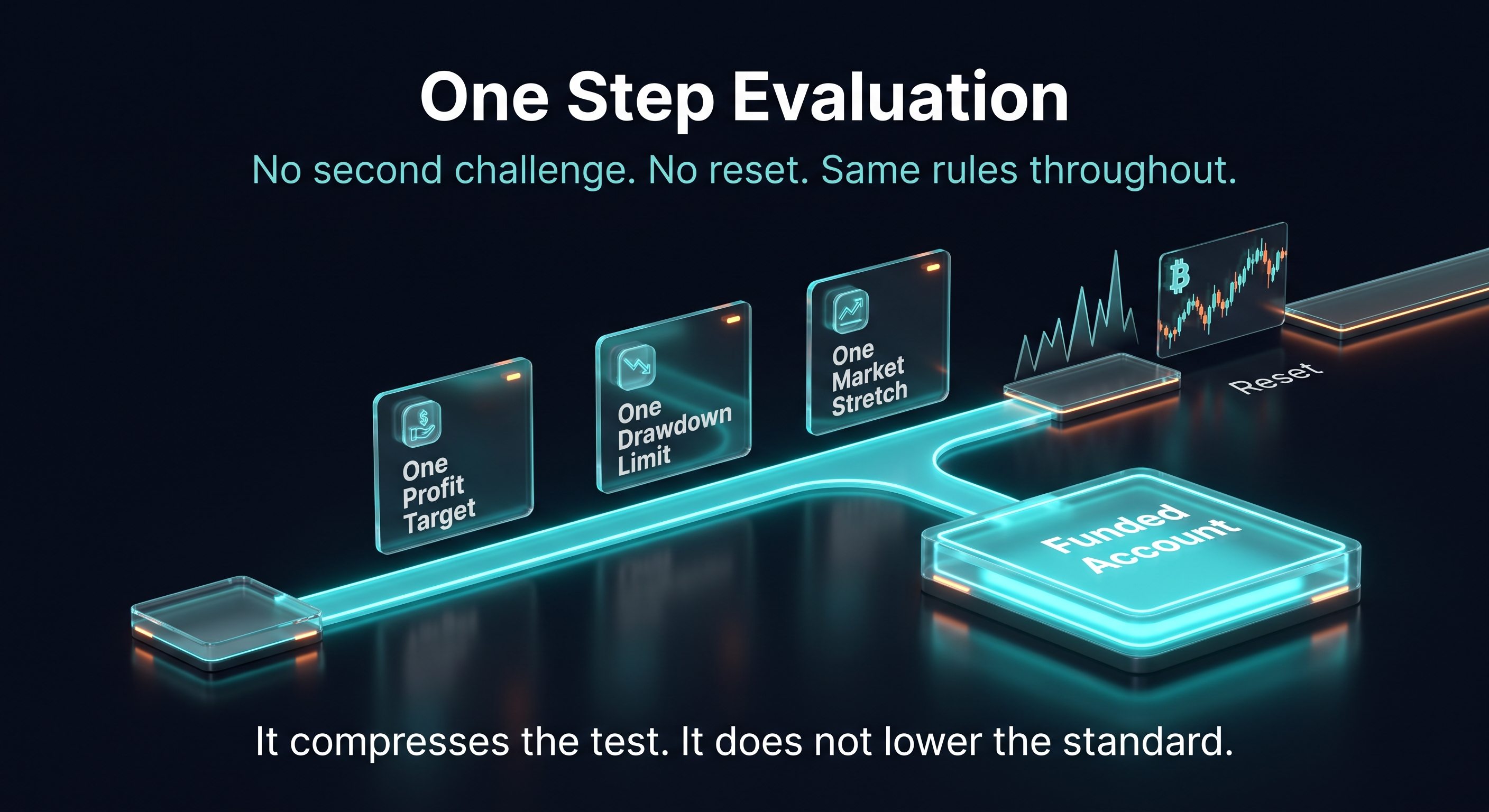
A one step evaluation crypto prop firm grants access to a funded account after one assessment phase. The trader reaches a single profit target while staying inside daily loss and maximum drawdown limits, and no second challenge follows. Passing still depends on disciplined risk control rather than on a shorter checklist.
One Clock Instead of Two
A two phase path splits the proof across two separate clocks. The trader reaches one target, waits for the account to be issued, then starts again under a second target that is often measured against a different market. A single phase path removes that reset, but it does not remove the risk standard behind it. It compresses that standard into one rule set, one drawdown floor, and one continuous stretch of market.
What the Evaluation Balance Actually Represents
The balance shown during an evaluation is usually simulated buying power rather than a personal cash deposit. The trader's financial exposure is typically limited to the program cost, not to the notional figure on the dashboard. That distinction matters when reading marketing material, because a large headline balance describes the size of the test, not money sitting in a wallet.
Does Removing a Phase Lower the Standard?
Not in most programs. The requirements are simply gathered into one window instead of two. Many single phase products compensate for the shorter path with a higher profit target, a tighter drawdown floor, or a consistency rule that quietly does the work the second phase used to do.
From Evaluation Account to Funding Eligibility
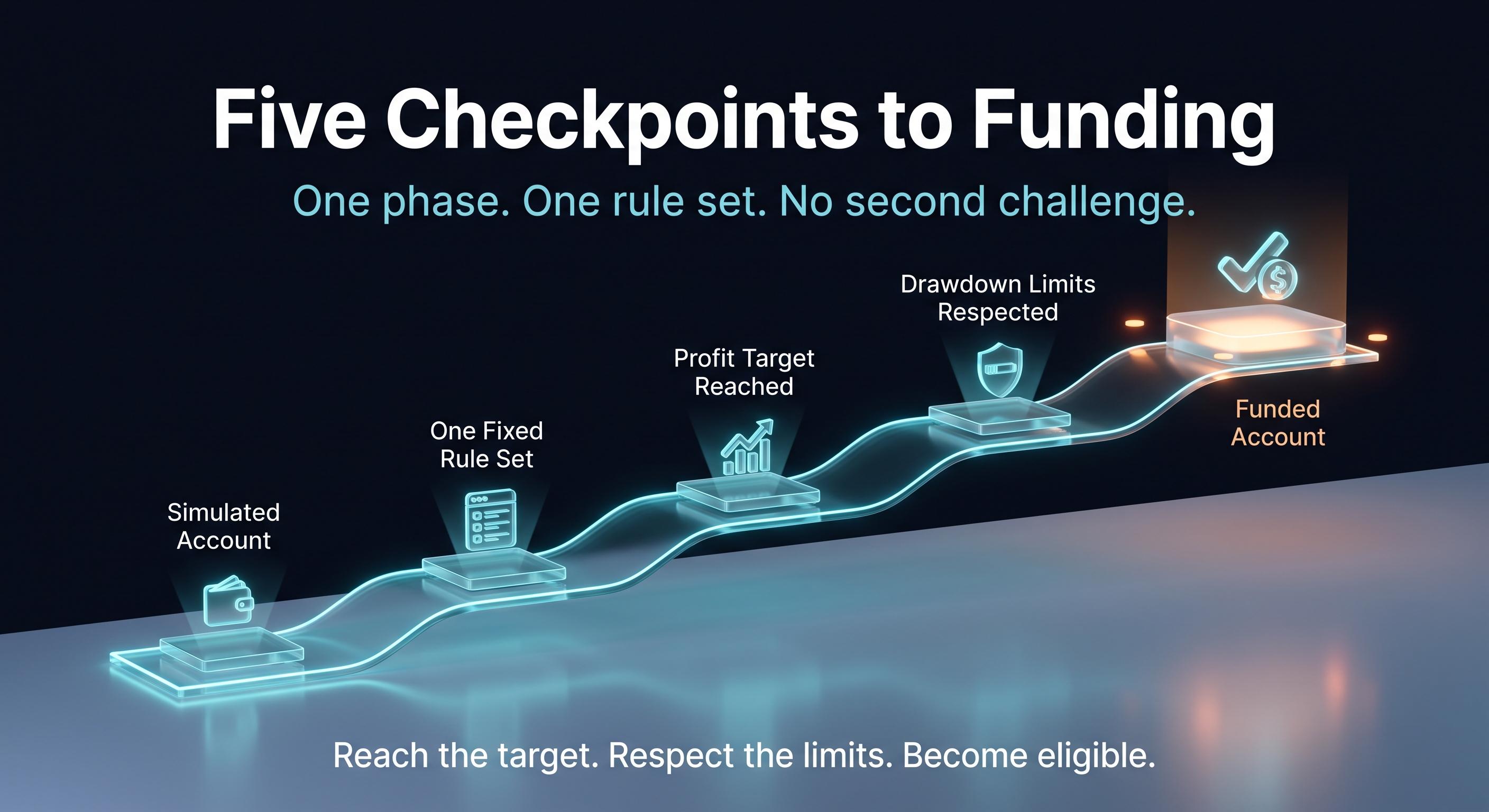
A single phase crypto challenge moves through five checkpoints rather than two targets. The trader receives a simulated account, trades one fixed rule set, reaches the profit target, stays inside the loss limits for the entire phase, and then becomes eligible for a funded account once the firm reviews rule compliance.
The Five Checkpoints
Receive a simulated evaluation account.
Trade under one fixed rule set.
Reach the required profit target.
Stay inside daily loss and maximum drawdown limits for the whole phase.
Become eligible for a funded account after the firm reviews rule compliance.
An Illustrative Rule Set
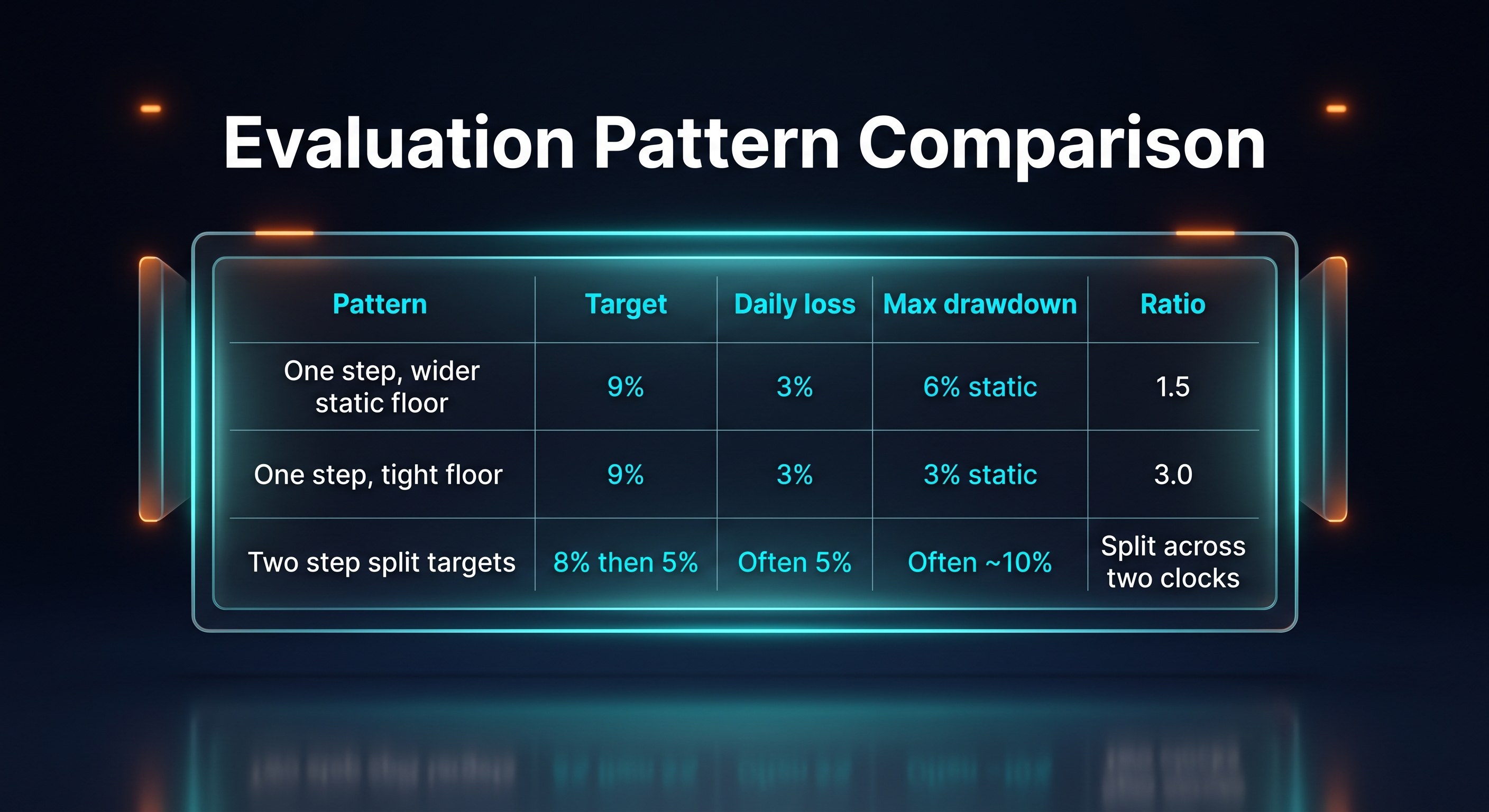
A common pattern on a $100,000 evaluation looks like a 9% profit target, a 3% daily loss limit, a 6% static maximum drawdown, and a small minimum day requirement. If the target is reached without a rule breach, the evaluation ends there. Some programs add no time cap at all, and some include funded stage access in the evaluation fee rather than charging a separate activation payment after a pass. These figures are illustrative only. Live rulebooks differ by firm and change without much notice.
How Long Does Funding Usually Take?
There is no universal clock. The answer depends on the trader's rhythm and on the contract, since some programs impose no time cap and only a small minimum day requirement, while others need several qualifying days before an account is approved. A target reached in three sessions can still wait on a minimum day rule.
Comparing Targets and Drawdown: One-Step vs. Two-Step Evaluations
Phase count answers how many times a trader must pass. The ratio between profit target and maximum drawdown answers something more practical: how little room exists to be wrong. Dividing the target by the maximum drawdown produces a number that describes the real pressure of the account, and two products labelled the same way can sit far apart on that measure.
Why Phase Count Is the Smallest Variable
A 9% target against a 6% floor and a 9% target against a 3% floor are advertised with the same phrase and traded in completely different ways. The first leaves room for a normal losing sequence. The second asks the trader to produce three times the buffer in profit before the buffer runs out, which forces smaller size, fewer attempts, and far less tolerance for a bad week.
Static and Trailing Floors Behave Differently
A static floor stays fixed under the starting balance, so an account that began at $100,000 with a 6% static limit fails at $94,000 whether equity has visited $108,000 or not. A trailing floor rises as equity makes new highs, which means the same run to $108,000 can lift the fail line to roughly $101,520 and turn a normal give back into a breach. Neither design is automatically better. Static is easier to model in advance, while trailing punishes handing open profit back to the market. Some trailing floors also lock once a profit threshold is reached, which changes the math again.
Does the Floor Count Open Positions?
It depends on whether the firm measures on equity or on balance. An equity floor counts floating loss, so an open trade can breach an account before it is closed, while a balance floor generally waits for the trade to be settled. Daily loss rules often reference start of day equity. The phrase "6% max" on a comparison page does not answer any of this, which is why the worked example in the live rulebook is worth more than the headline.
One Phase, Two Phases, and Instant Funding Compared
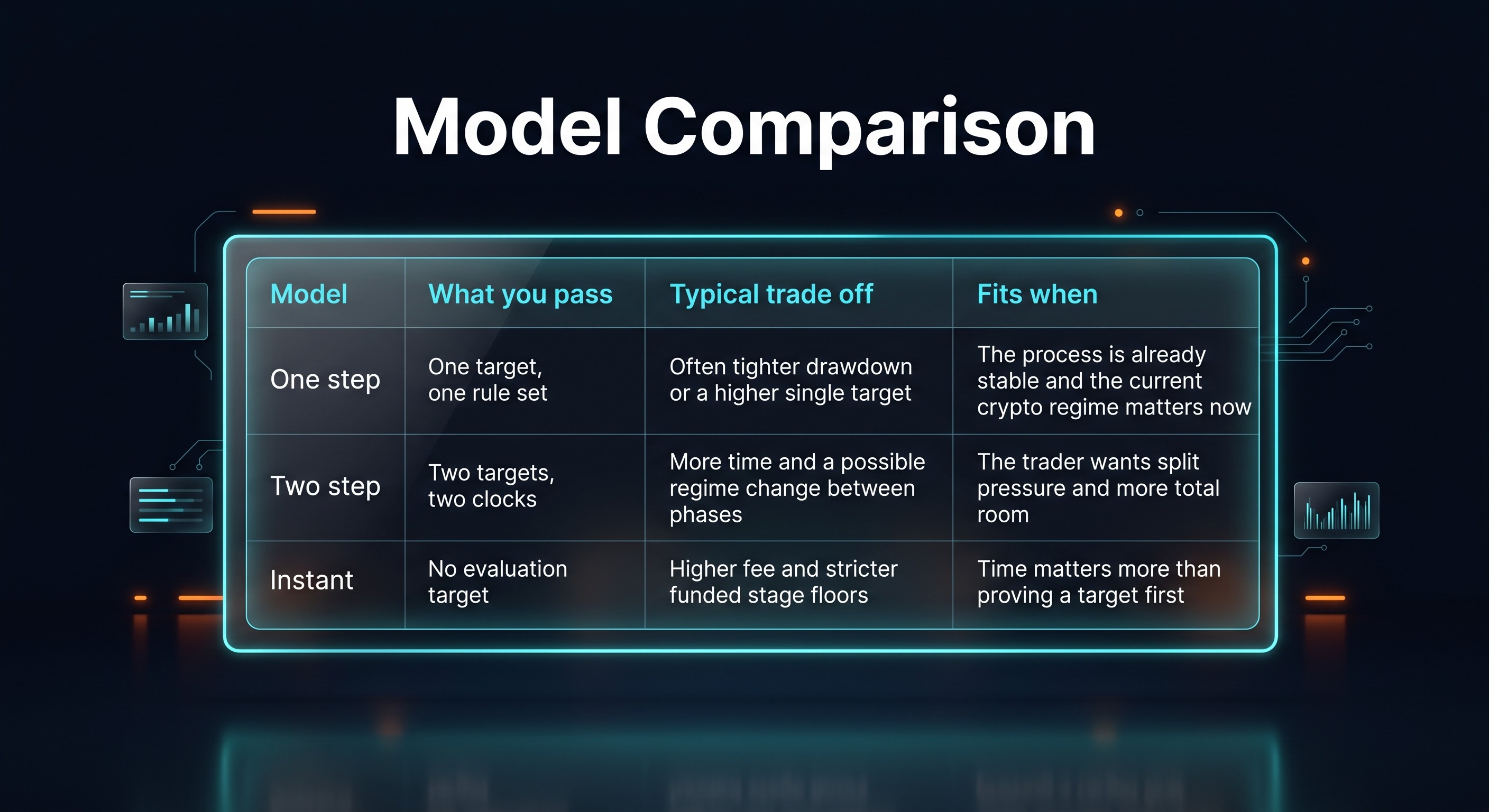
All three models try to identify traders who can make money without breaking risk limits, but they do not test the same path. A single phase product uses one target. A two phase product repeats the proof on a second clock. Instant funding skips the target entirely and usually charges more in exchange for stricter conditions once the account is live.
The Rules That Appear in Almost Every Contract
Underneath the model names, the same categories keep appearing: a profit target that usually sits somewhere between 8% and 10%, a daily loss limit, a maximum drawdown that may be static or trailing, a minimum number of trading days, and a list of restricted behaviours such as martingale sizing, grid systems, latency exploitation, and account sharing. Each firm defines those numbers differently, so a comparison built on one headline figure is close to useless.
Is a Single Phase Challenge Easier Than a Two Phase One?
Not necessarily. Fewer stages can shorten the path, but single phase programs often ask for a higher target or hold the trader to a narrower floor. Difficulty lives in the numbers and in the drawdown mechanics, not in the count of stages.
Why an Extra Phase Costs More in a Market That Never Closes
A second phase is not a rest. In crypto it is simply more market, usually a different market, measured against a fresh target. That is the part most comparisons leave out, because the equity hours version of the same argument does not carry the same weight.
The Cost of a Second Clock
Crypto does not close, so the pause between phases is exposure rather than recovery
A trend that funded the first phase can be a range by the time the second one starts
Weekend and news volatility still reach the account whenever holding is permitted
The trader ends up measured twice against two different tapes rather than twice against the same skill
Where Multi Phase Still Makes Sense
Repeating a target remains a legitimate filter, and a multi phase model is not weak by design. Forex hours markets at least share a daily close, which makes the second phase feel like a continuation of the first. Crypto can change character overnight, over a weekend, or during a single funding rate squeeze, so performance differences between two phases may say more about the market than about the trader. The cost of the extra stage is interruption: a process that worked in one regime is asked to prove itself again after the regime has moved.
Is Weekend Holding or News Trading Allowed?
Not always. Some crypto programs permit weekend holds and news trading, others ban them outright, and a few sell the permission as an add on or apply different rules before and after funding. The market trades around the clock, but the account may not, so both stages need checking before a swing or event driven book is assumed to fit.
What a Compressed Rule Set Demands From Execution
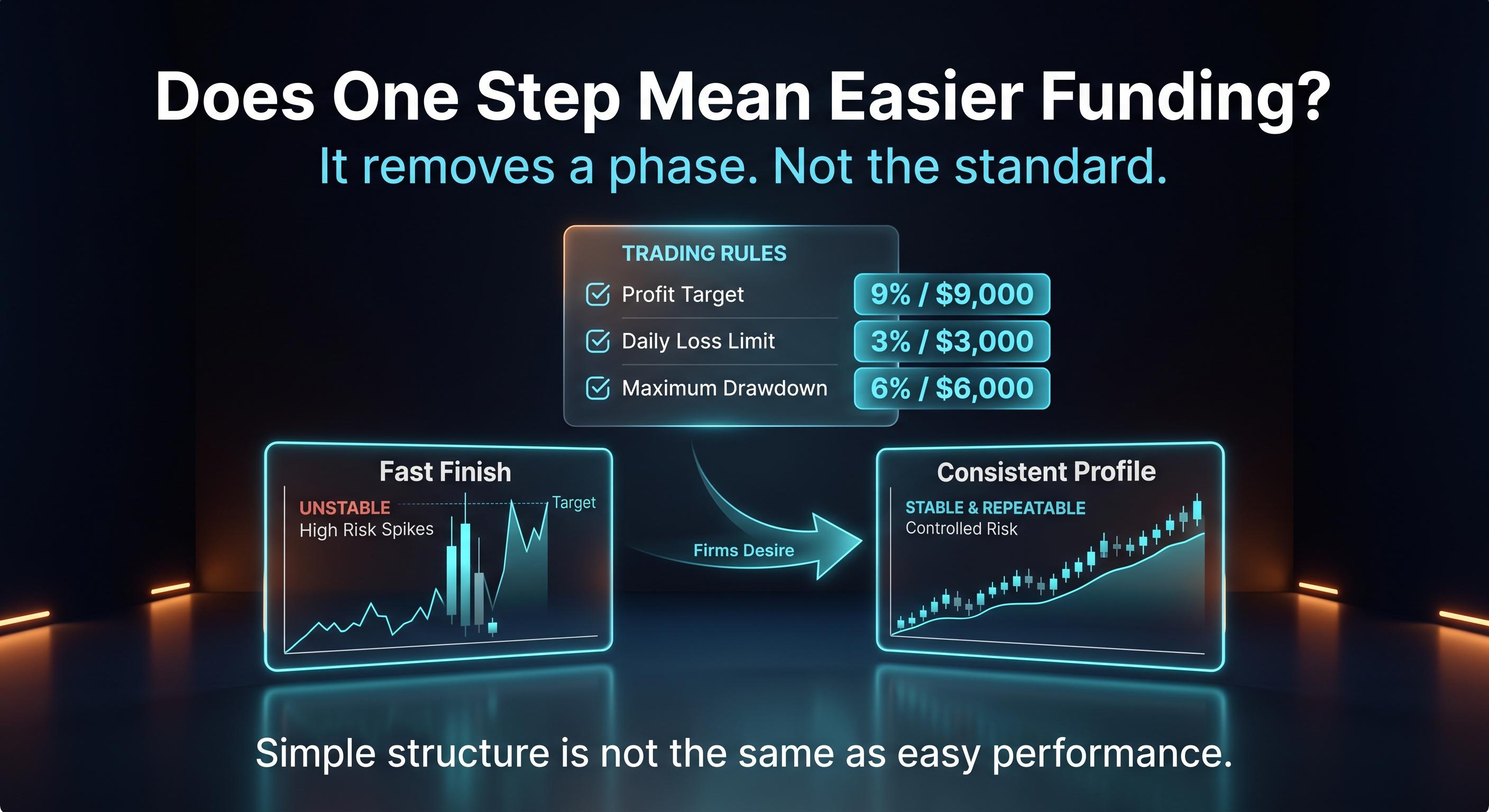
Removing a phase removes a reset, not a standard. On a $100,000 account, a 9% target is $9,000, a 3% daily loss limit is $3,000, and a 6% static floor leaves $6,000 of total room for the entire evaluation. The checklist is short, but the arithmetic is not loose, and figures like these vary from firm to firm.
Two Records, One Target
Two traders can reach the same target and look nothing alike. The first takes ten trades, risks roughly 1% on each, and follows a defined playbook. The second takes two trades, risks 8% to 10% at a time, and finishes in half the calendar time. The second record looks more efficient on a chart of days elapsed. The first is the one that tends to survive once the account is funded, which is why firms design consistency rules around it. After a pass, the objective quietly changes from qualifying to staying eligible.
Why Minimum Days and Consistency Rules Exist
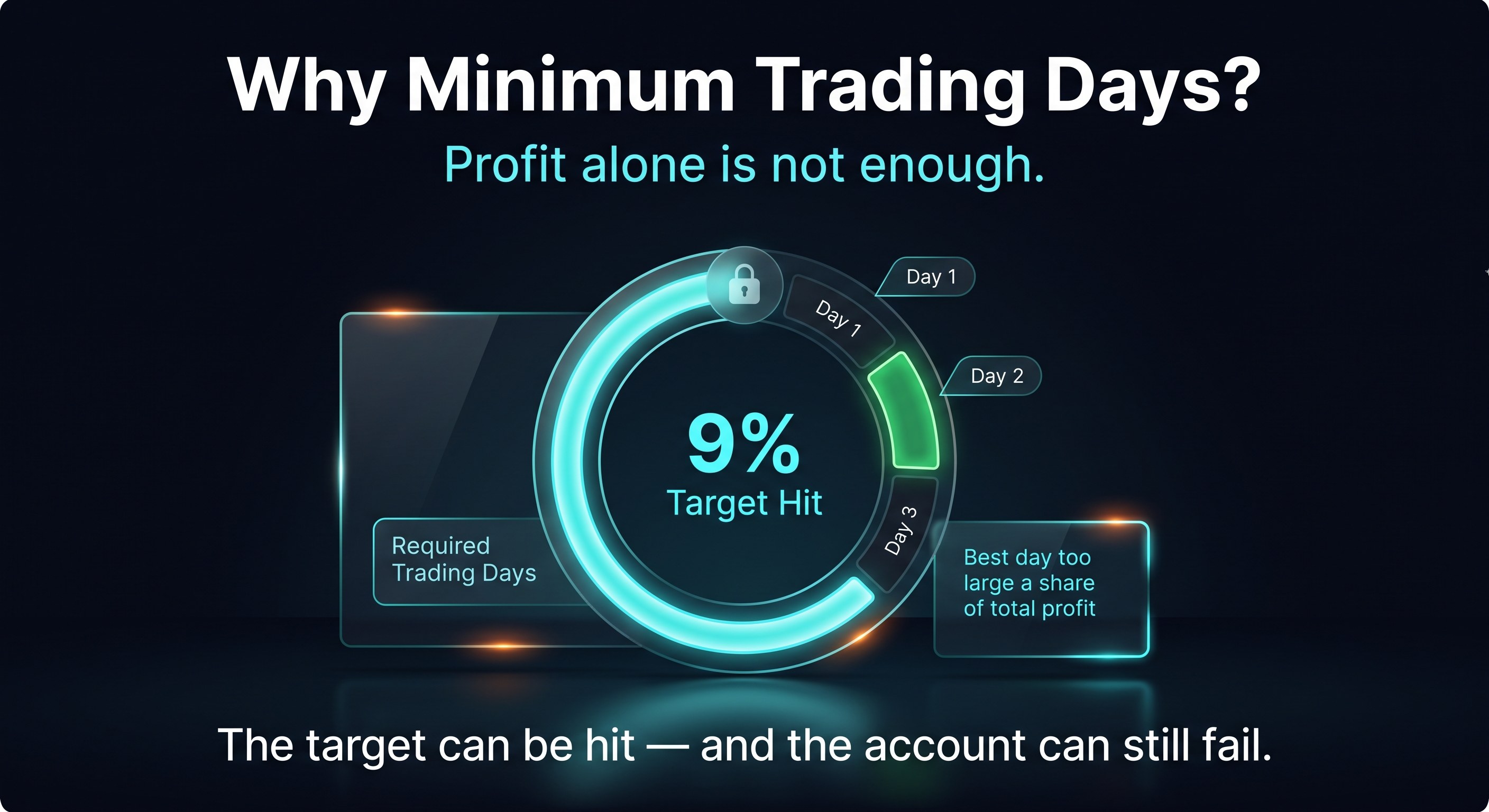
Minimum trading days exist so that one oversized win cannot finish the test. A 9% target reached in a single session may still fail a contract that asks for two, five, or more qualifying days. A consistency rule adds a second filter by capping how much of total profit may come from the best day, which means a target can be reached and the account still not pass. Whether that rule applies during the evaluation, after funding, or in both stages is worth confirming before the first trade.
Is the Funded Balance the Trader's Own Money?
Usually not. Most programs allocate simulated buying power or proprietary capital, and personal exposure stays limited to the program cost rather than the full notional balance. That is a structural feature of the model, not a detail buried in the terms.
Five Checks Before Paying for a Single Phase Evaluation
A one step account is worth choosing for the risk budget it creates, not for how short the path looks. Five checks separate a rule set a strategy can actually occupy from a cheap headline.
Ratio. Divide the profit target by the maximum drawdown. A 9/6 structure and a 9/3 structure are different products sold under the same label.
Anchor. Confirm whether the floor is static or trailing, and whether it is measured on balance or on equity.
Tape. Check weekend holding, news rules, the pair list, and whether "crypto" means perpetuals or a thin CFD book.
Interference. Read the strategy bans, minimum days, time caps, and consistency rules before rebuilding an existing playbook around them.
Aftermath. Map the payout split, the wait before a first payout, any scaling path, and any fee that only appears after a pass.
The Cheaper Fee That Costs More
A lower entry price attached to a 3% total floor can end up more expensive than a higher price attached to a 6% static floor, once failed attempts are counted. The relevant comparison is not the fee on its own but the fee divided by the realistic probability that the current strategy fits inside the floor. A rule set that forces a rebuild is measuring a different trader from the one who paid for it.
Do Single Phase Firms Offer Scaling?
Some do and some keep the account size fixed. Where scaling exists, it is normally conditional on profit, elapsed time, and clean risk behaviour, and the terms live in the funded stage contract rather than in the evaluation headline.

Who a One Step Challenge Fits, and Who Should Wait
A single phase challenge suits traders who already have a tested process and can operate comfortably inside a tight daily loss limit. It tends to fit momentum and intraday books that lose their advantage when a second clock starts in a new regime, because the whole edge of the model is finishing the proof inside one market condition.
When to Choose Something Else
A wide swing book that needs more buffer than a compressed floor allows is usually better served by a two phase product with more total room. A trader who freezes under a single target may also find the split version easier to execute, and anyone who needs payout access before proving anything is really looking at instant funding with its higher cost and stricter live rules.
The Limit of Structure
A trader with poor risk control can fail either model. Structure only decides how many times, and under which math, an edge has to show up. One phase is one pressure frame rather than a discount, so the account is best judged by its target to drawdown ratio, its floor type, and the funded stage rules that still apply long after the brochure has been closed.
Disclaimer: Educational only. Not financial advice. Crypto trading is risky and can result in loss. Prop accounts follow firm specific rules; some balances are simulated buying power rather than personal cash. Hypothetical figures above are not typical, not guaranteed, and not an offer.
About the Creator
Sophie
Trader focused on Price Action & Order Flow.
Into crypto, fast execution, controlled risk, and quality setups.
Passing funded accounts and refining my trading every day.
Enjoyed the story? Support the Creator.
Subscribe for free to receive all their stories in your feed.
Comments
There are no comments for this story
Be the first to respond and start the conversation.