
No Trailing Drawdown Crypto Prop Firms: Static vs Trailing Rules
A practical risk floor test for comparing static limits


Before comparing anything about prop firms, draw one line on paper: the account’s failure floor.
On a $10,000 account with a $500 maximum loss allowance, that line begins at $9,500. Now imagine the account climbs to $10,800 and then pulls back to $10,400. Under a static model, the floor remains at $9,500, leaving $900 of room. Under a simplified trailing model that stays $500 below the highest equity, the floor has moved to $10,300, leaving only $100.
Same account. Same pullback. Very different breach risk.
That is the real issue behind choosing a no trailing drawdown crypto prop firm. The important question is not simply, “How large is the drawdown?” It is, “What makes the loss floor move?”
A large advertised drawdown can become restrictive if it follows every new account high. A smaller static limit may be easier to understand because its absolute floor remains unchanged. However, neither label tells the complete story. Daily loss limits, equity calculations, reset times, trading fees, and payout rules can all change the amount of risk a trader can actually use.
This guide explains how no trailing models work, compares static and trailing drawdown, and provides a practical test for reading any crypto prop firm’s rules before purchasing a challenge.

What Is a No Trailing Drawdown Crypto Prop Firm?
A no trailing drawdown crypto prop firm does not move its maximum loss floor upward whenever the account reaches a new profit high. In a static model, the floor is normally calculated from the starting balance and remains fixed. Daily loss, equity, and reset rules may still apply, so traders must review the full rulebook.
Suppose a trader starts with a $100,000 account and a 6% static maximum loss limit. The permanent floor would be:
$100,000 − $6,000 = $94,000
If the account grows to $105,000, the maximum loss floor remains at $94,000. If it later grows to $115,000, the same $94,000 floor still applies.
Profits therefore increase the distance between the current account value and the original loss threshold.
This does not mean the trader can lose an unlimited amount. It also does not mean every rule on the account is static. A prop firm can use a fixed overall maximum loss floor while still applying a daily loss limit that resets according to balance or equity.
For that reason, no trailing drawdown should be treated as the beginning of the rule review, not the end of it.
Static vs Trailing Drawdown in 30 Seconds
Static and trailing drawdown are both designed to limit losses, but they use different reference points.
Static Drawdown
A static drawdown normally uses the starting balance to establish a permanent maximum loss floor.
If the account starts at $10,000 with a 5% static limit:
Starting balance: $10,000
Maximum loss allowance: $500
Permanent loss floor: $9,500
The floor does not rise when the trader makes a profit. At $10,200, $10,800, or $12,000, it remains at $9,500.
Trailing Drawdown
A trailing drawdown uses an account high, often the highest balance or equity, as its reference point. When the account reaches a new high, the loss floor may move upward.
In a simplified model with a fixed $500 trailing distance:
Account high: $10,000 → floor: $9,500
Account high: $10,400 → floor: $9,900
Account high: $10,800 → floor: $10,300
The exact calculation depends on the firm. Some systems trail live equity, some update only after a trade closes, and others recalculate at the end of the trading day. Certain trailing models also stop moving after reaching a defined lock point.
Main reference: Static Drawdown uses the starting balance as its main reference, while Trailing Drawdown uses the highest balance or equity.
Loss floor: With Static Drawdown, the loss floor normally remains fixed. With Trailing Drawdown, the loss floor moves after new account highs.
Effect of profit: Under Static Drawdown, profit expands the total cushion. Under Trailing Drawdown, profit raises the minimum account level.
Open profit: With Static Drawdown, open profit usually does not move the overall floor. With Trailing Drawdown, open profit may move the floor in equity based models.
Pullback behavior: Static Drawdown uses accumulated profit as additional room. Trailing Drawdown may approach the raised floor faster.
Main risk question: With Static Drawdown, the main question is “What other limits apply?” With Trailing Drawdown, the key question is “What value and timing move the floor?
The Risk Floor Test: A $10,000 Account Example
Consider two $10,000 accounts. Both begin with a $500 maximum-loss allowance.
The trader grows each account to a peak of $10,800. The market then retraces, bringing the account equity down to $10,400.
Account A: Static Drawdown
The loss floor was fixed at account creation:
$10,000 − $500 = $9,500
After the pullback, the remaining buffer is:
$10,400 − $9,500 = $900
The trader has given back $400 from the account high, but still has $900 between current equity and the static floor.

Account B: Simplified Trailing Drawdown
The trailing system keeps its floor $500 below the highest account value:
$10,800 − $500 = $10,300
After equity falls to $10,400, the remaining buffer is:
$10,400 − $10,300 = $100
The market movement was identical in both accounts. The difference came entirely from the rule.
This example does not prove that every static model is better than every trailing model. It illustrates why traders should calculate the active floor rather than relying on the advertised percentage.
Real prop firm rules may use:
Live equity
Closed balance
Intraday highs
End of day values
A trailing lock point
Different calculations during evaluation and funded stages
The Risk Floor Test is therefore simple:
Calculate the floor at the starting balance, after a profit peak, after a normal pullback, and after a payout.
If the rule remains clear in all four situations, the trader has a better understanding of the actual risk budget.
Seven Drawdown Rules to Check Before Buying a Challenge
Before purchasing a crypto prop challenge, review these seven parts of the drawdown system.
Is the Drawdown Static, Trailing, or Hybrid?
Do not rely only on phrases such as “maximum loss” or “account protection.” Look for the exact calculation.
A static floor is normally tied to the initial balance. A trailing floor follows a new balance or equity high. A hybrid model may trail temporarily and then stop at a specified level.
If the rulebook does not clearly state what moves the floor, ask the firm for a numerical example.

Is the Rule Based on Balance or Equity?
Balance normally reflects closed trading results. Equity includes both closed results and the unrealized profit or loss of open positions.
An equity based rule can be triggered while a position is still open. It may also react to temporary price movement, spreads, fees, or funding costs.
This distinction is especially important for traders who hold positions through volatility.
Does the Floor Update in Real Time or at the End of the Day?
Two trailing rules with the same percentage can behave very differently.
A real time equity model may move with open profit immediately. A balance based rule may update only after profitable trades are closed. An end of day system may take a snapshot at a particular time and apply the new floor during the next session.
Always identify the firm’s timezone as well as its calculation frequency.
How Does the Daily Loss Limit Work?
A prop firm can offer a static overall maximum loss limit while using a separate daily loss rule.
Check:
The daily loss percentage or dollar amount
Whether it is based on the initial balance, previous balance, or current equity
The exact reset time
Whether open positions count
Whether the floor moves after a profitable day
What happens to positions held through the reset
The daily limit may become the active constraint long before the overall maximum loss floor is reached.
What Counts Toward a Breach?
The displayed account balance may not show the entire risk calculation.
Determine whether the firm includes:
Unrealized losses
Trading commissions
Spreads
Funding fees
Overnight costs
Slippage
Pending orders
Simultaneous positions
A trader can remain above the balance threshold while equity briefly touches the breach level.
Does the Trailing Rule Ever Stop?
Some trailing models stop moving after the floor reaches the starting balance or another predetermined level. Others continue following the account throughout its lifecycle.
A rule that eventually locks may provide a different trading environment from a fully trailing equity model. The phrase “trailing drawdown” is not specific enough on its own; the stopping condition matters.
What Happens After a Payout?
A withdrawal reduces the account balance, but firms do not all handle the remaining risk cushion in the same way.
Before requesting a payout, calculate:
The balance after withdrawal
The maximum loss floor after withdrawal
The next daily loss floor
The minimum equity needed to continue trading
Whether the firm requires a post payout safety buffer
A profitable account can become fragile if most of its available cushion is withdrawn.
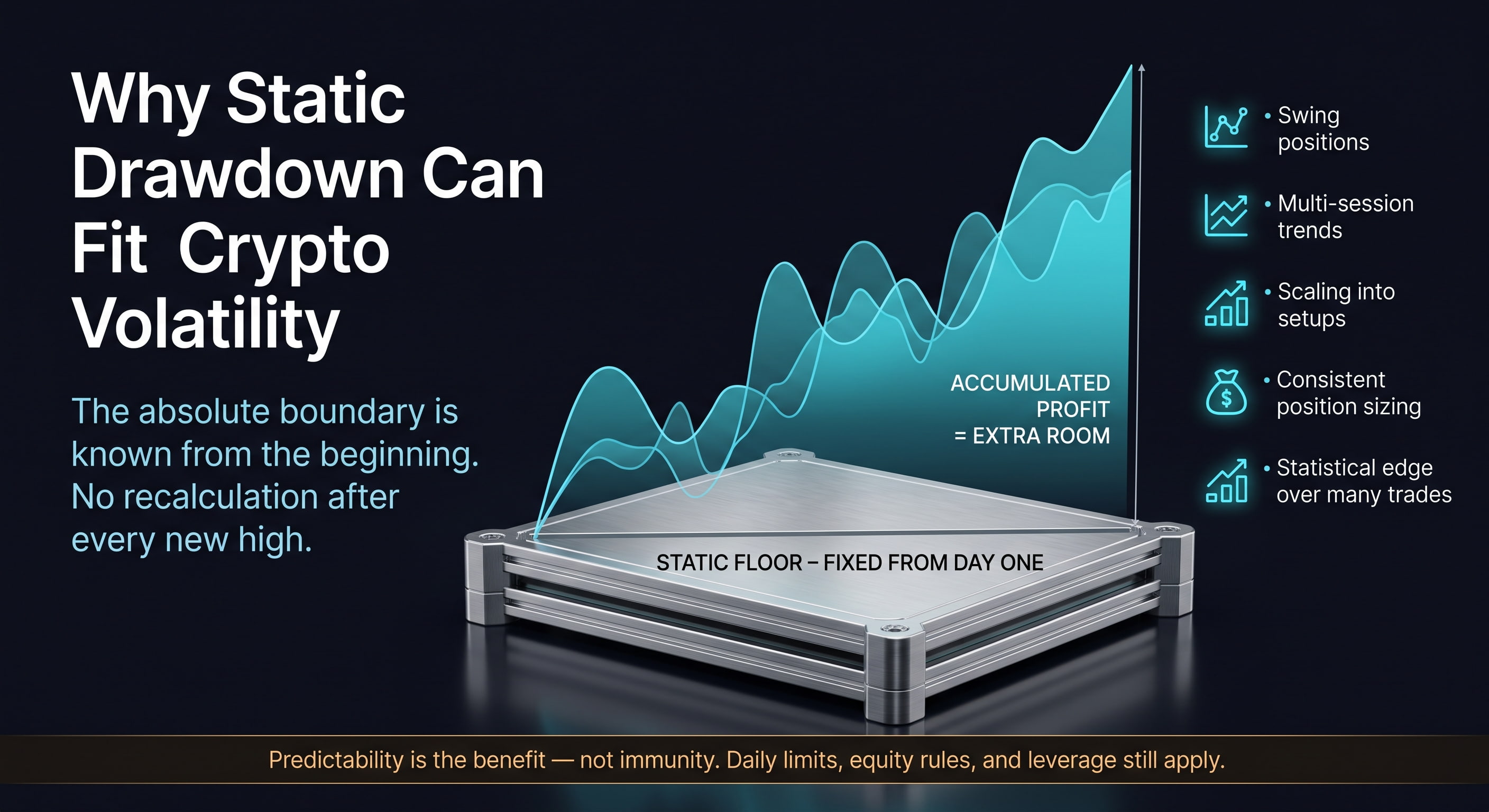
Why Static Drawdown Can Fit Crypto Volatility
Crypto markets trade around the clock and can move quickly. A position may experience a meaningful pullback without invalidating the trader’s original setup.
A static maximum loss floor can make this environment easier to plan because the absolute boundary is known from the beginning. The trader does not need to recalculate the overall floor after every new account high.
This may benefit strategies that depend on:
Holding swing positions
Following multi session trends
Scaling into confirmed setups
Using consistent position sizing formulas
Allowing a statistical edge to play out over many trades
Static drawdown can also change how profits function inside the account. Because the overall floor remains fixed, accumulated profit normally becomes additional room above that floor.
However, static drawdown is not automatically safe or suitable for every trader.
A static limit can still be small. An equity based breach can still close an account during an open loss. A separate daily limit can still restrict position size. High leverage can still exhaust the available risk budget quickly.
The practical benefit is predictability, not immunity from losses.
When No Trailing Drawdown Is Not Enough
The no trailing label answers one question: does the overall maximum loss floor follow new account highs?
It does not describe the entire trading environment.
Before evaluating a firm, traders should also review:
Daily loss rules and reset timing
Weekend position policies
News trading restrictions
Maximum leverage
Position size limits
Consistency requirements
Minimum trading days
Payout conditions
Breach and account closure policies
A firm can advertise no trailing maximum drawdown while applying a daily equity floor that changes at each reset. That does not make the label inaccurate, but it means the trader must distinguish between the overall maximum loss limit and the daily loss limit.
No trailing drawdown should therefore be one filter in the decision, not the only filter.
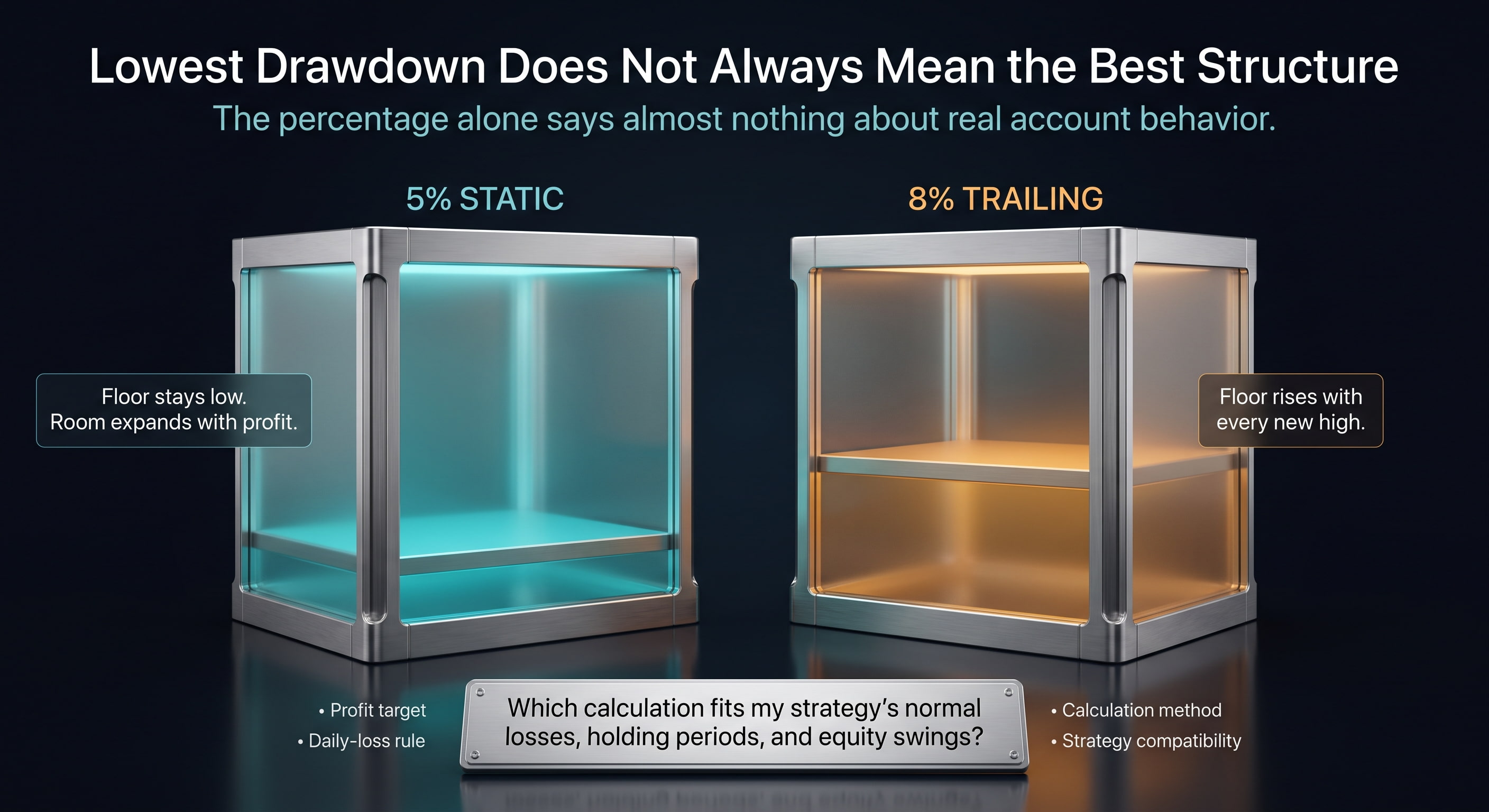
Lowest Drawdown Does Not Always Mean the Best Structure
A lower drawdown percentage may look safer or easier to understand, but the percentage alone says little about account behavior.
For example, compare a 5% static limit with an 8% fully trailing limit. The trailing account appears to offer more room at the start. After several profitable trades, however, its floor may be much higher than the static floor.
The opposite can also occur. A carefully designed trailing model that locks at the starting balance may be manageable for a short term trader, while a very tight static account may provide too little initial room.
The better comparison is not:
Which firm advertises the largest drawdown?
It is:
Which calculation is compatible with my strategy’s normal losses, holding periods, and equity fluctuations?
The percentage, calculation method, profit target, and daily loss rule must be evaluated together.
Four Drawdown Structures That Are Easy to Misread
Prop firm terminology is not always consistent. Two firms may both advertise “no trailing drawdown” while using different daily loss calculations, equity rules, or reset methods.
Instead of relying on the marketing label, traders should identify which limits remain fixed, which limits can move, and what account value triggers a breach.
Pure Static Maximum Drawdown
In a pure static model, the overall loss floor is calculated from the initial account balance and remains unchanged.
For a $10,000 account with a 5% maximum loss limit:
$10,000 − $500 = $9,500 static floor
The floor stays at $9,500 after profitable trades, losing trades, and new account highs. However, the firm may still enforce the rule using live equity, meaning unrealized losses can trigger a breach.
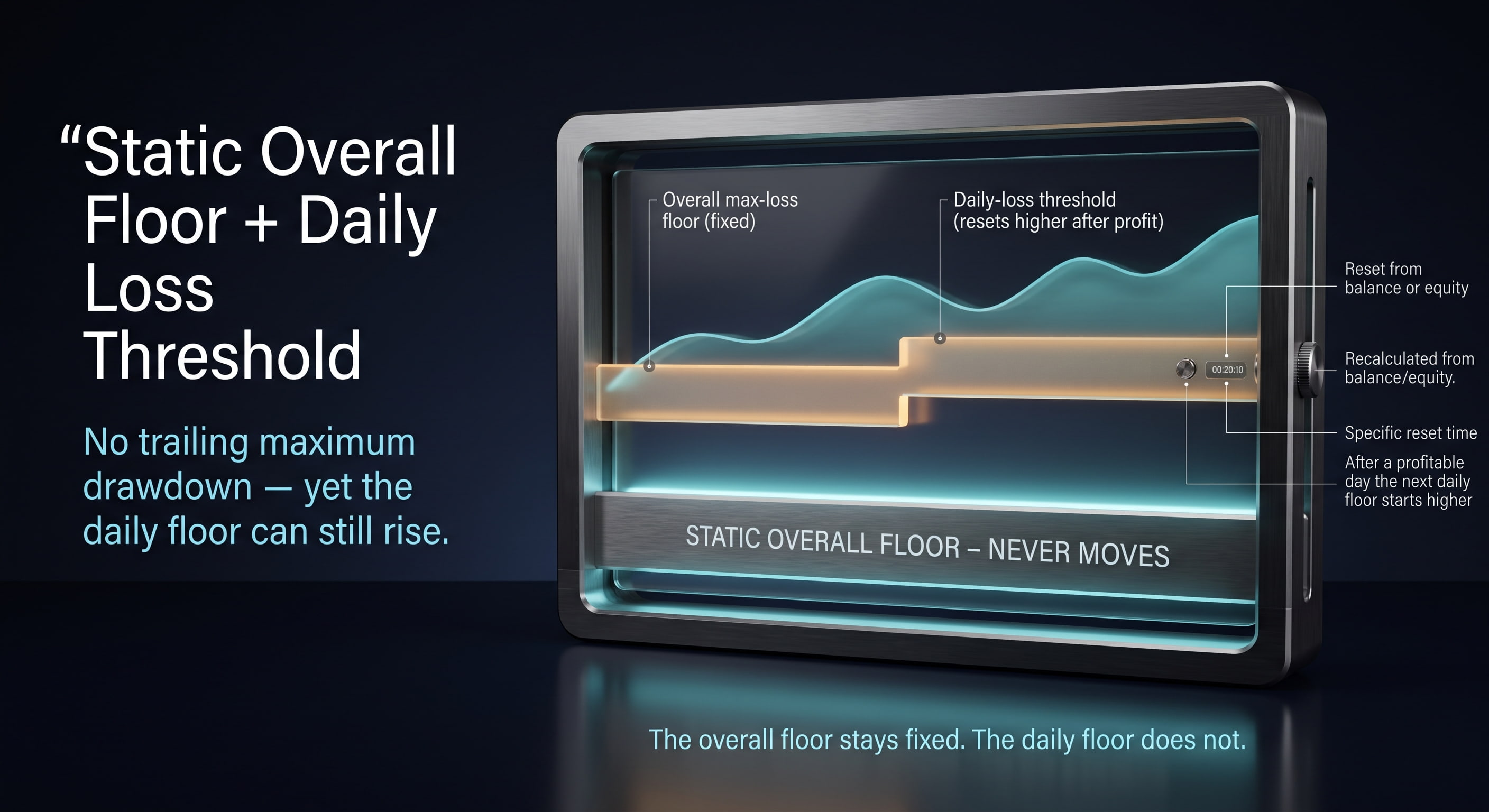
Static Maximum Drawdown With a Resetting Daily Floor
Some accounts combine a static overall floor with a separate daily loss threshold.
The maximum loss floor remains fixed, but the daily floor may be recalculated from the account’s balance or equity at a specific reset time. After a profitable day, the next daily floor may begin from a higher reference point.
This structure can accurately be described as having no trailing maximum drawdown, but it does not mean every active loss threshold remains fixed.
End of Day Trailing Drawdown
An end of day trailing model does not normally follow every intraday equity movement. Instead, the firm records the balance or equity at a specified daily cutoff and adjusts the loss floor after the session ends.
This may be less reactive than real time equity trailing, but it is still a trailing system. A profitable closing value can raise the floor applied to the next trading day.
Traders should check whether the update is based on closed balance, total equity, or the highest value recorded during the day.
Trailing Drawdown That Stops at a Lock Point
Some drawdown floors move upward only until they reach a predetermined level, such as the initial account balance. Once that lock point is reached, the floor stops trailing and becomes fixed.
This hybrid structure can behave like a trailing model during the early stages of the account and like a static model later.
The critical questions are:
What makes the floor move?
Where does it stop?
Can it move again after a payout?
Does open profit affect the calculation?
How to Identify the Real Model
Before classifying a drawdown rule, complete this sentence:
The account is breached if its [balance or equity] reaches [the active floor], which is calculated from [the starting balance, account high, or daily reset value] and updates [in real time, at the end of the day, or never].
If the rulebook does not provide enough information to complete that sentence, the drawdown model is not yet clear.
The key is to separate the permanent maximum loss floor from daily or temporary limits. A firm may genuinely offer no trailing maximum drawdown while still operating another threshold that changes with equity, daily resets, or withdrawals.
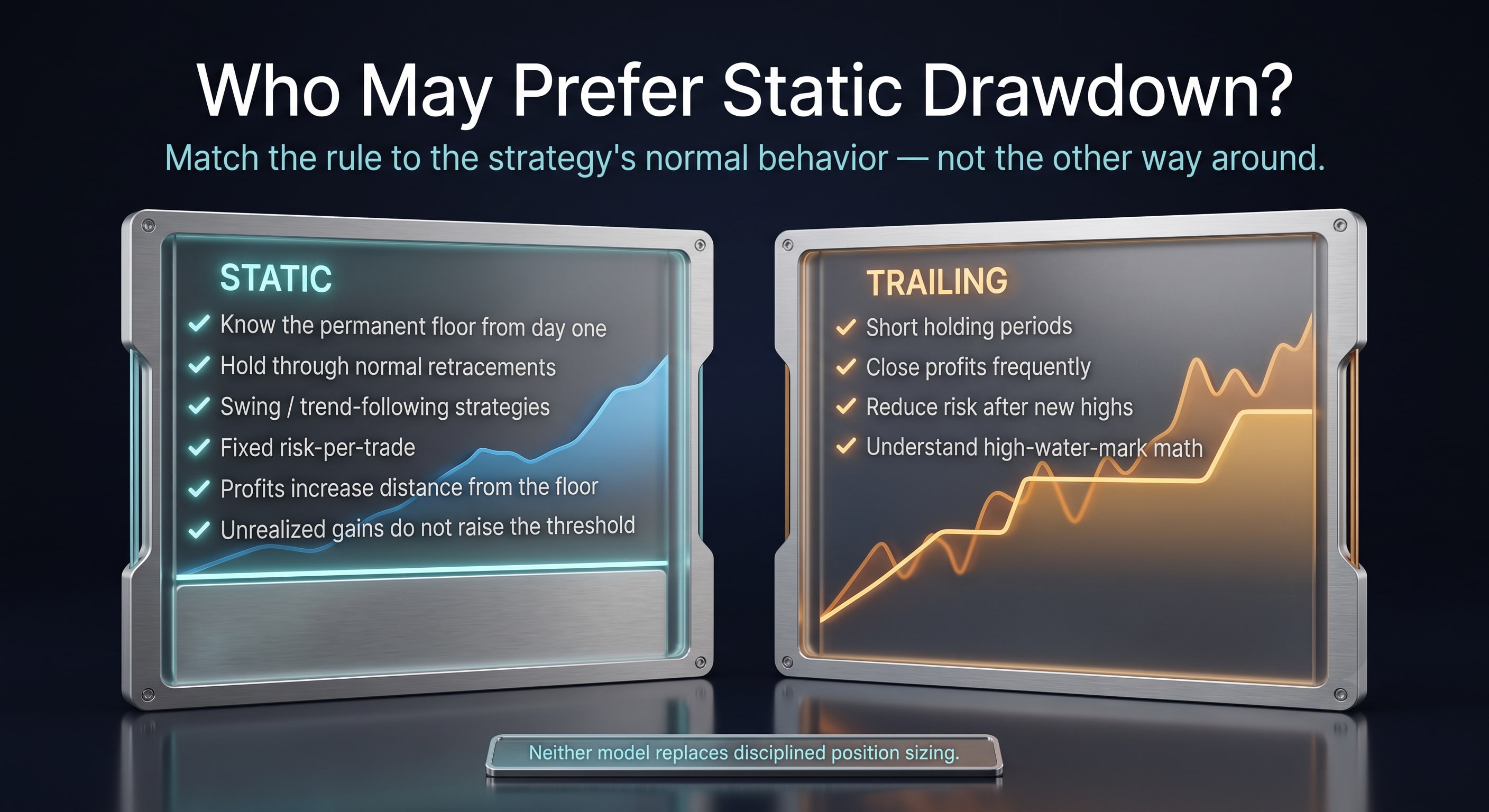
Who May Prefer Static Drawdown?
A static maximum loss model may be a better fit for traders who:
Want to know the permanent account floor from day one
Hold positions through normal market retracements
Use swing or trend following strategies
Apply fixed risk per trade calculations
Prefer profits to increase the distance from the overall floor
Do not want unrealized gains to raise the permanent maximum loss threshold
A trailing model may still be manageable for traders who:
Use short holding periods
Close profits frequently
Reduce risk after new account highs
Understand the high water mark calculation
Trade within a system specifically designed around a moving floor
Neither model replaces disciplined position sizing. The objective is to choose rules that do not conflict with the strategy’s normal behavior.
A 60 Second Pre Purchase Checklist
Before paying for a challenge, confirm that:
I know whether the overall drawdown is static, trailing, or hybrid.
I know whether balance or equity controls a breach.
I know exactly when the daily loss limit resets.
I know whether unrealized profits can move any floor.
I know how fees and trading costs are counted.
I know what happens after a payout.
I tested the rules against my strategy’s largest normal drawdown.
If any answer is unclear, the rulebook review is not complete.
No Trailing Drawdown Crypto Prop Firms: What to Know Before You Choose
Before selecting a challenge, traders should be able to explain how the loss floor behaves at the start of the account, after a profit, during a pullback, and following a payout. These final questions cover the details that matter most.
What is a no trailing drawdown crypto prop firm?
A no trailing drawdown crypto prop firm does not move its overall maximum loss floor upward whenever the account reaches a new profit high. In a static model, that floor is normally calculated from the starting balance and remains fixed throughout the account.
Does no trailing drawdown always mean every loss limit is static?
No. A firm may offer a static overall maximum loss floor while applying a separate daily loss limit that resets from balance or equity. Traders should distinguish between the permanent maximum loss threshold and any shorter term daily restriction.
Can an account be breached while its balance remains above the loss floor?
Yes. If the firm enforces its rules using equity, unrealized losses, commissions, spreads, or funding costs may count toward a breach. The account balance can remain above the threshold while live equity temporarily reaches the active floor.
Is static drawdown always better than trailing drawdown?
Not necessarily. Static drawdown provides a more predictable overall boundary, but its usefulness also depends on the permitted percentage, daily loss rule, leverage, profit target, and trading strategy. Some short term traders may adapt to a trailing model, while swing and trend following strategies may benefit more from a fixed floor.
What happens to the drawdown limit after a payout?
The answer depends on the firm. A static maximum loss floor may remain unchanged after a withdrawal, while a daily floor may be recalculated from the lower post payout balance or equity. Traders should calculate their remaining buffer before requesting a payout rather than assuming the original risk room will remain available.
What should traders check before buying a challenge?
Do not compare crypto prop firms by drawdown percentage alone. Confirm whether each limit is static, trailing, or hybrid; whether balance or equity controls a breach; when daily limits reset; which costs are included; and how payouts affect the account.
The most useful test is to calculate the active loss floor in four situations:
At the starting balance
After reaching a new profit high
After a normal market pullback
After withdrawing profits
No trailing model can provide a clearer and more predictable overall risk boundary, but it does not remove the need for disciplined position sizing. The better choice is the rule structure that matches the trader’s strategy and can be calculated without ambiguity before the first trade is placed.
Disclosure: This article is for educational purposes only and does not constitute financial or trading advice. Prop trading involves risk, and program rules may change. Always review the current terms before purchasing an evaluation.
About the Creator
Sophie
Trader focused on Price Action & Order Flow.
Into crypto, fast execution, controlled risk, and quality setups.
Passing funded accounts and refining my trading every day.
Enjoyed the story? Support the Creator.
Subscribe for free to receive all their stories in your feed.
Comments
There are no comments for this story
Be the first to respond and start the conversation.