
No Time Limit Crypto Prop Firm Challenge: Rules, Risks, and Strategy
What unlimited evaluation time actually changes, and how to protect your account when the deadline disappears.

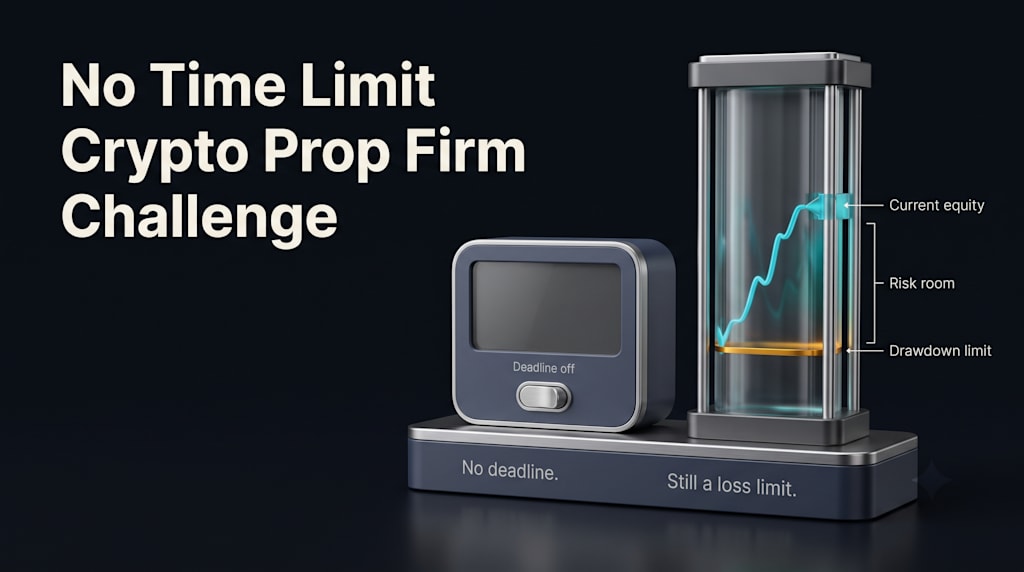
Every crypto prop firm challenge runs on two clocks.
The first counts the days left to pass. The second tracks the distance between the account’s current equity and the point where the evaluation ends in failure.
A no time limit challenge switches off the first clock. The second keeps running.
That distinction is easy to overlook when “unlimited time” appears beside a profit target and an account size. The offer sounds more forgiving, and in one specific way, it is: you do not have to manufacture a month’s worth of trading opportunities before an expiration date.
But removing a deadline does not widen the drawdown limit, improve a weak strategy, or make an unsuitable position safer.
A no time limit crypto prop firm challenge is a trading evaluation without a fixed deadline for reaching its profit target. Traders can progress at their own pace, but daily loss limits, maximum drawdown, minimum trading days, inactivity policies, and other account rules may still apply.
The useful question, then, is not simply whether unlimited time is better. It is whether that extra flexibility helps you trade your actual strategy, or merely gives you longer to repeat the same mistakes.
What Does “No Time Limit” Actually Remove?
It removes the evaluation’s fixed completion deadline.
In a time limited challenge, the trader must satisfy the passing conditions before a specified date. In a no time limit model, reaching the target is not tied to that same countdown, subject to the provider’s remaining terms.

Minimum Trading Days and Inactivity Rules May Still Apply
Removing the completion deadline is different from removing every time related condition.
A firm may still require a minimum number of trading days, impose an inactivity policy, or set separate conditions for reward eligibility after the evaluation. These rules answer different questions:
Evaluation deadline: How long do you have to pass?
Minimum trading days: On how many separate days must you trade?
Inactivity policy: How long can the account remain unused?
Payout schedule: When can eligible rewards be requested?
“No time limit” answers only the first question unless the firm explicitly states otherwise.
Unlimited Time Does Not Guarantee Permanent Account Access
An unlimited evaluation period does not mean the product will remain unchanged indefinitely. Before paying, read the terms covering account access, rule changes, service termination, and refunds, not just the evaluation summary.
Understand Whether the Funded Account Is Simulated or Live
The word “funded” deserves attention. Do not assume it means your orders will be executed using a live pool of capital. Check whether the evaluation and subsequent account are simulated or live, and what contractual conditions govern performance based payments.
Check Every Requirement, not Just the Profit Target
A typical evaluation contains several independent requirements:
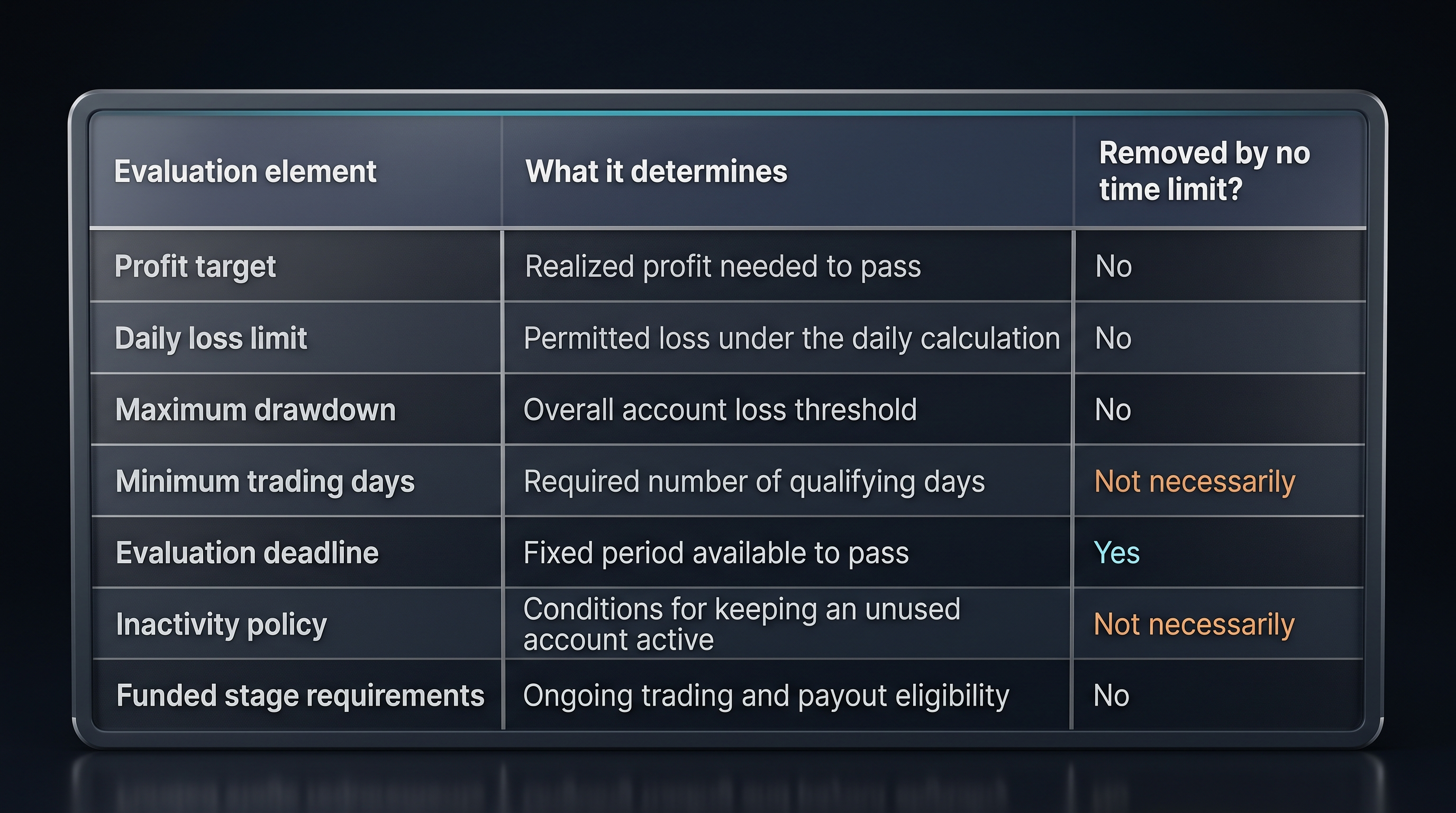
The target is only one part of the test. An account can move closer to the target while remaining vulnerable to a drawdown breach. Conversely, a trader can follow a sensible process for several weeks without making much progress because suitable opportunities have been scarce.
Unlimited time allows room for the second situation. It does not excuse the first.
No Time Limit vs. Time Limited Challenges
The main difference is the relationship between your strategy’s opportunity frequency and the evaluation calendar.
A strategy that produces only a few valid setups each month may fit poorly inside a short evaluation window. A strategy with frequent, repeatable opportunities may be less affected by the same deadline.
Neither format automatically makes the underlying strategy profitable.
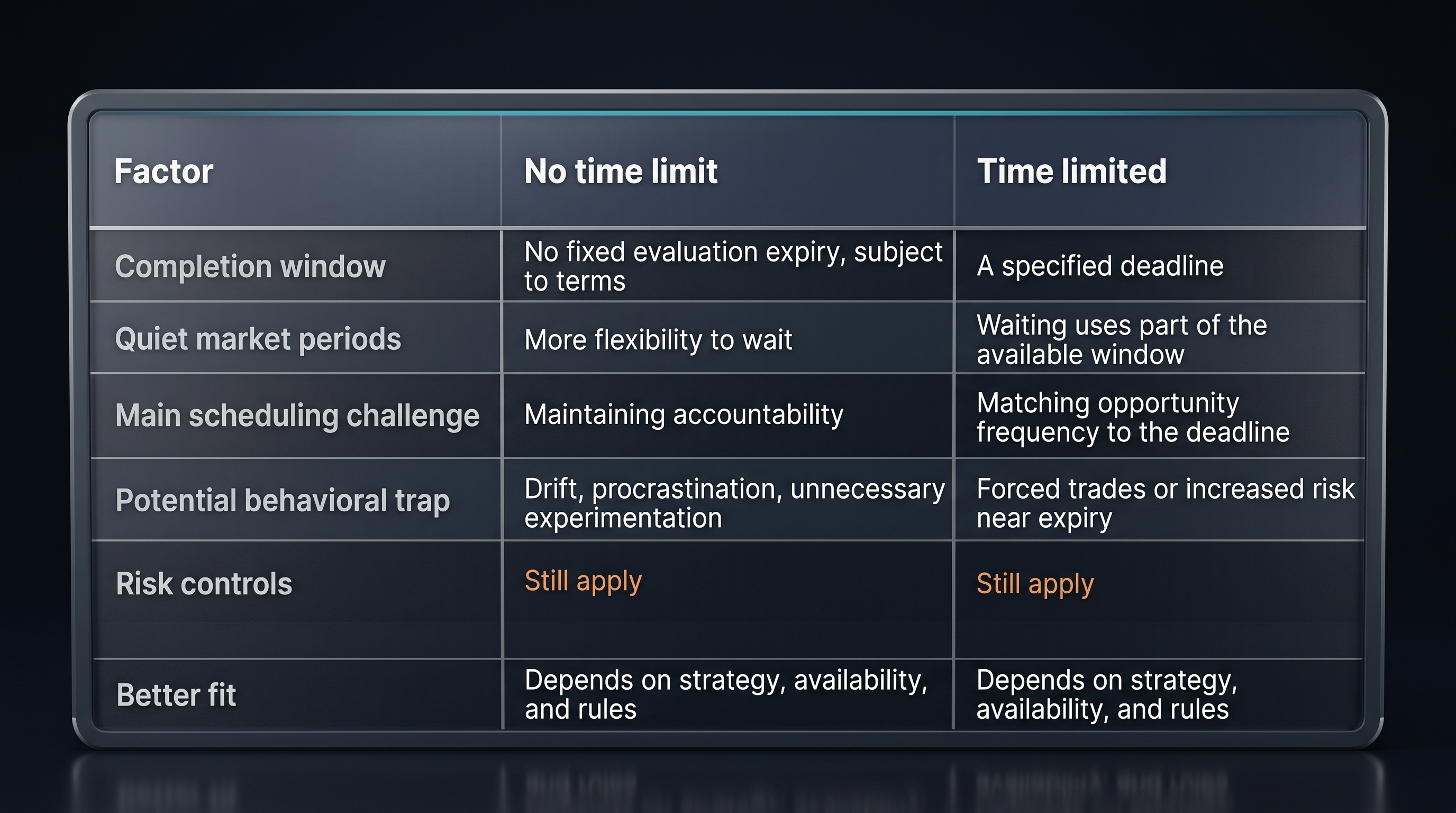
A deadline is not necessarily harmful. Some traders appreciate a defined project window.
The problem arises when the calendar starts making trading decisions. If an entry becomes attractive only because there are four days left to pass, the evaluation schedule has begun to replace the strategy.
Removing that pressure can be useful. It is not evidence that passing will be easy.
Why Extra Time Can Improve the Decision Making Environment
The strongest argument for an unlimited evaluation period is not that traders need forever. It is that markets do not produce opportunities on demand.
A breakout strategy may struggle during a directionless range. A trend following approach may encounter repeated reversals. A selective trader may find that several consecutive sessions offer nothing worth taking.
A fixed deadline does not change those conditions. It only changes how expensive waiting feels.
Waiting becomes a legitimate decision
With no fixed expiration date, a trader can reject an unsuitable setup without also worrying about losing another day from a limited window.
That flexibility matters only when waiting is part of a defined process.
“There is no valid setup because price has not met my entry conditions” is a trading decision. “I will come back when I feel more confident” is not necessarily one.
The difference is whether the decision can be explained and reviewed.

Position sizing can stay connected to the strategy
Near a deadline, increasing size may seem like a practical way to close the gap to the profit target. But the remaining target does not determine how much a position can safely risk. The setup, account limits, volatility, and existing exposure are more relevant.
Unlimited time removes one possible justification for oversizing: the claim that there is no longer enough time to progress at the original risk level. It does not remove the temptation itself.
Personal schedules become easier to accommodate
A trader with a full time job may have only a few reliable trading windows each week. Someone trading higher timeframes may need several days for an entry to develop. A flexible evaluation can accommodate those realities more naturally than a compressed schedule.
However, flexibility to enter less frequently should not be confused with an ability to leave positions unmanaged. Monitoring requirements depend on the strategy, instruments, and platform rules.
Who Benefits Most, and Who Might Not?
A no time limit challenge may suit traders whose opportunity frequency is low but whose process is well defined.
That includes selective swing traders, part time traders with consistent availability, and traders whose strategies work best in particular market conditions. The common feature is not patience alone. It is having a reason to wait.
A swing trader still needs to understand holding costs, weekend rules, and equity based drawdown. A part time trader still needs a realistic monitoring plan. A low frequency trader still needs enough evidence to distinguish a genuine edge from a handful of fortunate outcomes.
The format may be less useful for someone who continually changes strategies, avoids reviewing losses, or needs an external deadline to remain engaged. Extra time can support discipline. It can also conceal its absence.
A useful self test is this:
If the firm gave you another three months, could you explain exactly what you would do differently, or would you simply place more trades?
The Risks That Survive an Unlimited Evaluation Period
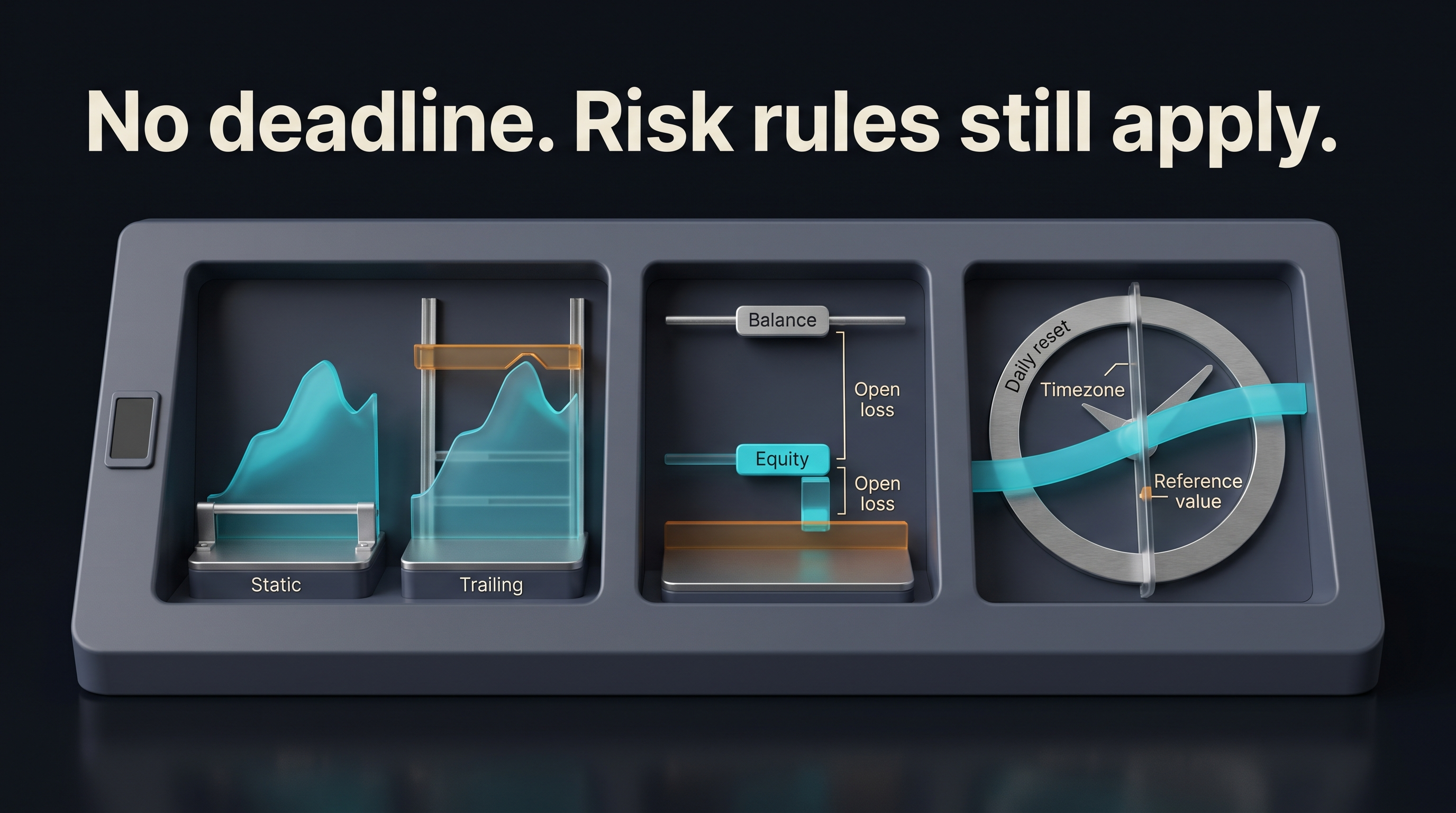
The deadline may disappear, but several other constraints remain capable of ending the account.
Drawdown calculations can matter more than the headline percentage
A maximum drawdown figure is incomplete without its calculation method. A static threshold remains anchored to a specified reference point. A trailing threshold moves according to the firm’s rules, potentially tightening the available room after profits.
Balance based and equity based calculations are also different. If open losses count toward a breach, a position does not need to close for the account to fail.
Daily resets introduce another layer. Learn the reset time zone, the reference value used, and how open positions are treated across the reset. These details are not administrative trivia. They determine what risk the account can actually tolerate.
Longer holding periods can carry costs
No deadline does not mean cost free trading. Depending on the product and platform, commissions, spreads, slippage, funding payments, or other charges may affect results. Funding on perpetual contracts can be paid or received depending on the applicable rate and position direction.
Check the provider’s own cost model. Do not assume a simulated account applies every cost exactly as a live exchange would.
Inactivity can be different from patience
If an inactivity condition exists, waiting for a setup may still require attention to account access rules.
Read what counts as activity. Logging in, opening a position, and closing a qualifying trade are not interchangeable unless the terms say they are.
Avoid buying an evaluation months before you are ready to use it simply because the headline says there is no time limit.
Passing can be separated from payout eligibility
The conditions for passing an evaluation may differ from those for receiving a reward. The funded stage may introduce qualifying day requirements, consistency rules, payout caps, verification checks, or other contractual conditions.
An evaluation that fits your entry strategy may still lead to a payout structure that does not fit your trading pattern. Review both stages before purchasing either.
How to Approach a No Time Limit Challenge
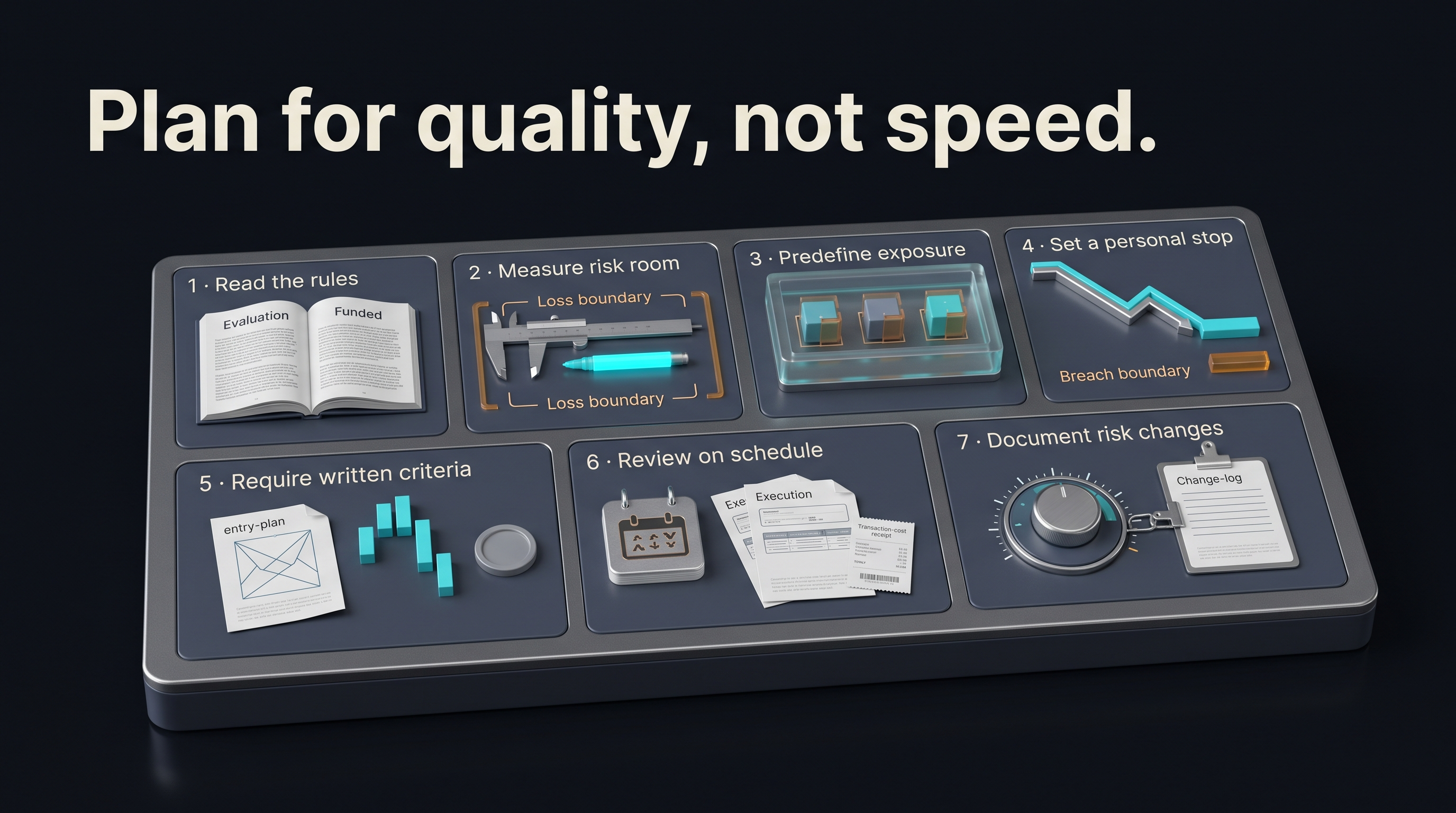
There is no strategy that guarantees a pass. A practical approach is to make the account rules part of your trading plan before the first position.
Read the complete evaluation and funded stage rules.
Calculate the distance to every active loss threshold.
Define position risk and combined exposure in advance.
Set a personal stopping point before the firm’s breach level.
Trade only setups that meet written entry criteria.
Review execution and costs on a fixed schedule.
Change risk only for a documented reason, not impatience.
The objective is not to finish as slowly as possible. It is to avoid making speed a substitute for quality.
Set review dates, not compulsory profit dates
A personal schedule can provide structure without recreating the pressure you wanted to avoid.
For example, commit to reviewing your journal each week and assessing the strategy after a predefined sample of trades. Track whether you followed the process and whether your assumptions remain valid.
That is different from insisting on a particular return by Friday.
You control preparation, selection, sizing, and review. You do not control when the market delivers the next favorable sequence.
Size from the available risk buffer
Base position sizing on the distance to the nearest active loss threshold, not merely the account’s starting balance. As equity falls, unchanged dollar risk consumes a larger share of the remaining buffer. Check both the daily and overall limits before opening another position.
Measure combined exposure
Several small positions can behave like one large position when they depend on the same market move.
A long BTC trade, a long ETH trade, and a long position in a highly correlated altcoin may create substantial shared downside exposure.
Assess what happens if the same adverse move affects all positions together. Per trade risk limits alone do not answer that question.
Keep the personal stop below the account’s limit
The firm’s loss threshold is a failure boundary, not a daily spending allowance.
A personal stopping rule should leave room for execution uncertainty and reduce the chance that emotional trading carries the account into a breach.
That rule may also include nonfinancial triggers: repeated entry violations, trading while exhausted, or continuing after an operational problem.
A stop loss order can help manage a position, but it does not guarantee an exact exit price under every market condition.
How to Compare No Time Limit Crypto Prop Firms
Start with the account conditions rather than the largest advertised balance or reward split.
Before purchasing, answer these questions:
Is there genuinely no fixed evaluation expiry?
Is there an inactivity rule or recurring fee?
What are the profit target and minimum day requirements?
Is maximum drawdown static or trailing?
Do unrealized losses count toward a breach?
How is the daily loss threshold calculated and reset?
Are overnight, weekend, and news related positions permitted?
Which execution costs and funding charges apply?
Is trading simulated or live?
What changes after the evaluation?
What conditions govern payouts and account termination?
Are you eligible under the jurisdiction and identity verification rules?
Save the applicable terms and ask support to clarify ambiguous wording before paying.
A provider’s own rules are the starting point for understanding the product. They are not, by themselves, independent proof of service quality, reliable payouts, or long term financial stability.
Those are separate due diligence questions.
What Happens When an Unlimited Challenge Falls Into Drawdown?
Removing the deadline gives a trader more time to recover from losses. It does not restore the account’s original risk allowance.
Consider a hypothetical evaluation with these conditions:
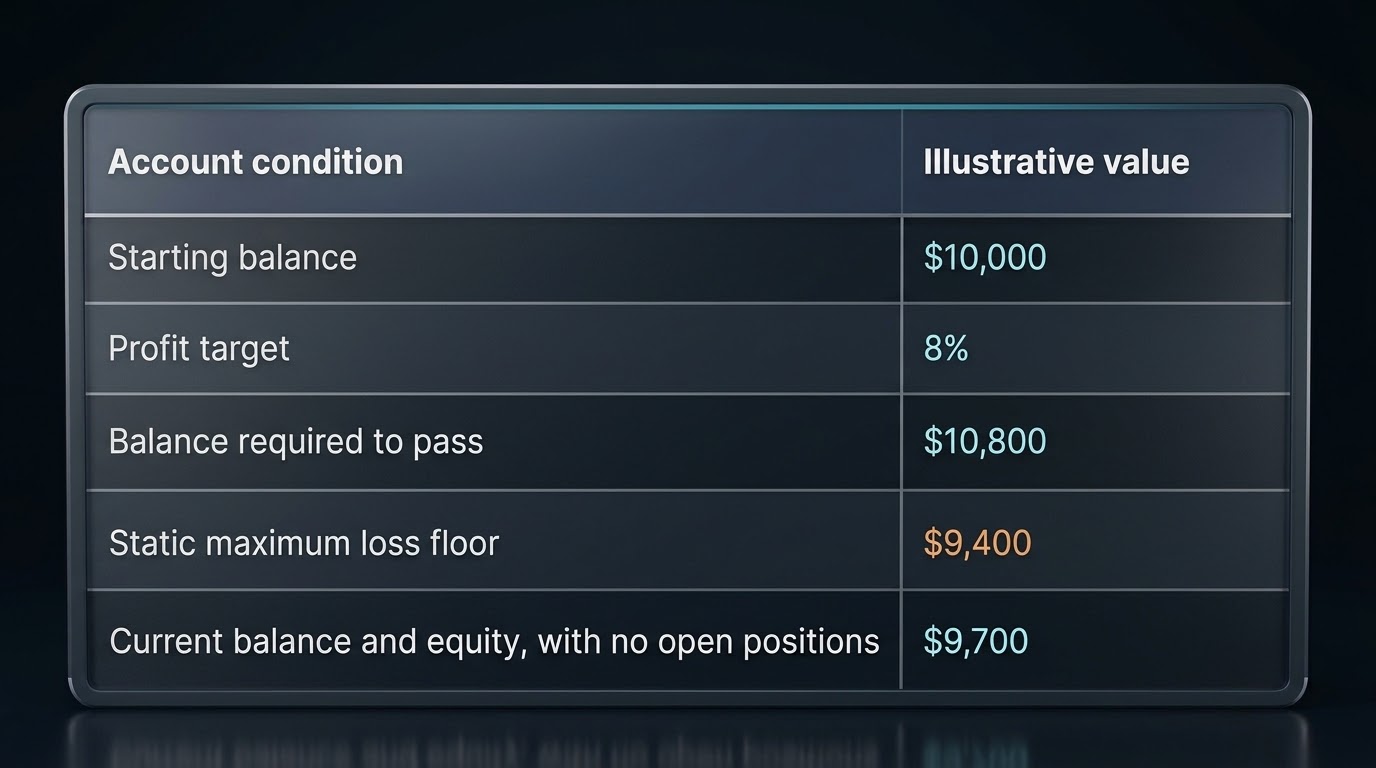
These figures are illustrative and do not represent a specific provider.
The account is down 3%, but the trader now needs approximately 11.3% growth from the current balance to reach $10,800. Meanwhile, only $300 separates current equity from the maximum loss floor.
There may be no deadline approaching, but the account has less room for error.
Recalculate the Recovery not Just the Remaining Target
From the starting balance, the required profit was $800. After the loss, the distance to the target has increased to $1,100.
That does not justify increasing position size. It means the trader should reassess whether the original risk settings remain appropriate for the smaller buffer.
A planned $100 loss, for example, would consume one third of the remaining distance to the maximum loss floor, before additional costs. A separate daily loss rule could restrict the account further.
Use the Extra Time to Review Before Resuming
An unlimited evaluation period creates room to pause without sacrificing days from a fixed completion window.
Use that pause to determine whether the drawdown came from ordinary strategy variance, execution mistakes, unexpected costs, or trades that should never have been taken. Each explanation calls for a different response; simply trading more does not resolve all four.
Resuming should depend on a clear plan for the account’s current condition, not a desire to return quickly to its starting balance.
Recovery Is an Option, Not an Obligation
Paying an evaluation fee does not make continued trading automatically worthwhile. The fee is already spent; the next decision should depend on the remaining risk buffer and the quality of the strategy.
If the process remains sound and the rules still accommodate it, a measured recovery attempt may be reasonable. If the strategy is untested or repeated rule violations caused the losses, stepping back may be more useful than extending the attempt.
Unlimited time makes waiting possible. It does not make recovery inevitable.

Does Unlimited Time Make a Crypto Prop Challenge Easier?
A no time limit crypto prop challenge is not automatically easier. It removes the completion deadline, but traders must still meet the profit target and comply with drawdown, daily loss, trading day, and platform rules. Its main advantage is scheduling flexibility, not necessarily lower risk or easier passing conditions.
For a selective trader, that flexibility may remove a genuine mismatch between the strategy and the evaluation window.
For a trader without a tested process, the same flexibility may simply extend the evaluation.
There is an important statistical point here: additional trades are not automatically beneficial. If a strategy has negative expectancy after costs, giving it more opportunities does not repair the underlying problem. Even a strategy with positive expectancy can experience a losing sequence that breaches the account’s limits.
Time is useful when it lets you wait for appropriate opportunities. It is not an edge on its own.
Is a No Time Limit Challenge Right for You?
The format is worth considering if you can describe your setup clearly, estimate how often it appears, and explain how your risk plan fits the provider’s rules.
It may also suit you if your trading availability is limited but predictable, or if fixed deadlines have previously pushed you away from otherwise sensible decisions.
Pause if you are buying the evaluation to discover whether you have a strategy in the first place.
An evaluation is a paid test under constraints. It is not necessarily the best environment for basic experimentation, especially when breaching a rule can end access.
Before paying, make sure you can explain:
What qualifies a trade.
What invalidates it.
How much you can lose across all open positions.
When you will stop.
How you will review the results.
What must happen before a payout becomes available.
If those answers are missing, more calendar flexibility is unlikely to be the most important improvement you need.
The Deadline Disappears. The Standard Does Not.
The real value of a no time limit crypto prop firm challenge is the freedom to let trading opportunities determine the pace.
You can sit through an unsuitable market, work around a realistic schedule, and reject a weak setup without watching an expiration date move closer.
But that freedom is useful only when it protects a process worth following.
The better question is not, “How long can I take to pass?”
It is, “Can I follow this strategy within these rules for as long as the evaluation requires?”
One clock has stopped. Protecting the account is still your responsibility.
Disclaimer: This article is for educational purposes and is not personalized investment advice. Evaluation fees may be lost, and neither passing an evaluation nor receiving a payout is guaranteed.
About the Creator
Sophie
Trader focused on Price Action & Order Flow.
Into crypto, fast execution, controlled risk, and quality setups.
Passing funded accounts and refining my trading every day.
Enjoyed the story? Support the Creator.
Subscribe for free to receive all their stories in your feed.
Comments
There are no comments for this story
Be the first to respond and start the conversation.