
No Activation Fee Prop Firm: What Crypto Traders Really Pay
The Complete Guide to Prop Firm Fees: Comparing Evaluation, Reset, and Payout Costs


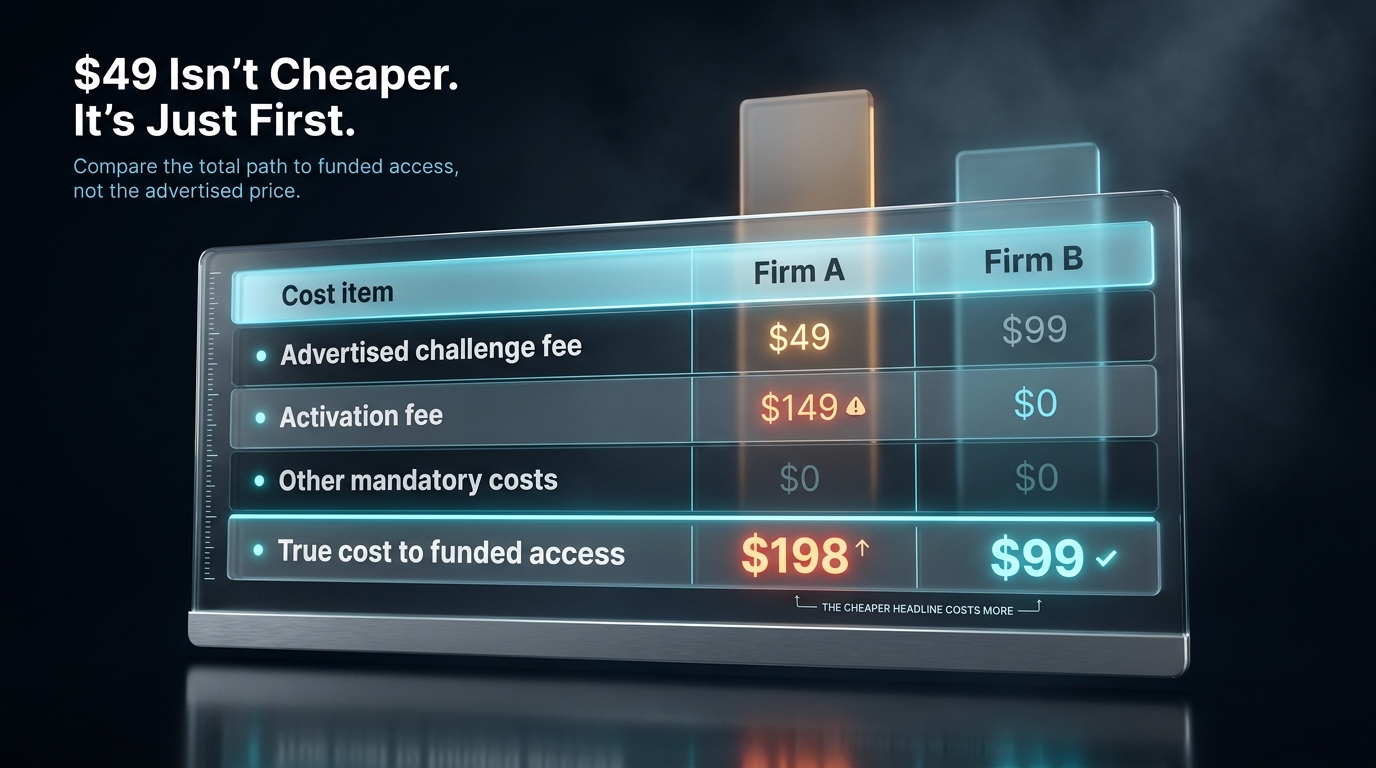
A $49 prop firm challenge can cost $198 before the trader places a single funded trade.
The extra cost may come from an activation fee, a platform subscription, a reset, or another mandatory payment that appears only after the evaluation has been completed. That is why the advertised challenge price is not always a reliable measure of affordability.
A prop firm with no activation fee eliminates an upfront cost, but it does not guarantee that the account is inexpensive. To compare two programs accurately, traders need to follow the entire financial path, from the first evaluation payment to funded account access and the first eligible payout.
This guide separates mandatory fees from trading costs and payout restrictions, then provides a seven question checklist for reviewing any prop firm offer.
What Is Activation Fee in Prop Firm?
A challenge fee, also called an evaluation fee, is normally paid before the qualification process begins. It gives the trader access to an account with a profit target, drawdown limits, and other trading rules.
An activation fee is different. It becomes payable after the trader passes the evaluation but before the funded stage account can be used. Depending on the firm, the same payment may be described as a setup fee, onboarding charge, funded account fee, verification payment, or account access fee.
The label is less important than the timing and purpose of the payment. If a trader must pay another mandatory charge after passing and before trading the funded stage account, that charge functions as an activation fee.

A genuine no activation fee model removes this payment stage. Once the trader passes and completes any required identity or compliance checks, funded stage access does not depend on another mandatory purchase.
That does not mean the complete path is free. The trader may still face:
An upfront evaluation fee
Recurring evaluation subscriptions
Reset or retry fees
Mandatory platform or market data charges
Trading commissions and spreads
Payout processing or currency conversion costs
The phrase “no activation fee” answers only one question: Is another mandatory payment due after passing and before funded stage access? It does not describe every other cost in the program.

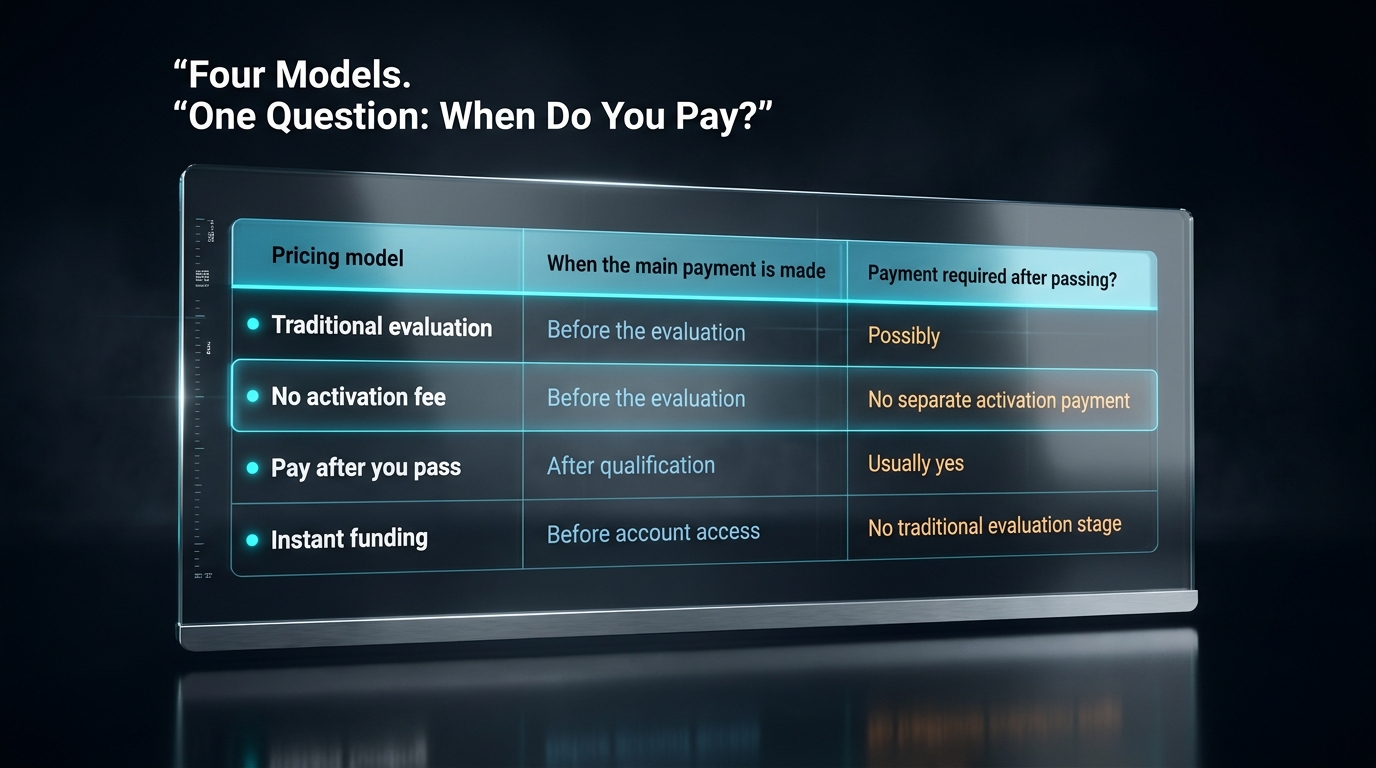
Four Pricing Models That Are Easy to Confuse
Prop firms use different names for similar pricing arrangements. Instead of relying on promotional labels, identify when each mandatory payment becomes due.
Traditional upfront evaluation: The trader pays before starting the challenge. A separate post pass fee may or may not apply.
No activation fee evaluation: The trader pays before starting, but no separate activation payment is required after passing.
Pay after you pass program: The initial evaluation may be free or less expensive, but the main payment becomes due after qualification.
Instant funding program: The trader pays before receiving account access and does not complete a traditional evaluation stage. Other restrictions may still apply.
The practical test is simple: What must be paid, when must it be paid, and is it mandatory?
How to Calculate the Cost to Funded Access
The challenge price is only the starting point. A clearer calculation is:
Cost to funded access = evaluation payments + reset or retry fees + mandatory platform or data fees + mandatory post pass charges
Optional upgrades should not be included in the minimum cost unless the standard account cannot support the trader’s normal strategy.
A Simple Hypothetical Comparison
Consider two fictional offers for similar account sizes and rules:
Firm A: $49 evaluation + $149 activation fee
Firm B: $99 evaluation + no activation fee
Assume the trader passes on the first attempt and neither firm has another mandatory charge.
Firm A: $49 + $149 = $198 to funded access
Firm B: $99 + $0 = $99 to funded access
Firm A advertises the cheaper challenge, but the trader pays twice as much before funded trading begins. Firm B looks more expensive at checkout yet has the lower total cost.
This example does not prove that every no activation fee program is cheaper. It shows why an advertised evaluation price cannot be compared in isolation.
The Number of Attempts Can Reverse the Result
A higher upfront fee may be economical for a trader who passes quickly but less attractive for someone who expects several attempts.
Suppose one no activation fee challenge costs $119. A traditional alternative costs $49 per attempt plus a $149 activation fee paid only after the successful attempt.
On the first attempt:
No activation plan: $119
Traditional plan: $49 + $149 = $198
The no activation plan saves $79.
After three paid attempts:
No activation plan: 3 × $119 = $357
Traditional plan: 3 × $49 + $149 = $296
Now the traditional plan is $61 cheaper.
Reset discounts, free retries, recurring subscriptions, and refunds can change the result again. A useful comparison should therefore include at least three scenarios:
Passing on the first attempt
Passing after two attempts
Passing after three or more attempts
Traders should use their own realistic assumptions rather than choosing the scenario that makes one offer look best.

Separate Three Different Types of Cost
A reliable comparison distinguishes mandatory cash fees from trading expenses and account restrictions. Combining all three under the word “fees” creates a misleading result.
1. Mandatory Cash Fees
These are direct payments required to enter, continue, activate, or withdraw from the program. They may include:
Evaluation or subscription payments
Reset and retry charges
Activation, setup, or onboarding fees
Required platform or market data fees
Mandatory verification or account access charges
Payout processing fees charged by the firm
These amounts belong in the cost to access calculation.
2. Trading Costs
Trading activity creates expenses even when the firm sends no separate invoice. Relevant costs include:
Commissions
Bid ask spreads
Slippage
Overnight financing
Weekend financing, where applicable
Currency conversion charges
Blockchain network or payment provider fees
The effect depends on the strategy. A high turnover trader may care more about commissions and spreads than a one time activation charge. A swing trader may be more affected by overnight financing or restrictions on weekend positions.
Before buying an evaluation, confirm whether commissions are quoted per side or per completed trade, how spreads are determined, and whether holding positions overnight or through the weekend creates additional costs.
3. Economic Restrictions
Some rules reduce the practical value of the account without creating a direct invoice. Examples include:
Profit splits
Consistency rules
Required profit buffers
Minimum trading days
Minimum withdrawal amounts
Payout frequency limits
Restrictions on strategies, news trading, or weekend holding
These conditions should not be called hidden fees. They are better described as economic restrictions because they affect when and how much a trader can withdraw.

Cost to Funded Access Is Not Cost to First Payout
Receiving a funded stage account is only one milestone. The next question is what must happen before the trader can receive money.
Cost to funded access is the total mandatory cash paid before the funded stage account becomes available.
Net cash cost through first payout can be estimated as:
Cost to funded access + mandatory funded stage charges + payout processing costs − refunds actually received
Only refunds that have actually been received should be subtracted. A challenge fee advertised as refundable may depend on reaching a payout, completing a minimum number of trading days, or meeting other conditions.
Profit buffers, consistency requirements, and minimum trading days should be shown separately. They are not cash fees, but they may delay the payout or reduce the amount that can be withdrawn.
A program with no activation fee can still provide poor value if its first payout conditions are difficult to satisfy. Conversely, a program with a modest post pass charge may be competitive if it offers transparent rules, suitable trading conditions, and a practical payout process.

Is a No Activation Fee Program Cheaper?
Not necessarily. The answer depends on:
The price per evaluation attempt
The expected number of attempts
Subscription renewals
Reset discounts
Mandatory platform and data costs
Post pass charges
Refund conditions
A simple first pass test is to calculate the no activation premium:
No activation premium = price of the no activation challenge − price of the traditional challenge
If the premium is lower than the activation fee avoided, the no activation offer is cheaper for a first attempt pass, assuming other mandatory costs are equal.
For example, if the no activation challenge costs $70 more but removes a $150 post pass fee, the potential first attempt saving is $80. If it costs $170 more to remove the same $150 fee, the traditional model begins with a $20 cost advantage.
The calculation must then be adjusted for additional attempts, subscriptions, resets, and platform charges.
Seven Questions to Ask Before Paying
1. What Happens Immediately After I Pass?
Review the exact steps between passing the evaluation and placing the first funded stage trade.
Look for references to activation, onboarding, account setup, verification, funded stage access, or platform migration. Then ask:
If I pass this specific evaluation, will I need to make any additional payment before receiving access to and trading the funded stage account?
The question should identify the account size and evaluation model. A firm may operate several programs with different fee structures.
2. Is the Evaluation Fee One Time or Recurring?
A low monthly price can become expensive if the evaluation takes several billing cycles.
Confirm:
Whether the charge is one time or subscription based
The date of each renewal
Whether billing stops automatically after passing or failing
Whether cancellation must be requested manually
Whether the account remains active after cancellation
For recurring programs, calculate the cost for one, two, and three billing periods rather than comparing only the first payment.
3. Are Platform, Data, or Software Charges Mandatory?
A firm may advertise no activation fee while requiring a paid platform, market data package, account connection, or software subscription.
Separate required services from optional upgrades. An optional add on does not belong in the minimum cost. However, an upgrade becomes a practical strategy cost if the standard account lacks a feature the trader genuinely needs.
For example, weekend holding may be essential for a crypto swing trader but irrelevant to a day trader who closes every position before the session ends.
4. What Happens After a Failed Attempt?
Check whether failure requires:
Buying a completely new evaluation
Paying a discounted reset fee
Waiting before trying again
Continuing a recurring subscription
Losing eligibility for a refund
The cost of the successful attempt matters, but so does the cost of reaching that attempt. A firm with a higher entry price may offer better value if its reset policy is more forgiving.
5. What Account and Trading Conditions Apply?
Verify whether the funded stage account is live, simulated, or structured in another way. Then review the conditions that could affect the strategy:
Daily and maximum drawdown calculations
Static versus trailing drawdown
Leverage limits
Commission and spread schedules
News trading rules
Weekend and overnight holding
Prohibited strategies
Inactivity rules
A cheap account is not useful if its rules conflict with the way the trader normally operates.
6. What Is Required for the First Payout?
Review the full payout policy, not only the advertised profit split.
Confirm:
Minimum profitable or trading days
Consistency requirements
Required profit buffer
Minimum withdrawal amount
Payout frequency
Maximum payout limits
Processing or conversion fees
Conditions for receiving an evaluation fee refund
A high profit split has limited value if payout eligibility is unusually restrictive or unclear.
7. Can I Document the Terms Before Purchase?
Pricing and account rules can change. Before paying, save or record:
The official pricing page
The rules for the specific account
The refund and cancellation policies
The payout policy
Written support responses
The date on which the terms were reviewed
Official pricing, legal, and rules pages should carry more weight than affiliate reviews, advertisements, or social media posts. If two official pages conflict, request clarification in writing before purchasing.
Predictable Pricing Still Has Value
Even when the numerical difference is small, a no activation fee model may offer better cost predictability. The trader knows the main cash commitment before starting and does not need to reserve another payment for the transition to the funded stage.
That predictability can matter to someone working with a fixed budget. It also removes the risk of completing an evaluation successfully but being unable or unwilling to pay the final access charge.
Predictable pricing does not make an account objectively better. It simply reduces uncertainty at one stage of the process.
When Activation Fees Should Not Be the Main Priority
The absence of an activation fee cannot compensate for unsuitable trading conditions.
A crypto swing trader may receive little value from a low cost program that prohibits weekend holding. A high turnover trader may lose more to commissions and spreads than to a one time post pass charge. A trader focused on regular withdrawals may care more about payout frequency, consistency rules, and profit buffer requirements.
The best offer is therefore not necessarily the program with the lowest advertised price or a $0 activation claim. It is the one whose complete cost structure, risk rules, trading conditions, and payout process match the trader’s strategy.
Final Takeaway
“No activation fee” is a useful pricing feature, but it is not a complete measure of affordability.
To compare crypto prop firm programs fairly, calculate mandatory cash fees, estimate the effect of multiple attempts, review strategy dependent trading costs, and evaluate payout restrictions separately. A higher priced challenge may offer lower total costs, while a cheaper evaluation may become expensive after renewals, resets, or post pass charges.
The goal is not to find the smallest number in an advertisement. It is to understand exactly what must be paid, what conditions must be met, and what the trader receives at each stage.
Disclaimer: This article is for educational purposes only and does not constitute financial advice. Prop trading involves financial risk. Firm pricing, account structures, and trading rules can change; always review the latest official terms before purchasing an evaluation.
About the Creator
Sophie
Trader focused on Price Action & Order Flow.
Into crypto, fast execution, controlled risk, and quality setups.
Passing funded accounts and refining my trading every day.
Enjoyed the story? Support the Creator.
Subscribe for free to receive all their stories in your feed.
Comments
There are no comments for this story
Be the first to respond and start the conversation.