
Netflix Stock Under Pressure: Why NFLX Is Falling Despite Strong Earnings in 2026
Strong Earnings, Weak Outlook: Netflix Faces Investor Pressure as Growth Slows and Leadership Transition Begins

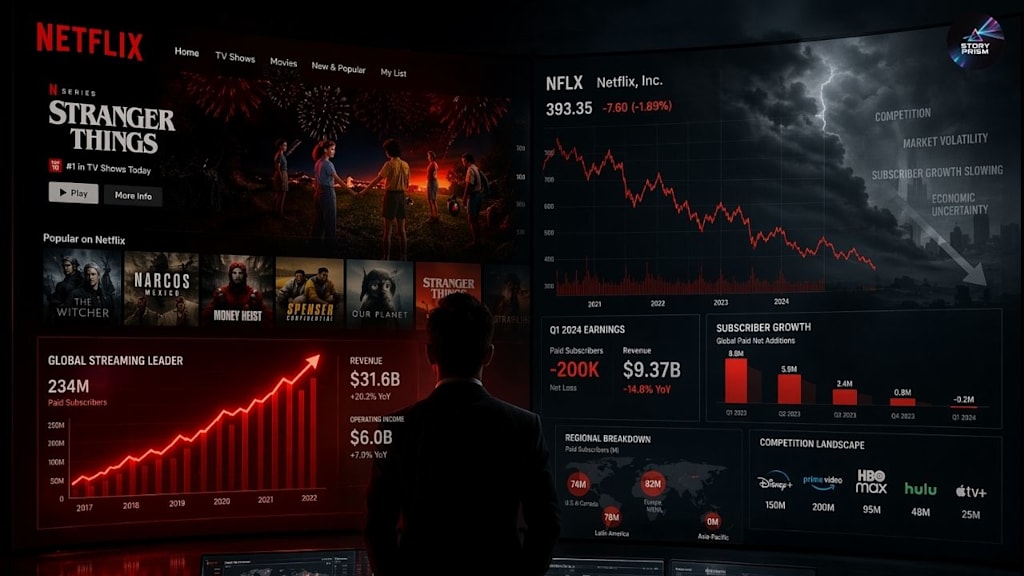
Netflix stock (NFLX) is once again at the center of Wall Street attention after its latest earnings report delivered a mix of strong financial results and growing investor concerns about the company’s future trajectory. While the streaming giant posted better-than-expected revenue and earnings, the stock still fell sharply as markets reacted more to forward-looking risks than past performance.
The situation highlights a familiar theme for mature growth companies: strong quarterly results are no longer enough to sustain investor confidence when long-term growth signals begin to soften.
Netflix reported approximately $12.25 billion in revenue for Q1 2026, representing double-digit year-over-year growth. Earnings per share also came in above analyst expectations, reinforcing the company’s continued ability to generate strong profits from its massive global subscriber base. With more than 300 million subscribers worldwide, Netflix remains the dominant force in the streaming industry, benefiting from pricing power, global scale, and expanding monetization strategies.
However, the headline earnings strength did not fully reflect the underlying quality of profits. A significant portion of the quarterly boost came from a one-time termination fee of around $2.8 billion related to a canceled Warner Bros. Discovery deal. While this inflates reported earnings, it does not represent recurring business performance. Investors typically discount such one-off gains when evaluating long-term valuation, which reduced enthusiasm for the “beat” on earnings.
The more important driver of the stock’s decline was Netflix’s weaker-than-expected forward guidance for Q2 2026. The company signaled that revenue growth and margins could face pressure in the coming quarter due to rising costs and evolving market conditions. Content production expenses continue to increase, and competition across the streaming industry is intensifying as platforms compete for both subscribers and advertising dollars.
In addition, Netflix is navigating a more complex transition in its business model. The company is increasingly relying on new revenue streams such as its advertising-supported subscription tier, live events, and gaming initiatives. While these segments show long-term promise, they are still in early stages and have not yet reached the scale needed to fully offset slowing momentum in traditional subscription growth.
This combination of rising costs and uncertain new revenue expansion has led investors to reassess Netflix’s near-term earnings trajectory. As a result, even strong current performance was overshadowed by concerns about future profitability.
Another major factor influencing sentiment is the ongoing leadership transition at the top of the company. Co-founder Reed Hastings, who helped build Netflix from a DVD rental service into a global streaming powerhouse, announced he will step down from the company’s board in June 2026. Although Hastings had already moved away from day-to-day operations in 2023, his full exit marks the symbolic end of the founder era.
For investors, this shift carries psychological weight. Hastings has long been viewed as the strategic force behind Netflix’s bold decision-making, long-term vision, and willingness to disrupt traditional media models. His departure raises questions about whether the company can maintain the same level of innovation and strategic risk-taking without its original architect actively involved.
Market reaction reflected these combined concerns. Netflix stock dropped roughly 8% to 10% in after-hours trading following the earnings release, despite the strong headline numbers. This reaction underscores a broader trend in financial markets: investors are increasingly focused on forward guidance, leadership stability, and sustainable growth rather than short-term earnings beats.
The broader streaming industry context also plays a role. Netflix now operates in a more saturated environment, where competitors such as Disney+, Amazon Prime Video, and regional streaming platforms are aggressively investing in content and distribution. Subscriber growth, once the company’s primary engine, is naturally slowing as global markets mature.
As a result, Netflix is shifting toward a hybrid model that blends subscriptions with advertising, live content, and interactive entertainment. While this diversification strategy could unlock new revenue streams over time, it also introduces execution risk and uncertainty about how quickly these segments will scale.
In summary, Netflix stock is under pressure not because the company is performing poorly, but because it is entering a new phase of its lifecycle. Strong earnings today are being weighed against softer growth expectations tomorrow. Investors are also adjusting to the reality of a post-founder leadership structure and a more competitive, slower-growth streaming landscape.
Netflix remains a financially strong and globally dominant platform, but its stock is now driven less by explosive growth expectations and more by questions of sustainability, execution, and long-term transformation.
About the Creator
Enjoyed the story? Support the Creator.
Subscribe for free to receive all their stories in your feed.
Comments
There are no comments for this story
Be the first to respond and start the conversation.