
Nasdaq Will Close for Only One Hour a Day
How Wall Street’s 24/7 gambit aims to drain Asia-Pacific liquidity—and why the "no more all-nighters" narrative is a dangerous half-truth.
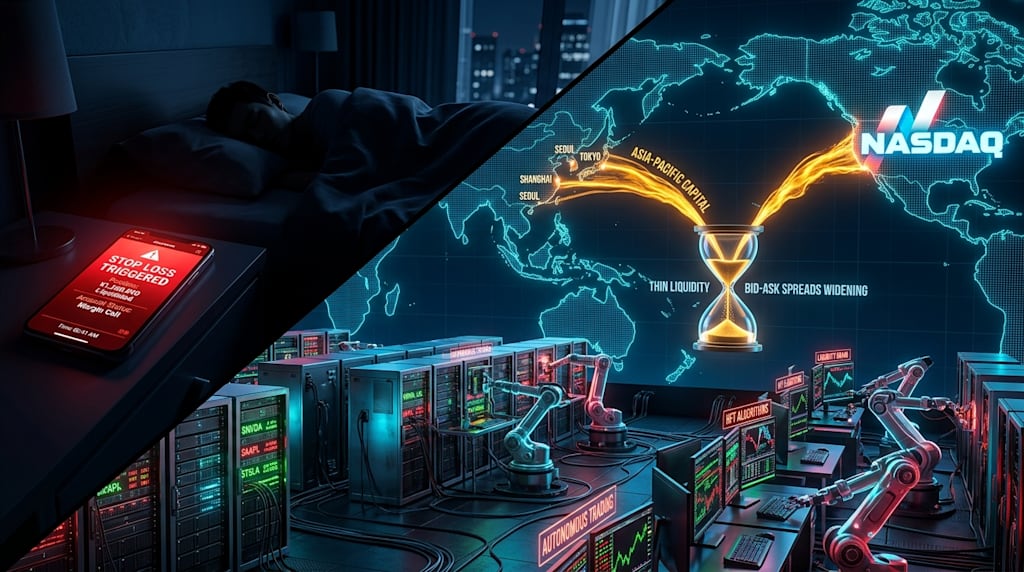
December 6, 2026. After that date, Nasdaq will shut down for just one hour each trading day – from 8:00 to 9:00 PM ET for system maintenance. For the other 23 hours, trading runs continuously.
Chinese social platforms lit up with the same reaction: Asian investors no longer have to stay up all night to watch the market.
That reaction is understandable. But it misses the bigger picture.
If you focus only on “no more all‑nighters,” you overlook the changes in liquidity, information gaps, and capital flows that come with stretching trading from 16 to 23 hours a day. Those changes will eventually show up in your account balance.
I. Pre‑Market and After‑Hours No Longer "Count"
U.S. stocks have always had pre‑market and after‑hours sessions. Those sessions share two features: light participation and wide price swings. Market makers widen bid‑ask spreads during those hours to cover the extra risk they take on in thin liquidity.
The new rule consolidates those fragmented sessions into one continuous channel. From Sunday evening through Friday night, there’s almost no gap.
There is a real upside. From 9:30 AM to 4:00 PM Beijing time – formerly the exclusive window for A‑shares and Hong Kong stocks – it now becomes an active slot for U.S. equities as well. Asia‑Pacific capital can trade U.S. stocks during local business hours without waiting until midnight.
But this channel was never designed for individual investors.
II. Volatility Gets Manufactured While You Sleep
A hard rule governs financial trading: the longer the session, the thinner the liquidity per unit of time.
That’s not an opinion; it’s arithmetic. Market makers place only so many orders at each price level. Spread those orders across 23 hours, and the depth at any given hour is far thinner than during the conventional 6.5‑hour session.
What does “thinner” mean?
The same amount of money that moves a price by 0.1% during regular hours can move it by 2% during the overnight session.
That’s not speculation. Algorithmic trading models run that calculation every day. Behind those models sit quantitative teams scanning the order book around the clock. Their time never sleeps; their systems never rest.
And individual investors? They’re bound by biology.
You might say, “I don’t trade overnight; I only watch during the day.” But your positions span time zones. The long position you built during the day can, during the night’s thin liquidity, have its stop‑loss triggered by a relatively small counter‑order. By the time you wake, the loss is already realised.
Your judgment didn’t fail. Your reaction speed simply hit its limit.
After the new rule kicks in, major moves are far more likely to occur during the thinnest liquidity windows – not because institutions have turned more aggressive, but because the same action costs less and delivers a bigger punch during those hours.
This is structural, not moral.
III. What Nasdaq Is Really After
Nasdaq executives have called this reform “expanding access to the world’s most dynamic and liquid markets.” In plain language: they’ve aimed their trading window directly at the Asia‑Pacific time zone.
Historically, the biggest hurdle for Asia‑Pacific capital investing in U.S. stocks was the time difference. Watching A‑shares and Hong Kong stocks during the day and U.S. stocks at night exhausted investors. The 23‑hour session removes that hurdle.
Now, Asia‑Pacific mutual funds, insurers, sovereign wealth funds, and a huge pool of retail money can trade U.S. equities seamlessly during local business hours. At the same moment, capital faces two choices: one in the local market, the other in the globally priced U.S. market.
This isn’t a forced withdrawal – but it is continuous competition.
Any rational capital allocator asks one question at 10 AM: which market offers a lower opportunity cost? If A‑shares and Hong Kong stocks aren’t generating decent returns, the convenience of U.S. stocks becomes an increasingly strong pull.
“Siphoning” isn’t too strong a word. It’s a slow, day‑by‑day migration, not a one‑day exodus.
But migration has its limits. On valuation, A‑shares and Hong Kong stocks trade near historical lows (CSI 300 P/E ~13‑14x), while Nasdaq, even after its correction, still sits above 30x. Long‑term capital allocates based on asset prices, not trading hours. A bubble doesn’t become rational just because you can trade it longer.
So short‑term speculative money will flow into Nasdaq’s overnight channel, but core anchor allocations won’t easily abandon their margin of safety. Both currents run at the same time.
IV. Wall Street Is Split
The new rule hasn’t won unanimous support on Wall Street.
UBS and Wells Fargo – major market‑making players – have publicly stated that extending trading hours does not automatically boost liquidity; it raises operational costs and market volatility.
Three concerns stand out:
First, back‑office clearing, compliance monitoring, and staffing schedules need a complete overhaul. For mid‑sized and smaller brokerages, that’s a heavy capital outlay not all firms can handle.
Second, client losses during overnight sessions invite lawsuits. When retail investors suffer slippage losses during thin liquidity, they don’t blame “insufficient liquidity” – they blame their brokerage’s systems. In the U.S. legal environment, that’s a real, hard‑to‑quantify risk.
Third, some market‑structure researchers argue that longer hours don’t necessarily improve price discovery. With fewer counterparties, prices are more easily driven by noise, making the next day’s opening prices less reliable as reference points.
These objections point to a core fact: the 23‑hour schedule is a revenue‑driven move by Nasdaq as a for‑profit exchange. More volume means more fees. It’s not a public service for retail investors.
V. What Retail Investors Can Do
Acknowledging your disadvantage is the first step to a viable strategy.
Under the 23‑hour regime, the gap between retail and institutional investors has widened further. It’s not a technology gap – it’s a biological one. You can’t stay awake 24 hours. Institutional algorithms can.
Four practical responses:
First, confine your trading window. Open and close positions only during the U.S. regular session (9:30 PM to 4:00 AM Beijing time). Voluntarily stay out of the Asian daytime and European windows. Staying out isn’t a loss – avoiding thin liquidity protects your cost basis.
Second, change your order type. Completely stop using market orders during overnight sessions. Use only limit orders, and set your stop‑loss prices in advance. Market orders expose you to slippage in thin liquidity; limit orders cap your execution price.
Third, reduce position size. Volatility will inevitably rise under a 23‑hour regime. Volatility itself is neutral, but if you don’t have enough margin to withstand intraday reversals, you’ll be forced out. Reducing leverage isn’t conservative – it’s how you stay in the game.
Fourth, accept your time limits. If you can’t monitor positions around the clock, use dollar‑cost averaging into ETFs or delegate to a professional manager. That’s not surrender – it’s admitting that after the rules changed, your physical capacity no longer matches the demands. Pushing through when you can’t keep up is the surest path to losses.
VI. The Only Certainty
Under a 23‑hour system, retail investors gain no new advantages.
No new information channels. No faster execution. No thicker capital cushion. The only new thing is a higher probability that prices will move during hours when you can’t watch.
That doesn’t mean “stay away from U.S. stocks.” It means recalculate your cost of being at the table.
In the old 16‑hour days, institutional and retail participants shared the same time window, and information decay remained manageable. Now, in a 23‑hour window, information decay accelerates while you sleep.
Fairness has never been about equal time. It’s about equal means of response. When the means aren’t equal, acknowledge that – and then use discipline to close the gap.
Nasdaq made a business decision. Your job is to take responsibility for your own account.
About the Creator
Jin
Writer of reamstories
https://reamstories.com/jin
Enjoyed the story? Support the Creator.
Subscribe for free to receive all their stories in your feed. You could also become a paid subscriber, letting them know you appreciate their work.
Comments
There are no comments for this story
Be the first to respond and start the conversation.