
Minnesota Made Prediction Markets a Felony. The CFTC Fired Back Within Days.
Minnesota’s new felony-level ban on prediction markets has triggered a major legal battle with the CFTC. Explore what the lawsuit means for platforms like Kalshi and Polymarket, federal regulation, and the future of prediction markets in the U.S.

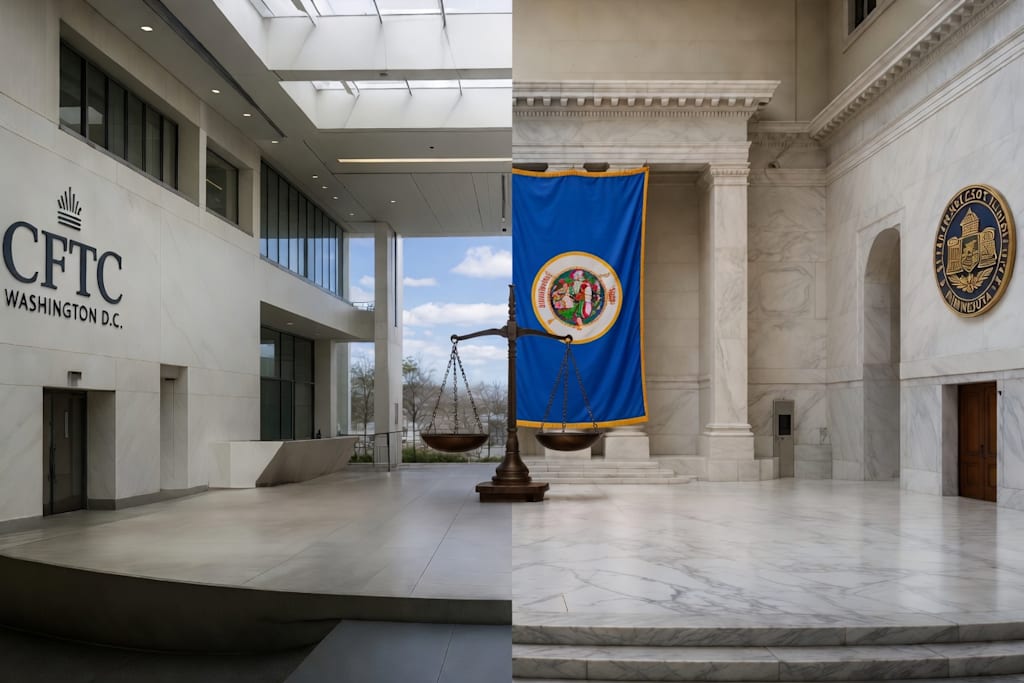
When Minnesota became the first state to criminalize prediction markets outright, federal regulators didn't wait. Here's what happened, why it matters, and what comes next.
Key Highlights
Most regulations are boring. A committee meets. A draft circulates. Months pass. But what happened between Minnesota and the federal Commodity Futures Trading Commission (CFTC) this week played out more like a legal showdown — and the implications could reshape the entire prediction market industry.
What Minnesota Actually Did
Minnesota's legislature tucked a sweeping prediction market prohibition into a broader public safety omnibus bill. Governor Tim Walz signed it, and the result is the most aggressive state-level crackdown on prediction markets in U.S. history.
The law broadly bans "event contracts" — financial instruments that let people bet on outcomes ranging from sports results to election winners to weather patterns. But the reach goes far beyond the platforms themselves.
What the Minnesota Law Covers
Operating Prediction Market Platforms
Platforms such as Kalshi and Polymarket could face direct felony exposure under the law.
Payment Processing
Banks and payment providers facilitating transactions tied to prediction markets may also face legal risk.
Advertising and Promotion
Marketing event contracts in Minnesota could become a felony offense under the legislation.
VPN and Access Tools
Even services that help users access prediction market platforms may potentially trigger enforcement issues.
Limited Exceptions
The law provides narrow carve-outs for:
- Traditional securities
- Insurance-related contracts
Why Supporters Back the Ban
Supporters of the legislation argue that states have long regulated gambling activities and should retain that authority.
Representative Emma Greenman stated that stronger restrictions are necessary to protect consumers, particularly younger residents, from speculative online markets.
Politically, that argument resonates. Legally, however, it creates a direct clash with federal regulators. Here's a full breakdown of whether prediction markets are even legal in the first place.
Why the CFTC came out swinging
The CFTC's core argument is simple: prediction markets are federally regulated financial instruments under the Commodity Exchange Act (CEA), and states cannot override that. It's a Supremacy Clause argument — federal law wins when there's a direct conflict.
Chairman Selig went further than the legal theory, though. He specifically called out the impact on Minnesota farmers, who use CFTC-regulated event contracts for weather and crop hedging. When a bill criminalizes a tool that agricultural workers rely on for risk management, it's harder for supporters to frame it purely as consumer protection.
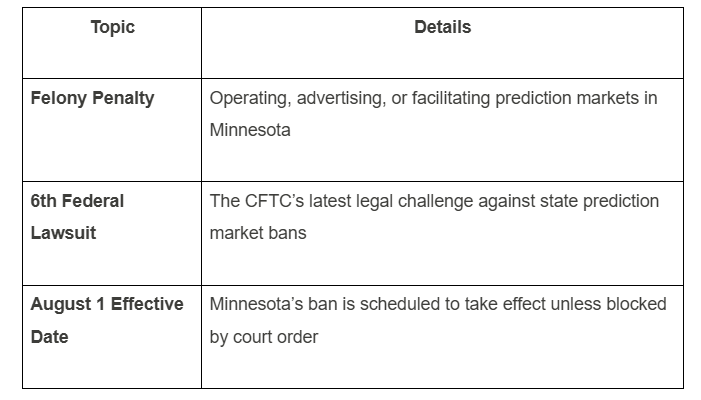
The agency filed suit Tuesday, naming Governor Walz, Attorney General Keith Ellison, the Minnesota Department of Public Safety, and gambling enforcement director Jon Anglin as defendants. The CFTC is seeking a preliminary injunction to block the August 1 effective date.
The Federal Lawsuit
The CFTC filed suit against multiple Minnesota officials, including:
- Governor Tim Walz
- Attorney General Keith Ellison
- Minnesota Department of Public Safety officials
- Gambling enforcement leadership
The agency is seeking a preliminary injunction before the law’s August 1 implementation date.
A preliminary injunction would temporarily block enforcement while courts determine whether the law violates federal authority.
This Is Not the First State Clash
Minnesota is now the sixth state involved in a federal dispute over prediction market restrictions in 2026.
States Already Facing CFTC Legal Challenges
- Arizona
- Connecticut
- Illinois
- New York
- Wisconsin
- Minnesota
In earlier cases, courts generally sided with the CFTC by granting temporary relief favoring federal jurisdiction.
That legal trend matters because it suggests federal courts may be receptive to the agency’s Supremacy Clause arguments.
What Prediction Market Platforms Are Saying
Kalshi has argued that state bans interfere with federally protected operations and damage competition in regulated markets.
Polymarket has similarly supported maintaining a unified federal framework under the Commodity Exchange Act.
Both platforms also point out a practical reality:
Restrictive bans rarely eliminate demand. They often push activity toward offshore or unregulated alternatives instead.
That argument mirrors broader debates seen in online betting, crypto, and digital asset regulation over the past decade.
The Bigger Legal Question
At the center of this fight is a broader constitutional issue.
Supporters of state bans believe prediction markets resemble gambling and therefore belong under state authority.
Federal regulators argue that once these products are legally recognized as regulated financial contracts, states cannot criminalize them independently.
This creates a direct test of the Supremacy Clause — the constitutional principle stating that federal law overrides conflicting state law.
The eventual outcome could influence how courts treat future financial innovations beyond prediction markets alone.
What Happens Next?
The immediate focus is the court’s decision on the requested preliminary injunction before August 1.
Based on prior cases, legal analysts expect the CFTC has a strong chance of temporarily blocking enforcement.
However, even if the injunction is granted, the larger legal battle would continue.
Possible Outcomes
If the CFTC Continues Winning
- State-level bans may become increasingly difficult to enforce
- Prediction markets could operate under a more unified federal framework
- Additional states may avoid pursuing similar legislation
- If States Begin Winning
- A fragmented state-by-state regulatory system could emerge
- Platforms may face operational restrictions across multiple jurisdictions
- National prediction market expansion would become significantly harder
Final Thoughts
The Minnesota case may become one of the defining legal battles for the future of prediction markets in America.
It is no longer just a debate about gambling or speculation. It is now a broader fight over:
- Federal versus state authority
- Financial innovation
- Regulatory consistency
- The future structure of online forecasting markets
The court decisions that follow could shape the industry for years to come.
About the Creator
Poly Punter
Poly Punter covers prediction market news, Polymarket trends, crypto forecasting, trader insights, and real-time event trading. We publish informative content about decentralised prediction markets and forecasting culture.
Enjoyed the story? Support the Creator.
Subscribe for free to receive all their stories in your feed.
Comments
There are no comments for this story
Be the first to respond and start the conversation.