
Meta Lost a $219 Billion Verdict in New Mexico. The Math Behind It Is Wild.
A Santa Fe jury found Meta misled users about data. The fine is not final, but the calculation shows how one state can hit a tech giant where it hurts.
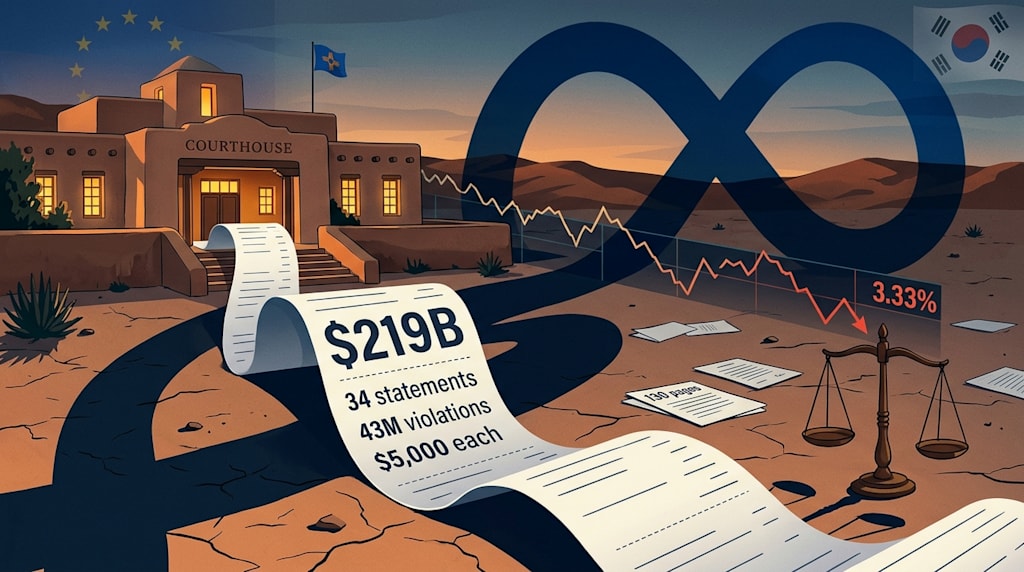
On September 25, 2026, at the First Judicial District Court in Santa Fe, New Mexico, the jury finished reading its verdict. Meta Platforms Inc. lost under the state’s Unfair Practices Act. After leaving the courtroom, State Attorney General Raúl Torrez said he would seek a civil penalty of up to $219 billion.
When the news reached the market, Meta fell 3.33% the next day.
The $219 billion figure needs context. Meta’s full-year 2025 revenue was $200.97 billion. Its net profit was $60.46 billion. The potential fine is 1.09 times annual revenue and 3.62 times annual net profit. The number is large. The calculation behind it matters more.
34 statements, 43 million violations, $5,000 each
New Mexico’s Unfair Practices Act allows a civil penalty of up to $5,000 per violation. The jury found Meta engaged in deceptive conduct in 34 specific statements and was responsible for most of them. The statements fell into two groups. One concerned Meta’s ability to protect user data. The other concerned Meta’s public statements about its investigation into data collection by third-party app developers after the Cambridge Analytica scandal.
The number of violations for each group ranged from 1.3 million to 2.1 million. That range roughly matches the number of Facebook users in New Mexico, or the state’s total population in 2020. The court counted each time a deceptive statement was shown to a user in the state as a separate violation. The total exceeded 43 million. Multiply 43 million by $5,000. The result is about $219 billion.
This is the statutory maximum, not the final judgment. Judge Francis Mathew will determine the final fine. At a news conference, Torrez said his legal team had not settled on a specific amount to seek, but would push for the maximum. The damages will go to an education fund.
A Meta spokesperson said: “We disagree with the jury’s verdict and will continue to fight the ‘distortion of our record.’” Meta’s lawyers also said at trial that the state’s evidence was outdated. The state had five years to gather materials. Apart from the Cambridge Analytica episode, it failed to find another concrete instance of a data breach.
Meta’s other defense rests on the First Amendment. The company’s statement read: “Under the First Amendment, we have the right to manage our platforms in the way we believe best serves the community, which means prioritizing free expression, protecting user information, and giving users control over their data.”
That argument pushes the case to a constitutional question. Are a platform’s public statements about its data policies speech protected by the First Amendment, or commercial conduct subject to consumer protection law? U.S. courts have not settled this. The final ruling in New Mexico may become the next reference point.
Cambridge Analytica, and a hidden clause in a 130-page settlement
The case traces back to 2018. The Cambridge Analytica scandal broke. A data scientist built a survey app that ostensibly collected user data while also harvesting friends’ information. The app ultimately involved 87 million user profiles. The now-defunct political consulting firm Cambridge Analytica obtained the data and used it for Trump’s 2016 presidential campaign.
Meta later tried to resolve related litigation through multiple settlements. It paid about $6 billion in total. The settling parties included the Federal Trade Commission, groups of Facebook users, and a bipartisan coalition of state attorneys general. In August 2026, Meta agreed to pay $459.3 million to 46 states and two U.S. territories to release future claims related to the Cambridge Analytica data breach.
That settlement agreement ran 130 pages. It contained a hidden clause. The clause shielded Meta from future legal liability arising from the Cambridge Analytica privacy breach. Most states joined the coalition and gave up their claims. New Mexico and Washington, D.C., did not join. Those two jurisdictions kept the right to continue litigation.
New Mexico went to trial. It became the only state to push the case that far. After the verdict, Torrez said: “Let this be a warning to every technology company doing business in our state. If you lie about how New Mexicans’ data is used, we will find out, and we will hold you accountable.”
New Mexico has beaten Meta before
Earlier in 2026, New Mexico won $942 million in another lawsuit over Meta’s protections for minors. The case was tried in two phases. It concerned Meta’s failure to protect children from sexual exploitation, online solicitation, and other harmful content. The court also ordered Meta to implement safety measures, including age-verification technology and rules limiting platform usage time.
After that ruling, Meta faced a fine and remedial obligations. The New Mexico Attorney General’s Office placed the two cases on the same line. Data privacy. Protection of minors. The truthfulness of platform statements. Each one asks whether what the platform said in public matched what it actually did.
Other U.S. cases
The New Mexico case is not isolated. Multiple U.S. states have sued Meta under the Children’s Online Privacy Protection Act. They allege Meta designed Facebook and Instagram to make minors addicted and collected data on children under 13 without verifiable parental consent. In August 2026, Meta agreed to pay up to $16.68 billion to settle those lawsuits. It promised a series of platform changes: a default two-hour daily usage limit for users under 18; blocking access between midnight and 6 a.m.; and muting push notifications at night and during class hours.
The antitrust case is also moving. In January 2026, the Federal Trade Commission appealed a ruling favorable to Meta. In November 2025, federal judge James Boasberg ruled that competition from TikTok and YouTube was enough to prevent Meta from being deemed a monopolist. The FTC argues Meta illegally monopolized the social media market by acquiring Instagram and WhatsApp. Consumers, the agency says, suffered monopoly harm. The case is still on appeal.
European fines
In Europe, Meta faces concrete penalties. In May 2023, the Irish Data Protection Commission fined Meta €1.2 billion under GDPR for transferring European user data to the United States. It was the largest fine in the history of the EU’s data protection rules.
In November 2024, the European Commission fined Meta €797 million for violating antitrust law. The commission said Meta bundled its online classified ads service, Facebook Marketplace, with its social network and imposed unfair trading conditions on other classified ads providers.
In April 2025, the European Commission found under the Digital Markets Act that Meta’s “pay or consent” model violated the rules. It fined Meta €200 million. The EU has also opened investigations under the Digital Services Act and GDPR into Meta’s failure to prevent underage users, its advertising privacy choices, and transparency around AI training data. Meta could face a fine of up to 6% of its global annual revenue.
Other regulators have issued fines too. In November 2024, the Personal Information Protection Commission of Korea fined Meta 21.6 billion won for illegally collecting sensitive user information. In September 2024, the Irish Data Protection Commission fined Meta €91 million over a password leak.
After $219 billion
This case gives state enforcement agencies a new calculation method. Use user scale to count violations. Turn consumer protection law into a deterrent against tech giants. Over the past decade, tech giants have grown used to package settlements with coalitions of state attorneys general. They trade compensation for immunity. New Mexico showed that strategy has a gap. If one state refuses to join the coalition, it can still sue.
$219 billion is almost impossible to enforce in full. The market still reacted. Meta’s shares fell 3.33% the next day. Investors are reassessing what happens if more states follow New Mexico, refuse settlements, and sue separately. Meta’s legal balance sheet could change.
Judge Francis Mathew has not ruled on the final fine. Torrez said the damages will go to an education fund. Meta said it will continue to defend itself.
Outside the Santa Fe courthouse, the temperature dropped after sunset. Court documents sat piled on the table: the 130-page settlement, the list of 34 statements, the calculation sheet for 43 million violations. The judge’s ruling had not yet been put to paper.
About the Creator
Jin
Writer of reamstories
https://reamstories.com/jin
Enjoyed the story? Support the Creator.
Subscribe for free to receive all their stories in your feed. You could also become a paid subscriber, letting them know you appreciate their work.
Comments
There are no comments for this story
Be the first to respond and start the conversation.