
Japan's New Graduates Are Picking Their Bosses. Companies Are Bowing.
With 4.12 job openings per high school applicant and starting salaries up 40%, Japan's labor market has flipped. Here is what that means for workers, small businesses, and the next decade.
I. Who bows now
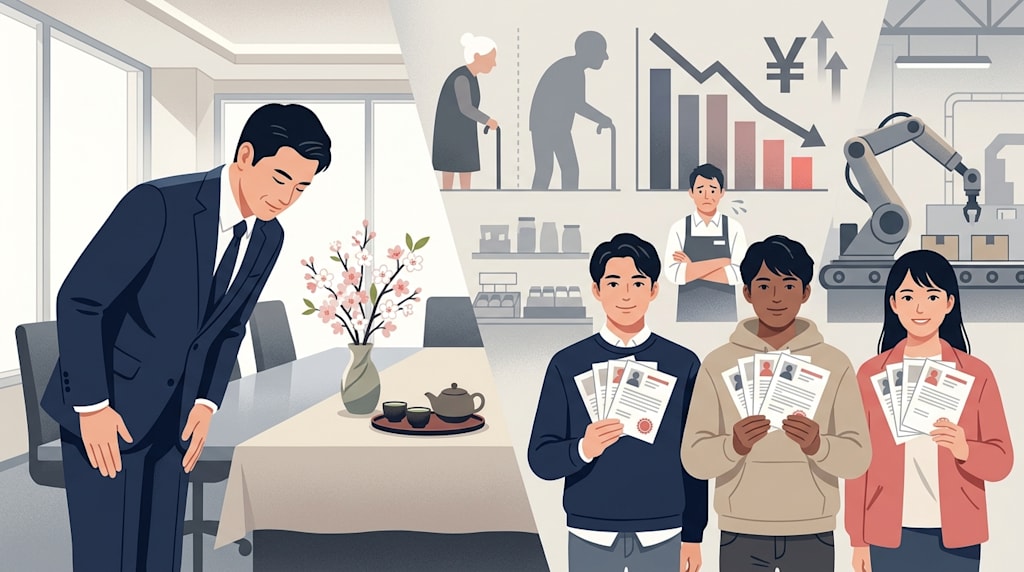
Every year on October 1, conference rooms at major Japanese companies fill with flowers and tea snacks. Executives in suits wait for the new graduates who will join next year.
This is not an onboarding ceremony. The students have not graduated. They will not start for months. The event is the naitei-shiki, an informal job-offer ceremony. Companies bring prospective employees in early for a meal, a bow, and a small gift. The goal is simple: keep them from changing their minds.
The scene usually goes like this. A department head gives a speech. "I very much look forward to working with all of you." Then he bows. Young HR staff carry trays around the room, refilling tea and offering snacks. Students sit in a circle with company brochures and souvenirs. They do not look moved. They look calm. They may be holding another company's offer.
Thirty years ago, this would have been unthinkable. After the bubble economy burst, Japanese university graduates often left school without a job. Job hunting was called shukatsu. Katsu meant activity. It also meant survival. To get one offer, students wore ill-fitting suits, memorized model answers, and bowed to interviewers until their backs ached. That generation is now in its fifties. They endured their way up to department head, section chief, president. Now they bow to new graduates.
A friend who does HR in Tokyo said his company is offering new graduates 320,000 yen a month this year, about 13,500 yuan. That is nearly 40 percent higher than five years ago. He added: "And even at that, people turned us down."
II. The numbers
Recruit, a Japanese recruiting platform, reports that high school students graduating in March 2026 face a job-openings-to-applicant ratio of 4.12. That means 121,000 job seekers for 499,000 positions. One high school student, four jobs to choose from.
University students have it slightly less extreme. For the class of 2027, the ratio is 1.62. But "slightly less" is relative. The number has stayed above 1.5 for years. In an economy with less severe aging, that would signal an overheated labor market.
Mynavi's data is more detailed. On March 1, 2026, 46.0% of the class of 2027 already had a job offer. By the end of March, 58.7%. By the end of April, 70.9%. By June 1, the legal start of recruiting, 77.2% had an offer.
June 1 is the official start. Three-quarters of students had already been claimed before the competition began. Companies are not fighting for people during recruiting season. They lock people down before it starts.
Locking someone down does not always work. In March 2026, 36.3% of companies said at least half of their offers were declined. Students accept an offer and sign a letter of commitment. If they change their minds before joining, they generally face no legal penalty. Companies can bow again at the naitei-shiki and give another gift. That is about it.
III. Pay raises and what comes with them
Money is the most direct lever. More large companies are raising starting salaries above 300,000 yen. In Japan, that goes far. A small apartment in central Tokyo rents for 80,000 to 120,000 yen. Food and commuting cost about 50,000. More than 100,000 is left for discretionary spending. For a 22-year-old, that is a solid start.
Money alone is not enough. At job fairs, companies list increasingly specific benefits: flexible hours, remote work, full parental leave, housing subsidies, internal training, overseas rotations. Some write "no overtime" into recruiting brochures. Some promise no relocation for three years.
A woman recruiting at an IT company said her firm printed both its ratio of women in management and its rate of men taking parental leave in this year's brochure. "Students ask very directly. How many female department heads do you have? If a male employee takes parental leave, will he be penalized? If you cannot answer well, they turn around and leave."
Job seekers' priorities have changed. When there are more jobs than people, students stop asking "Can I be hired?" They ask "Besides money, what else do you offer?" A Waseda student with offers from three companies said he chose the one with the best answer. It was not the highest salary. During the interview, the department head said, "If you find this project boring, you can apply to switch teams." "Just for that sentence, I felt they treat people as people."
IV. Population is the real boss
Japanese companies are humble for a surface reason and a deeper one. The surface answer is recruiting strategy. The deeper answer is demographics.
Japan's working-age population, ages 15 to 64, peaked in 1995 at about 87 million. By 2025, it was below 75 million. Thirty years removed 12 million workers. The decline has not slowed.
When supply shrinks and demand holds, price rises. In the labor market, that price is wages.
In July 2026, nominal wages rose 4.7% year on year, the highest in nearly 30 years. They have stayed above 3% for consecutive months. Part-time workers' wages rose 4.9%, higher than full-time employees. Labor shortages are transmitting to wages across the economy, not just in one industry.
Lifetime employment amplifies the effect. A Japanese company hiring a new graduate is not filling a position. It is hiring someone who might stay until retirement. Training costs are high. Dismissal costs are high. Companies would rather spend more at the entrance than search at the exit. Locking people down early and raising starting salaries becomes rational.
Inflation has also returned. Japan spent two decades in low growth, low inflation, and low wages. Stagnant real wages were seen as a core cause of deflation. Now inflation has rebounded and corporate profits have improved. That gives companies room to raise pay. Large firms started the salary arms race. Peers followed. The comparison effect amplified the increases.
V. The other side
This wave of employees choosing bosses is not as comfortable as it looks.
Small and medium-sized companies are the first to buckle. Large firms can raise starting salaries to 300,000 yen. SMEs cannot keep up. In the first half of fiscal 2026, 240 Japanese companies went bankrupt because of labor shortages, a record. Bankruptcies from surging labor costs were 1.7 times the same period a year earlier. Government subsidies for large companies to raise wages widened the gap between large and small firms.
Real wages are falling. This is the central contradiction. Nominal wages have risen. Prices have risen faster. In fiscal 2025, Japan's real wage index was 98.2, down 0.5% from the previous year. That was the fourth consecutive fiscal year of decline. Monthly data improved at times. The annual accounts show no gain in purchasing power. Inflation ate the raise.
The wage reversal is shaking traditional pay. New employees' starting salaries are rising so fast that they approach or exceed those of veterans with three to five years on the job. To avoid inversion, companies raise everyone's wages. In the short term, that pleases everyone. In the long term, the seniority-based pay system is loosening. How older employees feel about that remains an open question.
Structural mismatch persists. Jobs are plentiful. Hiring standards have not relaxed. Under lifetime employment, companies look for personality, communication skills, and teamwork, not just professional skills. A position is not open to anyone. The labor market's matching efficiency has not improved with the number of openings. "Hard to hire" and "hard to find a job" coexist.
VI. Japanese style versus Korean style
Japan and South Korea are both aging societies. Their youth labor markets tell different stories.
South Korea's higher education enrollment rate is nearly 70%. In 2024, nearly one-third of doctoral graduates were still unemployed. Many highly educated young people cannot find suitable positions. They withdraw from the labor market and become "economically inactive." That group exceeds 4 million. The result is extreme credential inflation and employment involution.
Japan's model has problems. It also turns labor shortage pressure into nominal wage increases and better hiring conditions. New graduates have bargaining power, though inflation offsets part of it. This is a problem of growth.
South Korea's model is closer to despair without growth.
Some say that if a society must age, its labor market should be Japanese-style rather than Korean-style.
VII. What it means for tomorrow
Japan's experience offers a preview for societies entering deep aging.
A labor market shifting from buyer to seller is an inevitable result of demographic change. That shift does not automatically improve worker welfare. Without benign inflation, social security reform, support for small businesses, and better labor matching, a seller's market can become an illusion. Wages rise on paper. Real pay shrinks.
Raising wages is the first step. Turning wage increases into purchasing power is harder. Keeping small businesses alive under higher costs is harder. Breaking structural mismatch is harder.
A friend doing research in Japan said he has noticed a shift. Young Japanese people are more willing to stay in the country. The best students once aimed for foreign investment banks or Silicon Valley. Now domestic large companies offer competitive starting salaries and conditions. The weak yen and rising overseas living costs make staying more attractive.
Whether this is an unexpected dividend of population shrinkage is unclear. It does show that when labor becomes scarce, companies change, markets adjust, and young people vote with their feet.
Conclusion
The bubble-economy generation begged bosses for jobs when they were young. As bosses, they beg new graduates. That looks like irony. It is demographics passing judgment on the economy and society.
No company outgrows demographic trends. No market outheats supply and demand.
That matters more than how great Japanese new graduates have it. A society that must grab people to keep running has to prepare for deeper structural reform.
Population is the ultimate boss.
About the Creator
Jin
Writer of reamstories
https://reamstories.com/jin
Enjoyed the story? Support the Creator.
Subscribe for free to receive all their stories in your feed. You could also become a paid subscriber, letting them know you appreciate their work.
Comments
There are no comments for this story
Be the first to respond and start the conversation.