
Japan’s $384 Billion Export Wake-Up Call: How the AI Boom Left Tokyo Behind
South Korea, Taiwan, Hong Kong, and even Guangdong now out-export Japan. The numbers show a country stuck in the equipment aisle while the chip money flows elsewhere.
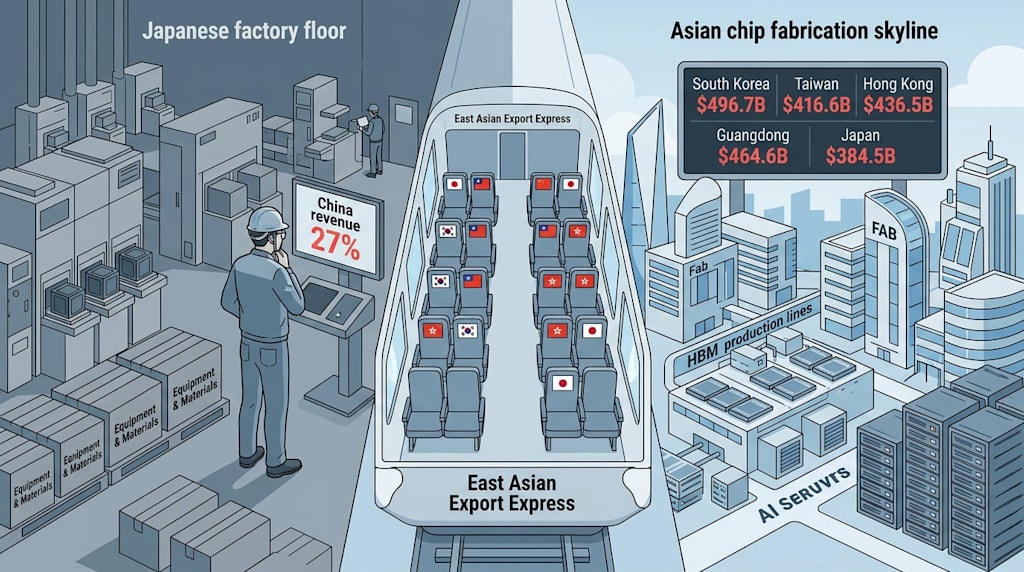
In the first half of 2026, Japan’s goods exports were about $384.5 billion. South Korea exported $496.7 billion. Taiwan exported $416.6 billion. Hong Kong exported $436.5 billion. Guangdong exported $464.56 billion. Japan was $112.2 billion behind South Korea, $32.1 billion behind Taiwan, $52 billion behind Hong Kong, and $80 billion behind Guangdong. Japan’s Ministry of Finance reported a trade deficit of 1.01 trillion yen for the same period. That was the tenth consecutive half-year deficit. Japan ranked last among major East Asian exporters. Deficit became normal.
South Korea and Taiwan’s export gains came from integrated circuits. South Korea exported $149 billion in ICs in H1. Taiwan exported $133.2 billion. Each was about 30% of total exports. Japan exported $21.2 billion in ICs. That was 5% of total exports. Samsung Electronics and SK Hynix run HBM lines in Hwaseong, Icheon, and Pyeongtaek. TSMC ships advanced processes from Hsinchu, Taichung, and Tainan. AI servers need these chips. Japan supplies equipment to make chips. Tokyo Electron makes cleaners. SCREEN makes etch tools. Shin-Etsu Chemical makes photoresists. In H1, Japan exported $15 billion in semiconductor manufacturing equipment. South Korea exported $5.2 billion. Taiwan exported $3.5 billion. SEMI forecasts global semiconductor equipment sales rising from $134.7 billion in 2025 to $229.5 billion in 2028. That is a 19.44% CAGR from 2026 to 2028. Japan holds about 25% of the global equipment market. It ranks second after the US. The equipment market is over $100 billion a year. The chip market alone reached $702 billion in H1 2026. It grew 102% year-on-year. Memory chips grew 305%. Logic chips grew 45%. Japan took a quarter of equipment. It took less than 5% of chips.
Hong Kong’s export surge came from re-exports. Electronics were over 70% of Hong Kong’s total exports. Semiconductors and electronic parts were main categories. Mainland AI hardware demand moved through Hong Kong ports. Hong Kong exports were $436.55 billion. That was up 39.1% year-on-year. Guangdong’s export increase came from a manufacturing loop. Shenzhen’s AI-related product imports and exports exceeded 1 trillion yuan in H1. IC exports grew 61.4%. Factories in Dongguan, Huizhou, and Guangzhou took server OEM, computing hardware, and smart terminal orders. Guangdong exported $464.56 billion. That was up 15.7%. Japan exported $384.5 billion. In yen terms, that was up 13.7%. In dollar terms, Japan was left behind.
Vietnam’s exports of computers, electronic products, and parts to the US were $27.9 billion in H1. That was up 51% year-on-year. Vietnam does server assembly. Japan supplies some components in this chain. But the increase in finished-unit exports did not land in Japan. The AI dividend Japan captured was mainly on the equipment side. That scale is small. The chain is short.
Autos are Japan’s other export pillar. Auto-related products are nearly 20% of Japan’s total exports. Japan’s domestic auto production fell from 9.27 million units a decade ago to 8.41 million. EV transition is slow. Intelligent structural conversion is slow. In ASEAN markets, Chinese NEV brands keep expanding share in Thailand’s BEV market. Japanese automakers still have export volume. They do not have increment.
Semiconductor equipment is Japan’s advantage. Policy is cutting it. After US-led export controls on China took effect, the five major Japanese chip equipment giants saw combined China sales fall 10% year-on-year in fiscal 2025. Tokyo Electron’s China revenue share fell from 50% to 27%. Japan’s semiconductor industry market value evaporated about 490 billion yen in half a year. JSFoundry went bankrupt. More than 143 supporting companies went bankrupt while still profitable. Equipment cannot be sold. Chips were not made. Japan’s position in the semiconductor chain narrowed.
Demographics pull export competitiveness down. People aged 65 and over are 29.8% of Japan’s population. Median age is 49.9. Shipyards have orders into 2028. Workers average 52. Auto parts factories cannot recruit night-shift workers. The startup ecosystem shrinks. Among 1,277 unicorns globally, Japan has 8. The US has 712. China has 157. Desks in Tokyo startup incubators sit empty. Venture capital scale is one-thirty-third of the US. Young people do not start companies. Big companies do not take risks. Money flows overseas. In SoftBank’s portfolio, Japanese projects are a low share.
Yen depreciation did not bring an export boom. Japan depends on imported energy and raw materials. Yen depreciation raises import costs. In July, crude oil imports were 1.41 trillion yen. That was up 87.8% year-on-year. A 5-kilogram bag of rice in a Tokyo supermarket was priced at 4,363 yen. Imported inflation eats household purchasing power. Overseas production by Japanese manufacturers is over 27%. Many products are made and sold abroad. They never pass through Japan’s export customs. The export figure on the books is only the residual part.
Fiscal space is locked by debt. Japan’s public debt-to-GDP ratio is over 230%. Interest payments are nearly a quarter of the fiscal budget. The central bank keeps ultra-loose monetary policy. The yen keeps weakening. The Ministry of Finance once spent nearly $100 billion to support the exchange rate. The yen briefly rose against the dollar. Then it fell back. Half of that $100 billion is gone. Fiscal expansion needs central bank cooperation. Central bank cooperation needs low rates. Low rates weaken the yen. A weak yen raises import costs. Import costs widen the deficit. The loop turned several times. Exports did not get stronger. The deficit became ten consecutive half-years.
On the screen at Tokyo Electron’s earnings meeting, China revenue share changed from 50% to 27%. At a server factory in Guangdong, a hiring notice is taped to the third utility pole outside the gate. Half the A4 sheet is soaked by rain. HBM lines in Hwaseong, South Korea, are expanding hiring. TSMC’s Fab 20 in Hsinchu is installing tools. Japan’s export seat has changed. It moved to the equipment and materials row. That row is not by the window.
About the Creator
Jin
Writer of reamstories
https://reamstories.com/jin
Enjoyed the story? Support the Creator.
Subscribe for free to receive all their stories in your feed. You could also become a paid subscriber, letting them know you appreciate their work.
Comments
There are no comments for this story
Be the first to respond and start the conversation.